如何写好并列句
- 格式:doc
- 大小:49.50 KB
- 文档页数:3
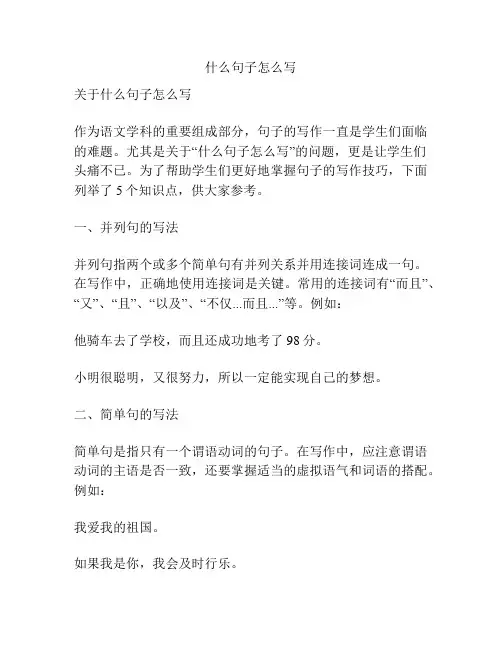
如何写好并列句
一.并列连词的意义与作用
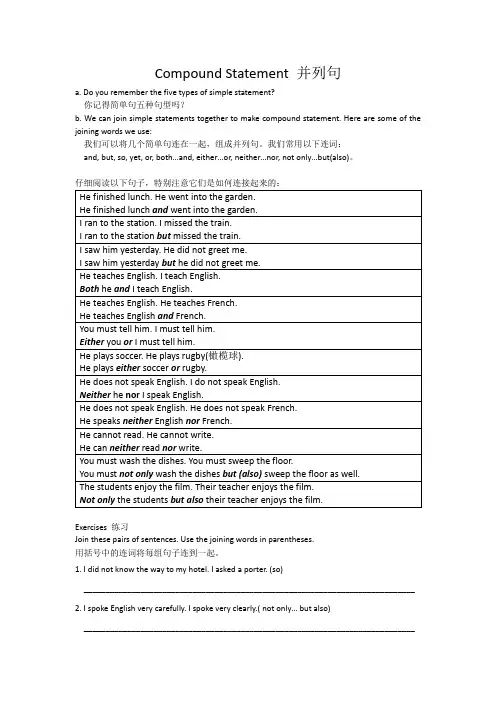
1.由两个或两个以上的简单句并列连接起来的句子叫并列句。
2.并列句的基本句型:简单句+并列连词(或连接副词)+简单句.
3.并列连词(或连接副词)的归类与功能的概括。
①and:连接两个同等概念。
(1)and连接并列的两个人或事物,在肯定句中用and,在否定句中用or。
They can sing and dance.
They can hardly see or hear.
(2)在双重否定句中,有事状语成分的并列用and;但并列成分出现在逐句中用or不用and Man can’t live without air and water.
Without gravity,there would be no air or sound of any kind.
(3)可以连接表示条件和结果的句子。
A:祈使句,and+陈述句。
Work hard and you will succeed.
B:名词(词组),and+陈述句。
One more effort,and you will succeed.
注:表“否则”,用or,or else或otherwise。
Hurry up,or you won’t miss the train. Hurry up or else you’ll be late.
(4)两个关系十分密切的人或物,用and连接可以看陈给一个意群或惯用词组。
作主语时谓语用单数。
如:
Knife and fork is necessary for some for some foreigners to eat with.
Bread and butter is what I like best.
Early to bed and early to rise is a good habit.
(5)and有时可译成“而”,这时不用but.
I went home and she stayed at the station.
I am a teacher and she is a student.
②Not only...but (also)不但...而且
She plays not only the piano,but(also)the guitar.
注意:not only...but also关联两个分句时,一个分句因有否定词not而必须倒装。
Not only does he like reading stories,but also he can even write some.
③ But:连接意义相反的短语或句子
He is very young but he knows a lot.
(1)用在某些否定词后,表示“只”(前有do后有to)
She knows no one but you.
He did nothing but sit there thinking.
He had no choice but to lie down to sleep.
(2)表示“除了”
Who but a fool would do such a thing?
Everybody is here but Paul.
(3)Im sorry but...
注:but表示转折,while表示对比。
Some people love cats,while others hate them.
④However:可放句末,句首或用逗号隔开。
⑤ yet作副词用,用于否定句表示“还”;用于疑问句表示“已经”;作连词表示“但是,
却”
I haven’t enough data yet. Has he come yet?
I have failed,yer I shall try again.
⑥ while
(1)表对比,“而” Tome issinging while Mary is dancing.
(2)引导让步状语从句,“虽然”While almost everybody knows him,nobody likes him.
(3)引导时间状语从句,助于动作与从句动作同时发生,从句必须用延续性动词。
She listened while he read.
⑦Or“或者,还是”Would you like coffe or tea?The sea can be blue or green or grey. “否则”(参见and用法)
⑧ rather than “……而不是……”It was what he meant rather than what he said.
这是他的原意而不是他的原话。
补充:“宁愿……而不愿……”prefer to do sth.rather than do sth./prefer doingsth.ranther than doing sth.
or rather”更确切地说”
I prefer to go to school rather than stay at home.我宁愿上学而不愿留在家。
He preferred doing something to doing nothing.他宁愿做事业不愿什么也不干。
I prefer beef rather than pork.我宁愿吃牛肉也不吃猪肉。
He played the computer game till late last night,or ther,early this moring.
他玩电脑游戏到深夜,或者更确切地说,到今天凌晨。
⑨ For表示对前面句子进行解释,不能放句首,常用逗号与前面分句隔开,也可以不用。
Because指直接原因,回答why的问题,常放在主句后面。
as 比because弱,表示显而易见的原因,常放在句首。
Since now that “既然”,常放句首。
He is absent because he is ill.他不来因为他病了。
As you are the oldest,you should take care of the others.由于你最大,你应该照顾其他人。
Now that/Since everybody is here,let’s begin our meering.既然大家都来了咱们开会吧。
It is morning,for the birds are singing in the trees.鸟叫了,早晨来了。
⑩Either...nor 意思为“既不……也不……”谓语迪拜更粗采用就进原则,与nor后的词保持一致。
Neither you nor he is to blame.
二.辨清不同功能的并列连词
在写作中,我们必须认真分析被连接起来的简单句之间内的逻辑关系,然后选择恰当的并列连词,才能真正写出质量好的并列句。
请认证研读一下并列句,分析其逻辑关系。
试试看,如果用别的功能的并列句连词替换,逻辑关系是否会依然成立?
a.He works hard,and he plays hard too.
分析:在分句1的意思的基础上有递进。
其含义相当于:He not only works hard,but also plays hard./He plays hard as well as works hard.
b. I was tired,but I felt happy.
分析:分句2的意思不是分句1意思的顺接,而是出现转折的结果。
c. We stayed at home,for it was raining.
分析:分句2是分句1的原因的补充。
d.It was cold, so we decided to stay at hom
e.
分析:分句2是分句1的结果。
e.Hurry up,or you’ll be late for class.
分析:分句2是与分句1的结果相反的结果。
由以上的分析可见,并列连词的选择也是要遵循句子间的逻辑关系的,如果不小心,同样会犯逻辑错误。