
【范本】原料耗用分析表
- 格式:doc
- 大小:498.50 KB
- 文档页数:2

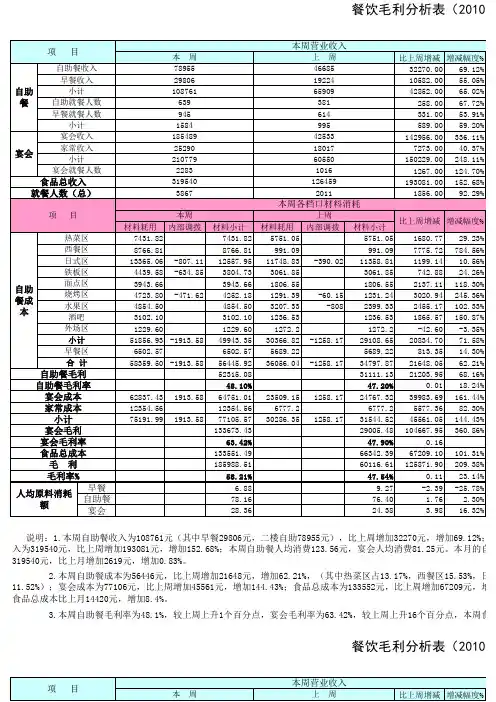
餐饮毛利分析表(2010.0说明:1.本周自助餐收入为108761元(其中早餐29806元,二楼自助78955元),比上周增加32270元,增加69.12%;宴入为319540元,比上周增加193081元,增加152.68%;本周自助餐人均消费123.56元,宴会人均消费81.25元。
本月的自助319540元,比上月增加2619元,增加0.83%。
2.本周自助餐成本为56446元,比上周增加21648元,增加62.21%,(其中热菜区占13.17%,西餐区15.53%,日式11.52%);宴会成本为77106元,比上周增加45561元,增加144.43%;食品总成本为133552元,比上周增加67209元,增加食品总成本比上月14420元,增加8.4%。
3.本周自助餐毛利率为48.1%,较上周上升1个百分点,宴会毛利率为63.42%,较上周上升16个百分点,本周食品餐饮毛利分析表(2010.0餐饮毛利分析表(2010.02.本周自助餐成本为9455元,比上周减少46991元,减少83.25%,(其中热菜区占17.54%,西餐区3.65%,日式区15.73%);宴会成本为71105元,比上周减少6001元,减少7.78%;食品总成本为80559元,比上周减少52992元,减少39.6比上月增加41310元,增加38.64%。
食品总成本为214111元,比上月减少1457元,减少0.68%。
3.本周自助餐毛利率为40.43%,较上周下降8个百分点,宴会毛利率为77.21%,较上周上升14个百分点,本周食品百分点,宴会毛利率为71.65%,较上月上升18个百分点,总食品毛利率为66.92%,较上月上升15个百分点。
说明:1.本周自助餐收入为15870元(其中早餐12374元,二楼自助3496元),比上周减少92891元,减少85.41%;宴会327808元,比上周增加8268元,增加2.59%;本周自助餐人均消费116.53元,宴会人均消费47.42元。

合同耗用材料统计表模板英文回答:Contract Material Consumption Report Template.Introduction:The Contract Material Consumption Report Template is a useful tool for tracking and analyzing the usage of materials in a contract. It provides a comprehensive overview of the materials consumed, their quantities, and associated costs. This template is designed to assist in monitoring material usage, identifying any discrepancies, and ensuring efficient resource allocation.Components of the Template:1. Contract Details: This section includes information about the contract, such as the project name, contract number, and duration. It helps to establish a context forthe material consumption analysis.2. Material List: This section lists all the materials used in the contract. Each material entry includes details such as the material name, description, unit of measure, and unit cost. This information is crucial for accurately calculating the total cost of each material used.3. Consumption Data: This section captures the consumption data for each material. It includes columns for recording the quantity used, the date of consumption, and the associated cost. This data can be entered on a regular basis to keep track of the ongoing material usage.4. Summary and Analysis: This section provides a summary of the material consumption data. It includes the total quantity consumed, the total cost incurred, and any variations from the estimated consumption. This analysis helps in identifying any over or underutilization of materials and enables better decision-making for future contracts.Benefits of Using the Template:1. Cost Control: By tracking material consumption and associated costs, the template helps in controlling expenses and avoiding budget overruns. It enables theproject manager to identify any excessive material usageand take corrective measures.2. Resource Optimization: The template allows for the analysis of material consumption patterns, therebyfacilitating better resource allocation. By identifying trends and patterns, the project team can optimize the procurement and utilization of materials, leading to improved efficiency.3. Transparency and Accountability: The template promotes transparency and accountability by providing aclear record of material consumption. It helps in ensuring that the materials are used as per the contractrequirements and that any deviations are promptly addressed.4. Decision-Making Support: The template providesvaluable insights into material consumption, enabling informed decision-making. The analysis of consumption patterns can guide future procurement strategies and helpin negotiating better contracts with suppliers.Example:Let's consider a construction project where the contract involves the installation of electrical wiring. The Contract Material Consumption Report Template can be used to track the usage of electrical wires, connectors, and other related materials.In the Material List section, the template would include entries for different types of wires, connectors, and other associated materials. The consumption data section would capture the quantity of each material used, the dates of consumption, and the associated costs.Using the template, the project manager can monitor the material consumption on a regular basis. They can identify any discrepancies, such as excessive usage of wires orunexpected costs due to changes in specifications. This information can then be used to take corrective actions, such as revising the procurement strategy or adjusting the project timeline.中文回答:合同耗用材料统计表模板。

企业生产的七大浪费1.等待浪费等待并非加工过程,不能改变物料的形状、尺寸、性质和状态从而改变韧料的功能,所以等待不创造价值。
待工和待料是两种最常见的等待情形。
常见的等待现象有:物料供应或前工序能力不足造成待料,监视设备作业造成员工作业停顿,设备故障造成生产停滞,质量问题造成停工,型号切换造成生产停顿.造成等待的常见原因有:流水线能力不平衡,计划不合理,设备维护不到位,物料供应不及时等。
2.搬运浪费搬运也非加工过程,不能改变物料的形状、尺寸、性质和状态从而改变物料的功能,而且搬运过程中的放置、堆积、移动、整理等造成空间、时间、人力和工具等浪费,可谓费时费力费资源。
3.不良浪费美国零缺陷大师克劳斯比说:“任何事情没有一步做到位都会造成额外或本。
”质量不良也不例外。
常见的不良浪费有:材料损失,设备折旧,人工损失,能源损失,价格损失,订单损失,信誉损失等。
4.动作浪费多余的动作、不合适的动作增加员工作业强度、降低生产效率,因此也是一种浪费。
常见的浪费动作有:两手空闲,单手空闲,作业动作停止,动作幅度过大,左右手交换,步行多,转身角度大,移动中变换动作,未掌握作业技巧,伸背动作,弯腰动作,重复动作及不必要动作.5.加工浪费每提高一级加工精度将增加数倍甚至数十倍的费用。
过高的加工精度造成浪费,它付出了额外的成本,或造成了不必要的高质量.常见的加工浪费情形有:加工余量过大、过高的精度、不必要的加工等,其造成的浪费有:设备折旧、人工损失、辅助材料损失、能源消耗等。
6.库存浪费制造型企业通过物料的大进大出实现产品增值和资金流动,从而创造利润。
现场物流直接服务于这一重要的目的,所以,使现场物流有序、顺畅、高效,是现场改善的重要方面。
库存是一种等待状态,违背上述目标就造成额外成本。
’企业内常见的库存形态有:原材料、零部件、辅助材料库存,半成品、在制品库存、成品、在途品库存等库存将带来额外的搬运储存成本,造成空间浪费,占用资金及孳生的利息和可能的投资回报损失,还有可能使物料价值衰减造成呆料废料,造成先进先出作业困难。

合同耗用材料统计表模板英文回答:Contract Material Consumption Report Template.Introduction:The Contract Material Consumption Report is a document used to track and record the consumption of materials in a contract. It provides a comprehensive overview of the materials used, quantities consumed, and associated costs. This report is essential for monitoring the progress of a contract and ensuring that materials are being used efficiently.Content:The template for a Contract Material Consumption Report typically includes the following sections:1. Contract Details: This section includes information about the contract, such as the contract number, project name, and contract period. It provides a brief overview of the contract's scope and objectives.2. Material Details: This section lists all the materials that are being used in the contract. It includes the material name, code, unit of measurement, and cost per unit. Additionally, it may include information about the supplier or vendor from whom the materials are being procured.3. Consumption Details: This section records the quantity of materials consumed during a specific period. It includes the date of consumption, quantity consumed, and the corresponding cost. This information helps in tracking the material usage and identifying any discrepancies or inefficiencies.4. Cost Analysis: This section provides a summary of the total cost incurred for each material. It includes the total quantity consumed, unit cost, and the total cost.This analysis helps in evaluating the overall expenditureon materials and identifying opportunities for cost savings.5. Remarks: This section allows for any additional comments or observations related to the material consumption. It can be used to highlight any issues or challenges faced during the contract period or suggest improvements for future contracts.Example:To illustrate the usage of the Contract Material Consumption Report, let's consider a construction project. The contract involves building a commercial complex, and various materials such as cement, steel, bricks, and electrical fittings are required.In the Material Details section, the report will list these materials along with their respective codes, units of measurement (e.g., bags, tons, pieces, etc.), and costs per unit. For instance, cement may be listed as Material Code: CMT001, Unit: Bags, and Cost per Bag: $10.In the Consumption Details section, the report will record the quantity of each material consumed during a specific period. For example, if 100 bags of cement were used on a particular day, the report will include the date, quantity consumed (100 bags), and the corresponding cost ($1000).The Cost Analysis section will summarize the total cost incurred for each material. It will calculate the total quantity consumed (e.g., 500 bags of cement), multiply itby the unit cost ($10 per bag), and provide the total cost ($5000). This analysis will help in evaluating the overall expenditure on materials and identifying any cost variances.The Remarks section can be used to note any issues or observations related to material consumption. For instance, if there were delays in material delivery or if there were instances of material wastage, it can be mentioned here.中文回答:合同耗用材料统计表模板。