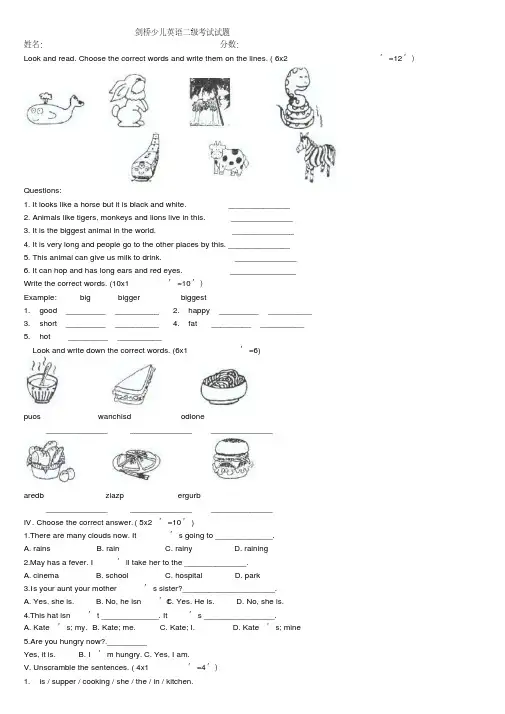
剑桥少儿英语考试全真试题
- 格式:docx
- 大小:37.55 KB
- 文档页数:4
剑桥少儿英语考试全真试题
Introduction:
The Cambridge Young Learners English Test, commonly known as the
Cambridge English: Young Learners (YLE), is an internationally recognized
assessment for young learners of English. This article aims to provide a
comprehensive overview of the YLE exam, including its structure, content,
and preparation tips.
Section 1: Overview of the YLE Exam
The YLE exam is designed for children aged 7 to 12 years old and is
divided into three levels: Starters, Movers, and Flyers. Each level assesses
the four language skills: listening, speaking, reading, and writing. The exam
focuses on practical communication skills and provides a positive and
motivating experience for young learners.
Section 2: Exam Structure and Content
2.1 Starters Level:
The Starters level is the first step for young learners. The exam consists
of three sections: Listening, Speaking, and Reading and Writing. The
Listening section includes listening to short dialogues and answering
questions. In the Speaking section, students communicate with the examiner
through answering questions and performing simple tasks. The Reading and
Writing section assesses students' ability to recognize and write simple
words and phrases.
2.2 Movers Level: The Movers level is the second level of the YLE exam. Similar to the
Starters level, it also comprises three sections: Listening, Speaking, and
Reading and Writing. However, the complexity of the tasks gradually
increases at this level. Students listen to longer dialogues and answer
questions with more detail. In the Speaking section, they engage in
conversations and describe pictures. The Reading and Writing section
requires students to comprehend short texts and write simple sentences.
2.3 Flyers Level:
The Flyers level is the highest level in the YLE exam. It evaluates
students' ability to use English for everyday purposes. The exam has four
sections: Listening, Speaking, Reading, and Writing. The Listening section
includes conversations and longer texts, followed by multiple-choice
questions. In the Speaking section, students interact with the examiner,
discussing various topics and sharing opinions. The Reading section assesses
reading comprehension skills through longer texts and multiple-choice
questions. The Writing section requires students to write stories or letters
based on given prompts.
Section 3: Preparation Tips
3.1 Familiarization:
To excel in the YLE exam, students should become familiar with its
format and types of questions. They can access sample papers and practice
materials available online or through books specifically designed for YLE
preparation.
3.2 Vocabulary and Grammar: Building a strong foundation in vocabulary and grammar is essential for
success in the YLE exam. Students should practice and review various word
types, verb tenses, and grammatical structures to enhance their language
skills.
3.3 Listening Skills:
To improve listening skills, students can actively engage in listening
exercises, such as watching English cartoons or listening to English songs.
They should focus on understanding the main ideas, details, and context of
the spoken language.
3.4 Speaking Skills:
Regular oral practice is crucial for developing speaking skills. Students
can engage in conversations with their peers or English-speaking individuals.
It is also helpful to practice describing pictures, telling stories, and
expressing opinions on different topics.
3.5 Reading and Writing Skills:
To enhance reading skills, students should read English books,
magazines, or newspapers. They can also practice summarizing or
discussing the content to ensure comprehension. Writing practice can
involve writing short paragraphs, letters, or stories in English.
Conclusion:
The Cambridge Young Learners English Test (YLE) offers young
learners a comprehensive evaluation of their English language proficiency.
By understanding the exam structure and content, and by following effective preparation tips, students can confidently take on the YLE exam and succeed
in their English language journey. Remember, practice and perseverance are
key to achieving success in any examination.