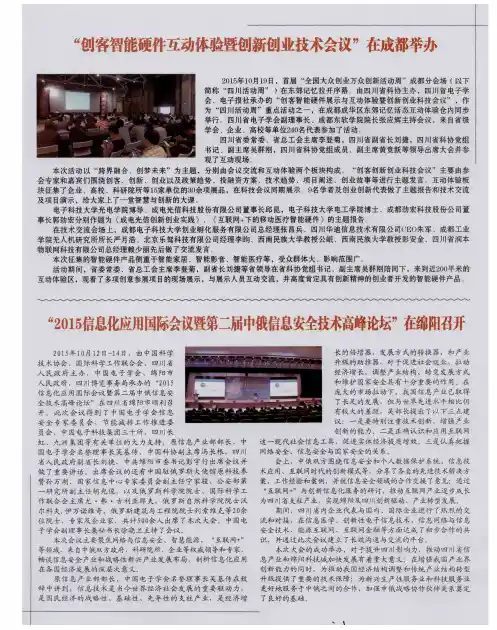
2015年ICMIC国际会议征稿启事
- 格式:pdf
- 大小:66.52 KB
- 文档页数:1

龙源期刊网
国际工业与应用数学大会将首次在亚洲举办作者:
来源:《求知导刊》2015年第13期
“ICIAM首次在中国举办,既是对我国工业与应用数学发展的肯定,也会对我国数学,特别是应用数学的发展产生巨大深远的影响。
”在7月1日召开的中国工业与应用数学学会新闻发布会上,中科院院士李大潜表示,该会议将极大地促进数学与科学技术及国民经济的密切结合与相互推动。
记者获悉,第八届国际工业与应用数学大会(ICIAM 2015)将于8月10—14日在北京举办,这也是该会议首次在亚洲以及在发展中国家召开。
预计将有来自70余个国家与地区、超过3000名工业与应用数学家参会。
据介绍,国际工业与应用数学大会每四年举办一次,是国际工业与应用数学层次最高、规模最大、影响最广的盛会。
(来源:《中国科学报》)。

数学中国MCM/ICM参赛指南翻译(2015版)(任何单位转载须注明来源:)MCM:The Mathematical Contest in ModelingMCM:数学建模竞赛ICM:The Interdisciplinary Contest in ModelingICM:交叉学科建模竞赛Contest Rules, Registration and Instructions比赛规则,比赛注册方式和参赛指南(All rules and instructions apply to both ICM and MCM contests, except where otherwise noted.)(所有MCM的说明和规则除特别说明以外都适用于ICM)To participate in a contest, each team may consist of a maximum of three students and must be sponsored by a faculty advisor from its institution.每个MCM的参赛队需要由最多三名学生构成,并且要有一名所在单位的指导教师负责。
Team Members: A team may consist of up to three students from the same school and is open to all undergraduate and high school students.参赛队的成员:一个队可以由多达3名来自同一个学校的学生组成,对于所有的大学生和高中生都可以参加。
Team Advisors: Please read these instructions carefully. It is your responsibility to make sure that teams are correctly registered and that all of the following steps required for participation in the contest are completed:Please print a copy of these contest instructions for reference before, during, and after the contest. Click here for the printer friendly version.指导老师:请认真阅读这些说明,确保完成了所有相关的步骤。
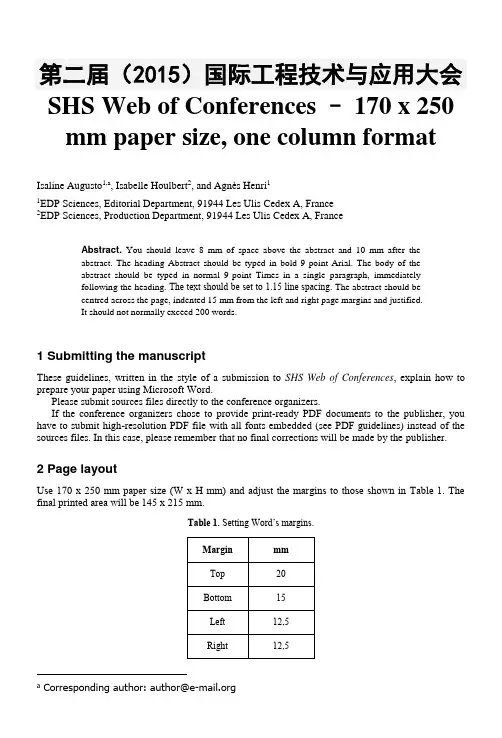
第二届(2015)国际工程技术与应用大会SHS Web of Conferences – 170 x 250 mm paper size, one column formatIsaline Augusto1,a, Isabelle Houlbert2, and Agnès Henri11EDP Sciences, Editorial Department, 91944 Les Ulis Cedex A, France2EDP Sciences, Production Department, 91944 Les Ulis Cedex A, FranceAbstract.You should leave 8 mm of space above the abstract and 10 mm after theabstract. The heading Abstract should be typed in bold 9-point Arial. The body of theabstract should be typed in normal 9-point Times in a single paragraph, immediatelyfollowing the heading. The text should be set to 1.15 line spacing. The abstract should becentred across the page, indented 15 mm from the left and right page margins and justified.It should not normally exceed 200 words.1 Submitting the manuscriptThese guidelines, written in the style of a submission to SHS Web of Conferences, explain how to prepare your paper using Microsoft Word.Please submit sources files directly to the conference organizers.If the conference organizers chose to provide print-ready PDF documents to the publisher, you have to submit high-resolution PDF file with all fonts embedded (see PDF guidelines) instead of the sources files. In this case, please remember that no final corrections will be made by the publisher.2 Page layoutUse 170 x 250 mm paper size (W x H mm) and adjust the margins to those shown in Table 1. The final printed area will be 145 x 215 mm.Table 1.Setting Word’s margins.Margin mmTop 20Bottom 15Left 12,5Right 12,5a Corresponding author: author@Insert “SHS Web of Conferences” in even headers and the short form title of the conference in odd headers, except the first one. Please check with the organisers the exact short form title of the conference.Do not add any page numbers to your paper.The articles will be quoted as follows:SHS Web of Conferences 2(2012) 01002, 2corresponding to the volume and 01002 to the number of the article (replacing thus the page number).2.1 Formatting the title, authors and affiliations2.1.1 Formatting the titleThe title is set in bold 14-point Arial, flush left, unjustified. The first letter of the title should be capitalised with the rest in lower case. You should leave 30 mm of space above the title and 5 mm after the title.2.1.2 Formatting author names and author affiliationsAuthor names should be typed in 10-point Times. The style for the names is First Names then last Name, with a comma after all but the last two names, which are separated by “and”. Do not use academic titles.Affiliations of authors should be typed in 10-point Times. They should be preceded by a numerical superscript corresponding to the same superscript after the name of the author concerned. Please ensure that affiliations are as full and complete as possible and include the country.2.2 Formatting the textThe text of your paper should be formatted as follows:- 10-point Times, Times Roman or Times New Roman.- The text should be set to single line spacing.- Paragraphs should be justified.- The first paragraph after a section or subsection should not be indented; subsequent paragraphs should be indented by 5 mm.The use of sections to divide the text of the paper is optional and left as a decision for the author. Where the author wishes to divide the paper into sections the formatting shown in Table 2 should be used.Table 2. Formatting sections, subsections and subsubsections.Font Spacing numberingSection12-pointArial bold6 mm before3 mm after1, 2, 3, etc.subsection10-pointArial bold6 mm before3 mm after1.1, 1.2, 1.3,etc.subsubsection10-pointArial Italic6 mm before3 mm after1.1.1, 1.1.2,1.1.3, etc.3 Figures and tablesFigures and tables, as originals of good quality and well contrasted, are to be in their final form, ready for reproduction, pasted in the appropriate place in the text. Try to ensure that the size of the text in your figures is approximately the same size as the main text (10 point). Try to ensure that lines are no thinner than 0.25 point.3.1 Captions/numberingCaptions should be typed in 9-point Times. They should be centred above the tables and flush left beneath the figures.3.2 PositioningPlace the figure as close as possible after the point where it is first referenced in the text. If there is a large number of figures and tables it might be necessary to place some before their text citation.Figure 1. Caption of the Figure 1. Below the figure.3.3 Colour illustrationsYou are free to use colour illustrations for the online version of the proceedings but any print version will be printed in black and white unless special arrangements have been made with the conference organiser. Please check whether or not this is the case. If the print version will be black and white only, you should check your figure captions carefully and remove any reference to colour in the illustration and text. In addition, some colour figures will degrade or suffer loss of information when converted to black and white, and this should be taken into account when preparing them.4 Equations and mathematicsEquations should be centred and should be numbered with the number on the right-hand side.T s (l,t) = T g (l,t) (1)T s (l,t) = T g (l,t) T b (x→-β, t) = 0 (2) Use italics for variables (u) and bold (u) for vectors. The order for brackets should be {[()]}, except where brackets have special significance.ReferencesOnline references will be linked to their original source, only if possible. To enable this linking extra care should be taken when preparing reference lists.References should be cited in the text by placing sequential numbers in brackets (for example, [1], [2, 5, 7], [8-10]). They should be numbered in the order in which they are cited. A complete reference should provide enough information to locate the article. References to printed journal articles should typically contain:• The authors, in the form: initials of the first name followed by last name (only the first letter capitalized with full stops after the initials),• The journal title (abbreviated),• The volume number (bold type),• The a rticle number or the page numbers,• The year of publication (in brackets);Authors should use the forms shown in Table 3 in the final reference list.Table 3. Font styles for a reference to a journal article.Element StyleAuthorsNormalInitials followed by last nameJournal titleNormal AbbreviatedBook title,Proceedings titleItalic Volume number Bold Page number NormalYearNormal In bracketsHere are some examples:1. A. Mecke, I. Lee, J.R. Baker jr., M.M. Banaszak Holl, B.G. Orr, Eur. Phys. J. E 14, 7 (2004)2.M. Ben Rabha, M.F. Boujmil, M. Saadoun, B. Bessaïs, Eur. Phys. J. Appl. Phys. (to be published)3. F. De Lillo, F. Cecconi, G. Lacorata, A. Vulpiani,EPL, 84 (2008)4.L. T. De Luca, Propulsion physics (EDP Sciences, Les Ulis, 2009)更多会议详情可以关注【活动家】。