
2010上海大学插班生模拟题答案
- 格式:doc
- 大小:57.00 KB
- 文档页数:2
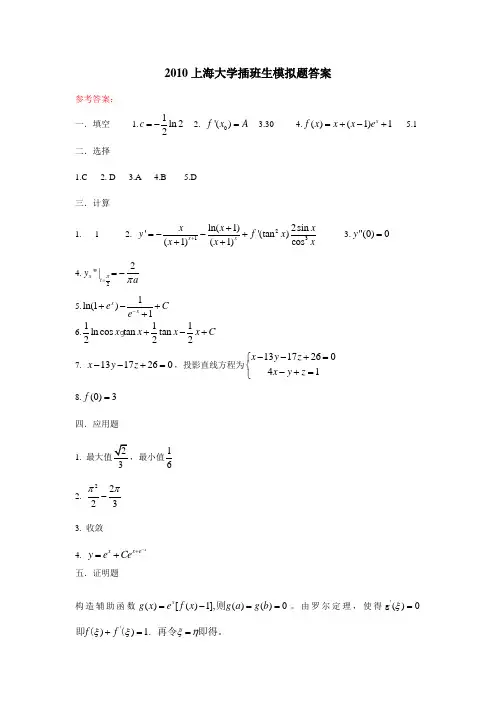
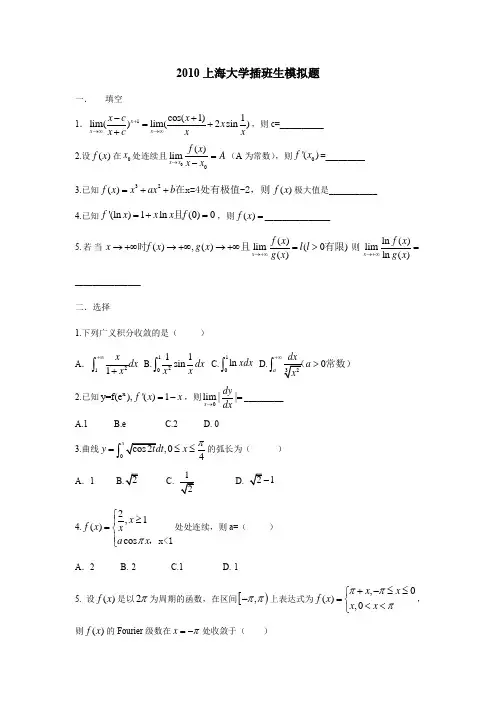
2010上海大学插班生模拟题一. 填空1.1cos(1)1lim ()lim (2sin )x x x x c x x x c x x +→∞→∞-+=++,则c=__________2.设()f x 在0x 处连续且00()lim x x f x A x x →=-(A 为常数),则0'()f x =_________ 3.已知32()f x x ax b =++在x=4处有极值-2,则()f x 极大值是___________4.已知'(ln )1ln (0)0f x x x f =+=且,则()f x =_______________5.若当()(),()lim (0)()x f x x f x g x l l g x →+∞→+∞→+∞→+∞=>时且有限则ln ()lim ln ()x f x g x →+∞=_______________二.选择1.下列广义积分收敛的是()A .211xdx x +∞+⎰ B.12011sin dx x x ⎰ C.10ln xdx ⎰D.0a a +∞>⎰常数) 2.已知x y=f(e ),'()1f x x =-,则0lim ||x dy dx →=_________A.1B.eC.2D. 03.曲线0,04xy x π=≤≤⎰的弧长为() A .1B.1 4.2,1()cos x f x x a x π⎧≥⎪=⎨⎪⎩,x<1处处连续,则a=()A .2 B.-2 C.1 D.-15.设()f x 是以2π为周期的函数,在区间[),ππ-上表达式为,0(),0x x f x x x πππ+-≤≤⎧=⎨<<⎩,则()f x 的Fourier 级数在x π=-处收敛于()A .0 B.π C.2π-D.2π三.计算1.求22000()lim ()x x x x f u du f u du →⎰⎰,其中'()f x 连续,(0)0,'(0)1f f ==2.设函数()f x 可导,求21()(tan )1x y f x x =++的导数 3.已知()y y x =由方程1y xy e =-所确定的隐函数,求"(0)y4.已知(sin cos )(cos sin )x a t t t y a t t t =-⎧⎨=+⎩求222d y t dx π=在处的值 5.2(1)x dx e -+⎰6.ln cos 1cos 2xdx x +⎰7.求过直线34210:230x y z L x y z --+=⎧⎨-+-=⎩,且垂直于平面:41x y z π-+=的平面方程,并求直线L 在平面π上的投影直线方程。

2010年上海市三校生高考数学试题及解答一、填空题(本大题满分56分)本大题共有14题,考生应在答题纸相应编号的空格内直接填写结果,每个空格填对得4分,否则一律得零分.1.已知全集,集合,则.2.若复数满足(是虚数单位),则.3.已知直线的倾斜角大小是,则.4.若关于的二元一次方程组有唯一一组解,则实数的取值范围是.5.已知函数和函数的图像关于直线对称,则函数的解析式为. 到渐近线的距离为.7.函数的最小正周期.8.若,则目标函数的最小值为.9.执行如图所示的程序框图,若输入的值是,则输出的值是.10.已知圆锥底面半径与球的半径都是,如果圆锥的体积恰好也与球的体积相等,那么这个圆锥的母线长为.11.某中学在高一年级开设了门选修课,每名学生必须参加这门选修课中的一门,对于该年级的甲乙名学生,这名学生选择的选修课相同的概率是(结果用最简分数表示).12.各项为正数的无穷等比数列的前项和为,若,则其公比的取值范围是 . 13.已知函数.当时,不等式恒成立,则实数的取值范围是.14.函数的定义域为,其图像上任一点满足.①函数一定是偶函数;②函数可能既不是偶函数,也不是奇函数;③函数可以是奇函数;④函数如果是偶函数,则值域是或;⑤函数值域是,则一定是奇函数.其中正确命题的序号是(填上所有正确的序号).二、选择题(本大题满分20分)本大题共有4题,每题有且只有一个正确答案,考生应在答案纸的相应编号上,填上正确的答案,选对得5分,否则一律得零分.15.已知,,则的值等于………………………()(A). (B). (C). (D).16.一个空间几何体的正视图、侧视图为两个边长是1的正方形,俯视图是直角边长为1的等腰直角三角形,则这个几何体的表面积等于…()(A). (B). (C). (D).17.若直线通过点,则………………………………()(A). (B).(C). (D).18.某同学为了研究函数的性质,构造了如图所示的两个边长为的正方形和,点是边上的一个动点,设,则.那么,可推知方程解的个数是………………………………………………………()(A). (B). (C). (D).三、解答题(本大题满分74分)本大题共5题,解答下列各题必须在答题纸相应编号的规定区域内写出必要的步骤.19.(本题满分12分)本题共有2小题,第1小题满分5分,第2小题满分7分.如图,设计一个正四棱锥形冷水塔,高是米,底面的边长是米.(1)求这个正四棱锥形冷水塔的容积;(2)制造这个水塔的侧面需要多少平方米钢板?(精确到米2)20.(本题满分14分)本题共有2小题,第1小题满分6分,第2小题满分8分.如图所示,扇形,圆心角的大小等于,半径为,在半径上有一动点,过点作平行于的直线交弧于点.(1)若是的中点,求;(2)设,求△周长的最大值及此时的值.21.(本题满分14分)本题共有2小题,第1小题满分6分,第2小题满分8分.已知椭圆.(1)直线过椭圆的中心交椭圆于两点,是它的右顶点,当直线的斜率为时,求△的面积;(2)设直线与椭圆交于两点,且线段的垂直平分线过椭圆与轴负半轴的交点,求实数的值.22.(本题满分16分)本题共有3小题,第1小题满分4分,第2小题满分6分,第3小题满分6分.已知函数.(1)若函数的图像过原点,求的解析式;(2)若是偶函数,在定义域上恒成立,求实数的取值范围;(3)当时,令,问是否存在实数,使在上是减函数,在上是增函数?如果存在,求出的值;如果不存在,请说明理由.23.(本题满分18分)本题共有3小题,第1小题满分4分,第2小题满分6分,第3小题满分8分.已知数列的前项和为,且,.从中抽出部分项, 组成的数列是等比数列,设该等比数列的公比为,其中.(1)求的值;(2)当取最小时,求的通项公式;(3)求的值.四区联考2012学年度第二学期高三数学一.填空题(本大题满分56分)本大题共有14题,考生应在答题纸相应编号的空格内直接填写结果,每个空格填对得4分,否则一律得零分.1.;2.;3.;4.;5.;6.;7.;8.4;9.;10.;11.;12.;13.;14.②③⑤二、选择题(本大题满分20分)本大题共有4题,每题有且只有一个正确答案,考生应在答案纸的相应编号上,填上正确的答案,选对得5分,否则一律得零分.15.D ;16.B;17.B ;18.C三、解答题(本大题满分74分)本大题共5题,解答下列各题必须在答题纸相应编号的规定区域内写出必要的步骤 .19.(本题满分12分)本题共有2小题,第1小题满分5分,第2小题满分7分.解:(1)如图正四棱锥底面的边长是米,高是米所以这个四棱锥冷水塔的容积是.(2)如图,取底面边长的中点,连接,答:制造这个水塔的侧面需要3.40平方米钢板.20.(本题满分14分)本题共有2小题,第1小题满分6分,第2小题满分8分.解:(1)在△中,,由得,解得.(2)∵∥,∴,在△中,由正弦定理得,即∴,又.记△的周长为,则=∴时,取得最大值为.21.(本题满分14分)本题共有2小题,第1小题满分6分,第2小题满分8分.解:(1)依题意,,,由,得,设,∴;(2)如图,由得,依题意,,设,线段的中点,则,,,由,得,∴22.(本题满分16分)本题共有3个小题,第1小题满分4分,第2小题满分6分,第3小题满分6分.解:(1)过原点,得或(2)是偶函数,即,又恒成立即当时当时,,当时,,综上:(3)是偶函数,要使在上是减函数在上是增函数,即只要满足在区间上是增函数在上是减函数.令,当时;时,由于时,是增函数记,故与在区间上有相同的增减性,当二次函数在区间上是增函数在上是减函数,其对称轴方程为.23.(本题满分18分)本题共有3小题,第1小题满分4分,第2小题满分6分,第3小题满分8分.解:(1)令得,即;又(2)由和,所以数列是以2为首项,为公差的等差数列,所以.解法一:数列是正项递增等差数列,故数列的公比,若,则由得,此时,由解得,所以,同理;若,则由得,此时组成等比数列,所以,,对任何正整数,只要取,即是数列的第项.最小的公比.所以.………(10分)解法二: 数列是正项递增等差数列,故数列的公比,设存在组成的数列是等比数列,则,即因为所以必有因数,即可设,当数列的公比最小时,即,最小的公比.所以.(3)由(2)可得从中抽出部分项组成的数列是等比数列,其中,那么的公比是,其中由解法二可得.,所以。
上海大学插班生考试高数范围Prepared on 21 November 2021上海大学插班生考试高数范围1、函数、极限、连续(1)、理解函数的概念,掌握函数的表示方法(2)了解函数的奇偶性、单调性、周期性和有界性(3)理解复合函数的概念,了解反函数及隐函数的概念。
会建立简单函数关系式(4)掌握基本初等函数的性质和图形(5)理解极限的概念,了解分段函数的极限(6)掌握极限四则运算法则,掌握利用两个重要极限求极限的方法。
(7)掌握极限存在的二个准则,并会利用它们求极限(8)理解无穷小、无穷大以及无穷小的阶的概念,会利用等价无穷小求极限1(9)理解函数连续性的概念,会判断函数间断点的类型(10)了解初等函数的连续性和闭区间上的连续函数的性质,并会应用这些性质2、导数与微分(1)理解导数的概念导数的几何意义和物理意义,函数的可导性与连续性之间的关系(2)掌握导数的四则元算法则和复合函数的求导法,掌握基本初等函数的导数公式。
会求分段函数的一阶二阶导数(3)了解高阶函数的概念,会求简单的函数的n阶导数,掌握初等函数的二阶导数的求法(4)会求隐函数和参数方程所确定的函数的一、二阶导数。
(5)了解微分的概念和四则运算(6)会用导数描述一些简单的物理量3、中值定理与导数的应用(1)理解并会应用罗尔定理、拉格朗日定理,利用定理能求方程的根、证明不等式。
了解柯西定理(2)理解函数的极值概念,掌握用导数判别函数的单调性和求函数极值的方法(3)会用导数描绘图形(4)会求MAX、MIN的应用问题(5)掌握洛必达法则求未定式极限的方法(6)了解曲率,曲率半径的概念,并会计算(7)了解求方程近似解的二分法和切线法4、不定积分(1)理解原函数的概念,理解不定积分的概念及性质(2)掌握不定积分的基本公式、换元法、分部积分法5、定积分及其应用(1)理解定积分的基本概念,定积分的中值定理(2)理解变限函数及其求导定理,掌握牛顿—莱布尼兹公式(3)掌握定积分的性质及换元积分法和分部积分法(4)了解定积分的近似计算方法(5)掌握定积分在几何上的应用,和物理上的应用(6)了解广义积分的概念,会计算广义积分6、级数(1)理解常数项级数收敛与发散的概念、收敛级数和的概念,掌握级数的基本性质及收敛的必要条件(2)掌握几何级数、P—级数的收敛性(3)掌握正向级数的判别法(4)会用交错级数的莱布尼兹判别法(5)了解无穷级数绝对收敛与条件收敛的概念,及两者之间的关系(6)了解函数项级数的收敛域和函数的概念(7)掌握幂级数的收敛半径,收敛区间及收敛域的求法(8)了解幂级数在收敛区间内的一些基本性质,会求一些幂级数在收敛区间内的和函数,并会由此求出某些数的项级数的和(9)了解泰勒公式、泰勒级数,掌握的麦克劳林展开式,会用它们将一些简单函数展开幂级数(10)了解幂级数在近似计算中得到简单应用(11)了解傅立叶级数的概念及函数展开成傅立叶级数的狄利克莱定理(12)会将定义在上函数展开为傅立叶级数,会将定义在上的函数展开为正弦与余弦级数、会些出傅立叶级数的和表达式7、向量代数与空间解析几何(1)理解向量的概念及其表示(2)掌握向量的运算,了解两向量垂直、平行的条件。
2010年松江区高考模拟考试英语试卷(满分150分,考试时间120分)2010.4第I卷I. Listening ComprehensionSection ADirections: In Section A, you will hear ten short conversations between two speakers. At the end of each conversation, a question will be asked about what was said. The conversations and the questions will be spoken only once. After you hear a conversation and the question about it, read the four possible answers on your paper, and decide which one is the best answer to the question you have heard.1. A. In Boston. B. In New York.C. In Washington.D. In Chicago.2. A. A pair of trousers. B. A bathing suit.C. A dress.D. A blouse.3. A. 19. B. 27. C. 31. D. 8.4. A. An article in the newspaper. B. A play on television.C. A play in the theatre.D. A telephone conversation.5. A. On the third floor. B. At a bookstore.C. In a department store.D. At school.6. A. She is tired of driving in heavy traffic.B. She enjoys it because she’s good at driving.C. She is unhappy to have to drive such a long way every day.D. She doesn’t mind it as the road conditions are good.7. A. The woman’s mom. B. The woman herself.C. The man.D. Not mentioned.8. A. On Tuesday. B. On Wednesday.C. On Thursday.D. On Sunday.9. A. Work for the exam. B. See a film. C. Play a joke. D. Have a rest.10. A. Dec.20. B. Dec.15. C. Dec. 30. D. Dec.28.Section BDirections: In Section B, you will hear two short passages, and you will be asked three questions on each of the passages. The passages will be read twice but the questions will be spoken only once. When you hear a question, read the four possible answers in your paper and decide which one would be the best answer to the question you have heard.Questions 11 through 13 are based on the following passage.11. A. A teacher. B. A chief officer.C. A lawyer.D. A computer engineer.12. A. He has to work hard if he wants something.B. He should spend more time reading.C. Sport is as important as working.D. It is important to make a schedule.13. A. Bill Gates and his way to success.B. Bill Gates and his study.C. Bill Gates and his classmates.D. Bill Gates and his company.Questions 14 through 16 are based on the following passage.14. A. England’s missile defense system. B. America’s shooting down a satellite.C. Russia’s shooting down an America’s satellite.D. Russia’s experiment on missiles.15. A. A clock which is the most accurate in the world now.B. A clock which keeps accurate time down to the second.C. A clock which may work for at least 80 million years.D. A clock which may be worth 200 million dollars.16. A. 110 billion yuan. B. 113 billion yuan.C. 121 billion yuan.D. 9 billion yuan.Section CDirections: In Section C, you will hear two longer conversations. The conversations will be read twice. After you hear each conversation, you are required to fill in the numbered blanks with the information you have heard. Write your answers on your answer sheet.Blanks 17 through 20 are based on the following conversation.Complete the form. Write ONE WORD for each answer.Blanks 21 through 24 are based on the following conversation.Complete the form. Write NO MORE THAN THREE WORDS for each answer.II. GrammarDirections: Beneath each of the following sentences there are four choices marked A, B, C and D. Choose the one answer that best completes the sentence.25. The effective communication ability for a writer is to get the knowledge out of his head and ____readers’ heads.A. out ofB. intoC. towardsD. for26. We had a party last month and it was a lot of fun, so let’s have _____ one this month.A. otherB. moreC. the otherD. another27. The wet weather will continue tomorrow when a cold front _____ to arrive.A. expectsB. is expectingC. is expectedD. will be expected28. I want to be very careful to talk only about ____ we've formally tested.A. whichB. thatC. whatD. whether29. ____ I paid a visit to this scenic spot, I was deeply attracted by its beauty.A.The first timeB. At the first timeC. For the first timeD. At first30. People pay ______as to the content of your speech.A. so much attention to your voiceB. as much attention to your voiceC. much attention to your voiceD. attention to your voice much31. _____ his ability of speech, he has made use of each chance.A. To improveB. ImprovingC. Being improvedD. Improved32. You _____ tell him. He is fully aware of the danger.A. mustn’tB. don’t needC. needn’tD. can’t33. Don’t promise anything _____ you are one hundred percent sure.A. ifB. afterC. in caseD. unless34. He found that complex problems, especially those _____ abstract thinking, were best for pickingout bright and dull students.A. involveB. involvedC. involvingD. being involved35. That is the man ____ house the police found the lost computer last week.A. in whoseB. in whatC. in thatD. in which36. ______ with severe drought in some areas, Chinese government is taking active measures toensure people’s essential need s.A. FacingB. FacedC. To faceD. Being faced37. It is the experience he had as a boy ______ has formed his present personality.A. thatB. whatC. whichD. who38. There is no doubt ____ we will host the 2010 World Expo successfully.A. whichB. whetherC. /D. that39. Not only ____ at music, but also they are ready to help others.A. they are talentedB. they have been talentedC. are they talentedD. they have talented40. It ____ that making a plan is easier than carrying it out.A. was turned outB. is turned outC. has been turnedD. turns outSection B: VocabularyDirections: Complete the passage by choosing the proper words in the box.Each word can only be used once. Note that there is one word more than you need.Almost every day we come across situations in which we have to make decisions one way or another. Choice, we are given to believe, is a right. But for a good many people in the world, in rich and poor countries, choice is a luxury, something __41__but hard to get, not a right. And for those who think they are exercising their right to make choices, the whole system is merely an illusion, a false idea created by companies and advertisers hoping to sell their products.The endless choice gives birth to anxiety in people’s lives. Buying something as basic as a coffee pot is not exactly __42__. Easy access to a wide range of everyday goods leads to a sense of powerlessness in many people, __43__in the costomer giving up and walking away, or just buying an unsuitable item that is not really wanted. Recent studies in England have shown that many electrical goods __44__ in almost every family are not __45__ needed. More difficult decision-making is then either avoided or trusted into the hands of the __46__, lifestyle instructors, or advisors.It is not just the availability of the goods that is the problem, but the speed with which new types of products come on the market. Advances in __47__ and production help quicken the process. Products also need to have a short lifespan so that the public can be persuaded to replace them within a short time. The __48__ example is computers, which are almost out-of-date once they are bought. This indeed makes selection a problem. So gone are the days when one could just walk with ease into a shop and buy one thing: no choice, no __49__.III. Reading ComprehensionSection ADirections: For each blank in the following passage there are four words or phrases marked A, B, C and D. Fill in each blank with the word or phrase that best fits the context.Nothing can better illustrate the failure of education in this country than the contrast between millions of college graduates finding it hard to get a proper job every year and the lack of workers in the more industrialized regions.According to news from Dongguan (东莞), one of the __50__ manufacturing centers in the Pearl River Delta (珠江三角洲) region in South China, ―over 90 percent‖ factories have said they are finding __51__ difficult to employ people from the second half of 2009, when the __52__ began picking up and overseas orders restarted pouring in. Running to full capacity seems a dream that the factories had__53__.An awkward reality is that only few, __54__, of the new college graduates could really fill the vacancies because the trainings they have received are entirely __55__ from the demands of the jobs. Nor will Chinese cities have enough workforce if they pursue a development model other than export-based manufacturing.The __56__ for that is simple: The knowledge about management graduates gather is totally out of step with reality, __57__ of them can hardly express themselves in English or compose an email message properly, and __58__ handle even paper work in a law service with the legal knowledge they have.I __59__ some college teachers, whom I went to college with, that the amount of time an average college student spends on studies today is less than half of what we __60__ in the late 1970s when proper college education was recovered after the ―cultural revolution‖ (1966-76).―They (the administrations) have enrolled so many students just to __61__ from their parents (tuition and other charges)‖, one of the teachers said embarrassedly. ―It's a nationwide phenomenon, you know.‖It is hard to believe that a country should not __62__ education so seriously when there are no longer as many young people as before and view its opportunities only in terms of immediate financial gains, which greatly affects the quality of education. __63__, vocational education faces a double threat: frequent ups and downs in the business cycle and that of a flooding of cheap college certificates.It is __64__ in a country with rapid development in many fields to see little reform and progress in its education system. When colleges are reduced to money-making machines, they cannot help a society create enough workers, thinkers and leaders.50. A. necessary B. key C. new D. remote51. A. this B. that C. it D. as52. A. economy B. country C. city D. industry53. A. in the near future B. at present time C. from time to time D. in the long past54. A. and some B. but none C. if any D. because such55. A. different B. same C. opposite D. similar56. A. result B. method C. reason D. expectation57. A. some B. most C. few D. all58. A. can B. must C. can’t D. mustn’t59. A. took from B. picked out C. caught sight of D. learned from60. A. spent B. cost C. wasted D. detected61. A. cost money B. make money C. create money D. deal with62. A. put B. set C. make D. take63. A. Although B. Besides C. However D. Therefore64. A. common B. likely C. worthwhile D. surprisingSection BDirections:Read the following four passages. Each passage is followed by several questions or unfinished statements. For each of them there are four choices marked A, B, C and D. Choose the one that fits best according to the information given in the passage you have just read.(A)In our culture, the sources of what we call a sense of ―mastery‖ —feeling important and worthwhile —and the sources of what we call a sense of ―pleasure‖— finding life enjoyable — are not always the same. Women often are told ―You can’t have it all.‖ Sometimes what the speaker really is saying is: ―You choose a career, so you can’t expect to have closer relationships or a happy family life.‖ or ―You have a wonderful husband and children —what’s all this about wanting a career?‖ But women need to un derstand and develop both aspects of well-being, if they are to feel good about themselves.Our study shows that, for women, well-being has two aspects. One is mastery, which includes self-respect, a sense of control over your life, and low levels of anxiety and depression. Mastery is closely related to the ―doing‖ side of life, to work and activity. Pleasure is the other aspect, and it is made up of happiness, satisfaction and optimism. It is tied more closely to the ―feeling‖ side of life.The two are independent of each other. A woman could be high in mastery and low in pleasure, and vice versa(反之亦然). For example, a woman who has a good job, but whose mother has just died, might be feeling very good about herself and in control of her work life, but the pleasure side could be damaged for a time.The concepts of mastery and pleasure can help us identify the sources of well-being for women, and correct past mistakes. In the past, women were encouraged to look only at the feeling side of life as the source of all well-being. But we know that both mastery and pleasure are important. And mastery seems to be achieved largely through work. In our study, all the groups of employed women were valued significantly higher in mastery than women who were not employed.A woman’s well-being is developed when she takes on multiple roles. At least by middle adulthood, the women who were involved in a combination of roles — marriages, motherhood, and employment — were the highest in well-being, in spite of warnings about stress and strain.65. It can be inferred from the first paragraph that ________.A. for women, a sense of ―mastery‖ is more important than a sense of ―pleasure‖B. for women, a sense of ―pleasure‖ is more important than a sense of ―mastery‖C. women can’t have a sense of ―mastery‖ and a sense of ―pleasure‖ at the same timeD. a sense of ―mastery‖ and a sense of ―pleasure‖ are both necessary to women66. The author’s attitude towards women having a career is________.A. negativeB. positiveC. indifferentD. realistic67. One can conclude from the passage that if a woman takes on several social roles, ________.A. it will be easier for her to overcome stress and strainB. she will be more successful in her careerC. her chances of getting promoted will be greaterD. her life will be richer and more meaningful68. Which of the following can be con sidered as a source of ―pleasure‖ for women?A. Family lifeB. Multiple roles in societyC. Regular employmentD. Freedom from anxiety(B)Welcome to the British Museum, the grandest and the most spectacular of human history. The admission is free and we open every day from 10:00 to 15:30. You can explore 10 departments including:The Department of Africa, Oceania and the AmericasThe collection of the Department of Africa, Oceania and the Americas includes around 350,000 objects. The scope of the collection is contemporary, and historical. It includes most of Africa, the Pacific and Australia, as well as the Americas. All of the collections were got during the nineteenth and twentieth centuries and date from this time.The Department of AsiaThe Department of Asia covers the material and visual cultures of Asia – a vast geographical area of Japan, Korea, China, Central Asia, Afghanistan, South Asia and South-East Asia. The collection dates from about 4000 BC, to the present day. It represents the cultures and ways of life of local people and other minority groups.The Department of Greek and Roman EmpiresThe Department of Greek and Roman Empires features antiquities (古董). It has one of the most comprehensive collections of antiquities from the Classical world, with over 100,000 objects. These mostly range in date from the beginning of the Greek Bronze Age (about 3200BC) to the time of the Roman emperor Constantine in the fourth century AD.69. The scope of the Department of Africa, Oceania and Americas doesn’t include______.A. AfricaB. AustraliaC. the South AmericaD. Britain70. The earliest collection is from ______.A. The Department of Africa, Oceania and the AmericasB. The Department of AsiaC. The Department of Greek and Roman EmpiresD. All of the above71. The Department of Asia represents ______.A. the geographic features of AsiaB. the relationships between Asian countriesC. the life styles and cultural traditions of some peoplesD. the cultural fights between some native groups(C)It is one of the greatest mysteries of nature. In case you haven’t noticed, all living things follow very definite, individual rhythms, all as regular as a clock, but what makes them regular?Though many scientists maintain that these rhythms are the result of some outside force like gravity or radiation or both, the results of most scientific researches agree with other scientists who believe that each living thing has its own built-in biological ―time clock.‖Take the mystery of migration for example. Scientists can’t really explain why many species of birds migrate in the autumn even though the temperature is still summery. The birds just seem to snub the comfortable weather that they are having. When a certain time comes, they travel south by the thousand. In spring time, they migrate northwards even though there probably is snow still covering the ground when they finally arrive. Something said ―go,‖ and they did.Animals that hibernate (冬眠) are obeying individual time clocks, too. When their clock indicates the time to take a winter’s nap, they do, and nothing can stop them. At a certain time in the spring, they wake up and come out regardless of the weather outside.Plants appear to have yearly rhythms, such as the sprouting of seeds, and they also have daily rhythms. Notice sometimes that plants raise their leaves in daylight and lower them at night.If you live along the California coast, you can easily observe a demonstration of this mysterious clock functioning regularly. There, from February to September, the highest tides occur exactly every fourteen and four-fifths days, and during these high tides, but at no other time, small silvery fish called grunions surf-ride a wave to the beach. There the female deposits her eggs in the sand and the male fertilizes them; then both hitch a wave-ride back to the sea. Exactly fourteen and four-fifths days later, never before or after, the tiny eggs hatch, and the high tide carries the new babies out to sea.72. According to the passage, the mysterious rhythms result from ______.A. the influence of gravity on living speciesB. the effect of radiation on living speciesC. the influence of a mysterious outer force on living speciesD. the internal mechanism inside the living species73. The u nderlined word ―snub‖ in the third paragraph probably means ______.A. fightB. ignoreC. symbolizeD. criticize74. Which of the following statements is NOT TRUE?A. Hibernating animals are obeying an internal time clock.B. The positioning of the leaves of some plants is due to the daily rhythms.C. The internal clock functioning is demonstrated in the reproducing habits of grunions.D. The yearly hibernation is more because of the weather influence than the biological functioning.75. The passage is mainly about ______.A. the rhythms of lifeB. the reasons of mysterious hibernationC. strange behaviors of speciesD. the timing for different events in the world of speciesSection CDirections: Read the following text and choose the most suitable heading from the list A-F for each paragraph. There is one extra heading which you do not need.(D)The difference between a human brain and a computer is more complicated than we can imagine. The large mammalian brain is the most complicated thing, for its size. Though the human brain only weighs three pounds, in that three pounds are ten billion neurons and a hundred billion cells. The many billions of cells are interconnected in such a vastly complicated network that wecan’t begin to explore as yet.Even the most complicated computer man has yet built can’t compare with the brain. Computer switches and processes number in the millions rather than in the billions. What’s more, the computer switch is just an on-off device, whereas the brain cell is itself possessed of a complex structure.It’s frequently said that computers solve problems only because they are ―programmed‖ to do so. They can only do what men have them do, in which way it is like the human brain. We can also do what we are ―programmed‖ to do. Our genes ―program‖ us the instant the zygote (授精卵) is formed, and our potentialities are limited by that ―program.‖Surely, though, if a computer can be made complex enough, it can be as creative as people. If it could be made as complex as a human brain, it could be the replacement of a human brain and do whatever a human brain can do. Then the real supercomputer comes along.In other words, once we pass a certain critical point, the computers will gain a dominating position and present a complexity explosion. In a very short time thereafter, computers may exist not only taking after the human brain, but far passing it. When the time comes, we might as well step aside and hand over all our work to them and really have them serve us.Section DDirections: Read the passage carefully. Then answer the questions or complete the statements in the fewest possible words.(E)Imagine a world in which there was suddenly no emotion—a world in which human beings could feel no love or happiness, no terror or hate. Try to imagine the consequences of such a transformation. People might not be able to stay alive: knowing neither joy nor pleasure, neither anxiety nor fear, they would be as likely to repeat acts that hurt them as acts that were beneficial.They could not learn: they could not benefit from experience because this emotionless world would lack rewards and punishments. Society would soon disappear: people would be as likely to harm one another as to provide help and support. Human relationships would not exist: in a world without friends or enemies, there could be no marriage, affection among companions, or bonds among members of groups. Society’s economic functions would be destroyed: since earning $10 million would be no more pleasant than earning $10, there would be no motivation to work. In fact, there would be no motivation of any kind. For as we will see, motivation implies a capacity to enjoy certain activties.In such a world, the chances that the human species would survive are next to zero, because emotions are the basic instrument of our survival and adaptation. Emotions structure the world for us in important ways. As individuals, we categorize objects on the basis of our emotions. True we consider the length, shape, size, or texture, but an object’s physical aspects are less important than what it has done or can do to us—hurt us, surprise us, anger us or make us joyful. We also use categorizations colored by emotions in our families, communities, and overall society. Out of our emotional experiences with objects and events comes a social feeling of agreement that certain things and actions are ―good‖ and others are ―bad‖, and we apply these categories to every aspect of our social life—from what foods we eat and what clothes we wear to how we keep promises and which people our group will accept. In fact, society exploits our emotional reactions and attitudes, such as loyalty, morality, pride, shame, guilt, fear and greed, in order to maintain itself. It gives high rewards to individuals when performing important tasks.81. According to the passage, the concept of right or wrong comes from ____________.82. Emotions are significant for man’s survival because ____________.83. What would an emotionless world lack?84. What is the result of the absence of emotion?第II卷I. TranslationDirections: Translate the following sentences into English, using the words given in the brackets. 1. 这美丽的风景是无法描述的。