
精品资料--必修一背诵(精校完美打印版)
- 格式:doc
- 大小:21.50 KB
- 文档页数:2

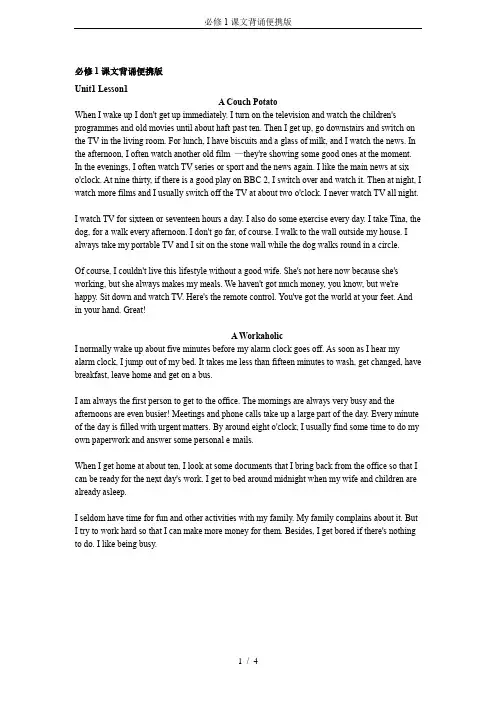
必修1课文背诵便携版Unit1 Lesson1A Couch PotatoWhen I wake up I don't get up immediately. I turn on the television and watch the children's programmes and old movies until about haft-past ten. Then I get up, go downstairs and switch on the TV in the living room. For lunch, I have biscuits and a glass of milk, and I watch the news. In the afternoon, I often watch another old film —they're showing some good ones at the moment. In the evenings, I often watch TV series or sport and the news again. I like the main news at sixo'clock. At nine thirty, if there is a good play on BBC 2, I switch over and watch it. Then at night, I watch more films and I usually switch off the TV at about two o'clock. I never watch TV all night.I watch TV for sixteen or seventeen hours a day. I also do some exercise every day. I take Tina, the dog, for a walk every afternoon. I don't go far, of course. I walk to the wall outside my house. I always take my portable TV and I sit on the stone wall while the dog walks round in a circle.Of course, I couldn't live this lifestyle without a good wife. She's not here now because she's working, but she always makes my meals. We haven't got much money, you know, but we're happy. Sit down and watch TV. Here's the remote control. You've got the world at your feet. And in your hand. Great!A WorkaholicI normally wake up about five minutes before my alarm clock goes off. As soon as I hear my alarm clock, I jump out of my bed. It takes me less than fifteen minutes to wash, get changed, have breakfast, leave home and get on a bus.I am always the first person to get to the office. The mornings are always very busy and the afternoons are even busier! Meetings and phone calls take up a large part of the day. Every minute of the day is filled with urgent matters. By around eight o'clock, I usually find some time to do my own paperwork and answer some personal e-mails.When I get home at about ten, I look at some documents that I bring back from the office so that I can be ready for the next day's work. I get to bed around midnight when my wife and children are already asleep.I seldom have time for fun and other activities with my family. My family complains about it. But I try to work hard so that I can make more money for them. Besides, I get bored if there's nothing to do. I like being busy.Unit1 Lesson4City and countryDebbie is an accountant in a large company in the centre of London.I need to be in my office by nine o'clock so I usually get up at seven o'clock. I travel to work on "the tube". That's what people call the underground in London. It takes about fifty minutes. Usually, it's so crowded that I can't find anywhere to sit. I just stand. I'm always tired before I arrive at work. I don't like the underground!I spend all morning checking numbers. Lunch is always simple. I often get a sandwich in a nearby sandwich shop or I just have some biscuits and a cup of coffee. Then in the afternoon, I return to the paperwork in the office.On Monday nights, I have dance classes, and on Wednesday nights, I go to the gym. I need to do that because I don't get enough exercise otherwise. On Tuesday and Thursday nights, I have French classes. I work for a French company so I think studying French will help me in my job.I go to the cinema almost every weekend. Sometimes, if the weather forecast is good, my friends and I drive to the countryside for a weekend break. We like to visit nice, quiet places far away from the city and go walking where there are no shops, crowds or the tube. That fresh air is so good for my lungs. I love it.Paul lives in a small village in the north of England.I usually get up at four o'clock every morning when it's still dark. I live and work on the farm so I don't need to travel. After a big breakfast in my house, I walk out of the front door and I'm already at work.There are many things to do on the farm all day. We don't have the same work hours that office workers in the city have. We do jobs when they need to be done and that could be early in the morning or late at night. I have cows, sheep, pigs and chickens on my farm. I have to make sure they are free of sickness. I also grow wheat and vegetables so there are many things to look after.In the evening, I like to play with my children. I have two children, a boy and a girl. They are six and eight years old. I also like to study. Right now I am studying Chinese by distance learning. I am very interested in China and it's my dream to see the Great Wall one day.I love movies. My wife calls me a "movie fan". But there isn't a cinema in my village so I don't get the chance to go very often. I go about twice a year, usually when I go to London with my family. We take a weekend break there when I am not too busy on the farm. My wife loves looking in the clothes shops and I like all the crowds and the noise. I also like to buy a few cigars. Unfortunately, my wife isn't as fond of them as I am. My son and daughter love to ride on London's red buses and they especially love to go on the tube!Culture CornerEnglish Tea And Coffee CultureOne thing that British and Chinese cultures share is a love for fine tea. Today, when we think of Western tea culture, we often think of the English and beautiful china tea cups.Afternoon TeaPeople believe that an English duchess, Anna, the 7th Duchess of Bedford (1788-1861) first introduced the idea of afternoon tea. In the 18th and 19th centuries, the English ate only two main meals each day breakfast and a heavy supper that would last for several hours in the evening. As a result, people often got very hungry during the long wait between these two meals. To solve this problem, the Duchess came up with the clever idea of inviting some friends to join her for an afternoon meal between four and five o'clock. This meal included cakes and sandwiches, and tea was served to wash down the food. In order to make this afternoon meal important, fine china cups and plates, and silver teapots, knives, forks and spoons were used. Soon, afternoon tea parties became popular social occasions. Today, afternoon tea parties continue to play an important part in the social life of wealthy people in modern Britain.Will you come for coffee?Coffee also has an important role in British culture. People often use the words "Will you come for coffee?" to mean "Would you like to come to my home for a chat?" Normally, several different drinks such as tea, hot chocolate or a soft drink like orange juice will be served as well as coffee, and you will be asked what you would like. However, you will not normally be offered wine at a "coffee" party.Coffeehouses and the London Stock ExchangeIn the 17th century London, coffeehouses were busy, noisy places. Merchants and bankers went to coffeehouses to do their business, as well as to drink coffee. In fact, the London Stock Exchange is believed to have started from these coffeehouses.Focus on ReadingToo far away from it all?A new TV series in England, Away from it all, has surprised everyone by becoming a huge success with young people across the country. Its success is surprising because the main character in the series is a shepherd, and the series is about the relaxing lifestyles of people who live in the country. There is none of the action that we usually see on TV today. There are also no stressful moments, busy offices or crowded cities. Away from it all is set in the peaceful English countryside and tells simple stories about people's kindness.The director of the TV series says that its success is a sign of teenagers suffering from stress. They say that watching Away from it all helps teenagers forget about the pressures of exams and homework, and the troubles that fill the world today. They also say that it's a good sign of today's young people switching to happier TV series as it shows they would like a happier and healthier world.Although the series' success might have a good side, many teachers and parents are worried, however. They say that some of their students and children are becoming couch potatoes and are using Away from it all as an excuse for not completing homework. Some children have even refused to learn for exams because they say that they can only achieve personal happiness by avoiding stressful situations completely.One mother, Lucy Linney, talks about her son Patrick. "Before he started watching Away from it all he loved challenges and did volunteer work every afternoon. But now he has become a couch potato. He switches on TV when he gets home from school and only switches it off when he goes to bed at midnight. His grades have dropped and he no longer volunteers but he says it doesn't matter as he wants his life to 'get away from it all'."And what do the experts say? Paula Ray, a doctor of education, says that TV can influence children's lifestyles. But she says that if a child reacts as strongly as Patrick, it's likely that there are other reasons for his change in behaviour. She says that there is nothing wrong with watching Away from it all but suggests that parents should make sure their children know TV is not the same as real life.。
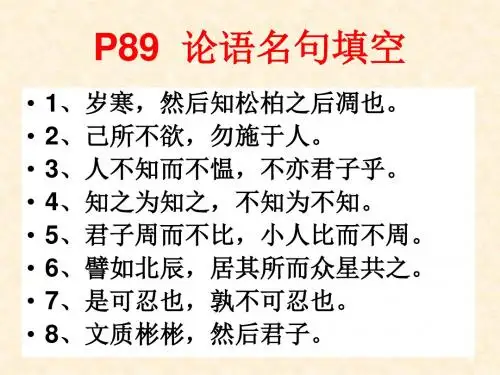

高中必修一必背资料高中必修一的学习内容涵盖了多个学科,包括语文、数学、英语等。
以下是一些必背资料的整理,希望对同学们的学习有所帮助。
语文1. 古诗词背诵:《离骚》(节选)、《出师表》、《滕王阁序》等。
2. 现代文阅读:鲁迅的《呐喊》、《彷徨》等,以及现代散文、小说的阅读。
3. 文言文阅读:《左传》、《史记》等经典文言文的选读。
4. 写作技巧:掌握议论文、记叙文、说明文等不同文体的写作方法。
数学1. 函数:理解函数的概念,掌握函数的性质,如单调性、奇偶性等。
2. 导数:学习导数的定义、计算方法及其在实际问题中的应用。
3. 几何:掌握平面几何的基本定理和性质,如三角形的内角和、勾股定理等。
4. 概率统计:了解概率的基本概念,学习统计图表的绘制和数据分析。
英语1. 词汇:积累高中英语词汇,尤其是高频词汇和短语。
2. 语法:掌握各种时态、语态、从句等语法知识。
3. 阅读:提高阅读理解能力,通过阅读英文报刊、杂志等材料来扩大词汇量和理解力。
4. 写作:练习写作,包括记叙文、议论文、说明文等不同文体。
物理1. 力学:理解力的概念,掌握牛顿三大定律。
2. 电磁学:学习电场、磁场的基本概念和性质。
3. 光学:了解光的传播、反射、折射等现象。
4. 热学:掌握热力学第一定律和第二定律。
化学1. 元素周期表:熟悉元素周期表的结构和元素的基本性质。
2. 化学反应:理解化学反应的类型和反应速率。
3. 化学键:掌握离子键、共价键等化学键的形成和性质。
4. 化学平衡:学习化学平衡的概念和计算方法。
生物1. 细胞:了解细胞的结构和功能,掌握细胞分裂的过程。
2. 遗传:学习基因的概念,了解遗传的基本规律。
3. 生态学:掌握生态系统的组成和功能,了解生态平衡的重要性。
4. 生物技术:了解现代生物技术的应用,如基因工程、克隆技术等。
以上是高中必修一各学科的一些必背资料,希望同学们能够认真复习,掌握这些基础知识,为后续的学习打下坚实的基础。
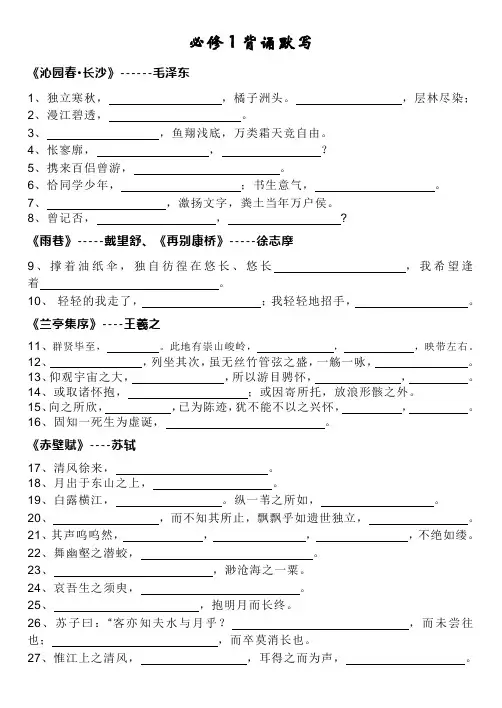
《沁园春·长沙》------毛泽东1、独立寒秋,,橘子洲头。
,层林尽染;2、漫江碧透,。
3、,鱼翔浅底,万类霜天竞自由。
4、怅寥廓,,?5、携来百侣曾游,。
6、恰同学少年,;书生意气,。
7、,激扬文字,粪土当年万户侯。
8、曾记否,,?《雨巷》-----戴望舒、《再别康桥》-----徐志摩9、撑着油纸伞,独自彷徨在悠长、悠长,我希望逢着。
10、轻轻的我走了,;我轻轻地招手,。
《兰亭集序》----王羲之11、群贤毕至,。
此地有崇山峻岭,,,映带左右。
12、,列坐其次,虽无丝竹管弦之盛,一觞一咏,。
13、仰观宇宙之大,,所以游目骋怀,,。
14、或取诸怀抱,;或因寄所托,放浪形骸之外。
15、向之所欣,,已为陈迹,犹不能不以之兴怀,,。
16、固知一死生为虚诞,。
《赤壁赋》----苏轼17、清风徐来,。
18、月出于东山之上,。
19、白露横江,。
纵一苇之所如,。
20、,而不知其所止,飘飘乎如遗世独立,。
21、其声呜呜然,,,,不绝如缕。
22、舞幽壑之潜蛟,。
23、,渺沧海之一粟。
24、哀吾生之须臾,。
25、,抱明月而长终。
26、苏子曰:“客亦知夫水与月乎?,而未尝往也;,而卒莫消长也。
27、惟江上之清风,,耳得之而为声,。
28、取之无禁,用之不竭,,而吾与子之所共食。
”29、盖将自其变者而观之,;,则物与我皆无尽也。
《游褒禅山记》----王安石30、夫夷以近,;险以远,。
《氓》《采微》-----《诗经》1、乘彼垝垣,。
2、不见复关,。
既见复关,。
3、,其叶沃若。
4、桑之落矣,。
5、,渐车帷裳。
6、淇则有岸,。
总角之宴,。
7、昔我往矣,。
今我来思,。
《离骚》-----屈原8、,哀民生之多艰。
9、亦余心之所善兮,。
10、,余不忍为此态也。
11、,集芙蓉以为裳。
12、,长余佩之陆离。
13、民生各有所乐兮,。
14、路漫漫其修远兮,。
《短歌行》----曹操、《归园田居》----陶渊明15、对酒当歌,?16、何以解忧?。