
动词的时态与语态
- 格式:ppt
- 大小:283.00 KB
- 文档页数:30


实用文档 动词的时态和语态
时 态
一般现在时
(1)可表示客观真理、科学事实。
The sun rises in the east and sets in the west.
太阳从东方升起,从西方落下。
(2)可用在由if,unless引导的条件状语从句,由even/if/though引导的让步状语从句,由when,before,until/till,as soon as,the moment引导的时间状语从句,由no
matter what/who/when/where/how或whatever,whoever等引导的让步状语从句中,这时主句往往表将来或主句是祈使句。
I’ll go with you as soon as I finish it.
我一做完,就与你一同去。
Whatever you say,I will not change my mind.
无论你说什么,我都不会改变主意。
一般过去时
表示“刚才,在过去”之意,暗示现在已“不再这样”。
—Your phone number again?I didn’t quite catch it.
——再重述一下你的电话号码好吗?我没记下来。
—It’s 9568686. 实用文档 ——是9568686。
一般将来时
(1)“will+动词原形”表示事物的固有属性与必然趋势。
Fish will die without water.离开水,鱼就会死。
(2)“be going to+动词原形”可表示根据迹象对未来进行推断。
Look at the dark clouds.It is going to rain.
看那乌云,要下雨了。
(3)“be about to+动词原形”表示立即的将来,很少与时间状语连用。
The train is about to start.火车就要开了。
(4)位移动词如come,go,arrive等,其一般现在时表按时间表将要发生的事,现在进行时可表计划、安排要做的事。

龙源期刊网
动词的时态、语态
作者:
来源:《时代英语·高三》2014年第05期
1. Anne ___ to Australia seven months ago.
A. went B. has been
C. goes D. has gone
2. — Have you seen Peter recently?
— Yes. He asked me to ask you how you ___ along with your new job these days.
A. have been getting B. were getting
C. are getting D. are getting
3. I hope her health ___ greatly by the time we come back next year.
A. improves B. will improve
C. has improved D. will have improved
4. Mrs Green wants to buy that kind of cloth because the cloth ___ very well.
A. washes B. is washed
C. will be washed D. will wash
5. By the time you ___ this book, your meal will get cold.
A. will have finished B. have finished
C. are finishing D. finished
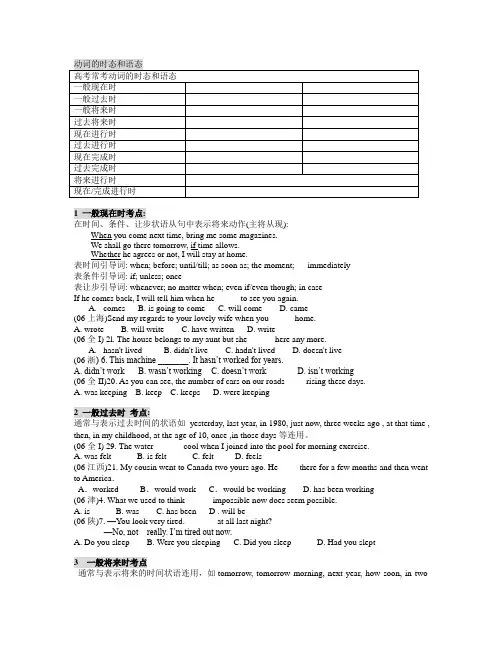
动词的时态和语态
高考常考动词的时态和语态
一般现在时
一般过去时
一般将来时
过去将来时
现在进行时
过去进行时
现在完成时
过去完成时
将来进行时
现在/完成进行时
1 一般现在时考点:
在时间、条件、让步状语从句中表示将来动作(主将从现):
When you come next time, bring me some magazines.
We shall go there tomorrow, if time allows.
Whether he agrees or not, I will stay at home.
表时间引导词: when; before; until/till; as soon as; the moment; immediately
表条件引导词: if; unless; once
表让步引导词: whenever; no matter when; even if/even though; in case
If he comes back, I will tell him when he _____ to see you again.
A. comes B. is going to come C. will come D. came
(06上海)Send my regards to your lovely wife when you _____ home.
A. wrote B. will write C. have written D. write
(06全I) 2l. The house belongs to my aunt but she______ here any more.
A. hasn't lived B. didn't live C. hadn't lived D. doesn't live

维普资讯 维普资讯 维普资讯 维普资讯 维普资讯 It IS said that this book has been translated into several languages. 据说这本书被译成几种语言。
G. 一些动词不用被动语态,如:
break out,take place,happen,belong to,cost,suit,fit,suffer,last,meet,join,fail等
H. 宾语为反身代词时,不用被动语态,只用主动语态形式,如:
The man introduced himself as Mr.Wang.那个人作自我介绍,你自己为王先生。
I. 有些动词或情态动词常用所接的不定式来表示被动意义。如:happen,pretend,
seem,used to,ought to,appear等
The house used to be painted white.房子在过去被漆成白色。
The iob has to be done befor edark.工作要在天黑之前完成。
On the way we happened to be caught in the rain.在路上我们碰巧被雨淋了。
J.有些动名词在want,need,require和worth后形式为主动,意义为被动,如:
y w砒ch needs/wants repairing‘ 我们的表需要修理。 MY watch needs.wants to be repaired. I 一…~…”…一…
This book is wonh reading・ 1 This book is worthy of being read. 这本书值得一读。 This bo。k is WOrthy to be read. J