
Cargo Packing , Stowage and Marking
- 格式:ppt
- 大小:1.65 MB
- 文档页数:25
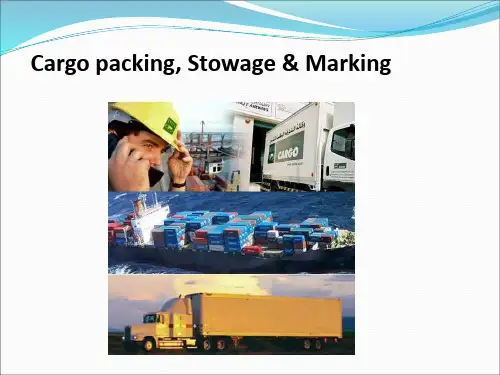



Seminar forCarriage of Dangerous Goods05 July 2002GL ASEA BusanY. S. Kim Brief InstructionThere is a tremendous variety of dangerous cargoes being carried on seagoing ships, to some extent in very large quantities. Dangerous goods are mainly mineral oils and products of the chemical industry which may represent a danger for the crew, the ship and environment. This has been taken account by the IMO in the international Convention for the Safety of Life at Sea, SOLAS. The carriage of dangerous goods in general is dealt with in SOLAS Chapter VII, covering chemical tankers in Part B, gas carriers in Part C and the carriage of dangerous goods in packaged form or in solic form in bulk is contained in Part A.Part A of SOLAS Chapter VII contains general requirements covering mainly operational aspects and applies to all ships, including cargo shipes of less than 500 gross tons, carrying dangerous goods. Part A of SOLAS Chapter VII is the legal base for the “International Maritime Dangerous Goods Code“ (IMDG Code) and the “Code of Safety Practice for Solid Bulk Cargoes“ (BC Code). There codes contain the specific requirements with regard to packing, labelling , stowage, segregation and other operational aspects.In Regulation 2 of SOLAS Chapter VII, Part A dangerous goods are classified according to their specific properties:Class 1 ExplosiveClass 2.1 Flammable GasesClass 2.2 Non-flammable GasesClass 2.3 Poisonous GasesClass 3.1/3.2 Flammable liquids with flash point of 23︒C and belowClass 3.3 Flammable liquids with flash point above 23︒C up to 61︒CClass 4.1 Flammable solidsClass 4.2 Substances liable to spontaneous combustionClass 4.3 Substances, which, in contact with water, emit flammable gasesClass 5.1 Oxidizing substancesClass 5.2 Organic substancesClass 6.1 Toxic substancesClass 6.2 Infectious substancesClass 7 Radioactive materialsClass 8 Corrosives (liquids and solid forms)Class 9 Miscellaneous dangerous substances and articlesFor the details of the classification of the dangerous goods, refer to IMGD Code Para.5 as attached. Dangerous substances in packaged form are to be shipped in approved packagings as specified in the IMDG code for each substance individually, including a limitation of the filling capacity. Common packagings are boxes, drums, pressure cylinders etc. These parcelled goods are either be stowed directly in the cargo hold or inside a freight container. Goods stowed in tank containers, bulk containers or big bags are considered packaged as well. Please note that bulk cargoes mean cargoes which are intended to be transported without any intermediate form of containment in bulk packagings or portable tanks. Stowage requirements specify, among other things, restrictions related to the distance to living quarters and to engine room boundaries, or whether on deck or under deck stowage is permitted or stowage on passenger ships.Segregation is required for incompatible goods like substances, which stowed together, present a risk for undue hazards in case of leakage or spillage.Regulations and ProvisionSOLAS II-2, Reg. 54 Specific requirements for ships carrying dangerous goodsThese regulations specify the required installations and equipment in the cargospaces for the individual cargoesSOLAS VII, Part A Carriage of dangerous goods in packaged form or in solid form in bulk.Application of the Rules and classification of the various goods. Generalinformation regarding packaging, marking, labelling, documents and stowage. IMDG Code International Maritime Dangerous Goods CodeSpecific provisions for each individual cargo with respect to packing, stowage andsegregation duing the transport. To be onboard if goods in packaged form arecarried.BC Code Code of Safe Practice for Solid Bulk CargoesSpecific provisions for each individual cargo with respect to stowage andsegregation during the transport. To be onboard if buldk cargopes are carried. INF Code Code for the safe carriage of irradiated nuclear fuel, plutoniym and high-levelradioactive wastes in flasks on board ships. INF 1, INF 2, INF-3 dependent on thetotal radioactive quantity.Class 7, not covered by SOLAS II-2, Reg. 54.As indicated in the list of classes some goods are dangerous on account of their features (e.g. explosive or poisonous products). Other goods constitute a hazard during the transport if they get in touch with other materials and thereby a chemeical reaction is caused, e.g. development of ignitable or toxic gases after contact with water. Therefore,the cargo spaces concerned have to be provided with the fire protection and safety systems dependent on the scheme of the carriage of dangerous goods as specifified on SOLAS Chapter II-2, Regualtion 54 in order to cope with dangerous situations which may evolve.It should be noted that a ship need not to comply with all the requirements indicated in the SOLAS II-2, Regulation 54. The classes of dangerous goods which may be carried and possible restrictions are ascertained on the basis of the arrangements and equipment provided for each space and such stated in the “Document of Compliance for the Carriage of Dangerous Goods (Dangerous Goods Certificate)“.As attached, our Rules Chapter 2, Section 12, The tables 12.7 and 12.8 are used to determine the requirements to be fulfilled for particular classes of dangerous goods to be carried in a particular type of cargo space.Specific Requirements for the Carriage of Dangerous GoodsGeneral information regarding the application of the Special Requirements of Regulation 54 of SOLAS II-2 according to the scope of dangerous goods to be carried.The scope of dangerous goods, which may be carried, depends on the vessel’s outfitting.A. Transport of Dangerous Goods (D.G.) in package formA minimum of such requirements as detailed here below has to be met in case D.G. in packaged form shall be carried in a cargo hold:1. All cargo holds to be fitted with a fixed fire extinguishing system(conventional/container/bulk cargo spaces: CO2 system)special category spaces, open ro/ro spaces and alike: water spraying system2. Immediate availability of water for fire fighting by remote start of the fire pumps from the wheelhouse3. Hydrants to be arranged such that any part of the empty cargo space can be reached with four jetsof water simultaneously. Two of the jets shall be supplied via single length of hose each, two may be supplied via two coupled hose lengths. This requirement applies also to the cargo weather deckdesignated for the stowage of D.G.4. Approved fire detection system for the cargo holds (in case of class 1 on weather deck alsoapplicable to the cargo hold beneath)5. Four sets of chemical protective clothing6. Two additional breathing apparatus with spare charges acc. to flag state requirements 1, but not lessthan two7. Additional dry powder fire extinguishers total 12 kg per hold (not required in container cargo holds,but also for weather deck stowage)With foregoing equipment the following may be carried in the cargo hold(s):16000 ltrs. each for German flag.Provided additional dry powder fire extinguishers of total 12 kg are available dedicated to the use in the cargo deck area all classes of D.G. may be carried on weather deck.8. For the carriage of flammable gases (class 2.1), toxic gases (class 2.3), substances of IMO class 4.3,liquids of class 6 and 8 with flash point 61 °C, but above 23 °C and for the carriage of those goods for which the IMDG code requires "stowage in a mechanically ventilated space", the cargo hold is to be provided with mechanical exhaust ventilation giving 6 air changes per hour based on the empty hold.T his applies also to goods of IMO classes 4.1, 4.2 and 5.1 if stowage in a mechanically ventilated space is stipulated in the IMDG code.The ventilation ducts shall be arranged such that approximately 1/3 of the air volume is removedfrom the upper and 2/3 lower part of the cargo hold.The ventilation may be reduced to two air changes per hour in case of container cargo spaces and if these goods are carried in closed freight containers.The inlet (if supply fans are provided) and outlet ventilation openings are to be fitted with wire mesh guards not exceeding 13 mm mesh to prevent foreign objects from entering into the fan casing.9. With ventilation acc. to 8. and ex-proof electrical equipment of explosion group IIB, temperature classT4 and grade of protection IP 55, also the flammable gases (class 2.1) with the exception ofHydrogen and mixtures thereof may be carried in the hold.I t should be noted that all electrical equipment coming into contact with hold atmosphere has to meetthis requirement (lighting, fire detection system, ventilators etc.).The carriage also of Hydrogen and mixtures thereof would require ex-proof installation of IIC T4.Lighting is not a requirement of the Rules nor SOLAS. Lighting or any other electrical equipment,unless required by the Regulations or in connection with the transport of D.G., may be isolatedduring the transport of goods requiring ex-proof electrical equipment.10. With ventilation according to 8., ex-proof installation according to 9. and an additional fixed bilgesystem for the removal of D.G. spills, the classes 3.1, 3.2, 6.1 and 8 may be carried withoutrestrictions.11. In case of IMO-class 1, except 1.4.S, the following would have to be provided in addition to the basicrequirements as per items 1. - 10:–electrical equipment of at least IIB T5, IP 65 (only for goods liable to emit explosive dust or vapour)–water spraying system for the part where class 1 is to be stowed (5 litres/m2 ∙ min)– a machinery space bulkhead adjoining the cargo hold is to be insulated to A-60 standard.12. In a cargo hold adjoining the machinery space various IMO classes have to be stowed 3m awayfrom the machinery space bulkhead, unless it is insulated to A-60 standard. For details please refer to the Rules. This requirement, however, is not applicable to container cargo holds.In case of IMO class 1 (except 1.4.S) however, the A-60 fire protection insulation is mandatory for the machinery space bulkhead adjoining a cargo hold. In addition, these goods have to be stowed3 m away from the machinery space bulkhead.13. Note: IMO-class 5.2 never is permitted to be carried in a hold regardless of any equipment fitted.This sub-class is allowed on deck only.14. Carriage of containers on Non-weathertight Hatch coversWith regard to the carriage of containers on non-weathertight hatch covers, potential hazards have been identified in case of dangerous goods of which leaked liquids may enter into the containercargo hold and for dangerous goods for which the IMDG code requires “on deck stowage〞 only.For newbuildings intended for the carriage containers on non-weathertight hatch covers with gaps, followings shall be observed:a.IACS LL 64From the carriage of dangerous goods point of view, he main items are:-the gaps shall not exceed 50 mm-to minimise the entry of leaked liquids into the container cargo hold, effective provisions(e.g. gutter bars) shall be provided in way of the gaps-the requirement CO2 quantity for the cargo hold is to be increased by at least 10 %b.In accordance with interpretation, para 9 of LL64 need not to be observed under followingconditions:1.Stowage of containers on the hatch covers inside the gutter bars, i.e. withoutbridging the gaps: no further requirement2.Stowage of containers above gaps, i.e. by bridging the gaps:Additional drainage recess, e.g. recessed labyrinth arrangement, shall be providedbetween the hatch covers.c.Mechanical ventilation in the cargo holds shall be provided. The kind of ventilation (exhaustor overpressure ventilation) should be selected as follows:1.For container cargo holds fitted with certified safe electrical equipment of at leastIIBT4 IP55 and ventilation giving at least 2 air changes per hour, GL recommendsmechanical ventilation of exhaust type which we deem more effective in case ofleakage of dangerous goods from containers stowed within the hold. Should anygases or vapour from the “on deck only〞 cargo be drawn into the hold it will bediluted sufficiently so that together with the forementioned standard of electricalprotection there should be no risk of ignition.2.Overpressure ventilation of the cargo holds beneath should be required only if thecargo holds are not equipped for the carriage of flammable gases and liquids withflash point below 23 C (that means e.g. no certified safe electrical equipment). Anair change rate of at least 2/hr shall be provided and continuous ventilation shouldbe maintained throughout the holds if such cargoes are stowed on the hatches. For details regarding the individual requirements please refer to the Rules.B. Transport of Solid Dangerous Goods in BulkIn case a vessel shall also be suitable for the carriage of solid D.G. in bulk the following is to be applied: 1. If fitted with equipment as per items 1., 2., 3., 5. and 6., the following classes can be carried in bulk:5.1 1,6.1, 8 and 9 22. Mechanical ventilation is mandatory only for a limited number of bulk cargoes. For details pleaserefer to the Rules.3. A fire detection system as per item4. is not required in case of solid D.G. in bulk.4. The CO2 system may be exempted on application in case of bulk cargoes which are non-combustible or of low fire risk or for which CO2 is deemed to be ineffective (IMO MSC/Circ.671). 5. Class 4.1 2 in bulk would require electrical equipment of at least IP 55, max. surface temperature200°C orT3, IP 55 (sulphur T4, IP55).6. For class 4.2 1 in bulk only for some goods the electrical equipment must be of at least IIA T2, IP55.7.For class 4.3 1 in bulk following requirements shall be complied with:-The electrical equipment must be of at least IIC T1 (ferrosilicon), other goods of this class require IIC T2.-The ventilation must consist of at least 2 independent fans with a sill height such that weathertight closure need not be provided in accordance with ILLC.-The bilge system is to be designed acc. to item 10 of para A.-Two portable gas measuring apparatus for quantitative measuring of Phosphine and Arsine are to be provided.-Special flag state requirements may have to be observed for the carriage of class 4.3 in bulk.E.g. in case of German flag a full-scale separate bilge system is to be provided for the hold.For the breathing apparatus spare charges of 9600 litres each are required.Foregoing covers the most important aspects. For details of design please refer to the Rules.C. Forms to be submitted by the shipyard (F236 / F184)a.)The forms F 236 shall be completed by the shipyard and to be submitted to our MachineryDepartment together with a General Arrangement Drawing in order to provide informationregarding the type of cargo spaces, the hatch covers (weathertight, or non-weathertight with gaps) and the scope of IMO classes intended to be carried.b.)The forms F 184 shall be completed by the shipyard and to be submitted to our ElectricalDepartment for approval in due time before delivery of the ship. For issue of the Document ofCompliance for the Carriage of Dangerous Goods an approved form is required.D.Document of Compliance for the Carriage of Dangerous GoodsThe document of compliance will be issued by GL for most of the flag states upon a special survey acc. to GL form F 235 for initial surveys and Form F 237 for renewal surveys.In case of German flag the document will be issued by the German Authorities. The necessary surveys however will be performed by GL, who will initiate the issue of the document by See-BG.1Separation to engine room bulkhead in accordance with BC code.2In a cargo hold adjoining a machinery space stowage at least 3 m away from engine room bulkhead, unless it is insulated to A-60 standard.Explosion Protection of Electrical Equipment for the Carriage of Dangerous Goods1.InstructionDuring the past few years transport s of dangerous goods on board ships have increased substantially, as as a result of which installatioans enabling such transports to be effected safely are now provided for the cargo spaces of almost all newbuildings. One of the essential measures taken is explosion protection of the electrical equipment. From the general objectives defined it can be deduced that in particular the following items have to observed.1.1Definition of areas subject to explosion hazard1.2Adaptation of explosion protection to the dangerous goods to be carried (explosion group,temperature class).1.3Definition of restrictions for disconnection of non-explosion protected equipment. Equipmentprovided for ensuring the safety of crew and ship and for the carriage of dangerous goods must be not disconnected.Both the IEC/TC18 and IACS WP/EL have prepared relevant regulations, which have been duly considered in Germanischer Llyod’s Rules.2.Areas subject to explosion hazard (comparable to zone 1)Hazardous areas have been subdivided into areas subject to explosion hazard (comparable to zone 1) and extended hazardous areas (comparable to zone 2), depending on the probability of occurrence of an atmosphere in dangerous quantity.As a matter of principle, cargo holds in which dangerous goods are carried, as well as the pertinent ventilation ducts and enclosed or semi-enclosed spaces with direct, non-closable openings to these spaces, are areas subject to explosion hazard.A distinction has to be made between2.1explosive substances in packaged form conforming to class 1, except for goods in division 1.4,compatibility group S.2.2solid goods in bulk, which may develop dangerous dust only, and2.3flammable liquids with a flash point below 23︒C in packaged form, flammable gases or highlydangerous bulk cargoes, which under certain conditions develop a potentially explosive gasatmosphere.It is assumed that in the event of failure, e.g. damage to the packaging and discharge of a liquid with a flash point below 23︒C, a gas/air mixture in dangerous quantity and concentration is liable to occur from time to time.The same consideration applies to dangerous concentrations of dust/air mixtures in the case of carriage of certain bulk cargoes, such as grain and fish meal.When coal is carried, a combined hazard due to duct and gas (methane) may occur. The concentrations is to be expected depending on a large extent on the type of coal and the country of origin.Ferrosilicon may be quoted as an example for a hazard being caused during the carriage of solid cargo in bulk due to explosive gas atmosphere. Under the effect of water, ferrosilicon develops, inter alia, hydrogen in dangerous concentrations and quantity.3.Extended hazardous areas (comparable to zone 2)Extended hazardous areas are to be taken into consideration only in the event of carriage of flammable liquids with a flash point 23︒C in packaged form, flammable gases or highly dangerous bulk cargoes, which under certain conditions develop a potentially explosive gas atmosphere. Extended hazardous areas include:3.1Areas with a gastight, closable door to areas subject to explosion hazard and not provided withoverpressure ventilation or separation by a gas lock. If ventilation by overpressure with at least 6air changes per hour or separated by a gas lock, these areas are considered to be safe. In case of the failure of ventilation system a visual and audible alarm is to be given and the equipment, which is not of certified safe type (e.g. IP 55) must be automatically or manually switched off.3.2Bilge pump spaces and pipe tunnels with components, such as flanges, valves, pumps, etc., whichserve the area subject to explosion hazard. If ventilated (exhaust air) with at least 6 air changes per hour, these areas are considered to be safe. In case of the failure of ventilation system a visual and audible alarm is to be given and the equipment, which is not of certified safe type (e.g. IP 55) must be automatically or manually switched off.3.3Areas on the open deck within a spherical of 3 m around the exhaust openings of ventilation ductsfrom hazardous areas.4.Choice of equipment for use in areas subject ot explosion hazardIn practice, the choice of explosion-protected equipment, taking into account explosion group and temperature class, has to be problematical.The following facts may be recalled: The ignition penetration charcteristics of gases through gaps are reflected in the explosion group, while the maximum admissible temperature of electrical equipment is reflected in this temperature class. The maximum temperature of electrical equipment must always be below te ignition temperature of the explosive gas atmosphere.Explosion group and temperature class are based on the physical properties of the substances, which may form an explosive gas atmosphere.Aa abbreviations for theexplosion group A/B/C are used and for thetemperature class T1 – T6,with the most stringent requirements being represented by explosion group C and temperature class T6.The problem is that the IMO danger classes mentioned previously cannot be directly correlated to the explosion groups and temperature classes. In particular, products of classes 1, 2, 3, 6 and 8 contain a wide range of completely different substances, which owing to their physical properties make high demands on explsion protection, i.e.•explosion group IIC•temperature class T5.Carbon disulfide, which would be required to come under temperature class T6, is not permitted to be carried below deck, and need, therefore, not be considered.Also, details relating to explosion group and temperature class are not always available or in some cases are unkwown. Examples for the groups of solid bulk are shown in attached.In the following the correct choice of explosion-protected equipment is dealt with. As in the case of the areas subject to explosion hazard of 2. to 2.3 above , a subdivision is used.4.1Explosive substances in packaged form conforming to class 1, except for goods in division 1.4,compatibility group SExplosive, dusty atmosphere: Degree of protection IP 65Maximum surface temperature 100︒C Potentially explosive, gaseous atmosphere: explosion-protection equipment inExplosion group: IIATemperature class T54.2Solid goods in bulk, which may develop dangerous dust onlyDegree of protection IP 55M aximum surface temperature 200︒Cor explosion-protected equipment inD egree of protection IP 55M aximum surface temperature T34.3Flammable liquids with a flash point below 23︒C in packaged form, flammable gases or highlydangerous bulk cargoes, which under certain conditions develop a potentially explosive gasatmosphere.Explosion group IICT emperature class T4Where all requirements of 4.1 to 4.3 have to be complied with, due to the fact that the whole range of dangerous goods is intended to be carried, the most stingent requirements will have to beapplied. The electrical equipment will then have to meet the following maximum requirements.Degree of protection IP 65Maximum surface temperature 100︒CExplosion group IICTemperature class T5These extracting requirements imply considerable costs, are in some cases difficult to put intopractice technically and need frequently due to restrictions on the kind of cargo carried not beapplied. However, if a ship is intended to carry all admissible substances without restrictions as to the danger calsses, their observance is to ensured.In practice, in many cases relaxations are possible, as transports of substances can be excluded.Some important special arrangements, for instance, are as follows:4.4If no hydrogen, no hydrogen mixtures and no cargo in bulk which may develop hydrogen undercertain conditions are carried on board ships, explosion group IIC as stipulated for explosionprotection in 4.3 above may be reduced to IIB.4.5Where in the cargo holds of container ships tranports of class 1 goods (explosion substances) andof hydrogen mixtures can be excluded, the electrical equipment has to meet the followingrequirements only:Degree of protection IP 55Explosion group IIBTemperature class T45.Choice of equipment for use in extended hazardous areasElectrical equipment chosen for use in these areas has to meet the following minimum requirements: In general, equipment in used which does not produce sparks in normal operation and thesurfaces of which do not attain inadmissible temperatures, or equipment wih simplified pressurised enclosure or vapourproof enclosure; degree of IP 55.The surface temperature must not exceed a value below the ignition temperature of the productsintended to be carried, i.e. in general a value below 135︒C (T4).Since surface temperature exceeding 135︒C occue rarely only and the equipment, such as lighting, switches, ventilator motors and distributors, in these areas meets the prescribed degree ofprotection requirements anyhow, special measures are in most cases not required.Use of explosion-protected equipment of of equipment with Ex(n) type protection is, of cource, also possible.6.Installation and operation of electrical equipmentA special provision should be mentioned here, which in practice is of partucular significance. So far, the condition of the electrical equipment has been described, which will make it suitable for operation also in the event of dangerous cargo being carried. However, dangerous cargo is by no means carried all the time. Therefore, systems are frequently installed such that part of the electrical equipment does not comply with the requirements for transports of dangerous cargo, with this equipment being operated also during normal service, i.e. when no dangerous cargo is carried, and disconnected only in the event of dangerous cargo in fact being carried.In this connection the following is to be observed:If electrical equipment is installed which is not suitable for use during tranportation of dangerouscargo, it must be disconnected and capable of being safeguarded against unautyhorizedreconnection. The disconnection device is to be located outside the hazardous area and should, for instance, include lockable switches in its design.Where electrical equipment is important for ensuring the safety of the crew, the cargo or the ships, it should not be disconnected and must comply with the requirements for use in hazardous areas.7.Special provisionsA special arrangement in the Baltic Sea area is of particular significance for a number of ro-ro vessels (cargo and passenger vessels).The carriage of dangerous goods on board ro-ro vessels operating in the Baltic Sea and of late also in the national North Sea area is subject to the “Memorandum of Understanding“ as amended in Copenhagen on 8/10 January 1992 and signed by Denmark, Finland, Sweden, Poland and the Federal Republic of Germany. The funtions arising from this memorandum in the area of the FRG have been entrusted to Germanischer Lloyd by the Federal Ministry of Transport.The reason for this special arrangement are that arrangements existed in the Baltic Sea prior to entry into force (1984) of SOLAS, Regulation 54 already and that some of the distance covered by the vessels are very short, so that rail/road traffic (RID and ADR) had to be taken into account to a large extent. Apart from detailed special provisions for passenger and cargo vessels (prohibition of certain substances) and regulations for stowage on and below deck, in closed and open holds, requirements have been laid down for explosion protection of electrical equipment, providing for at least 20 changes of air per hour during loading and unloading operations and during voyage.Simplified explosion protection of electrical equipment, as against the measures required to be taken subject to SOLAS reg. 54, owing to the frequent changes of air is conditionally possible. This measure is also referred to as primary explosion protection.In specific cases, which can not be dealt with, explosion protection of electrical equipment is required throughout the full height of the hold; in other cases it is sufficient to provide explosion protection up to a height of 45 cm, while above that height provisions are made for limited explosion protection (measures for extended hazardous areas).Explosion GroupsTemperature Classes。
