
Session 24 - Class Notes - leases II (1)
- 格式:ppt
- 大小:451.00 KB
- 文档页数:76
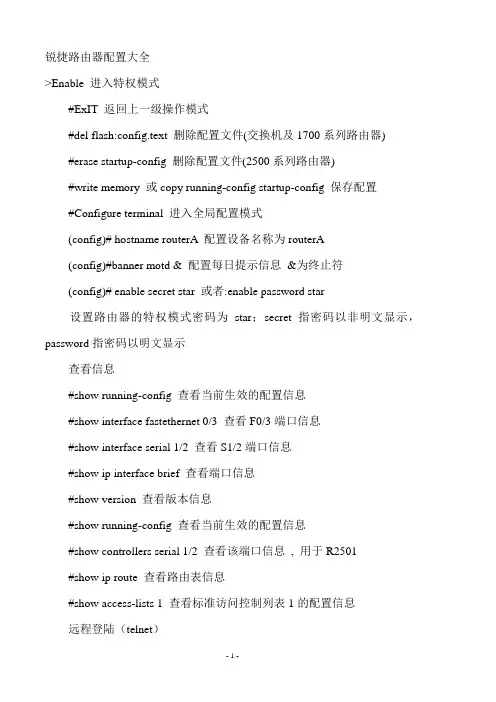
锐捷路由器配置大全>Enable 进入特权模式#ExIT 返回上一级操作模式#del flash:config.text 删除配置文件(交换机及1700系列路由器)#erase startup-config 删除配置文件(2500系列路由器)#write memory 或copy running-config startup-config 保存配置#Configure terminal 进入全局配置模式(config)# hostname routerA 配置设备名称为routerA(config)#banner motd & 配置每日提示信息&为终止符(config)# enable secret star 或者:enable password star设置路由器的特权模式密码为star;secret 指密码以非明文显示,password指密码以明文显示查看信息#show running-config 查看当前生效的配置信息#show interface fastethernet 0/3 查看F0/3端口信息#show interface serial 1/2 查看S1/2端口信息#show ip interface brief 查看端口信息#show version 查看版本信息#show running-config 查看当前生效的配置信息#show controllers serial 1/2 查看该端口信息, 用于R2501#show ip route 查看路由表信息#show access-lists 1 查看标准访问控制列表1的配置信息远程登陆(telnet)(config)# line vty 0 4 进入线路0~4的配置模式,4为连续线路最后一位的编号,线路为0~4(conifg-line)#login(config-line)#password star 配置远程登陆密码为star(config-line)#end 返回上层端口的基本配置(config)#Interface fastethernet 0/3 进入F0/3的端口配置模式(config)#interface range fa 0/1-2 进入F01至F0/2的端口配置模式(config-if)#speed 10 配置端口速率为10M,可选10,100,auto(config-if)#duplex full 配置端口为全双工模式,可选full(全双工),half(半双式),auto(自适应)(config-if)#no shutdown 开启该端口(config)# interface serial 1/2 进入端口S1/2的配置模式(config-if)# ip address 1.1.1.1 255.255.255.0 配置端口IP及掩码(config-if)# clock rate 64000 配置时钟频率(单位为K , 仅用于DCE端) (config-if)# bandwidth 512 配置端口带宽速率为512KB(单位为KB)(config-if)# no shutdown 开启该端口(config-if)#encapsulation PPP 定义封装类型为PPP,可选项:Frame-relay 帧中继Hdlc 高级数据链路控制协议lapb X.25的二层协议PPP PPP点到点协议X25 X.25协议路由协议(config)# ip route 172.16.1.0 255.255.255.0 172.16.2.1 配置静态路由注:172.16.1.0 255.255.255.0 为目标网络的网络号及子网掩码172.16.2.1 为下一跳的地址,也可用接口表示,如ip route 172.16.1.0 255.255.255.0 serial 1/2(172.16.2.0所接的端口)(config)# router rip 开启RIP协议进程(config-router)# network 172.16.1.0 申明本设备的直连网段信息(config-router)# version 2 开启RIP V2,可选为version 1(RIPV1)、version 2(RIPV2)(config-router)# no auto-summary 关闭路由信息的自动汇总功能(只有在RIPV2支持)(config)# router ospf 开启OSPF路由协议进程(针对1762,无需使用进程ID)(config)# router ospf 1 开启OSPF路由协议进程(针对2501,需要加OSPF进程ID)(config-router)# network 192.168.1.0 0.0.0.255 area 0申明直连网段信息,并分配区域号(area0为骨干区域)注意:如果是Rip Version1,那么在不连续的子网中,需要为中间网段的两个路由器都配置子接口!!!RA(config)#int serial0RA(config-if)#ip address 172.16.2.1 255.255.255.0 secondaryRB(config)#int serial0RB(config-if)#ip address 172.16.2.2 255.255.255.0 secondaryPAP路由器Ra为被验证方、Rb为验证方;两路由器用V.35线连接(串口线),分别配置各端口的IP及时钟频率后:Rb(config)# username Ra password 0 star 验证方配置被验证方的用户名,密码Rb(config)# intterface serial 1/2 进入S1/2端口Rb(config-if)# encapsulation ppp 定义封装类型为PPPRb(config-if)# ppp authentication pap PPP启用PAP认证方式Ra(config)# itnterface serial 1/2 进入S1/2端口Ra(config-if)# encapsulation ppp 定义封装类型为PPPRa(config-if)# ppp pap sent-username Ra password 0 star 设置用户名为ra 密码为star,用于发送到验证方进行验证#debug ppp authentication 可选命令:观察PAP验证过程(如果没看到验证消息,则将端口shutdown,然后再no shutdown,即可看到验证过程的相关信息)CHAP路由器Ra、Rb, 两路由器用V.35线连接(串口线),分别配置各端口的IP及时钟频率后:被验证方配置:Ra(config)# username Rb password 0 star 以对方的主机名作为用户名,密码和对方的路由器一致Ra(config)# interface serial 1/2 进入S1/2端口Ra(config-if)# encapsulation PPP 定义封装类型为PPP验证方配置:Rb(config)# username Ra password 0 star 以对方的主机名作为用户名,密码和对方的路由器一致Rb(config)# interface serial 1/2 进入S1/2端口Rb(config-if)# encapsulation PPP 定义封装类型为PPPRb(config-if)# ppp authentication chap PPP启用CHAP方式验证PAP与CHAP的区别:1. PAP:被验证方发送用户名、密码到验证方进行身份验证,所以需要在端口模式下设置Ra(config)#ppp pap sent-username Ra password 0 star;验证方需要定义用户和密码配对数据库记录,所以要定义命令:Rb(config)# username Ra password 0 star2. Chap:CHAP由验证方主动发起挑战,由被验证方应答进行验证(三次握手),所以验证方要配置命令:Rb(config-if)# ppp authentication chap。
何旋职称:金程教育高级培训师、通过CFA三级、通过FRM 工作经验:2009年至今,担任金程教育CFA(注册金融分析师)高级培训师,主要负责《经济 学》、《固定收益》、《衍生产品》和《组合管理》的课程讲解;2007年2011年4月,在金程教 育金融研究院内担任研究员,主要负责包括CFA项目研发以及的相关内训课程的课程体系开 发,主要项目经验包括:摩根史丹利项目(组长):组织小组内成员定期讨论;搜集金融基础 知识方面的英文资料,撰写英文课件,确保项目质量;中国银行项目:负责企业财务报表粉饰 及合并报表、关联交易模块的研究与课件撰写;中国工商银行CFA培训项目:CFA一级二级辅 导员;金程教育CFA三级课程体系的整体开发及相关课件、资料制作;金融热点专题研究,包 括:次级债、IPO、一行三会等,形成研究报告,并开发相关课程(形成大纲,研究编写课件 及各类辅助材料);基于内训客户的培训课程体系开发:南京银行、兴业基金、瑞穗实业银行 等。
授课:讲授CFA® Level I 20次,CFA® Level II 15次等。
授课范围广泛:经济学、固定收益投资、 衍生品投资、投资组合、资产配置、个人理财、数量分析等。
专业能力:金融理论知识扎实,在金融教学中有自己独到的方法。
多年对CFA考试体系的研究 使她全面掌握考试重点,尤其擅长经济学课程的讲授,能将复杂的理论具体化。
,在授课过程 中能够从考生角度出发,提供自己在备考过程中的经验和方法,帮助考生更好的准备考试。
客户:摩根史丹利、工商银行、中国银行、瑞穗实业银行、南京银行、兴业基金等。
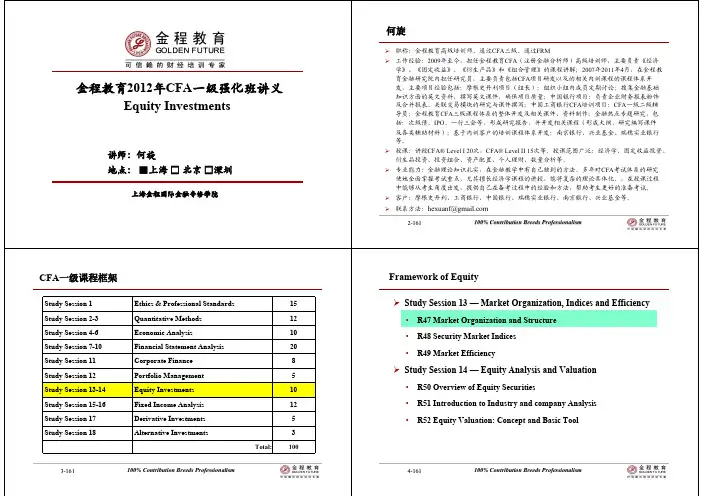
联系方法:hexuanf@金程教育2012年CFA一级强化班讲义 Equity Investments讲师:何旋 地点: ■上海 □ 北京 □深圳上海金程国际金融专修学院12-161100% Contribution Breeds ProfessionalismCFA一级课程框架Study Session 1 Study Session 2-3 Study Session 4-6 Study Session 7-10 Study Session 11 Study Session 12 Study Session 13-14 Study Session 15-16 Study Session 17 Study Session 18 Ethics & Professional Standards Quantitative Methods Economic Analysis Financial Statement Analysis Corporate Finance Portfolio Management Equity Investments Fixed Income Analysis Derivative Investments Alternative InvestmentsTotal:Framework of Equity15 12 10 20 8 5 10 12 5 3100Study Session 13 — Market Organization, Indices and Efficiency• • • R47 Market Organization and Structure R48 Security Market Indices R49 Market EfficiencyStudy Session 14 — Equity Analysis and Valuation• • • R50 Overview of Equity Securities R51 Introduction to Industry and company Analysis R52 Equity Valuation: Concept and Basic Tool3-161100% Contribution Breeds Professionalism4-161100% Contribution Breeds ProfessionalismOutlook of R.47 Market Organization and StructureR.47.1 Characteristics of a Financial MarketR.47.1 Characteristics of a Financial Market R.47.2 Classification of assets and markets R.47.3 Organization of the securities market R.47.4 Instructions of transaction processes5-161100% Contribution Breeds Professionalism6-161100% Contribution Breeds ProfessionalismR.47.1 Characteristics of a Financial MarketLos 47.a: Explain the main functions of the financial systemR.47.1 Characteristics of a Financial MarketFirst function: fulfill different entities’ requirements• Risk management: Entities face risks from changing interest rates, currency management values, commodities values, and defaults on debt, among other things. So they would like to find a way to manage these risks. Hedgers enter a financial market with the purpose of reducing the risk of the transaction. Hedging instruments are available from exchanges, investment banks, insurance firms, and other institutions. • Exchanging assets: The financial market also allows entities to exchange assets assets with other entities. For example: currency exchange • Utilizing information: Investors with correctly analyzed information expect to information earn an additional return by identifying assets that are currently undervalued or overvalued.First function: fulfill different entities’ requirements function• Savings: stocks, bonds, certificates of deposit, real assets, and other assets are tools for Savings saving. Individuals save to gain interest. Firms save a portion of their profits for future expenditures. Borrowing: Borrow money from lenders who require collateral, take an equity position, Borrowing or investigate the credit risk of the borrower to protect themselves in case of borrower defaults. Individuals may borrow in order to buy a house or for other purposes. Firms may borrow to meet their finance capital expenditures and for other activities. Governments may issue debt to meet their expenditures. Issuing equity: Another method of raising capital beside borrowing is to issue equity, equity where the capital providers will share in any future profits. Investment bank help with issuance. Analysts value the equity. Regulators and accountants encourage the dissemination of information.7-161 100% Contribution Breeds Professionalism••8-161100% Contribution Breeds ProfessionalismR.47.1 Characteristics of a Financial MarketSecond function: Determine interest rates• Interest rates are justified according to the total supply of savings and the total demand of borrowings. • Equilibrium interest rate: rate when the interest rate at which the entities are willing to borrow is equal to the amount that entities are willing to lend, we say that the supply and demand are balanced, and such balanced interest rate is called the equilibrium interest rate. Equilibrium rates for different types of borrowing and lending will differ due to differences in risk, liquidity, and maturity.R.47.1 Characteristics of a Financial MarketThird function: Allocate capital to its most efficient uses• Investors have to weigh the expected risks and returns of different investments to determine their most preferred investments due to limited availability of capital. • This would result in an allocation to capital to its most valuable uses.9-161100% Contribution Breeds Professionalism10-161 10-100% Contribution Breeds ProfessionalismR.47.1 Characteristics of a Financial MarketLos d: Describe the types of financial intermediaries and the services that they provideR.47.1 Characteristics of a Financial MarketBrokers, Dealers and Exchange (Cont.)• Dealers: trade by buying for or selling from their own inventory and thus Dealers provide liquidity in the market and profit primarily from the differences of buy and sell prices. Dealers that trade with central banks to affect the money supply are referred to as primary dealers. dealers Broker-dealers: Some dealers also act as brokers. Broker-dealers have an inherent conflict of interest. Brokers: should seek the best prices for their clients; Dealers: are to profit through prices or spreads.Brokers, Dealers and Exchange• • • • • Brokers: Brokers help their clients buy and sell securities by finding Brokers counterparties to trades in a cost efficient manner. Block brokers: help with the placement of Large trades. Typically, large trades brokers are difficult to place without moving the market. Investment banks: help corporations sell common stock, preferred stock, and banks debt securities to investors. Exchanges: provide a venue whew traders can meet. Exchanges sometimes act Exchanges as brokers by providing electronic order matching. Alternative trading systems (ATS): serve the same trading function as exchanges but have no regulatory function, are also known as electronic communication networks (ECNs) or multilateral trading facilities (MTFs). ATS that do not reveal current client orders are known as dark pools. pools (used to reduce market impact)11-161 11100% Contribution Breeds Professionalism12-161 12-100% Contribution Breeds ProfessionalismR.47.1 Characteristics of a Financial MarketSecuritizers• Securitizers pool large amounts of securities or other assets together and sell interests in the pool to other investors. By securitizing the assets, the securitizer creates a diversified pool of assets with more predictable cash flows than the individual assets in the pool. This creates liquidity in the assets, because the ownership interests are more easily valued and traded. There are also economies of scale in the management costs of large pools of assets and potential benefits from the manager’s selection of assets.R.47.1 Characteristics of a Financial MarketSecuritizers (Cont.)• • Assets that are often securitized include mortgages, car loans, credit card receivables, bank loans, and equipment leases. A firm may set up a special purpose vehicle (SPV) or special purpose entity (SPE) to buy firm assets, which removes them from the firm’s balance sheet and may increase their value by removing the risk that financial trouble at the firm will give other investors a claim to the assets’ cash flows. Absorb deposits by paying interest on customer deposits Provide transaction services on one hand, and then make loans with the deposits on the other hand.Depository Institutions• •13-161 13-100% Contribution Breeds Professionalism14-161 14-100% Contribution Breeds ProfessionalismR.47.1 Characteristics of a Financial MarketInsurance Companies• • • Insurance companies collect insurance premiums in return for providing risk reduction to the insured. Such intermediaries are able to do this by pooling policyholders with uncorrelated risk of losses. Insurance firms also provide a benefit to investors by managing the risks: Moral hazard occurs because the insured may take more risks once they are protected against losses. Adverse selection occurs when those most likely to experience losses are the predominant buyers of insurance. In fraud, the insured purposely cause damage or claim fictitious losses so they can collect on their insurance policies.R.47.1 Characteristics of a Financial MarketArbitrageurs• • Arbitrageurs are intermediaries who seek to gain certain return without bearing any risk. In markets with good information, pure arbitrage is rare because traders will favor the markets with the best prices. Clearinghouses: act as buyers when customers want to sell assets and as sellers when customers want to buy assets, and thus limit counterparty risk. Custodians: also improve market integrity by holding client securities and Custodians preventing their loss due to fraud or other events that affect the broker or investment manager.Clearinghouses and Custodians• •15-161 15-100% Contribution Breeds Professionalism16-161 16-100% Contribution Breeds ProfessionalismR.47.1 Characteristics of a Financial MarketLos k. describe the characteristics of a well-functioning financial system A well functioned financial market:• allows entities to achieve their purposes.R.47.1 Characteristics of a Financial MarketLos l. describe the objectives of market regulation.Problems when there are no regulations Fraud and theft: the potential for theft and theft fraud increases because investment managers take advantage of unsophisticated investors. Objectives of market regulations Protect unsophisticated investors. Require minimum standards of competency to make it easier to perform valuation.Characteristics of a well functioned financial Market• Complete markets: Savers receive a return, borrowers can obtain capital. markets hedgers can manage risks, and traders can acquire needed assets. • Operational efficiency: Trading costs are low. efficiency • Informational efficiency: Prices reflect fundamental information quickly. efficiency • Allocational efficiency: Capital is allocated to its most productive use. efficiencyInsider trading: Investors would exit the Prevent insiders from exploiting other trading market and thus reduced liquidity if they believe investors. traders with inside information will exploit them. Costly information: If obtaining information is information relatively expensive, markets will not be as informationally efficient and investors will not invest as much. Defaults: Parties might not honor their Defaults obligations in markets. Require common financial reporting requirements.Require minimum levels of capital so that participants will honor long-term commitments.17-161 17-100% Contribution Breeds Professionalism18-161 18-100% Contribution Breeds ProfessionalismOutlook of R.47 Market Organization and StructureR.47.2 Classification of assets and marketsR.47.1 Characteristics of a Financial Market R.47.2 Classification of assets and markets R.47.3 Organization of the securities market R.47.4 Instructions of transaction processes19-161 19-100% Contribution Breeds Professionalism20-161 20-100% Contribution Breeds ProfessionalismR.47.2 Classification of assets and marketsLos 47.b.c: Describe classification of assets and markets Classification of assets-Financial Assets• Security (Fixed income vs. Equity Securities ) Fixed income securities: make sure the borrowed funds can be repaid securities Bonds Generally long-term (with maturity longer than 10 years) Notes Bills Commercial paper Certificates of deposit Intermediate term (with maturity between 2 to 10 years) Short term (with maturity less than 1 year) Short term issued by firms (with maturity less than 1-2 years) Issued by banksR.47.2 Classification of assets and marketsClassification of assets-Financial Assets-Security• Security (Fixed income vs. Equity Securities ) Equity securities: represent ownership in a firm securities Common stock Residual claim on a firm’s assets. Dividends are paid only after interest is paid to debt holders and dividends are paid to preferred stockholders. Debt holders and preferred stockholders have priority over common stockholders in the event of firm liquidation Is an equity security with scheduled dividends that typically do not change over the security’s life and must be paid before any dividends on common stock may be paid. Are similar to options in that they give the holder the right to buy a firm’s equity shares (usually common stock) at a fixed exercise price prior to the warrant’s expiration.Preferred stockRepurchase agreements Borrower sells a high quality asset and has both the right and obligation to repurchase it (at a higher price) in the future. Repurchase agreements can be for terms as short as one day. Convertible debt21-161 21-WarrantsIs debt that an investor can exchange for a specified number of equity shares of the issuing firm100% Contribution Breeds Professionalism 22-161 22100% Contribution Breeds ProfessionalismR.47.2 Classification of assets and marketsClassification of assets-Financial Assets-Security• Security (Fixed income vs. Equity Securities ) Pooled investment vehicles: vehicles individual securities can be combined in pooled investment vehicles. Include mutual funds, depositories, and hedge funds. The investor’s ownership interests are referred to as shares, units, depository receipts, or limited partnership interests.R.47.2 Classification of assets and marketsClassification of assets-Financial Assets-Security• Security (Fixed income vs. Equity Securities ) Pooled investment vehicles: vehicles Mutual funds are pooled investment vehicles in which investors can purchase shares, either from the fund itself (open-end funds) or in the secondary market (closed-end funds) trade like closed-end funds, but have special provisions allowing conversion into individual portfolio securities, or exchange of portfolio shares for ETF shares, that keep their market prices close to the value of their proportional interest in the overall portfolio. represent a claim to a portion of a pool of financial assets such as mortgages, car loans, or credit card debt. organized as limited partnerships( investors limited partners; fund manager general partner). Hedge funds often use leverage. Hedge fund managers are compensated based on the amount of assets under management as well as on their investment results.100% Contribution Breeds ProfessionalismExchange-traded funds (ETFs) & exchange-traded notes (ETNs) Asset-backed securities Hedge funds23-161 23-100% Contribution Breeds Professionalism24-161 24-ExampleThe Standard & Poor's Depositary Receipts (SPDRs) is an investment that tracks the S&P 500 stock market index. Purchases and sales of SPDRs during an average trading day are best described as: A. primary market transactions in a pooled investment. B. secondary market transactions in a pooled investment. C. secondary market transactions in an actively managed investment.R.47.2 Classification of assets and marketsClassification of assets-Financial Assets• Derivative Contract: Contract are agreements between two parties that require some action in the future, such as exchanging an asset for cash. Forward contract Futures contracts Swap contracts Option contracts Insurance contracts Credit default swaps Is an agreement to buy or sell an asset in the future at a price specified in the contract at its inception Are similar to forward contracts except that they are standardized, and are traded on an exchange so that they are liquid investments. A series of forward contracts Gives its owner the right to buy or sell an asset at a specific exercise price at some specified time in the future. Pays a cash amount if a future event occurs. They are used to hedge against unfavorable, unexpected events. Are a form of insurance that makes a payment if an issuer defaults on its bonds.100% Contribution Breeds Professionalism25-161 25-100% Contribution Breeds Professionalism26-161 26-R.47.2 Classification of assets and marketsClassification of assets-Real Assets• Commodity: Commodity Commodities are goods like precious metals, industrial metals, agricultural products, energy products, and credits for carbon reduction that are traded in spot, forward, and futures markets. Note: Spot markets are for immediate delivery while forwards, futures, and options markets are for the future delivery of physical and financial assets.R.47.2 Classification of assets and marketsClassification of assets-Real Assets (Cont.)• Real Assets: Assets Examples of real assets are real estate, equipment, and machinery. Characteristics: Provide income, tax advantage, diversification benefits Entail substantial management costs Require substantial due diligence before investing Investor may choose to buy real assets indirectly: REIT (real estate investment trust) MLP (master limited partnership)27-161 27-100% Contribution Breeds Professionalism28-161 28-100% Contribution Breeds ProfessionalismR.47.2 Classification of assets and marketsLos e. compare the positions an investor can take in an asset Long Position• • An investor who owns an asset, or has the right or obligation under a contract to purchase an asset, is said to have a long position. Benefit form an increase in the priceR.47.2 Classification of assets and marketsShort Position• For a short-sale, the procedure is as below: Borrow the stock through your broker and simultaneously sell it in the market. Return the stocks upon your brokers request Maintain the proceeds of short-sales as collateral. • • • Benefit from a decrease in the price Unlike a long position, the potential loss of a short sale is unlimited Payment-in-lieu: the received dividends and interests must be paid back to the Payment- in- lieu investor who lent the stockStock Lender Div.29-161 29100% Contribution Breeds Professionalism 30-161 30-Deposit Short Seller Interest Broker100% Contribution Breeds ProfessionalismR.47.2 Classification of assets and marketsLeveraged Positions• Margin Requirement: the required equity position is called the margin requirement. Initial Margin: a minimum amount of equity at the time of a new margin purchase Maintenance Margin: is the investor’s required equity position in the Margin account. Margin Call: if an investor’s margin account balance falls below the Call maintenance margin, the investor will receive a margin call and will be required to either liquidate the position or bring the account back to its maintenance (minimum) margin requirementR.47 Leverage ratioLos f. Calculate and interpret the leverage ratio, the rate of return on a margin transaction, and the security price at which the investor would receive a margin callLeverage ratioLeverage ratio=•value of the asset value of the equity positionPrice Triggering a Margin Call Margin Call Price for a Long Position⎛ 1 − IM ⎞ PL' = P0 ⎜ ⎟ ⎝ 1 − MM ⎠ Margin Call Price for a Short Position⎛ 1 + IM ⎞ PS' = P0 ⎜ ⎟ ⎝ 1 + MM ⎠31-161 31100% Contribution Breeds Professionalism 32-161 32100% Contribution Breeds ProfessionalismExampleA trader has purchased 200 shares of a non-dividend-paying firm on margin at a price of $50 per share. The leverage ratio is 2.5. Six months later, the trader sells these shares at $60 per share. Ignoring the interest paid on the borrowed amount and the transaction costs, what was the return to the trader during the six-month period? A. 20 percent.. B. 33.33 percent. C. 50 percent. The current price of a stock is $25 per share. You have $10,000 to invest. You borrow an additional $10,000 from your broker and invest $20,000 in the stock. If the maintenance margin is 30 percent, at what price will a margin call first occur? A. $9.62. B. $17.86. C. $19.71.33-161 33100% Contribution Breeds ProfessionalismR.47.2 Classification of assets and marketsLos i. describe the primary and secondary markets and explain how secondary markets support primary markets Classification of markets• Primary vs. Secondary markets Primary market: is the market where newly issued securities are sold. market Newly issued securities involve: IPO (initial public offerings): first-time issues by firms whose shares are not currently publicly traded. Seasoned offerings (secondary issues): new shares issued by firms whose shares are already trading in the marketplace. • Money vs. Capital markets • Traditional vs. Alternative markets34-161 34-100% Contribution Breeds ProfessionalismR.47.2 Classification of assets and marketsClassification of markets• Primary vs. Secondary markets • Money vs. Capital markets Money markets: refer to markets for debt securities with maturities of one markets year or less. Capital markets: refer to markets for longer-term debt securities and markets equity securities that have no specific maturity date. • Traditional vs. Alternative marketsR.47.2 Classification of assets and marketsClassification of markets• Primary vs. Secondary markets • Money vs. Capital markets • Traditional vs. Alternative markets Traditional investment markets: refer to markets for debt and equity. Alternative markets: refer to markets for hedge funds, commodities, real markets estate, collectibles, gemstones, leases, and equipment.35-161 35-100% Contribution Breeds Professionalism36-161 36-100% Contribution Breeds ProfessionalismOutlook of R.47 Market Organization and StructureR.47.3 Organization of the securities marketR.47.1 Characteristics of a Financial Market R.47.2 Classification of assets and markets R.47.3 Organization of the securities market R.47.4 Instructions of transaction processes37-161 37-100% Contribution Breeds Professionalism38-161 38-100% Contribution Breeds ProfessionalismR.47.3 Organization of the securities marketHow securities are sold through primary market• Sold Publicly : Underwritten Offering (the most common way) Best Efforts Indications of Interest • Sold Privately Private placement • Other transaction methods Shelf registration Dividend Reinvestment Plan Rights Offering Competitive bids Negotiated salesR.47.3 Organization of the securities marketHow securities are sold through primary market- Sold Publicly :• Difference between underwritten offering and best efforts Underwritten offering Obligated to buy the unsold portion Investment bank would prefer that the price be set low enough to gain more profit Best Efforts Not obligated to buy the unsold portion Investment bank sets the issue price as high as possible to raise the most funds for the issuer39-161 39-100% Contribution Breeds Professionalism40-161 40-100% Contribution Breeds ProfessionalismR.47.3 Organization of the securities marketHow securities are sold through primary market- Sold Publicly :• Indications of Interest Indications of interest: the investment bank finds investors who agree to interest buy part of the issue. This process of gathering indications of interest is called book building, building and the investment bank during this process is called book builder or book runner. runner If securities must be issued quickly, the process is called accelerated book building. buildingR.47.3 Organization of the securities marketHow securities are sold through primary market- Sold Privately :• Private placement Securities are sold directly to qualified investors, typically with the assistance of an investment bank. • Shelf registration In a shelf registration a firm makes its public disclosures as in a regular offering, but then issues the registered securities over time when it needs capital and when the markets are favorable. • Dividend Reinvestment Plan A dividend reinvestment plan (DRP or DRIP) allows existing shareholders to use their dividends to buy new shares from the firm at a slight discount. • Rights Offering In rights offering, existing shareholders are given the right to buy new shares at a discount to the current market price.41-161 41-100% Contribution Breeds Professionalism42-161 42-100% Contribution Breeds ProfessionalismExampleA German publicly traded company, to raise new capital, gave its existing shareholders the opportunity to subscribe for new shares. The existing shareholders could purchase two new shares at a subscription price of €4.58 per share for every 15 shares held. This is an example of a(n): A. rights offering. B. private placement. C. initial public offering.R.47.3 Organization of the securities marketSecondary Capital Markets• • The secondary market is the place where securities are traded after their initial offerings. The secondary market supports the primary market by providing: Liquidity Investors who buy stocks in the primary markets want to sell then again to acquire other securities such as risk free bonds and cash. Price discovery New issues of stocks and bonds are based on prices in the secondary markets.43-161 43-100% Contribution Breeds Professionalism44-161 44-100% Contribution Breeds ProfessionalismR.47.3 Organization of the securities marketSecondary Capital Markets• When securities are traded in a secondary market Call Markets Trading for individual stocks occurs at specific times. All bids and asks are gathered and then a negotiated price is produced to make the demand quantity as close as possible to the supply quantity. Continuous Markets Trades occur at any time when market is open. The price is determined either by an auction process or through a dealer bid-ask process. There are differences between dealer markets and an auction market in continuous markets.R.47.3 Organization of the securities marketLos j. describe how securities, contracts, and currencies are traded in quotedriven markets, order-driven markets and brokered markets; Secondary Capital Markets• How securities are traded in Secondary Markets Order-Driven Market Quote-Driven Market Brokered Markets45-161 45-100% Contribution Breeds Professionalism46-161 46-100% Contribution Breeds ProfessionalismR.47.3 Organization of the securities marketSecondary Capital Markets• • How securities are traded in Secondary Markets- Order-Driven Market Two sets of rules are used in these markets: Order matching rules: establish an order precedence hierarchy. Price priority: trades with the highest bid (buy) and lowest ask (sell) prices are traded first, this is so-called price priority. Secondary precedence rule: if orders are at the same prices, the earliest arriving orders are traded first. Trade pricing rules: are used to determine the price after orders are created using order matching rules. Under the uniform pricing rule, all orders trade at the same price, which is the price that results in the highest volume of trading. The discriminatory pricing rule uses the limit price of the order that arrived first as the trade price.47-161 47100% Contribution Breeds ProfessionalismR.47.3 Organization of the securities marketSecondary Capital Markets• How securities are traded in Secondary Markets Quote-Driven Market QuoteQuote-driven market is also referred to as a dealer market, a pricedriven market or an over-the-counter market. Individual dealers provide liquidity for investors by buying and selling the shares of stock for themselves. Numerous dealers compete against each other to provide the highest bid prices when investors are selling and the lowest asking price when investors are buying stock. Brokered Markets In brokered markets, brokers trade with the counterparty they find. This service is especially valuable when the trader has a security that is unique or illiquid.48-161 48100% Contribution Breeds Professionalism。

第十一章配置和测试网络001网络中的用户发现向远程服务器传输文件时响应很慢。
发出什么命令可以确定路由器是否存在任何输入或输出错误?A show running-configB show startup-configC show interfacesD show ip routeE show versionF show memory002请参见图示。
技术人员将图示中的配置应用于全新的路由器。
为了验证配置,技术人员在与该路由器的CLI 会话中发出了show running-config命令。
技术人员在路由器的show running-config命令输出中应看到哪几行结果?A enable password class line console 0 password ccnaB enable secret cisco enable password class line console 0 password ccnaC enable secret 5 $1$v0/3$QyQWmJyT7zCa/yaBRasJm0 enable password class line console 0 password ccnaD enable secret cisco enable password 7 14141E0A1F17 line console 0 password 7 020507550AE enable secret 5 $1$v0/3$QyQWmJyT7zCa/yaBRasJm0 line console 0 password 7 020507550A 003Cisco 路由器上的哪个接口将用于初始配置?A B CD004路由器B 和C 之间的连接测试获得成功。
但是,重新启动路由器C 之后,管理员注意到网络10.10.3.0 和10.10.4.0 之间的响应时间变慢。
两台路由器之间可以成功Ping 通。

Practical activity (2)Blue-white Screening(Teacher’s Guide)I.Objectives of the experiment1.To perform bacterial transformation using a recombinant plasmid with the LacZα genefor the production of β-galactosidase;2.To perform the blue-white screening test; and3.To demonstrate the successful transformation in the mutant strain of E. coli cells.II.Expected Learning OutcomesUpon completion of the activities, students should be able to:1.outline the principle of transformation;2.apply aseptic techniques in bacterial culture;3.carry out bacterial transformation;4.understand the principle of blue-white screening;and5.perform the blue-white screening test.III.Teaching notes1.Introduce the task by going through the “Background” with the students, or have thestudents read through this part and the “Guiding questions about the design of theexperiment” as a pre-class activity.2.Discuss the design of the experiment with the students using the “Guiding questionsabout the design of the experiment”.3.Plan the laboratory work with reference to the “Time allocation for the experimentalactivities” in section IV according to the lesson time of your school.4.Always remind the students about the safety precautions of each part of the experimentbefore they carry out the experiment.5.Go through the “Results” and “Discussion” with the students.IV. Time allocation for the experimental activitiesExperimental activitiesDurationWithin class Out of class(To be done by the laboratory technicians) Lab session 1: Part (1) of the experiment 1 Insertion of DNA into plasmids75 min 2 Ice-cooling and heat shock of E. coli 60 min Lab session 1: Part (2) of the experiment 1 Plating of transformed E. coli cells on agar plate20 min 2 Incubation of microbes1–2 days Lab session 2: Part (3) of the experiment 1 Plate count and analysis30 minTotal lesson time for the experimental activitiesLab session 1: 1 hr 20 min Lab session 2: 30 minV.Equipment, materials and preparatory work for the experimentsA commercial kit “Blue/White Cloning of a DNA fragment and Assay of β-galactosidase”, EDVO-Kit #300 from EDVOTEK will be needed or this experiment.This kit has enough materials and reagents for 24 students (6 groups of 4 students). Some additional equipment or materials may be required.Website: https:///300A.Part (1)of the experiment: Insertion of DNA fragments into a vector plasmid andtransformation of E. colia)Equipment (per group)-Water bath (42o C) × 1 (per class)-Water bath (37o C) × 1 (per class)-Centrifuge × 1 (per class)-Bunsen burner × 1-Spark lighter × 1-Ice bath × 1-Timer × 1-Micropipettes (P1000, P200 and P20) and sterile tipsb)Materials (per group)-Culture plate with E. coli cells × 1-Sterile micro-centrifuge tube × 3-Micro-centrifuge tube rack × 1-Inoculating loop × 1-Tube “D” containing DNA and plasmid mixture × 1-Tube “P” containing plasmid solution × 1-Tube “C” containing sterile distilled water × 1-Reaction buffer (60 µl) × 1-CaCl2 solution (800 µl) × 1-Recovery broth (800 µl) × 1-Permanent marker × 1-70% ethanol in spray bottle × 1-Paper towel × 1 box-Biohazard bag × 1-Disposal container with 10% chlorine bleach × 1c)Preparatory workPreparation of E. coli culture plates (Two days before lab session; to be done by teacher/laboratory technicians)1.Remove a single BactoBead TM (provided in the education kit) from the vial, usingforceps to transfer it to a regular source agar plate (e.g. LB agar plate).2.Add 10 µl sterile distilled water to dissolve the BactoBead TM.ing a sterile inoculating loop, streak the dissolved bead liquid into 4 quadrants ofthe agar plate.4.Invert the plate and incubate it at room temperature for 24–48 hours.5.Prepare 1 plate per group.Preparation of samples (To be done by teacher/laboratory technicians before lab session)1.Tube “D”: add 15 µl Reaction Buffer and 20 µl DNA fragment and plasmidmixture. Incubate the tube at room temperature for 1 hour. Prepare 1 tube “D” pergroup.2.Tube “P”: add 15 µl Reaction Buffer and 20 µl plasmid solution incubate the tubeat room temperature for 1 hour. Prepare 1 tube “P” per group.3.Tube “C”: add 15 µl Reaction Buffer and 20 µl sterile distilled water. Incubate thetube at room temperature for 1 hour. Prepare 1 tube “C” per group.Aliquot of experimental materials (To be done by teacher/laboratory technicians before lab session)1.Aliquot 800 µl CaCl2 solution into micro-centrifuge tubes. Prepare 1 tube pergroup.2.Aliquot 800 µl Recovery Broth into micro-centrifuge tubes. Prepare 1 tube pergroup.d)Sterilisation and disposalAfter the experiment, some equipment and materials to discard (solid or liquid)should be sterilised by steam under pressure (autoclave) at 121o C, 15 psi pressure for at least 30 minutes or immersed in 10% chlorine bleach for at least 2 hours.B.Part (2) of the experiment: Plating and incubation of E. coli on agar platesa)Equipment-Bunsen burner × 1-Spark lighter × 1b)Materials-X-gal/IPTG/ampicillin agar plate × 1-Inoculating loop × 1-Permanent marker × 1-Adhesive tape × 1-Parafilm-70% Ethanol in spray bottle × 1-Paper towel × 1 box-Biohazard bag × 1-Disposal container with 10% chlorine bleach × 1c)Preparatory workPreparation of X-gal/IPTG/ampicillin agar plates (One day before lab session; to be done by teacher/laboratory technicians)1.Heat the bottle of ReadyPour medium (provided in the education kit) using amicrowave oven or hot plate, with occasional swirling, until the medium iscompletely melted.2.Allow the melted medium to cool to ~50°C. Add 0.3 ml ampicillin, 0.3 ml IPTGand all X-gal. (All reagents are provided in the education kit.) Swirl it well, andpour it into Petri dishes (12 ml per dish). Alternatively, purchase the ready-to-useX-gal/IPTG/ampicillin agar plates from biotechnology companies.3.Prepare 1 X-gal/IPTG/ampicillin agar plate for each group.d)Sterilisation and disposalAfter the experiment, some equipment and materials to discard (solid or liquid)should be sterilised by steam under pressure (autoclave) at 121o C, 15 psi pressure for at least 30 minutes or immersed in 10% chlorine bleach for at least 2 hours.C.Part (3) of the experiment: Observation and analysis of experimental results a)Equipment-Mobile device × 1b)Materials-Agar plate from part (2) × 1-Permanent marker × 1-70% ethanol in spray bottle × 1-Paper towel × 1 box-Biohazard bag × 1-Disposal container with 10% chlorine bleach × 1c)Preparatory workNo specific preparation work is required.d)Sterilisation and disposalAfter the experiment, some equipment and materials to discard (solid or liquid) should be sterilised by steam under pressure (autoclave) at 121o C, 15 psi pressure for at least30 minutes or immersed in 10% chlorine bleach for at least 2 hours.D.Other teaching kits suitable for the experiment1.HiPer Cloning Teaching Kit (Blue-White Selection); HiMediaLaboratories;#HTBM036Website: /intl/en/products/Molecular-Biology/HiPer%C2%AE-Teaching-Kits-Molecular-Biology/HiPer%C2%AE-Cloning-Teaching-Kit-Blue-White-selection-HTBM0362.Genetic defect correction with bacteria transformation; G-Biosciences; #BE-313Website: https:///Educational-Products/Genetic-Defect-Correction-with-Bacterial-TransformationVI.Suggested answers to the “guiding questions about the design of the experiment”1.Suggest a molecular technique for introducing external plasmids into E. coli cells.Heat shock2.Which chemical(s) should be added into the agar plates in order to induce thedevelopment of blue colour in the colonies?X-gal and IPTGVII.Results1.Paste the photo or draw a picture of your agar plate in the space provided below.2.Record the number of blue colonies and white colonies in the following table.[Hint:Blue colonies: pale blue in the centre with a dense blue periphery.White colonies: faint blue in the centre but colourless at the periphery.][For reference only]Section Number of blue colonies Number of white coloniesD1 48 22P1 TNTC 1C1 Nil Nil3.Do you observe any colonies in section C1? Give a brief explanation of yourobservation.No colonies are found in section C1. The E. coli cells are not transformed with the given plasmid; thus they cannot grow in the presence of ampicillin without the ampicillin-resistance gene.4.What do you observe in section P1 of the agar plate? Describe and explain yourobservation.There are only some blue colonies found in section P1 of the agar plate. This implies that these colonies have been transformed by the plasmids because the plasmids have an ampicillin-resistant gene. Also, these colonies turn blue. This implies that the colonies produced functional beta-galactosidase, and hence the substrate X-gal was metabolized and gave rise to products with blue pigments.5.What do you observe in section D1 of the agar plate? Describe and explain yourobservation.There are some blue colonies and some white colonies in section D1 of the agar plate.These bacterial colonies can grow on the agar plates with ampicillin. This implies that these colonies have been transformed by those plasmids because the plasmids have an ampicillin-resistant gene.Also, some colonies are blue. This implies that the colonies produced functional beta-galactosidase, and hence the substrate X-gal was metabolised and gave rise to products with blue pigments. Hence, these blue colonies should have been transformed with the plasmids which have no target gene inserted. The plasmids have just replicatedthemselves.In addition, some colonies remain white. This implies that they did not producefunctional beta-galactosidase and hence did not metabolise the substrate X-gal and no blue precipitates/pigments are formed. Hence, these white colonies should have been transformed with the plasmids which have the target gene inserted and hence its LacZ gene is disrupted.VIII.Discussion1.After heat shock [Part (1) of the experiment, Step 21] the tubes were mixed by using“finger-flicking” or “wrist-flicking” instead of vortexing. Suggest the reason for this.Calcium ions enhance the permeability of the bacterial cell membrane.The heat shock step further weakens the cell structure.Vortexing exerts a shearing force to cells, which breaks the cells and causes cell death.It is necessary to mix the cells using milder methods.2.During the heat shock step, a student accidentally heated the cells at 42o C for 5 minutes.Only a few colonies were found on the agar plates at the end of the experiment. Explainthe results.During transformation, the cellular structure of the bacteria was weakened. Prolongedheating damaged the cells and caused cell death.3.What are the functions of X-gal and IPTG in blue-white screening?X-gal is actually the substrate of the enzyme β-galactosidase. Upon enzymaticmetabolism, X-gal is degraded into products with blue pigments. IPTG is used to inducea strong expression of the LacZ gene in bacteria.IX.ReferencesJulin, D. A. (2018). Blue-white selection. In R. D. Wells, J. S. Bond, J. Klinman, & B. S. S.Masters (Eds.), Molecular life sciences. NY: Springer.Ullmann, A., Jacob, F., & Monod, J. (1967). Characterization by in vitro complementation of a peptide corresponding to an operator-proximal segment of the beta-galactosidasestructural gene of Escherichia coli. Journal of Molecular Biology,24(2), 339–343.。