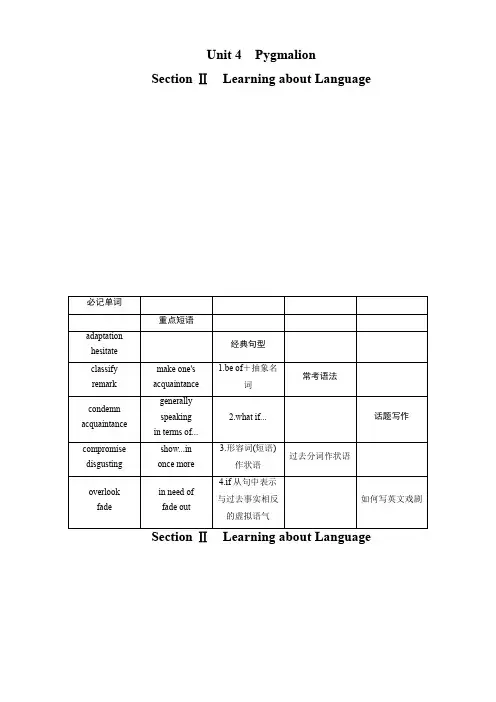
Unit 4 Pygmalion Section Ⅱ Learning about Language
- 格式:docx
- 大小:705.78 KB
- 文档页数:19
Unit 4 Pygmalion
Section Ⅱ Learning about Language
必记单词
重点短语
adaptation
hesitate 经典句型
classify
remark make one's
acquaintance 1.be of+抽象名词 常考语法
condemn
acquaintance generally
speaking
in terms of... 2.what if... 话题写作
compromise
disgusting show...in
once more 3.形容词(短语)作状语 过去分词作状语
overlook
fade in need of
fade out 4.if从句中表示与过去事实相反的虚拟语气 如何写英文戏剧
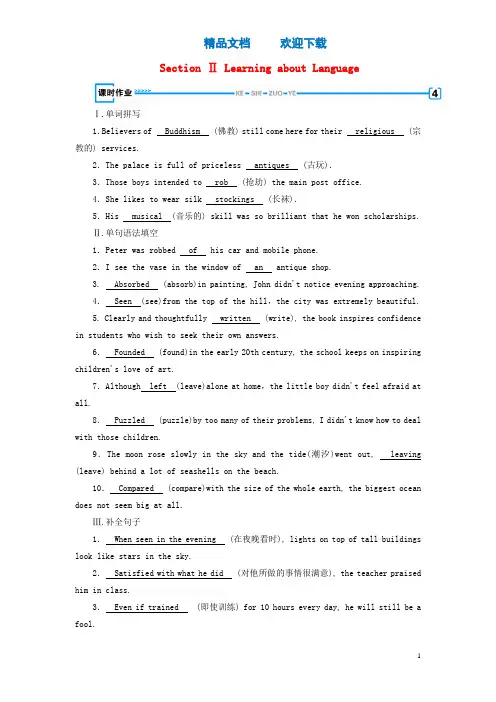
Section Ⅱ Learning about Language
Ⅰ.单词速记
1.__antique__ (adj.) 古时的;珍贵的 (n.) 古董;文物
2.__musical__ (adj.) 音乐的→__music__ (n.) 音乐
3.__Buddhism__ (n.) 佛教→__Buddhist__ (n.) 佛教徒
4.__rob__ (v.) 抢劫→__robber__ (n.) 强盗→__robbery__ (n.) 抢劫,偷盗
Ⅱ.短语互译
__rob_sb.of_sth.__ 抢某人某物
Ⅲ.语法感悟
用所给动词的适当形式填空
1.Now once ___taught__ (teach) by me, she'd become an upper class lady.
2.Once __educated__ (educate) to speak properly, that girl could pass herself off in three months as a
duchess.
3.__Written__ (write) in a hurry, this article was not so good.
4.__Accepted__ (accept) by the Party, he decided to devote his life to the cause of the Party.
5.She walked out of the house, __followed__ (follow) by her little daughter.
重 点 词 汇
rob vt. 抢劫;盗窃;剥夺
①The bank at the corner was robbed last night.
昨天晚上街角的那家银行被抢了。
常用形式:rob sb.of sth.抢劫某人某物;剥夺某人某物
②They knocked the driver down and robbed him of his car.
他们把司机打倒在地,抢走了他的车。
③They robbed the people of their liberty.
他们剥夺了人民的自由。
,G)归纳拓展
robber n.抢劫者;强盗;盗贼
robbery n.抢劫;盗窃;偷盗;失窃
①The bank robber drew a gun and shot the guard in cold blood.
那个银行抢劫者拔出枪,残忍地杀了警卫员。
②The robbery occurred in broad daylight.
在光天化日之下发生了抢劫。
注意:“动词+sb.+of sth.”的短语还有:
accuse sb.of sth.指控/指责某人某事
inform sb.fo sth.通知某人某事
remind sb.of sth.使某人想起某事;提醒某人某事
warn sb.of sth.警告某人某事 ,T)图解助记
,Y)易混辨析
rob和steal
rob
抢劫
rob sb./someplace of sth.抢劫某人/某地某物
steal 偷盗 steal (sth.)from sb.偷某人的东西
,J)即时巩固
单句语法填空
①Jane used to steal money __from__ her father's drawer.
②The __robber__ (rob) robbed her __of__ her money and phone.
③The photo will remind me __of__ the days when we were together.
④The police will look into the __robbery__ (rob) soon.
重 点 短 语
in return 作为回报
①I asked her opinion, but she just asked me a question in turn.
我征求她的意见,她却反过来问了我一个问题。
②You sent me your watch and in return I gave you my book.
你给我寄来了你的手表,作为回报我把我的书送给你。
,G)归纳拓展
in return for作为对……的回报或报答
in turn依次;轮流;反过来 by turns(指人或人的动作)轮流地;逐个地
speak/talk out of turn说不该说的话
take turns (in) doing/to do sth.轮流做某事
,J)即时巩固
补全句子
①Can I buy you lunch __in_return_for_your_help__ (作为对你的帮助的回报)?
②Don't push! Get on the bus __in_turn__(依次).
③We do cleaning __by_turns__ (轮流).
④We __take_turns_in_doing_cleaning或take_turns_to_do_cleaning__(轮流打扫卫生).
经 典 句 式
Generally speaking, he thought that lower class people betrayed themselves with their remarks
whenever they spoke, and that he could classify people's social position after only a few minutes' observation.
一般而言,他认为阶级地位低者一开口他们的言论便会暴露他们的身份,并且他可以在几分钟的观察之后判定人们的社会地位。
whenever在句中引导让步状语从句,意为“无论何时,每当”,此时相当于no matter when。
Whenever/No matter when you call, you will find him at his desk.
不管你什么时候去看他,他都在用功。
You may come whenever/no matter when you please.
你什么时候愿意来就什么时候来。
,G)归纳拓展
类似引导让步状语从句的词除了whenever外,还有however, wherever, whatever, whoever, whichever等,相当于“no matter+疑问词”。“疑问词+ever”除了可引导让步状语从句外,有时还可引导名词性从句,而“no matter+疑问词”只能引导让步状语从句。
However late he is, his mother will wait for him to have dinner together.
不管他回来多晚,他的母亲总会等他一起吃晚饭。
Whatever you say, I won't believe you.
不管你说什么,我都不会相信你。
Whoever breaks the law will be punished.
无论是谁,违反法律都将受到惩罚。
,J)即时巩固
单句语法填空 ①(高考真题改编)Your support is important to our work.__Whatever__ you can do helps.
解析:考查主语从句。句意:你的支持对我们的工作是重要的。无论你做什么都有帮助。helps是谓语,“you can do”是主语部分,即主语从句,在主语从句中,do后缺少宾语,因此用whatever引导。
②Please call my secretary to arrange a meeting this afternoon, or __whenever__ it is convenient to you.
解析:考查whenever引导的让步状语从句。句意:下午请给我的秘书打电话安排会议,或者其他对你来说方便的时间也可以。根据题中的时间状语可知,这里强调的是时间,所以答案为whenever,意思是“无论何时,任何时候”。
过去分词作状语
过去分词作状语,进一步说明谓语动词的动作和状态,即动作发生时的背景或状况。其逻辑主语通常是句子的主语,且与主语之间构成逻辑上的“动宾关系”或在逻辑上构成“系表结构”。过去分词短语在句中担任条件状语,原因状语以及时间状语时,通常放在句首;担任伴随状语或结果状语时,通常放在句末;担任方式状语时,一般位于句末,有时也可位于句首;担任让步状语时,一般位于句首,有时也可位于句末。
Ⅰ.过去分词担任状语时的语法功能
(1)原因状语
①Caught in a heavy rain, he was all wet.
因为淋了一场大雨,所以他全身湿透了。
②Frightened by the noise in the night, the girl didn't dare sleep in her room.
被夜晚的响声惊吓,那姑娘不敢睡在她的房间里了。
(2)时间状语
①Asked why he did it, the monitor said it was his duty.
当被问及为何要做这件事时,班长说这是他的职责。
②Approached in the dark the bulbs looked lonely and purposeless.
在黑暗走近时,那些电灯显得孤单而无意义。