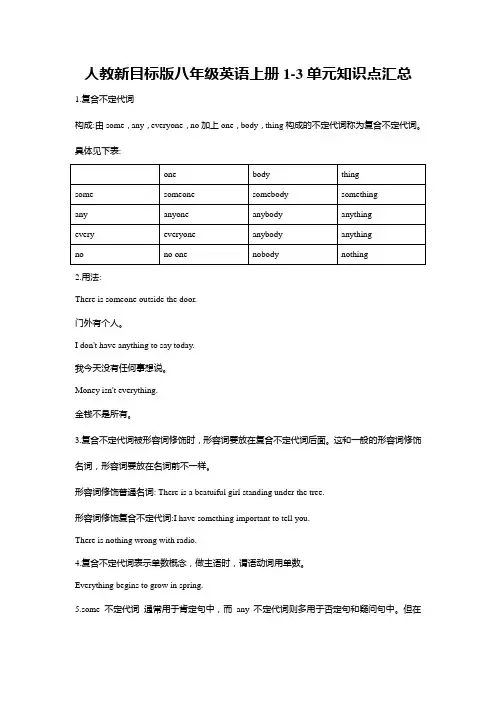
人教新目标英语八年级上册Unit1-3重点词组句子及语法
- 格式:doc
- 大小:139.00 KB
- 文档页数:8
人教新目标英语八年级上册Unit 1 Where did you go on vacation?重点短语:(1)go on vacation/holiday 去度假take a vacation/holiday 度假(2)stay at home 呆在家(3)go to the mountains 去爬山(4)go to the beach去沙滩(5)visit museums 参观博物馆(6)go to summer camp 去夏令营(7) visit my uncle 看望我的叔叔(8)quite a few(+可数名词复数)=quite a lot of 相当多,不少(9)study for……为…而学习(10)go out 出去(11)most of the time 大多数时间(12)taste good 尝起来不错(13)have a good time过得愉快(14)of course 当然= sure= certainly (15)feel like 给….的感觉,感受到(16)go shopping 去买东西(17)in the past 在过去(18)walk around…..四处走走(19)too many(+ 可数名词复数) 太多too much(+不可数名词)太多much too+ adj. 实在太…(12)because of + n./pron./v-ing 因为because + 句子(14)one bowl of 一碗…(16)find out 查明,弄清(18)take photos 照相(19)something important重要的事情(20)up and down 上上下下(21)come up 上来(22)come down 下来(23)make a difference 有影响,起作用重点句型:(1)Where did you go on vacation? I went to New York City.(2)Did you go out with anyone? No, No one was here. Everyone was on vacation. (3)Did you buy anything special? Yes, I bought something for my father. (4)How was the food? Everything tasted really good. (5)Did everyone have a good time? Oh,yes. Everything was excellent.习惯用法:(1)buy sth for sb./ buy sb. sth 为某人买某物(2)taste + adj. 尝起来……look + adj 看起来(3)nothing ….but + V.(原形)not… anything =nothing(4)seem + (to be) + adj 看起来(5)arrive in + 大地点arrive at + 小地点到达某地reach+ 地点到达某地get to +地点到达某地(注:若地点为副词home/there/here则要省掉介词)(6)decide to do sth. 决定做某事= make a decision/resolution to do sth.(7) try doing sth. 尝试做某事try t o do sth. 尽力/努力/设法做某事 try one’s bes t to do sth 尽力做某事 try 过去式:tried, 三单:tries (8)enjoy doing sth . 喜欢做某事 enjoy oneself 玩得开心 (9)want to do sth . 想去做某事 (10)start / begin doing sth. 开始做某事 start / begin to do sth. 开始做某事 (11)stop doing sth. 停止正在做的某事 stop to do sth 停下来做(另一件)某事 (12)dislike doing sth. 不喜欢做某事dislike to do sth . 不喜欢做某事 (13)Why not do sth. 为什么不做…….呢? =Why don’t you do sth.(14)so + adj + that + 从句 如此…以至于 (15)tell sb. (not) to do sth.告诉某人(不要)做某事(16)keep doing sth. 一直做某事Keep on doing sth. 坚持/继续做某事 (17)forget to do sth . 忘记去做某事forget doing sth 忘记做过某事 (remember 记得, 用法一样) 语法点:1.seem 的用法(1)seem + 形容词 看起来….. You seem happy today.(2)seem + to do sth . 似乎、好像做某事 I seem to have a cold No one seemed to be bored.(3)It seems / seemed that+ 句子 看起来好像…;似乎…. It seems that no one believes you. 2. decide to do sth .决定做某事 We decided to go to the beach.. decide + 疑问词 + 动词不定式 He can not decide when to start . 3. over 介词,多于,超过,在…以上(表示数目、程度)= more than My father is over 40 years old. We waited over an hour for the train. 4. because of 因为,由于,后接名词、代词或动名词,不能接句子。
because 连词,因为,引导状语从句,表示直接明确的原因或理由。
He can’t take a walk because of the rain .We couldn’t see anything below because of the bad weather . I didn’t buy anything because it was much too expensive.5. enough 用法:enough 用在名前形副后(enough 用在名词前形容词副词后) 名前: enough money/time My father didn’t bri ng enough money. 形副后: happy enough fast enough6.下小雨: rain a little 下大雨: rain hard/heavily1. people can live to 100,but people can live to 150.2. There is time left, I don’t catch the first bus.3. Could you give me milk? 9. none / no onenone 指人或物,强调数量,用how many 提问,常与of 连用。
no one 多指人,强调“无人”这种状态,用who 提问,不可与of 连用,作主语时,其谓语动词用第三人称单数形式。
1、 of the pens are mine .2、 is in the classroom.语法1.一般过去时1) 一般过去时的含义:表示过去某个时间发生的动作或存在的状态。
2) 标志时间:yesterday, last night/week/month/year, three days ago 等过去时间的词。
3)4) (1)含实义动词肯定句:主语+动词过去式+其它. Tom lived in the US two years ago.否定句:主语+didn ’t+动词原形+其它. Tom didn ’t live in the US two years ago. 一般疑问句:Did+主语+动词原形+其它? Did Tom live in the US two years ago? 肯定回答:Yes, 主语 did. Yes, he did. 否定回答:No, 主语 didn ’t. No, he didn ’t. 特殊疑问句:特殊疑问词+did+主语+动词原形+其它?Where did Tom live in the US two years ago?5) 含be 动词肯定句:主语+ was/were+其它. He was a primary school student last year. 否定句:主语+wasn ’t/ weren ’t+ 其它。
He wasn ’t a primary school student last year.一般疑问句:was/ were+主语+ 其它? Was he a primary school student last year? Unit 2 How often do you exercise?短语:(1)help sb with sth 帮助某人做某事 (2)go shopping 去买东西 (3)on weekends 在周末 (4)how often 多少次 (5)hardly ever 几乎从不 (6)once a week 一星期一次 (7)twice a month 一个月两次 (8)go to the movies 去看电影 (9)every day 每天(10)use the Internet =go online 上网 (11)be free =be not busy=have time 有空 (12)have dance and piano lessons 上舞蹈和钢琴课 (13)swing dance 摇摆舞 (14)play tennis 打乒乓球(15)stay up late 熬夜到很晚 (16)go to sleep 睡觉 (17)go to bed 上床睡觉(18)at least 至少,不少于,起码 (19)go to bed early 上床睡觉早 (20)play sports 做运动 (21)be good for 对….有好处 (22)be good at doing sth 擅长做某事 (23)go camping 去野营(24)in one’s free time 在某人的业余时间里 (25)the most popular 最受欢迎的(26)such as 例如….像….这样 (27)go to the dentist 看牙科医生 (28)more than 多于(29)less than少于(30)old habits lie hard旧习难改(31)junk food垃圾食品(32)take care of sb照料某人(33)look after sb照顾某人(34)have to do sth必须做某事(35)get in…进入…(36)be late for =arrive late for迟到(37)eat a healthy breakfast 吃一份健康的早餐语法要点:(1)What do you usually do on weekends? I always exercise.(2)What do they do on weekends? They often help my mother with housework. (3)What does she do on weekends? She sometimes goes shopping.(4)How often do you go to the movies? I go to the movies maybe once a month. (5)How often does he watch TV? He hardly ever watches TV.(6)Do you go shopping? No, I neve r go shopping.习惯用法:1. help sb. with sth=have sb do sth 帮助某人做某事2. How/What about doing…? ….怎么样?/ ….好不好?3. be healthy for 对…是健康的4. How many + 可数名词复数+ 一般疑问句….有多少…..5. 主语+ find+ that 从句…发现…6.It’s + adj.+ to do sth. 做某事是….的7. spend time with sb. 和某人一起度过时光8. ask sb. about sth. 向某人询问某事9. by doing sth. 通过做某事10. What’s your favorite…..? 你最喜欢的……是什么?11 start doing sth. 开始做某事12. the best way to do sth. 做某事的最好方式13.be full of=be filled with装满14.what about doing sth?做某事怎么样?15.not….at all 一点儿也不16. the answers to…….的答案(the key to……的钥匙)17.keep/be/stay healthy=keep/be in good health 保持健康18.be good for(反:be bad for) 对…有利19. be good at doing sth. 擅长做某事20. be good to sb. =be friendly to sb 对某人友好21. be good with sb. 与某人相处得好22. use sth. for fun 使用某物来玩23. 基数词-year-old(16-year-old)多少岁的(16岁的)24. favorite =like…best 最喜欢25. twice = two times 两次词语辨析:1.free空闲的,有空的,反义词为busy. be free 有空,闲着,相当于have time.I’ll be free next week. = I’ll have time next week.2.How come?怎么会?怎么回事?表示某件事情很奇怪,有点想不通;可单独使用,也可引导一个问句,相当于疑问句why, 但how come 开头的特殊疑问句使用的仍然是陈述语序。