状语从句讲解
- 格式:doc
- 大小:45.50 KB
- 文档页数:6
状语从句讲解一,定义:状语从句指句子用作状语时,起副词作用的句子。
它可以修饰谓语、非谓语动词、定语、状语或整个句子。
二分类:一般可分为九大类,分别表示时间、地点、原因、目的、结果、条件、让步、比较和方式。
状语从句的关键是要掌握引导不同状语从句的常用连接词和特殊的连接词即考点。
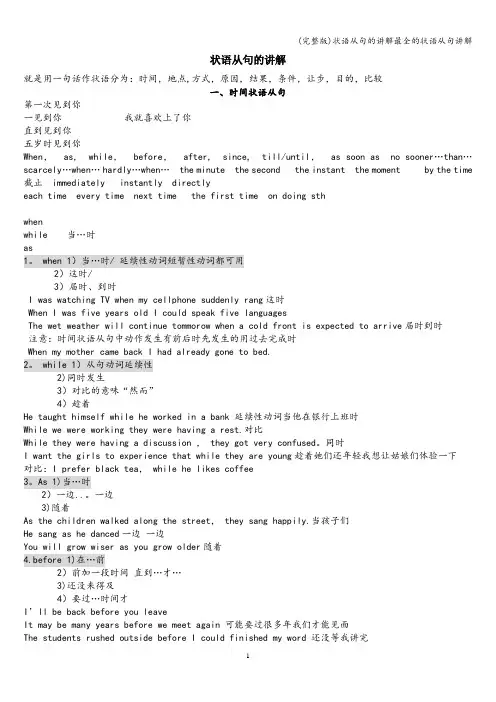
三.时间状语从句常用引导词:when, as, while, as soon as, while, before, after, since , till, until 特殊引导词:the minute, the moment, the second, every time, the day,the ins tant, immediately , directly, no sooner … than, hardly …when, scarcely … wh en1,when 指的是“某一具体的时间”。
whenever 指的是“在任何一个不具体的时间”。
When I came into the room, he was writing a letter. 当我进屋时,他正在写信。
,We shall go there whenever we are free. 我们什么时间有空,我们就去那里。
2,when 意为“这时”或“在那个时候”,可以看作是并列句, 这种用法的when 分句一般位于句末。
when I was walking along the street when suddenly someone patted me on the shoulder from behind. 我正在街上走着,这时忽然有人从后面拍我的肩膀。
3,while 指“在某一段时间里”,“在…期间”,while 引导的动作必须是持续性的。
While it was raining, they went out. 天下雨的时候,他们出去了。
4,as 引导持续性动作,强调主句和从句的动作同时发生as She always sings as she walks .她总是一边走一边唱5,before 译为在…之前after,翻译为在,,,,,之后before Be a pupil before you become a teacher. 先做学生,再做先生。
after He arrived after the game started. 比赛开始后,他到了。
6,till 如果主句动词是持续性动作,常用肯定式,表示“直到…为止”We waited till (until)he came back . 我们一直等到他回来。
7,until如果主句动词是瞬间动词,常用否定式,表示“ 直…才”“ 在…以前不”,从句放在句首表示强调,一般用untilShe didn’t stop working until eleven o’clock . 她到11 点钟才停止工作。
Until he had passed out of sight, she stood there. 她站在那里看着,直到看不见他的身影。
8,since自从。
As soon as 一,,,,就。
状语从句在主句之前时一般用逗号与主句分开,如从句在主句之后则不必用标点符号。
since as soon as Great changes have taken place in China since 1978.As soon as I arrive in Shanghai, I’ll write to you.我一到上海就给你写信。
9 hardly…when 和no sooner…than的意义相当于as soon as:一,,,就。
但只表示过去发生的事情,主句为过去完成时,从句为过去时,如果hardly 或no sooner 位于句首时语气强,而且主句的谓语要用部分倒装。
I had hardly got home when it began to rain.=Hardly had I got home when it began to rain.No sooner had we got to the station than the train left. 我们刚到车站,火车就走了。
Hardly had we begun when we were told to stop. 我们刚开始就被叫停。
10,every time, by the time, the moment等在时间状语从句中,不能用将来时或过去将来时,而要用现在时或过去时代替将来时。
Every time I travelled by boat, I got seasick. 我每次乘船都晕船。
The moment I heard the song, I felt cheerful. 我一听到这首歌,就感到很愉快。
Next time you come ,you’ll see him. 下次你来的时候,就会见到他。
四,地点状语从句常用引导词:where 特殊引导词:wherever, anywhere, everywhere。
1,where 与wherever 意义基本相同,但后者语气较强,多用于书面语Where there is a will, there is a way. 有志者,事竟成。
You are free to go wherever you like. 你可以随意到你喜欢的任何地方去。
Wherever you go, you must obey the law. 无论你去哪都要遵守法律。
五,原因状语从句常用引导词:because, since, as, since 特殊引导词:seeing that, now that, in that, considering that, given that, conside ring that,1,because 用来回答why 的问题,语气最强一般放在主句之后because I came back late yesterday because I was on duty. 昨天我回来晚了,因为我值班。
2,,since 表示既然或全已知的理由,稍加分析即可表明的原因,多放句首since Since everyone is here, let’s begin our meeting. 既然大家都到了,我们开始开会。
3,as 从句常放在句首,说明原因,主句说明结果,常用于口语中As he didn’t know much English, he looked up the word in the dictionary .4,now that, seeing that和since, as 意义相似,他们都有“鉴于某个事实”的意思,that可以省去。
Now (that) the weather has cleared up, we can start our journey. 鉴于天气已经晴朗,我们可以启程了。
Seeing (that) he was badly ill, we sent for the doctor.鉴于他病情严重,我们派人去请医生去了。
六,目的状语从句常用引导词:so that, in order that 特殊引导词:lest, in case, for fear that,in the hope that, for the purpose that, to the end that1,that,so that目的状语从句中常用情态动词may (might) can (could) ,should 等放在动词之前,从句往往放在主句之后,主从句之间不用任何标点符号。
I shall write down your telephone number that I may not forget.We’ll tell you the truth so that you can judge for yourself.我把真实情况告诉你,使你能自己作出判断。
2,in order that为了They worked harder than usual in order that they could finish the work ahead of time . 他们比往常更加努力工作,为了能提前完成工作。
3,for fear that /lestPut on more clothes for fear that you should catch cold. 多穿点衣服,以免患感冒。
七,结果状语从句常用引导词:so … that, such … that, 特殊引导词:such that, to the degree that, to the extent that, to such a degree that,1,so that ,so…that。
so that 前有逗号为结果状语从句。
so…tha t 的so 后面跟形容词或副词。
We turned up the radio, so that everyone heard the news.我们把收音机的音量放大,大家都听到了新闻。
He was so excited that he couldn’t say a word. 他十分激动,以致一句话都说不出来。
2,such…that such…that 的such 后面跟名词,如果名词是单数就要用such a /an…that 还可以转换用so…that,语气较强He gave such important reasons that he was excused。
It is such an interesting novel that all of us want to read it. It is so interesting a novel that all of us want to read it. 这是一本十分有意思的书,大家都想看。
八,条件状语从句:常用引导词:if, unless, 特殊引导词:as/so long as, only if, providing ,provided that, suppose that, in case that, on condition that1,unless 和if…not同义,unless 从句的谓语只能用肯定式。
unless 是书面语,if…not 是口语,通常二者可以换用。
条件状语从句中的谓语动词的时态一般要用现在时或过去时代替一般将来时或过去将来时。
Difficulties are nothing if we are not afraid of them.如果我们不怕困难,困难就算不了什么了。