
Module 4 Unit 1 Period 1
- 格式:ppt
- 大小:3.56 MB
- 文档页数:41
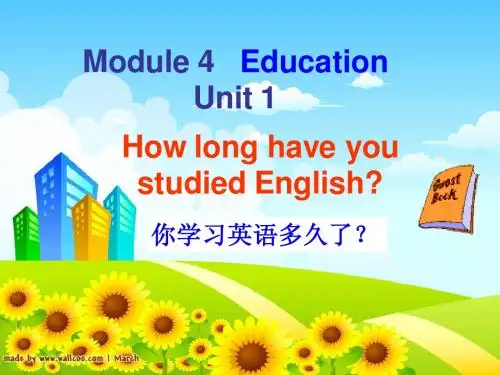

Module4 Unit1 period1(说课稿及素材)外研社(三起)-四年级英语上Teaching Aims(教学目标)1.能听、说、认读动物名称:elephant, lion, panda, rabbit, monkey, giraffe, camel, tiger。
2.能运用所学动物名称进行交流对话,激发学生学习英语的兴趣。
3.继续巩固和拓展数字1-10的认知和记忆。
4.继续培养学生的听力,学会通过听音识别单词。
Teaching Contents(教学内容)1.新词汇:elephant, lion, panda, rabbit, monkey, giraffe, camel, tiger。
2.数字1-10。
3.跟读、模仿练习课文,并进行角色扮演对话。
Teaching Procedures(教学过程)Step 1 Greetings and Lead-in(问候和导入,5 minutes)1.Greet the students and lead-in with greetings like “Good morning, children. How are you today?”.2.Show the students some pictures of different animals and ask them what they are. Encourage them to say the names of the animals aloud.Step 2 Presentation of New Vocabulary(新词汇呈现,10 minutes)1.Present the pictures of the new animals (elephant, lion, panda, rabbit, monkey, giraffe, camel, tiger) to the students, and introduce their names.2.Point to each animal on the picture, while saying the name of the animal, and ask the students to repeat after you.e gestures or facial expressions to help students better understand the meanings of the words.4.Ask students to try saying each animal’s name on their own.Step 3 Presentation of Numbers(数词呈现,5 minutes)1.Ask the students to show how many fingers they have.2.Introduce the numbers 1 to 10 using hand gestures.3.Write each number on the board and ask the students to repeatafter you.Step 4 Listening Comprehension(听力训练,10 minutes)1.Read aloud the vocabulary words and numbers.2.Play an audio recording of a short conversation involving the animals and numbers you have just introduced.3.Ask students to listen carefully and try to follow the conversation.4.Play the recording again, and ask students to repeat after the speaker.Step 5 Role-Playing(角色扮演,10 minutes)1.Divide the students into pairs.2.Ask one student in each pair to be the animal and the other student to be the zookeeper or visitor.3.Encourage the students to use the new vocabulary to imagine the conversation that would take place between the animal and the zookeeper or visitor.4.Walk around the classroom and monitor the students’ co nversations.Step 6 Assessment(练习和测试,10 minutes)e flashcards to test the students’ memory.2.Show a flashcard to the students and ask them what animal is on it.3.Ask students to count from 1 to 10.4.Call on individual students to read a word or a number.5.Give immediate feedback to the students.Step 7 Summary and Homework(课堂小结和作业布置,5 minutes)1.Summarize the key points of the lesson, emphasizing the new vocabulary, numbers, and listening comprehension practice.2.Ask students to review the new vocabulary and numbers and practice saying their own sentences using the new words at home.Teaching Materials(教学材料)1.Flashcards: elephant, lion, panda, rabbit, monkey, giraffe, camel, tiger.2.Audio recording of a conversation about the animals and numbers.3.Pictures of animals.Teaching Reflection(教学反思)1.The role-playing activity was effective in helping students to practice the new vocabulary in a fun way. It also gave them the chance to use the language in a real-life context, enhancing their motivation to learn.2.The assessment using flashcards and counting exercises may have been a bit too simple for some of the students. Next time, I will try to include more challenging assessment options.3.The use of gestures and facial expressions was helpful in conveying the meanings of the new words, especially for visual learners.I will continue incorporating various teaching methods to cater to diverse learning styles.。
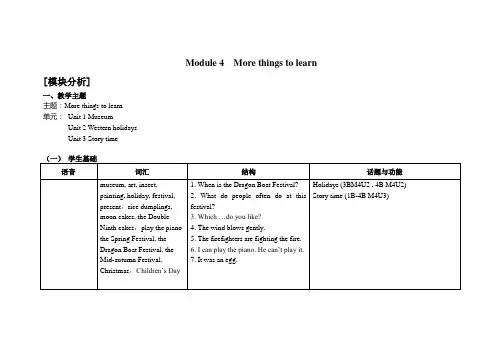
Module 4 More things to learn [模块分析]一、教学主题主题:More things to learn单元:Unit 1 MuseumUnit 2 Western holidaysUnit 3 Story time[单元分析]Unit 1 Museums三、情感与人文1、了解我们身边有许多种类的博物馆。
2. 体会到博物馆是我们的“Special classroom”3. 感受到博物馆的内涵及他的博大精深。
4. 激发学生学习探究的欲望。
Module4 Unit1 Period1 Sub-topic: Museums I knowI.Objectives:1. Contents:(1) Words and expressions: *famous, science, Shanghai Science Museum, China Art Museum, railway,Shanghai Railway Museum,Shanghai Car Museum(2) Story: Museums I know2. Abilities:(1) Be able to know the International Museum Day.(2) Be able to the names of the museums and talk about various museums.3. Culture: Help the students know about the International Museum Day and love museums.II. Language Focus:(1) Using Noun phrases to identify different kinds of museums.(2) Using Modeled sentences to ask about the museums.III.Difficulty:(1) Using the key phrases to identify different kinds of museums.(2) Understanding wh-questions asking for specific informationIV. Teaching aids: Multi-media入学习状态。

小学英语新外研版(一起)四年级上册Module 4 Unit 1《Chinese people invented paper》教案第二课时教学目标1.掌握一般过去时的肯定结构和否定结构。
2. 能够运用目标语言来谈论中国发明的东西和不是中国发明的东西。
教学重点理解和掌握:Chinese people invented …… /Chinese people didn’t invented ……教学难点一般过去时的肯定结构和否定结构。
教学方法任务型教学法,小组讨论法,直观演示法。
课前准备图片,录音机课时安排1课时教学过程Step 1 Review1.Show the students some pictures .Encourage them to say out the four great inventions of ancient China :Printing ,paper ,compass ,gunpowder .e the sentence pattern to describe the pictures .Chinese people invented paper .Chinese people invented compass .Chinese people invented printing .Chinese people invented gunpowder .Step 2 Presentatione the pictures to present the new sentence pattern .Chinese people didn’t invent bicycle .Chinese people didn’t invent telephone .Chinese people didn’t invent plane .Chinese people didn’t invent computer .1.Help the students summarize the sentence pattern :主语+didn’t+动词原形+其他。