
Laboratory Safety Manual
- 格式:ppt
- 大小:3.99 MB
- 文档页数:28
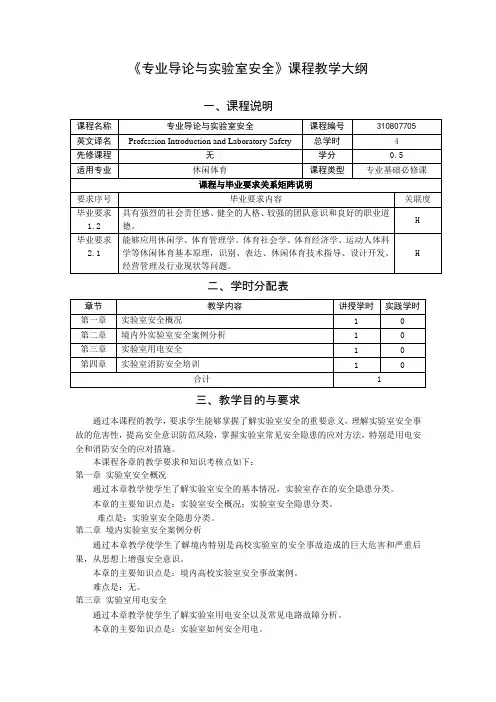
《专业导论与实验室安全》课程教学大纲一、课程说明二、学时分配表三、教学目的与要求通过本课程的教学,要求学生能够掌握了解实验室安全的重要意义,理解实验室安全事故的危害性,提高安全意识防范风险,掌握实验室常见安全隐患的应对方法,特别是用电安全和消防安全的应对措施。
本课程各章的教学要求和知识考核点如下:第一章实验室安全概况通过本章教学使学生了解实验室安全的基本情况,实验室存在的安全隐患分类。
本章的主要知识点是:实验室安全概况;实验室安全隐患分类。
难点是:实验室安全隐患分类。
第二章境内实验室安全案例分析通过本章教学使学生了解境内特别是高校实验室的安全事故造成的巨大危害和严重后果,从思想上增强安全意识。
本章的主要知识点是:境内高校实验室安全事故案例。
难点是:无。
第三章实验室用电安全通过本章教学使学生了解实验室用电安全以及常见电路故障分析。
本章的主要知识点是:实验室如何安全用电。
难点是:无。
第四章实验室消防安全培训通过本章教学使学生了解实验室消防安全的一些基本知识,掌握一些消防基本技能。
本章的主要知识点是:实验室消防安全知识;消防安全技能。
难点是:消防安全技能。
四、教学内容纲要第1章实验室安全概况第2章境内实验室安全案例分析第3章实验室用电安全第4章实验室消防安全培训五、课程教材教科书:朱莉娜等.高校实验室安全基础[M]. 天津:天津大学出版社,2018参考书:[1] 敖天其廖林川.实验室安全与环境保护[M].成都:四川大学出版社,2015六、考核方式期末考核方式:撰写一篇报告。
七、课程思政八、其他说明本大纲适用于休闲体育专业《专业导论与实验室安全》课程。
执笔人:许洪文审核人:审定人:。

Committee on Professional TrainingLaboratory SafetyLaboratory safety involves the development of skills and responsibility and must be an integral part of every chemistry curriculum. This means that safety awareness must be integrated into each laboratory course including research with increasingly broader scope at more advanced levels. The creation of a culture of laboratory safety requires a broad commitment from all levels of the educational institution. At the department level, faculty need to assume responsibility for continuing review of safety issues with students in teaching and research laboratories, especially the persons responsible for undergraduate instruction, often graduate students or instructors. Faculty must lead by example in a coordinated departmental safety effort. At the administrative level, this will involve implementation of a chemical hygiene plan that is in agreement with any campus chemical hygiene/safety efforts and must address the safe handling, storage, and disposal of chemicals. Eye wash and showers must be in operating condition, and fume hoods with proper sashes are essential. Anyone working or visiting in the lab must be wearing goggles, and consumption of food or drinks must not be permitted. A clean, uncluttered laboratory is more likely to encourage careful work.Development of safety skills may be divided into four emphasis areas.1•R ecognize Hazards•A ssess Risks•M inimize Risks•P repare for EmergenciesThe ACS Committee on Chemical Safety has recently published three useful resources that provide guidelines for chemical safety in academic institutions.2 and help in the identification and evaluation of hazards in research laboratories.3-4Recognize HazardsA hazard is a potential source of danger or harm and can result from working with chemicals, equipment, and instrumentation. Introduction to this topic can start with an understanding of the terms describing chemical hazards, such as “toxic”, “flammable”, or “corrosive”, and how to obtain information from chemical labels, Safety Data Sheets (SDS), and other reference sources. Chemical hazards encountered in early undergraduate laboratories should be explained in more detail – for example, acids, bases, flammables, and toxic compounds. At more advanced levels, more details of chemical and physical hazards should be explained so that students are able to identify hazards themselves in experiments – for example, types of toxic compounds, compressed gases, cryogenics, pressurized systems, peroxides, reactives, unstable compounds, pyrophorics, explosives, and water-reactives. Other topics might include toxicology, nanomaterials, biohazards, and radiological hazards, which become relevant when the chemistry curriculum becomes broader in scope.5Assess RisksOnce a hazard(s) is recognized, laboratory safety necessarily requires an assessment or evaluation of risk from potential exposure to the hazard. Identifying potential routes of exposure is followed by judging the relative risk posed by the hazards of the experiment. The hazardous physical, chemical, and toxic properties of solvents, reactants, catalysts, products, and wastes should be considered as well as circumstances of the experiment – for example, how much is being used, is the right equipment available, can the hazard be controlled or minimized?Are the reactions exothermic or water- or air-sensitive? Are there risks associated, for example, with the use of lasers or equipment utilizing high voltages (electrophoresis)?Minimize RisksBased on a risk assessment, experiments should be designed to minimize potential risks. These steps may involve carrying out experiments in a fume hood with a protective shield and wearing protective gloves and goggles. The handling and storage of wastes is a critical component. It is often useful to consider case histories of incidents that have resulted in injury or damage. What could have been done to prevent or minimize such incidents? Discussion can be implemented by giving students a picture of a risky or hazardous environment and then asking them, “What is wrong with this picture?”Prepare for EmergenciesSince it is essential to react promptly and deliberately to emergencies, students should learn what to do in various emergencies and be prepared to act accordingly – for example, fires, injuries, and spills. Safety devices such as showers, eye washes, fire extinguishers, and spill kits, must be clearly labeled and their use and location known to all those working in a laboratory. Emergency phone numbers, alarms, and escape routes should be clear to everyone.The Culture of Laboratory SafetyFaculty and staff must be leaders in safety: teaching safety to students, continuously promoting safety, demonstrating the importance of safety through their actions, and accepting responsibility for safety. At some institutions the graduate students teach the undergraduate labs, in which case the graduate students TAs must be champions of safety ethics. The Safety Ethic is, above all, a value, stated as: I value safety, work safely, prevent any risk-behavior, promote safety, and accept responsibility for safety.6-7 It emphasizes personal responsibility of each person involved. In order for this culture to thrive, everyone must be promoting it. It is, of course, necessary to be familiar with Occupational Safety and Health Administration (OSHA), Environmental Protection Agency (EPA), Department of Transportation (DOT), and Department of Energy (DOE) regulations, but responsibility goes beyond simply complying with federal, state and local regulations – it is about caring for the safety of fellow students, faculty, and staff. There are several chemical and laboratory safety resources that can be very useful in building a strong culture of safety.8-11Curricular ApproachesLaboratory safety education and training is an ongoing process and therefore must be integrated into every laboratory course. In research laboratories, the responsibility for necessary instruction will lie with the research director. Because of time and resource constraints, presentation and discussion may be limited in lab lectures prior to the start of a laboratory or pre-lab assignments.Three possible approaches are suggested:1. A seminar course devoted entirely to laboratory safety;2. Laboratory safety as part of a seminar devoted to chemistry as a profession; and,3. Online materials where students would be required to do reading and then pass exams, the grades beingrecorded.It is very important to emphasize that safety is about learning how to carry out laboratory work safely and not only about rules and regulations, so students are required to think about responsibility for safety in the conduct of their work. Working safely is a basic responsibility of every employee and every student. Reduce unnecessary risks,- 2 -insure that regulations are followed by others, and always bring safety concerns to the attention of a supervisor or a departmental safety committee. A departmental safety committee should be established if it does not exist. References1. Hill, Robert H, Jr. and David C. Finster, Laboratory Safety for Chemistry Students, Wiley, Hoboken, 2010. Thisis a comprehensive text that partitions safety considerations into three tiers, with increasingly more involved considerations being reflective of increased knowledge by students. Emphasis is on learning on a “need to know basis”.2. Guidelines for Chemical Laboratory Safety in Academic Institutions, ACS Committee on Chemical Safety,Washington, DC., 2016. A comprehensive document providing a broad overview of the range of safetyconsiderations for undergraduate, graduate and continuing safety education.(/content/dam/acsorg/about/governance/committees/chemicalsafety/publications/acs-safety-guidelines-academic.pdf?logActivity=true)3. Identifying and Evaluating Hazards in Research Laboratories, ACS Committee on Chemical Safety,Washington, DC., 2015. A comprehensive overview of methodologies that can be used to assess and control hazards that can be successfully used in a research laboratory.(/content/dam/acsorg/about/governance/committees/chemicalsafety/publications/identifying-and-evaluating-hazards-in-research-laboratories.pdf)4. Hazard Assessment in Research Laboratories, ACS Committee on Chemical Safety, Washington, DC. An on-line resource that helps with the identification of hazards, the assessment of risk, and selection of appropriate control measures to eliminate a hazard or reduce the risk of accident or injury.(/content/dam/acsorg/about/governance/committees/chemicalsafety/publications/acs-safety-guidelines-academic.pdf?logActivity=true)5. Prudent Practices in the Laboratory, The National Academies Press, Washington, 2015. A comprehensivestudy of laboratory safety issues including leadership and management considerations.(/catalog.php?record_id=12654)6.Creating Safety Cultures in Academic Institutions: A Report of the Safety Culture Task Force of the ACSCommittee on Chemical Safety. A comprehensive document dealing with the promotion of safety culture across the entire educational institution.(/content/dam/acsorg/about/governance/committees/chemicalsafety/academic-safety-culture-report-final-v2.pdf)7. Safe Science – Promoting a Culture of Safety in Academic Chemical Research, National Academies Press,2014. This document describes the culture of safety in research institutions and provides recommendations to support safety as a core value of these institutions.8. ACS Committee on Chemical Safety, Washington DC. This ACS Committee serves as a resource to the ACSand the public on chemical and laboratory safety. In maintains current information on safety practices and recommendations, classroom safety, symposia, and safety-related activities.(/content/acs/en/about/governance/committees/chemicalsafety.html)9. ACS Division of Chemical Health and Safety, Washington, DC. This division organizes chemical health andsafety symposia at National ACS meetings; publishes the Journal of Chemical Health and Safety, provides the DCHAS Listserve – an internet resource for division members providing a forum for questions and answers for chemical health and safety issues. (/)10. S afety Data Sheets (SDS) are required by the U.S. Occupational Safety and Health Administration under theirHazard Communication Standard. (/Publications/OSHA3514.html)11. C hemical Laboratory Safety and Security: A Guide to Prudent Chemical Management, L. Moran, T.Masciangioli (editors) An accompanying toolkit (7 components) is available for use with this manual.(/global/bcst/Chemical-Management)Last revised in August 2017- 3 -。

Laboratory Safety RulesAll LaboratoriesParticular laboratories have special rules which are to be observed. In addition the following general rules apply.(a)The Hazardous Substances Regulations now in force in NSW require us to maintain aregister of all substances listed or assessed as hazardous, to have a material safety datasheet (MSDS) for those substances available, and to label all containers for hazardoussubstances in an appropriate manner. Access to the ChemAlert database for an MSDSand the production of labels is provided at.au/chemweb/Further details on the Hazardous Substances Regulations are available at:.au/su/ohs/haz-subs/index.htm(b)No experiment may be commenced without first assessing the hazards of all materialsinvolved and the risks associated with the experimental procedures. The risk assessmentprocedures which must be followed are detailed in Section III-8.(c)Safety glasses must be worn at all times whilst in all chemistry laboratories and should beworn while working all laboratories.(d)Research students and research workers working in a laboratory outside normal workinghours must comply with the regulations detailed in Sections III-7.Repairs to faulty equipment, particularly electrical equipment, should not be attempted except by suitably trained and qualified personnel, faulty equipment must be removed from use and arrangements made for repair by an appropriately qualified person.RESEARCH LABORATORIES1. General.(a)Electricity cables must not be run across the floor. The use of double adaptors in the Faculty isprohibited; only powerboards with overload protection should be used.(b)Appropriate Personal Protective Equipment (PPE) must be worn in laboratories.i)Eye protection must be worn at all times in all laboratories where chemicals arebeing used.ii)Gloves and protective clothing should be worn when handling corrosive or toxic chemicals. It should be noted, however, that latex gloves are permeable to organic (or organic-soluble) substances and therefore offer only limited protection; they should be used as a line of last defence only and should be replaced immediately if contamination by an organic substance occurs.iii)Shoes must be worn at all times in these buildings. Shoes with enclosed toes are mandatory for all student practical classes and should be worn in alllaboratories/workshops. Thongs and high-heeled shoes are not acceptable footwear in any laboratory.iv)Long hair and loose clothing must be confined; shorts, cutoffs or miniskirts are not recommended.v)Laboratory coats must be worn at all times in boratory coats (and gloves)must not be worn outside laboratories except for trips between laboratories.On no account should laboratory coats be worn in offices or staff rooms. The same applies to all other items of protective clothing or apparatus.∙Gloves must be removed before touching objects such as door handles and should never be worn whilst using telephones, computers, photocopiers etc.∙If the lab coat you have is uncomfortable or unsuitable, get a better one.∙You must wear a clean laboratory coat. It is not acceptable for you to continue to wear a lab coat on which chemicals have been spilled. The faculty operates (throughthe main office) a laundry service which turns lab coats around in 2 weeks.∙If supervisors feel that the wearing of lab coats should not be mandatory in certain rooms, then a risk assessment must be made with respect to the hazards associated withnot wearing lab coats in such rooms.c)First aid kits are placed in a number of locations throughout the Faculty. The Safety Officershould be informed (by email) when materials are removed from the first aid kits so that they can be replaced.d)No eating, drinking, smoking or applying cosmetics is permitted in any laboratory or in anyother chemical storage area.2. Cleanliness.Cleanliness is essential to prevent unnecessary toxic hazards to yourself and other workers and to ensure optimal operation of equipment.(a)Work areas (benches, fume cupboards etc) should be cleaned as soon as work is finished.(b)Thoroughly wash and rinse all glassware as soon as you have finished with it - do not let itaccumulate on the sink(c)All spillages must be cleaned up immediately.(d)For large acid spills on benches and floors, apply liberal amounts of solid sodiumhydrogencarbonate (or sodium carbonate and sand). Do not use water as this only spreads the acid further. Similarly, for large alkali spills use solid boric acid.(e)In the event of a spillage of mercury, every effort must be made to recover every trace ofthe mercury since mercury is a highly toxic cumulative poison. A Pasteur pipette connected to a water pump, via a suitable trap, can be used to collect the mercury. Inform the Safety Officer immediately for instructions on removal of the last traces.(f)In the event of a large organic solvent spill, immediately evacuate the area and inform theSafety Officer. DO NOT A TTEMPT TO CLEAN IT UP WITHOUT APPROPRIATEPROTECTIVE APPARATUS.3. Chemical Storage and Use(a)Material Safety Data Sheets (MSDS) for every chemical housed in this faculty should beavailable in each laboratory using that chemical. The MSDS's contain information about any hazards associated with the chemical, safety precautions, first aid and clean-up procedures. When purchasing chemicals or hazardous goods, you MUST ask for an accompanying MSDS from the manufacturer/supplier. A copy of each new MSDS must be filed in the lab.(b)All workers are required to be familiar with the hazards associated with the use ofcommon reagents and of the specific chemicals used in their work. Many of the compounds used daily in the laboratory may be hazardous or dangerous, for example corrosive, toxic, inflammable or carcinogenic.(c)All workers are required to know the location and proper use of emergency equipment(safety showers, eyebaths, fire blankets, extinguishers, first aid kits etc.) and be familiar with emergency procedures (exits, alarm stations, evacuation etc.)(d)Safety glasses or goggles will be worn in all areas where chemicals are used, handled orstored, or where particular eye hazards exists e.g. uv or laser light, particulate matter or systems under pressure.(e)Label all your solutions, samples etc with exact contents, your name and the date.Unlabelled items will be thrown out.(f)Solvent vapours, many of which are cumulative poisons, must not be inhaled. Wherepossible, all operations involving volatile solvents should be confined to a fume hood.(g)Flammable solvents must be stored in metal solvent cabinets.(h)Vessels containing more than 2.25 litres of flammable solvent may not be stored inlaboratories.(i)Bottles containing flammable solvents on open shelves should be kept to a minimum; thecontainer volume must not exceed 500 ml.(j)Empty bottles of flammable solvents must be stored safely as they may contain explosive vapour.(k)Only the minimum volume of solvents required for efficient working may be stored in laboratories.(l)Corrosive materials should be stored in/on chemically resistant vessels or trays that can contain the entire contents in the event of a spillage. Acids and alkalis should be adequately segregated.(m)Incompatible chemicals that could react violently or explosively or might produce toxic or corrosive products must be adequately segregated(n)Do not pipette anything by mouth. Use a pipette filler.(o)Perchlorates are classified as Class A explosives and all experiments with perchlorates must first be discussed with the Safety Officer. In general, perchlorates should only beused as a last resort, and even then only on a small scale <100 mg.(p)Liquid nitrogen must never be used in unventilated areas.(q)All reagents and products must be clearly labelled with description, owner and date.(r)Refrigerators are not designed for the long term (> 1 year) storage of chemicals.Flammable solvents must not be stored in refrigerators. All items stored in refrigeratorsmust be clearly labelled as to contents, owner and date. Service room personnel willroutinely check refrigerators and may remove incorrectly labelled items for disposal.Refrigerators used for chemicals must be clearly labelled NO FOOD or DRINK.Disposal of Hazardous Waste(a) Chemical Wastei)All organic solvent residues must be placed in the appropriate plastic residuecontainer (halogenated and non-halogenated solvent wastes must be kept separate) andnot down the sink. Concentrated acid and alkali solutions should be carefully dilutedwith water (add the reagent to the water) and then washed down the sink with copiousamounts of water.ii)Do not mix acetone and chloroform in the residue containers. Mixtures of these solvents can explode.iii)Sodium residues should be COMPLETELY dissolved in ethanol and then washed down the sink. They must not be left in winchesters.iv)Broken glass, Pasteur pipettes, etc., should be disposed of in appropriate sharps containers. CLEAN, unbroken glass bottles may be placed in the general rubbish.Procedure for disposal of Sharps and Chemical Wastei)Ensure that the waste is in a suitable container. Waste solvents should be in aplastic drum available on request from Risk Management.ii)Complete the form Request for Disposal of Hazardous Waste available from .au/su/ohs/forms/w-r-form.pdfiii)Photocopy the completed “Request for Disposal of Hazardous Waste” and attach the copy to the container. Place the waste in the waste storage bunker (opposite RmN229)iv)Give the original “Request for Disposal of Hazardous Waste” form to Jay in the post room who will fax the form to Risk Management. This needs to be at least 2days before the next scheduled hazardous waste pick-up.Further information on the disposal of chemical wastes may be found in the reference materials given in Section V. If there is any doubt over correct disposal procedures, the Faculty Safety Officer should be consulted.Spill kitsAll laboratories have access to a suitable spill kit available to deal with spills.The kit may include:∙Personal protection equipment including protective clothing, chemically resistant gloves, safety∙glasses or a face shield, rubber boots, and suitable respiratory protection which may include self-contained breathing apparatus.∙ A barrier to contain a spill such as clean, dry sand or a commercial product.∙Vermiculite to absorb a spill.∙Reagents necessary for decontamination procedures eg. Calcium carbonate, boric acid.disinfectant∙Appropriate containers in which to store waste and contaminated materials eg plastic bags and∙buckets.∙Warning signs and barriers.。