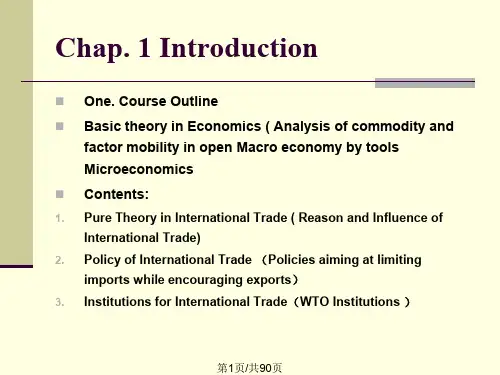
Chapter 1 Introduction 国际贸易2
- 格式:ppt
- 大小:566.50 KB
- 文档页数:22


《国际贸易实务(双语)》三习题库第一章国际贸易简介Chapter 1 A Brief Introduction to International Trade预习题1. What is international trade?2. Why do nations trade?练习题3. What are the differences between international trade and domestic trade?4. P17-20 专业术语、课后练习复习题5. What are the characteristics of international trade?6. What are the forms of international trade?7. Useful certificates for your future job-hunting.第二章进出口交易的一般程序General Procedure of International Trade一、国际贸易的基本流程Basic procedure of international trade预习题:1. Suppose you are an exporter, what will you do before you enter into a business with a trade partner?2.我国某出口公司与香港C公司签订了一笔总值25万美元销售猪肉的合同,FOB青岛,目的港韩国釜山,付款方式为D/A远期120天办理托收。
该出口公司按规定的装运期限装运货物后,通过中国银行办理托收手续。
中国银行委托香港南洋商业银行为代收行向香港C公司收款。
单据到香港后,C公司即承兑赎单,又以原提单向韩国收货人收取了货款。
香港南洋商业银行在汇票到期时向C公司催促付款,但此时该公司已宣告破产。
经查核C公司在当地注册资本仅15万港元,其财产远远不够抵偿该公司的欠款。

《国际经济与贸易》教学大纲课程编号:112602B课程类型:□通识教育必修课□通识教育选修课□专业必修课√专业选修课□学科基础课总学时:32 讲课学时: 32学分:2适用对象:金融学(国际金融英文班)先修课程:经济学、金融学一、教学目标本课程的主要目标:本门课程的教学,旨在使学生了解和掌握《国际经济学》中的主要理论和研究方法,并能灵活运用所学的理论和方法研究和分析国际经济领域的问题和现象,认识现象和问题的本质属性。
Through the teaching of this course, students should know and seize the major theories and inquisitive method of the international economics. Meanwhile, students should be able to research and analyze some problem and phenomena and understand the substantial properties in the field of international economy according to the theories and methods studied in this course.二、教学内容及其与毕业要求的对应关系要求学生掌握国际贸易基本理论、基本知识,了解当代国际贸易的热点问题及发展趋势,把握国际贸易理论研究前沿。
学完本课程后,应达到以下基本要求:1、了解国际贸易理论前沿和发展状况,能够理解和掌握国际贸易基本概念、历史、理论、政策、新趋势和新实践等基本知识,掌握国际贸易基本方法和基本知识;2、了解国际贸易实践,通过案例教学把握国际贸易的实际情况,能够理论联系实际解决问题,具有分析和解决国际贸易实际问题的能力和研究、分析和编写报告的能力;3、使学生能够运用所学知识,正确分析和解释国际贸易问题与现象。

教案院 (系):外语系课程名称:国际贸易理论与实务(本科)专业班级:英语1401、1402授课教师:贾晓鸽TEACHING DESIGN FORLecture No.1Lecturer Xiaoge Jia Lecturee English Major 1401, 1402 Approved byContent Chapter 1 Introduction to international tradeObjectives (1)Reasons for international trade(2)Differences between international trade and domestic trade (3)Basic concepts related to international tradeCore contents (1)Differences between international trade and domestic trade (2)Basic concepts related to international tradeTeaching methods 1. Teacher:(1)Q & A(2)Theory demonstration & case study(3)Class discussion2. Students:(1)Preview the chapter contents(2)Take notes in shorthand and get involved in the class discussion (3)Timely review the notesTeaching procedures 1. Warm-up2. Lecture3. Class activity4. Summary of the lecture5. AssignmentsReview questions 1. How do you consider the necessity for international trade?2. What factors impact the balance of trade?Assignments 1. Summarize the reasons for international trade2. Consider the skills for the professionals engaged in the international tradePreview Chapter 2Timeallocation Warm-up Lecture Class activity Summary Assignments5 mins 50 mins 45 mins 4 mins 1 minI.Warm-upThe exchange of goods and services arises simply because countries differ in their demand for goods and services and in their ability to supply them. There are some special problems in international trade including cultural problems, monetary conversion, etc. International trade has played an important role in the world history as well as in sustaining and modernizing the Chinese economy.II.Lecture0.Need for International Trade1.Reasons for international tradea)Resources reasonsb)Economic reasonsc)Other reasons2.Differences between international trade and domestic tradea)More complex context. Deals might have to be transacted in foreign languages andunder foreign laws, customs and regulations.b)More difficult and risky. Information on foreign countries needed by a particular firmmay be difficult to obtain. Exchange rate variations can be very wide and create many problems for international trade. Numerous culture differences have to be taken into account when trading with other nations.c)Higher management skills required. The risks include political risks (such as theimposition of restrictions on imports, etc. ); commercial risks (such as products not appealing to foreign customers, etc. ) ; financial risks and transportation risks.3.Basic Concepts in International Tradea)Visible trade vs. invisible tradeb)Favorable balance of trade (positive trade balance, trade surplus) vs. unfavorablebalance of trade (negative trade balance, deficit)c)General trade system vs. special trade systemd)Value of international trade (of goods) vs. quantum of international trade (of goods)e)Direct trade vs. indirect tradef)The commodity composition of foreign tradeg)Geographical composition of foreign tradeh)The degree of dependence on foreign tradeIII.Class activityGroup discussion questions1.How do you consider the necessity for international trade?2.How does international trade influence your everyday life?3.What factors impact the balance of trade?4.What professional skills do you have to develop to get yourself engaged in internationaltrade?IV.Summary of the lectureV.Assignments1.Multiple choices2.True or false questionsTEACHING DESIGNLecture No.2Lecturer Xiaoge Jia Lecturee English Major 1401, 1402 Approved byContent Chapter 2 Classical trade theoriesObjectives (1)Development of Mercantilism thought (2)David Hume’s price-specie-flow mechanism (3)A bsolute advantage theory(4)Comparative advantage theoryCore contents (1)Critical pillars of Mercantilism (2)Price-specie-flow mechanism (3)A bsolute advantage theory (4)Comparative advantage theoryTeaching methods 1. Teacher:(1)Q & A(2)Theory demonstration & case study(3)Class discussion2. Students:(1)Preview the chapter contents(2)Take notes in shorthand and get involved in the class discussion (3)Timely review the notesTeaching procedures 1. Warm-up2. Lecture3. Class activity4. Summary of the lecture5. AssignmentsReview questions 1. What are the critical pillars of Mercantilism?2. What are the critical assumptions of the price-specie-flow mechanism ? What happens to trade balance in a surplus country if the demand for traded goods is price inelastic? Why?Assignments 1. Summarize the critical assumptions for the four classical trade theories2. Case studyPreview Chapter 3Time allocation Warm-up Lecture Class activity Summary Assignments 5 mins 50 mins 45 mins 4 mins 1 minI.Warm-upThe purpose of this chapter is to trace out some of the early ideas regarding the basis for international trade and the distribution of the benefits to be gained from trade. It not only provides some historical perspectives to trade theory, but also makes clear why certain contemporary protectionist attitudes can be seen as being based in a Mercantilism view of the world.II. Lecture1.Mercantilisma)Development of mercantilist thoughtb)Mercantilist economic systemi.Zero-sum nature of international tradeii.Need for strong and powerful governmentbor theory of valueiv.Need to regulate economic activitiesv.Need for a positive trade balancec)Economic policies pursued by the mercantilists2.David Hume’s challenges to mercantilisma)Assumptions of price-specie-flow mechanismi.The quantity theory of moneyii.Perfect competition with flexible wages and pricesiii.Price-elastic demand for traded goodsiv.Existence of a gold standard, with no government interference with the movement of the gold and no actions to sterilize gold’s impact on the money supplyb)Price-specie-flow mechanism3.Adam Smith’s theory of absolute advantagea)Assumptions of theory of absolute advantageb)Challenges to mercantilismi. A nation's wealth was reflected in its productive capacityii.Specialization would generate productivity gainsiii.Free environmentc)Example4.David Ricardo’s theory of comparative advantagea)Concept of comparative advantageThe ability of a country to produce a particular good at a lower, relative cost than another country.b)ExampleIII. Class activityBriefly define the concepts1.Zero-sum game2.Gold standardbor theory of valueIV. Summary of the lectureV.Assignments1.Summarize the critical assumptions for the four classical trade theories2.Case studyTEACHING DESIGNLecture No.3Lecturer Xiaoge Jia Lecturee English Major 1401, 1402 Approved byContent Chapter 3 Neoclassical trade theoriesObjectives (1)Gains from trade in neoclassical trade theory (2)Reciprocal demand theory(3)Factor endowment theory(4)Leontief paradoxCore contents (1)Reciprocal demand theory (2)Factor endowment theory (3)Factor price equalization (4)Income terms of tradeTeaching methods 1. Teacher:(1)Q & A(2)Theory demonstration & case study(3)Class discussion2. Students:(1)Preview the chapter contents(2)Take notes in shorthand and get involved in the class discussion (3)Timely review the notesTeaching procedures 1. Warm-up2. Lecture3. Class activity4. Summary of the lecture5. AssignmentsReview questions 1. How do you define Labor theory of value?2. What are the assumption of theory of absolute advantage and the theory of comparative advantage?Assignments 1. Summarize the critical assumptions for the four classical trade theories2. Case studyPreview Chapter 4Time allocation Warm-up Lecture Class activity Summary Assignments 5 mins 50 mins 45 mins 4 mins 1 minI. Warm-upThe purpose of this chapter is to use more tools to analyze the gains for a country to participate in international trade rather than to remain in autarky, and to explain the existence of different relative autarky prices in different countries. Particular attention is paid to factor endowments, factor intensities, the Hechscher-Ohlin theorem, the factor price equalization process and qualifications to the Hechscher-Ohlin explanation. It also attempts to acquaint students with the applicability/non-applicability of Hechscher-Ohlin theorem in practice.II. Lecture1.Gains from trade in neoclassical trade theorya)Increasing opportunity costs on the PPFb)General equilibrium and gains in autarkyc)General equilibrium and gains after the introduction of international trade2.Reciprocal demand theorya) A country’s offer curveb)Trading equilibriumc)Measurement of terms of trade3.Factor endowment theorya)Factor intensity in productionb)Factor endowments, factor prices, and comparative advantagec)Assumptions of the factor proportions theoryd)The Hechscher-Ohlin theoreme)The factor price equilibrium theoremf)The Stolpher-Samuelson theorem4.Leontief paradoxa)The Leontief paradoxb)Suggested explanations for the paradox and related theoriesIII. Class activityDistinguish the following concepts1.“Gains from exchange” (consumption gains) V.S “Gains from specialization”2.price definition of factor abundance V.S. physical definition of factor abundance IV. Summary of the lectureV.Assignments1.Multiple choices2.Case studyTEACHING DESIGNLecture No.4Lecturer Xiaoge Jia Lecturee English Major 1401, 1402 Approved byContent Chapter 4 Post-Hechscher-Ohlin theories of tradeObjectives (1)The product cycle theory (2)The Linder theory(3)Intra-industry trade theoryCore contents (1)The product cycle theory (2)Intra-industry trade theoryTeaching methods 1. Teacher:(1)Q & A(2)Theory demonstration & case study(3)Class discussion2. Students:(1)Preview the chapter contents(2)Take notes in shorthand and get involved in the class discussion (3)Timely review the notesTeaching procedures 1. Warm-up2. Lecture3. Class activity4. Summary of the lecture5. AssignmentsReview questions 1. What are the differences between “gains from exchange”(consumption gains) and “gains from specialization”?2. What are the differences between the price definition of factor abundance and the physical definition of factor abundance?Assignments 1. Summarize the critical assumptions for the four classical trade theories2. Case studyPreview Chapter 5Time allocation Warm-up Lecture Class activity Summary Assignments 5 mins 50 mins 45 mins 4 mins 1 minI. Warm-upThe purpose of this chapter is to survey theories that introduce new considerations beyond factor endowments and factor intensities into the examination of the underlying causes of international trade.II. Lecture1.The product cycle theorya)The intimation lag hypothesisb)The product cycle theory2.The Linder theorya)Assumptions of the Linder theoryb)Trade comes in the overlapping ranges of product sophistication3.Intra-industry trade theorya)Explanation of intra-industry tradeb)Measurement of intra-industry tradeIII. Class activityDiscuss the following topics1.What factors are important in determining the length of the imitation lag and the lengthof the demand lag?2.What products might be examples of goods that are currently going through or havegone through the various stages outlined in the product cycle theory?IV. Summary of the lectureV.Assignments1.Define the terms2.Multiple choices3.Case study。