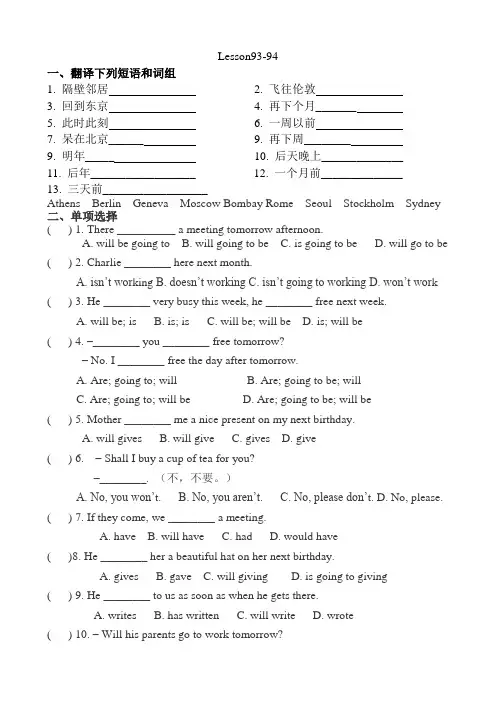
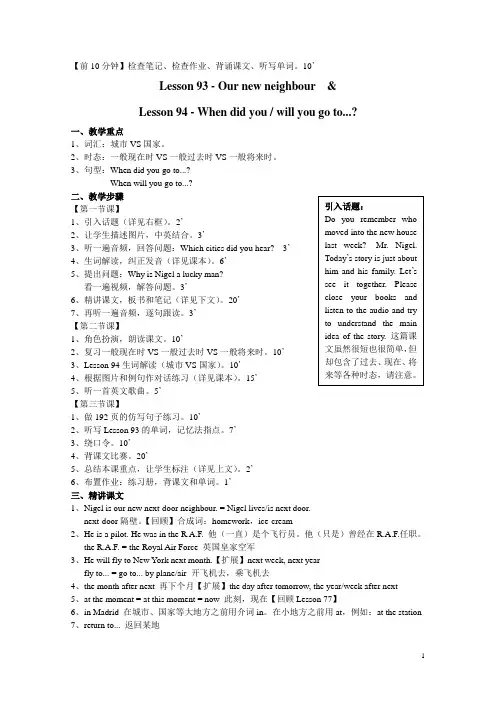
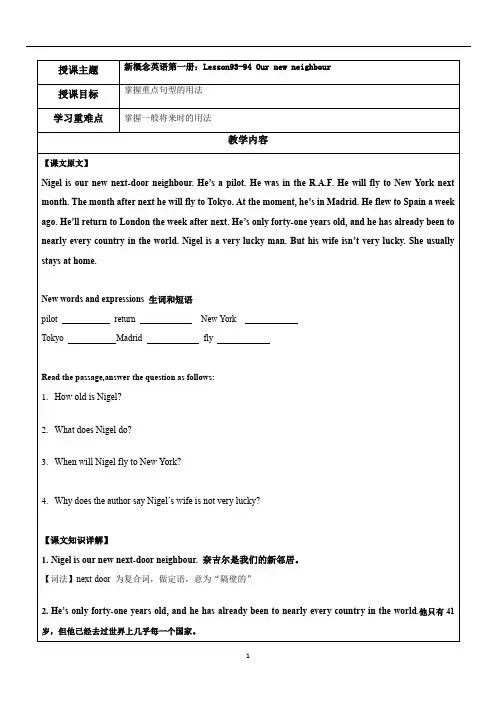
新概念第一册93-94知识点
- 格式:doc
- 大小:81.50 KB
- 文档页数:10
1
Lesson95-96
一.单词讲解
1.return n.往返
return ticket 往返票(Br) 回程票(Am) round-trip ticket 回程票(Am)
Single ticket(one-way ticket) 单程票
2.train 1)n.火车 take the train to…. 坐火车去…..
2)v.训练,培养He is training the horse for the race. (他为了比赛在训练那匹马)
3.plenty
1).n.大量 plenty of….(用于肯定句中,其后接可数或不可数名词,谓语动词的单复数形式须与其修饰的名词一致。)eg.plenty of time plenty of vegetables
There is plenty of milk in my cup. (我杯里有许多牛奶。)
There are plenty of books in the desk. (桌子里有很多书。)
2)plenty of 通常用于肯定句,在否定句中常用many,much,疑问句中换成enough。
eg.There is not money in him. (他身上钱不多。)
Are there enough money? (钱足够多了吗?)
a lot of /lots of 即可接可数名词,也可接不可数名词
4.station 1).n. 车站 火车站 a railway station 火车站 a bus station/stop 公共汽车站
2).(政府机关等的)局,所,中心
a police station 警察局 a gas station 加油站 a power station 电站
5.catch
1)v.捕捉,逮捕eg.The police caught a thief on the bus . (警察在公车上抓了一个小偷)
2).v.及时赶上,赶得上,追上
eg. I ran to catch the last bus. (我以跑代步以便赶上最后一班车)
2 3)染上(疾病),感染 eg.She caught a bad cold. (她得了重感冒。)
6.Miss 1)v.错过 eg.We missed the last bus . (我们错过了最后一班车)
2)想念,思念 eg.We all miss you. (我们都会想你的)
二.Had better 的用法
had better (常简略为’d better)是一个固定词组,意思是“最好”,表示忠告或建议。其用法有以下几点:
1) had better+动词原形,构成had better do sth.句行。
eg.You’d better go to hospital at once. (你最好立即去医院。)
2) 不论主语是第几人称,句子是什么时态,都要用had better的形式。
eg.Now you’d better listen to the teacher. (你现在最好听老师讲)
3) had better常用的否定形式是将否定副词not直接放在had better的后面。
eg.You had better not miss the last bus. (你最好不要错过末班公共汽车。)
4) had better 在反义疑问句中,疑问部分一搬用“had+主语”,但有时可用“will
you”表示一种请求或建议。
eg.You’d better not go out today, had you? (今天你最好不要外出,好吗?)
三.课后小结
return ticket to 去…..往返票 nineteen minutes past eight 八点十九分
what time…. 什么时间…. plenty of+可数/不可数名词 大量的,充足的
three minutes to eight 七点五十七分 next door to… 与…相邻,在...隔壁
had better …. 最好做…… had better not…. 最好不做…..
miss the train错过火车 catch the train 赶上火车
in five hours’ time 五小时以后
3 时态 用法 动词形式 时间状语标志词 例句
一般
现在时 一般、经常、
习惯、真理
原形/三单
am/is/are; do/does always, usually,
frequently, often,
sometimes, every
day
I am a teacher. I
teach English.
Do you usually
get up early?
一般
过去时
过去发生的事,不强调对现在的影响
过去式
was/were, did
yesterday, last
month, ten years
ago, after 6 o’clock I had lunch an
hour ago.
He went to
London last year.
She washed her
hair yesterday.
一般
将来时 将要或计划发生的事 shall/will do
am/is/are going to
do tomorrow/in ten
minutes
this afternoon/
after
He will be a
lawyer after
graduation.
We’re going to
shopping this
afternoon.
Lesson 97-98
一. 单词讲解
1. leave 1)v.遗留,遗忘eg.I left my homework at home 我把作业忘在家了。
注意:leave指知道东西丢在那个地方,而lose丢失,(不知道丢失东西的地方)
eg.I lost my key on my way home. 我的钥匙丢在了回家的路上。
2)v.离开Remember to turn off the light when you leave. 你离开的时候记得关灯。
leave ….for…. 离开某地前往某地 leave for….前往某地
3)v.把…留下/留在…(有意识的留下而不是忘记或是遗留)
You can leave your children at home. 你可以把孩子留在家里
4)n.准假,休假 ask for leave 请假 a sick leave of three days 三天病假
2. Describe v.描述,把…称为
Can you describe your suitcase?=What’s your suitcase like? 你能描述一下您的手提箱是是什么样的吗?
4 3.label n.标签tag n.标签(写有名称,地址号码及定价等的牌子)a price tag价目标签
4.handle.n.提手,把手the handle of a kettle 茶壶的把手
6.belong v.属于 belong to eg.The house belong to me . 这个房子属于我。
二. 语法:
(1)名词性物主代词
物主代词可分为形容词性物主代词和名词性物主代词。
1) 形容词性物主代词起形容词的作用,用在名词前。eg.This is my book .
2) 名词性物主性代词起名词的作用
eg.He likes my pen,he doesn’t like hers. 他喜欢我的钢笔,不喜欢她的。
3) 名词性物主代词在使用中必须注意:
A. 在使用名词性物主代词时,必须有特定的语言环境。也就是要省略的名词大家都已经知道,已经提起过。
eg.It’s hers.是她的。 (单独使用大家不知道是怎么回事,故不可这么用)
There is a book,It’s hers.那有本书,是她的。(先提及,大家才明白)
B. 名词性物主代词=形容词性物主代词+名词
为避免重复使用名词,有时可用“名词性物主代词”来代替"形容词性物主代词+名词"的形式. eg.My bag is yellow,her bag is red,his bag is blue and your bag is pink.
= My bag is yellow, hers is red, his is blue and yours is pink.
(2)如果名词前有两个或两个以上的形容词,通常来说,描述形状、大小的形容词要放在颜色词前。Eg.a small blue case
(3)英语国家的地址按从小到大的顺序排列,与中国的正好相反。eg.No.102,Guanghua Road,Chaoyang District,Beijing,China中国北京市朝阳区光华路102号
在英文中书写地址时,要把门牌号放在街名的前面。eg.83,Bridge Street
5 三. 课后小结
leave sth…把某物忘在…. What’s the matter? 怎么了?
the other day 几天前 belong to… 属于
with…+介词短语(做伴随状态语)
Lesson 99-100
一.单词短语讲解
1)fall v.落下,跌倒 eg. She fell into the river yesterday. 她昨天掉进河里去了。 Leaves fall in autumn. 秋天叶子落了。
2)downstairs adv.楼下(反义词upstairs)
3)help v. 帮助 help sb. do sth
help sb. with sth. 帮某人做某事Can you help me with my English?
4)sure: adj. 一定的,确信的
eg.Are you sure of it? I am sure of my answer.
She is sure that she lost her purse.