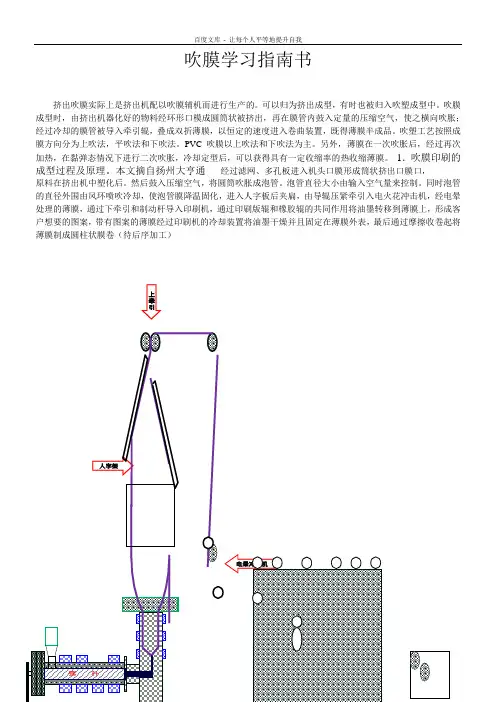
吹膜工艺流程
- 格式:docx
- 大小:16.07 KB
- 文档页数:7
吹膜工艺流程
Blown Film Process: A Comprehensive Guide。
The blown film process is a popular method used in the
manufacturing of plastic films for various applications. It
involves the extrusion of a molten polymer through a
circular die, followed by the inflation of the extruded
tube to the desired thickness and width. This process is
widely used in the packaging industry for the production of
bags, pouches, and other flexible packaging products. In
this article, we will discuss the blown film process in
detail, including the equipment used, the materials
involved, and the various parameters that affect the
quality of the final product.
Equipment Used in the Blown Film Process。
The blown film process requires several pieces of
equipment, including an extruder, a die, an air ring, a
collapsing frame, and a winding system. Let's take a closer look at each of these components.
Extruder: The extruder is the heart of the blown film
process. It is a machine that melts and homogenizes the
plastic resin and feeds it to the die. The extruder
consists of a hopper, a barrel, and a screw. The hopper is
where the resin is loaded, and the screw is responsible for
moving the material through the barrel and melting it. The
barrel is heated to maintain a consistent temperature, and
the screw is designed to create a pressure gradient that
forces the molten plastic through the die.
Die: The die is a circular-shaped component that shapes
the molten plastic into a tube. It is made up of two parts:
the mandrel and the die ring. The mandrel is a rod that
sits in the center of the die and creates the inner
diameter of the tube. The die ring is a circular plate that
surrounds the mandrel and shapes the outer diameter of the
tube.
Air Ring: The air ring is a device that blows air onto
the extruded tube to cool it down and stabilize its shape. It is located at the exit of the die and is designed to
provide a uniform flow of air around the tube.
Collapsing Frame: The collapsing frame is a set of
rollers that flattens the tube as it exits the air ring. It
is designed to prevent the tube from collapsing and to
maintain its shape.
Winding System: The winding system is responsible for
collecting the finished film and winding it onto a roll. It
consists of a set of rollers that guide the film onto a
core and a motor that drives the system.
Materials Used in the Blown Film Process。
The blown film process can be used with a variety of
plastic resins, including polyethylene, polypropylene, and
polystyrene. Each of these materials has its own unique
properties and is used for different applications.
Polyethylene (PE): PE is the most commonly used plastic
resin in the blown film process. It is a thermoplastic polymer that is lightweight, flexible, and easy to process.
PE films are used in a wide range of applications,
including food packaging, agricultural films, and
industrial packaging.
Polypropylene (PP): PP is another popular plastic resin
used in the blown film process. It is a thermoplastic
polymer that is lightweight, strong, and resistant to
moisture. PP films are used in a variety of applications,
including food packaging, medical packaging, and industrial
packaging.
Polystyrene (PS): PS is a thermoplastic polymer that is
lightweight and rigid. It is commonly used in the
production of disposable cups, plates, and other food
packaging products.
Parameters that Affect the Quality of the Blown Film。
Several parameters can affect the quality of the blown
film, including the melt temperature, the die gap, the air
ring gap, the take-up speed, and the cooling rate.
Melt Temperature: The melt temperature is the
temperature at which the plastic resin is melted in the
extruder. It is important to maintain a consistent melt
temperature to ensure that the plastic is melted evenly and
that the final product has the desired properties.
Die Gap: The die gap is the distance between the
mandrel and the die ring. It is important to maintain a
consistent die gap to ensure that the tube is formed evenly
and that the final product has the desired thickness.
Air Ring Gap: The air ring gap is the distance between
the air ring and the extruded tube. It is important to
maintain a consistent air ring gap to ensure that the tube
is cooled evenly and that the final product has the desired
properties.
Take-Up Speed: The take-up speed is the speed at which
the finished film is wound onto the roll. It is important
to maintain a consistent take-up speed to ensure that the
film is wound evenly and that the final product has the