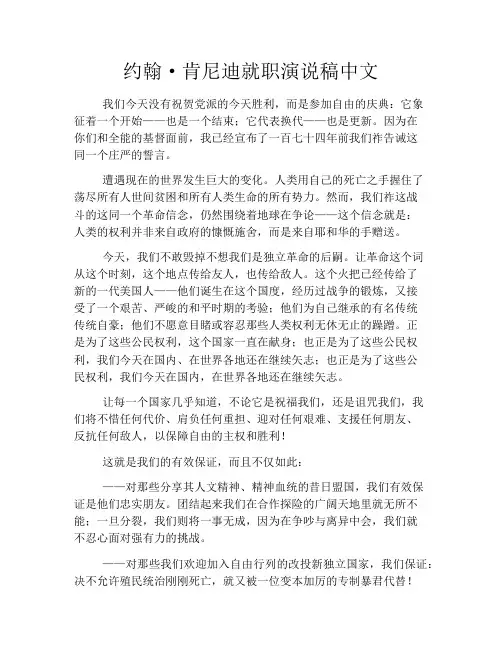
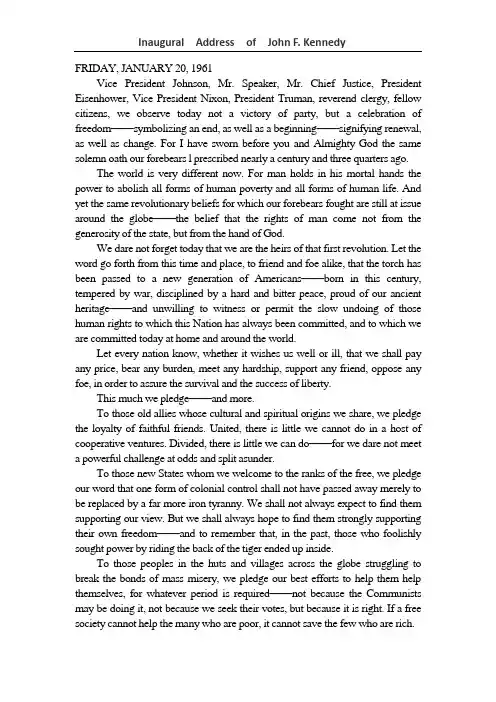
美国最年轻总统肯尼迪的就职演说
- 格式:doc
- 大小:180.00 KB
- 文档页数:7
『美国最年轻总统肯尼迪的就职演说』
2001-10-13 0:29:00 出处: 作者: 阅读 5814 次
右键另存为下载语音
John F. Kennedy INAUGURAL ADDRESS
FRIDAY, JANUARY 20, 1961
Vice President Johnson, Mr. Speaker, Mr. Chief Justice, President
Eisenhower, Vice President Nixon, President Truman, reverend clergy,
fellow citizens, we observe today not a victory of party, but a
celebration of freedom--symbolizing an end, as well as a
beginning--signifying renewal, as well as change. For I have sworn
I before you and Almighty God the same solemn oath our forebears l
prescribed nearly a century and three quarters ago.
The world is very different now. For man holds in his mortal hands
the power to abolish all forms of human poverty and all forms of human
life. And yet the same revolutionary beliefs for which our forebears
fought are still at issue around the globe--the belief that the rights
of man come not from the generosity of the state, but from the hand
of God.
We dare not forget today that we are the heirs of that first revolution.
Let the word go forth from this time and place, to friend and foe alike,
that the torch has been passed to a new generation of Americans--born
in this century, tempered by war, disciplined by a hard and bitter
peace, proud of our ancient heritage--and unwilling to witness or
permit the slow undoing of those human rights to which this Nation
has always been committed, and to which we are committed today at home and around the world.
Let every nation know, whether it wishes us well or ill, that we shall
pay any price, bear any burden, meet any hardship, support any friend,
oppose any foe, in order to assure the survival and the success of
liberty.
This much we pledge--and more.
To those old allies whose cultural and spiritual origins we share,
we pledge the loyalty of faithful friends. United, there is little
we cannot do in a host of cooperative ventures. Divided, there is
little we can do--for we dare not meet a powerful challenge at odds
and split asunder.
To those new States whom we welcome to the ranks of the free, we pledge
our word that one form of colonial control shall not have passed away
merely to be replaced by a far more iron tyranny. We shall not always
expect to find them supporting our view. But we shall always hope to
find them strongly supporting their own freedom--and to remember that,
in the past, those who foolishly sought power by riding the back of
the tiger ended up inside.
To those peoples in the huts and villages across the globe struggling
to break the bonds of mass misery, we pledge our best efforts to help
them help themselves, for whatever period is required--not because
the Communists may be doing it, not because we seek their votes, but
because it is right. If a free society cannot help the many who are
poor, it cannot save the few who are rich.
To our sister republics south of our border, we offer a special
pledge--to convert our good words into good deeds--in a new alliance
for progress--to assist free men and free governments in casting off
the chains of poverty. But this peaceful revolution of hope cannot
become the prey of hostile powers. Let all our neighbors know that we shall join with them to oppose aggression or subversion anywhere
in the Americas. And let every other power know that this Hemisphere
intends to remain the master of its own house.
To that world assembly of sovereign states, the United Nations, our
last best hope in an age where the instruments of war have far outpaced
the instruments of peace, we renew our pledge of support--to prevent
it from becoming merely a forum for invective--to strengthen its
shield of the new and the weak--and to enlarge the area in which its
writ may run.
Finally, to those nations who would make themselves our adversary,
we offer not a pledge but a request: that both sides begin anew the
quest for peace, before the dark powers of destruction unleashed by
science engulf all humanity in planned or accidental
self-destruction.
We dare not tempt them with weakness. For only when our arms are
sufficient beyond doubt can we be certain beyond doubt that they will
never be employed.
But neither can two great and powerful groups of nations take comfort
from our present course--both sides overburdened by the cost of modern
weapons, both rightly alarmed by the steady spread of the deadly atom,
yet both racing to alter that uncertain balance of terror that stays
the hand of mankind's final war.
So let us begin anew--remembering on both sides that civility is not
a sign of weakness, and sincerity is always subject to proof. Let us
never negotiate out of fear. But let us never fear to negotiate.