
【精品报告】埃森哲-十年努力:CEO可持续发展目标调查(英文)
- 格式:pdf
- 大小:46.18 MB
- 文档页数:43


e in LeadershipThe Essence of Effective LeadershipEffective leadership is a crucial factor in the success of any organization. A good leader can inspire and motivate their team to achieve great things, while a poor leader can demotivate and demoralize their team, leading to poor performance and even failure. In this essay, we will explore the essence of effective leadership from multiple angles, including the qualities of a good leader, the importance of communication, the role of emotional intelligence, and the need for adaptability.Qualities of a Good LeaderOne of the most important qualities of a good leader is the ability to inspire and motivate their team. A good leader should be able to communicate their vision and goals clearly, and create a sense of purpose and direction for their team. They should also be able to lead by example, demonstrating the values and behaviors they expect from their team.Another important quality of a good leader is the ability to make tough decisions. Leaders are often faced with difficult choices, and a good leader should be able to weigh the pros and cons of each option and make a decision that is in the best interests of the organization and its stakeholders.Finally, a good leader should be able to build and maintain strong relationships with their team members, stakeholders, and partners. This requires empathy, communication skills, and a willingness to listen and understand the perspectives of others.Importance of CommunicationEffective communication is essential for effective leadership. A good leader should be able to communicate their vision and goals clearly, and ensure that their team members understand their roles and responsibilities. They should also be able to provide feedback and guidance to their team members, and listen to their concerns and ideas.Communication is also important for building trust and rapport with team members. A good leader should be approachable and open to feedback, and should create a safe andsupportive environment where team members feel comfortable sharing their thoughts and ideas.Role of Emotional IntelligenceEmotional intelligence is another important factor in effective leadership. Emotional intelligence refers to the ability to understand and manage one's own emotions, as well as the emotions of others. A good leader should be able to recognize and regulate their own emotions, and should also be able to empathize with the emotions of their team members.Emotional intelligence is important for building strong relationships with team members, as well as for resolving conflicts and managing difficult situations. A leader with high emotional intelligence is able to stay calm and composed under pressure, and can help their team members do the same.Need for AdaptabilityIn today's fast-paced and constantly changing business environment, adaptability is a crucial trait for effective leadership. A good leader should be able to adapt to new challenges and opportunities, and should be able to pivot quickly when necessary.Adaptability requires flexibility, creativity, and a willingness to take risks. A good leader should be able to think outside the box and come up with innovative solutions to problems, and should be able to inspire their team members to do the same.ConclusionIn conclusion, effective leadership is essential for the success of any organization. A good leader should possess qualities such as the ability to inspire and motivate their team, make tough decisions, and build strong relationships. They should also be skilled in communication, emotional intelligence, and adaptability. By cultivating these qualities, leaders can create a positive and productive work environment that fosters growth and success for all.。

科技类词汇对应阅读passage1A snake﹣robot designer,a technologist,an extradimensional physicist and a journalist walk into a room.The journalist turns to the crowd and asks:Should we build houses on the ocean?Like a think﹣tank panel,members of the team dream up far﹣out answers to the crucial problem,such as self﹣driving housing units that could park on top of one another in the coastal city center.The setting is X,the enterprise which considers more than100ideas each year,in areas ranging from clean energy to artificial intelligence.Although only a tiny percentage become"projects"with far﹣reaching creativity,these projects exist,ultimately,to change the world,like Waymo,the biggest self﹣driving﹣car company.In the past60years,something strange has happened.As the academic study of creativity has thrived (蓬勃发展),the label innovation may have covered every tiny change of a soda can or a toothpaste flavor,but the rate of productivity growth has been mostly declining since the1970s.John Fernald,an economist,points out that the notable exception to the post﹣1970decline in productivity occurred when businesses throughout the economy finally figured out the breakthrough technology﹣information technology.John Fernald says,"It's possible that productivity took off,because we picked all the low﹣hanging fruit from the IT wave."Actually,the world economy continues to harvest the benefits of IT.But where will the next technology shock come from?Breakthrough technology results from two distinct activities﹣invention and innovation.Invention is typically the work of scientists and researchers in labs,while innovation is an invention put to commercial use.Seldom do the two activities occur successfully under the same roof.They tend to thrive in opposite conditions;while competition and consumer choice encourage innovation,invention has historically progressed in labs that are protected from the pressure to generate profit.Allowing well﹣funded and diverse teams to try to solve big problems is what gave us the computer and the Internet.Today,we fail to give attention to planting the seeds of this kind of ambitious research,while complaining about the harvest."Companies are really good at combining existing breakthroughs in ways that consumers like.But the breakthroughs come from patient and curious scientists,not the rush to market,"says Jon Gertner,the author of The Idea Factory."Technology is a tall tree,"John Fernald said."But planting the seeds of invention and harvesting the fruit of innovation are entirely distinct skills,often mastered by different organizations and separated by manyyears."As for me,both of them are essential for technology,although they are relatively independent.I don't think X is a planter or a harvester,actually.It is like building taller ladders.Nobody knows for sure what,if anything,the employees at such enterprises are going to find up on those ladders.But they're reaching.At least someone is.(1)What is the main purpose of the first two paragraphs?A.To present the process of group discussion.B.To illustrate X's worry about big problems.C.To reveal the importance of the crazy ideas.D.To stress the varied backgrounds of the team.(2)What can we learn from the passage?A.Breakthroughs must stand the test of the market.B.Innovation on necessities can promote productivity.C.Invention develops slowly under the pressure of profit.D.The harvest of innovation lies in some ambitious research.(3)Regarding John Fernald's view on technology,the author is.A.supportiveB.cautiousC.uncertainD.critical(4)What can be inferred about X from the passage?A.It will focus on innovation.B.It will have its outcome soon.C.It may give in to its fruitless reality.D.It may bring an encouraging outlook.【分析】这是一篇说明文。

17可持续发展目标英语The 17 Sustainable Development Goals (SDGs) were adopted by the United Nations in 2015 as a universal call to action to end poverty, protect the planet, and ensure that all people enjoy peace and prosperity by 2030. These goals are interconnected and focus on various areas such as poverty eradication, health, education, gender equality, water and sanitation, sustainable cities, climate action, and partnerships for sustainable development. They are as follows:1. No Poverty: End poverty in all its forms everywhere.2. Zero Hunger: End hunger, achieve food security, and improve nutrition and promote sustainable agriculture.3. Good Health and Well-being: Ensure healthy lives and promote well-being for all at all ages.4. Quality Education: Ensure inclusive and equitable quality education and promote lifelong learning opportunities for all.5. Gender Equality: Achieve gender equality and empower all women and girls.6. Clean Water and Sanitation: Ensure availability and sustainable management of water and sanitation for all.7. Affordable and Clean Energy: Ensure access to affordable, reliable, sustainable, and modern energy for all.8. Decent Work and Economic Growth: Promote inclusive and sustainable economic growth, employment, and decent work for all.9. Industry, Innovation, and Infrastructure: Build resilient infrastructure, promote inclusive and sustainable industrialization, and foster innovation.10. Reduced Inequalities: Reduce inequality within and among countries.11. Sustainable Cities and Communities: Make cities and human settlements inclusive, safe, resilient, and sustainable.12. Responsible Consumption and Production: Ensure sustainable consumption and production patterns.13. Climate Action: Take urgent action to combat climate change and its impacts.14. Life Below Water: Conserve and sustainably use the oceans, seas, and marine resources for sustainable development.15. Life on Land: Protect, restore, and promote sustainable use of terrestrial ecosystems, sustainably manage forests, combat desertification, halt and reverse land degradation, and halt biodiversity loss.16. Peace, Justice, and Strong Institutions: Promote peaceful and inclusive societies for sustainable development, provide access to justice for all, and build effective, accountable, and inclusive institutions at all levels.17. Partnerships for the Goals: Strengthen the means of implementation and revitalize the global partnership for sustainable development.These goals require collective action from governments, civil society, businesses, and individuals to create a more sustainable and equitable world for future generations.。
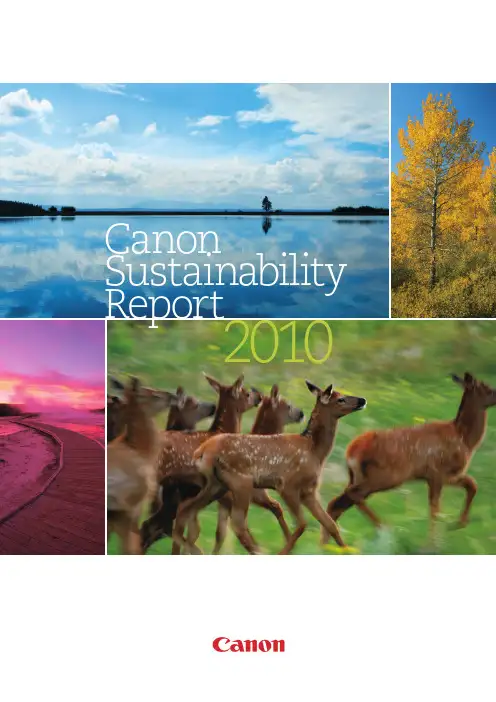
Canon Sustainability Report2010Tsuneji Uchida Fujio MitaraiChairman and CEOAs we advance along a new growth path, we will continue to fulfill our social responsibilities, as befits a truly excellent global corporation.Heading into the Final Year of Phase III of the Excellent Global Corporation PlanThe harsh management environment, stemming from the global recession, continued during 2009. We responded with a major shift in direction for Phase III of the Excellent Global Corporation Plan—our medium- to long-term management plan, which we launched in 2006— moving from a focus on sound growth to that of improving management quality. Based on the achievements of management reforms to date, we promoted the unificationof information, from planning and design to sales and after-sales service, through IT reforms to achieve total optimization and management efficiency. In addition, Canon boosted thein-house production of core parts, implemented structural reforms, upgraded product lineups and reinforced its global sales network. Despite unavoidable decreases in sales and profits, we maintained our sound financial structure while preparing to take the offensive in the face of challenging conditions.In 2010, we will close out the final year of Phase III ofour Excellent Global Corporation Plan by again setting the Company on a new growth path, following through with various measures and policies in pursuit of our goal to become a truly excellent global corporation.In order to ensure that Canon continues to develop over the next 100, and even 200, years, and takes its place as a corporation worthy of admiration and respect worldwide, we have adopted a longer-term perspective in our efforts involving matters related to our corporate management foundation and themes aimed at contributing to the realization of a sustainable society. We are making steady progress in this regard in several areas, including our environmental activities along with measures to maintain and improve compliance, quality and safety, and implement employment initiatives.A New Start with 2010 as Our First Yearof Renewed GrowthWe have set 2010 as the first year of a new era of growth. Important steps toward achieving this goal include the formulation and implementation of policies and measures to overcome the global recession.By bolstering our R&D efforts, we aim to create innovative products and services and cultivate new business areas. Moreover, the Company is improving its foundation in termsof development, production and sales networks toward the realization of its Three Regional Headquarters system.In addition, we are placing greater emphasis on raising management quality, while promoting IT system reforms and the elimination of every form of waste from our operations. Renewing Our Pledge to the Environment, Compliance and QualityIn addition to formulating growth strategies, fulfilling oursocial responsibilities is a key objective for 2010. We are further strengthening our foundation toward becoming a truly excellent global corporation.We launched our “Action for Green” environmental visionin 2009 as a statement of our environmental consciousness, currently standard practice in the corporate world. This vision steers us toward achieving a balance between social prosperity and environmental sustainability. Looking at the entire product lifecycle—Produce, Use, Recycle—we are working aggressivelyin collaboration with our customers and business partnersto promote reduced CO2 emissions, the effective utilizationof resources, and the elimination of hazardous substances.We feel that these are important responsibilities for a global corporation.In addition, we are reinforcing compliance toward thefurther promotion of globalization. Canon abides with all national and local laws and regulations in the countries and regions in which it operates, in addition to acting in accordance with social norms and moral values.Recognizing quality as the lifeline of a manufacturing company, Canon is making a concerted effort, working tirelesslyto not only maintain, but also continually improve the quality of its products, services and operations.Cultivating Quality Human Resourcesthat Contribute to a Sustainable SocietyAn excellent global corporation is defined by the excellence ofits corporate culture. Respect for human dignity, an emphasison technology and an enterprising spirit have all made up Canon’s corporate DNA since its foundation, along with the Company’s guiding principle of the “Three Selfs” spirit (self-motivation, self-management and self-awareness). By further instilling our corporate DNA and guiding principles, we will continue to cultivate high-quality personnel capable of risingto the challenges of the new age, and also continue efforts to establish ourselves as a company that can maintain sustainable growth. As we pursue our corporate philosophy of kyosei,we will continue to fulfill our social responsibilities as a truly excellent global corporation hand in hand with our customers, investors, suppliers, employees and other stakeholders aroundthe globe.We thank you for your understanding and look forward to your continued support in the future.Canon Sustainability Report 20104Facsimile machinesLCD lithography system Multifunction inkjet printerDigital radiography system60 in total, including consumers, suppliers, investors, analysts, as well as NPOs and NGOs in Japan, theThe CK (Canon-Kyoto University Cooperative Research) Project was launched in 2006 to contribute to preventative care through the early detection and treatment of diseases.One primary research theme of the project has been visualization of the inside of the body using the photoacoustic effect for the development of optical ultrasound mammography that will aid the early detection of breast cancer. The photoacoustic effect refers to body tissue absorbing optical energy and emitting ultrasonic waves when distended. Using thisphenomenon, ultrasonic waves generated by body tissue irradiated by a near-infrared laser beam can be detected by a sensor, facilitating observation of blood vessels with high absorption of near-infrared light. This simplifies investigation of angiogenesis * and bloodflow irregularities that can be observed during the formation of carcinoma cells and cancer-specific hypoxia and other indicators, thus enabling early cancer detection.There has been a significant worldwide increase in the number of cancer patients in recent years. However, the mortality rate is on a downtrend. This contrary pattern is attributable to the effectiveness of x-ray mammography. The ultrasound mammography under development by Canon differs from broadly utilized x-ray mammography techniques in that it is free from the dangers of x-ray exposure. As a result of this reduced physical burden duringexamination, the widespread adoption of ultrasound mammography is anticipated to contribute greatly to raising detection rates.At present, the CK Project targets practical application of ultrasound mammography as an aid for early detection of breast cancer and diagnosis as to whether cancers are benign or malignant. Currently, we are advancing with equipment performance improvements and preparing for clinical trials.Canon will continue to focus on developing technologies that contribute to improvements in quality of life so that people can enjoy better health as they go about their everyday lives.Pursuing R&D to Boost the Screening Rate for Breast Cancer through Optical Ultrasound Mammography* A ngiogenesis is a physiological process involving the growth of new blood vessels from pre-existing vessels to form a vascular network. This effect has an impact on the proliferation of cancer cells.Visualization of the Inside of the Body Using the Photoacoustic Effect for Early Detection of Pathological ChangesSignificant Alleviation of the Burden Incurred during Breast Cancer ExaminationsResearch conducted as part of the CK Project at Kyoto UniversityCord guides made from recycled plasticAs part of the WWF-Canon Polar Bear TrackerProgram, Canon Europe and WWF have established an environmental education website targeting seven- to 11-year-olds in 13 languages. The site allows students to learn both the environmental threats the bears face and the importance of global environmental conservation through quizzes, games and other media exploring the environment of the Arctic Circle, including the ecology of polar bears. In addition, Canon is creating environmental education tools for fourth and fifth graders.These are provided free of charge to educational institutions throughout Europe. During 2009, these materials were distributed to elementary schoolsthroughout Austria, with the backing of the Austrian Ministry of Education, Arts and Culture, to enhance understanding of global environmental preservation.Supporting the Tracking of Polar Bears, as a WWF Conservation Partner, to Asses the Impact of Climate Change on Their Habitat and Promoting Environmental Education ProgramsSupporting Environmental Studies on the Impact of Global Warming by Tracking Polar BearsA lesson utilizing Canon’s environmental materials at Mondweg Elementary School in Vienna, AustriaPromotion of Environmental Education by Tracking Polar BearsNowhere in the world is the impact of global warming more evident than at the North Pole. Ecological studies of the polar bears that live atop the ice flows of the Arctic Circle are an effective way to determine the state of global warming. Canon Europe, which became a Worldwide Fund for Nature (WWF) conservation partner in 1998, has provided support for the organization’s Polar Bear Tracker Project since 2007.For this project, polar bears are fitted withtransmitter collars, enabling their movements to be tracked by satellite and viewed on a publicly accessible website. By tracking the movements of polar bears,we will learn more about how they use their natural habitat and how they are adapting to the changes in sea ice due to the effects of climate change.© Michel Terrettaz / WWF-CanonEnvironmental education websiteContributing to the Cultivation of Human Resources for the Next Generation by Supporting Educational Infrastructure Development in VietnamSupport for the Construction, Enlargement and Improvement of School BuildingsThere are many mountainous regions in Vietnam in which it is difficult for children to acquire an adequate education.In addition to carrying out business activities, Canon Vietnam Co., Ltd., is following through on its desire to be of service to the community through the Canon Friendship School Chain Project, launched in 2007. Thisinitiative supports the construction, enlargement and improvement of school buildings. By the end of 2008, the project had reached out to 12 schools. Support for construction of new schools spanned four provinces in 2009, including the Canon-Cuu Tu Elementary School in Quevo District, Bac Ninh Province.Support for Schoolchildren through Distribution of Educational Materials and Employee Volunteer ActivitiesCanon Singapore and Canon’s Vietnam representative office initiated “Canon-For the Next Generation” in April 2009 as an educational support program.Through this project, we help supply pencils, textbooks, notebooks, desks and other materials and facilities indispensable for school education. In addition, Canon employees visit schools, volunteering to help with such tasks as the installation of purification systems for drinking water, the maintenance and repair of toilet facilities and school buildings, and the planting of trees,while also taking time to interact with the childrenpersonally. During 2009, these activities were carried out in nine schools over a period of eight months, providing the equivalent of 400 million dong in supplies.Canon aims to continue supporting such endeavors in line with its belief that improving the educational environment for children is a step toward cultivating the human resources on which the future and development of the country depend.Students at Canon-Bet Tray Elementary School, which was constructed through the Canon Friendship School Chain ProjectStudents at Canon-Cuu Tu Elementary School Employees taking part in Canon-For the Next Generation activitiesVIXIA HF S21 (LEGRIA HF S21 in some areas) digital video cameraVoice-recognition controlConference for individual investorsalong the Great Wall in China.Tree cultivation as part of the FOR A GREEN VIETNAM campaign30-2, Shimomaruko 3-chome, Ohta-ku, Tokyo 146-8501, Japan Contact usTEL: +81-3-3758-2111E-mail: sus@list.canon.co.jpWebsite:/environmentCanon Sustainability Report 2010, published July 2010 (Next scheduled publication: July 2011)This brochure is printed on paper certified by the Forest Stewardship Council with ink that realizes superior decomposability and deinkability.PUB.ECO06E 1007SZ8.7 Printed in JapanThe world-famous Yellowstone National Park is located within the United States in Wyoming. Canon U.S.A., Inc., supports the Eyes On Yellowstone research and education program by providing product to enable ecological observation of wildlife and assisting in the creation of website content for the Yellowstone Park Foundation. Through these and other initiatives, we contribute to the conservation of the natural environment and the protection of endangered species.About the Cover Photograph。