北师大版高中英语必修一 Unit 2 Communication Workshop教学课件
- 格式:ppt
- 大小:3.55 MB
- 文档页数:31
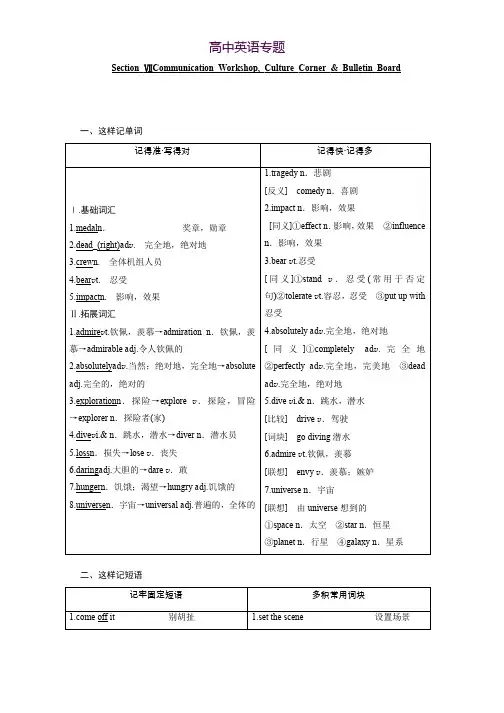
Section_ⅦCommunication_Workshop,_Culture_Corner_&_Bulletin_Board 一、这样记单词二、这样记短语三、这样记句式1.(教材P30)Make notes about your opinions. (e.g. who you admire—Ge Fei, the badminton champion)记录你们的观点。
(例如,你钦佩的人——羽毛球冠军葛菲)admire vt.钦佩,羡慕;欣赏compliments(赞美).(2013·湖北高考短文写作)同桌非常羡慕我流利的英语,我经常被他的赞美所鼓舞。
②We admire the old scientist for his great contribution to the country.我们钦佩这位老科学家对国家作出的巨大贡献。
③We expressed/had_admiration_for the soldiers, who behaved bravely in the action.我们对解放军战士在这次行动中英勇的表现表示钦佩。
2.(教材P32)For the families of the seven, we cannot bear, as you do, the full impact of this tragedy.对于这七位英雄的家庭来说,我们也像你们一样,不能承受这次悲剧的巨大冲击。
bear v.容忍;忍耐;支撑,承担(责任) n.熊她担心自己不能忍受疼痛。
②My leg was painful, and I wasn’t sure if it would bear my weight.我的腿很痛,不知道是否能承受我身体的重量。
③She can’t bear to be looked down by others.=She can’t bear/stand being_looked (look) down by others.她无法忍受被人瞧不起。
Unit2 Communication Workshop 重难点词汇详解1. come off it 别胡扯come off it(粗鲁地表示不同意)别胡扯,别胡说,住口。
教材原文Oh, come off it!噢,别胡扯!经典例句①Come off it!We don't have a chance of winning the match.别胡扯了!我们没有希望赢这场比赛。
②Now, come off if, Henry!Tell the truth!得了,亨利,别胡扯了!快讲实话!2. suppose v. 认为,猜想教材原文I suppose…but…我认为……但是……经典例句①—Do you suppose it is going to snow?—I suppose so/not.——你认为会下雪吗?—我想会吧。
/我想不会。
②You're not supposed to smoke in the office.你不可以在办公室里吸烟。
③Everyone supposes him to be poor, but he is really quite wealthy.大家都以为他穷,但是他的确很富有。
④Suppose/Supposing (that) he is out of work, what will his children do?假如他失业了,他的孩子们怎么办?⑤It was generally supposed that it would not happen again.一般都认为此事不会再发生。
(It为形式主语,真正的主语是that从句)3. point n. 要点教材原文You've got a point there. 你说的有道理。
经典例句句①She tried in vain to point out to him the unfairness of his actions.她试图向他指出他的做法不公正,但无济于事。
《Unit 2 Heroes》Communication WorkshopObjectives■To prepare for a discussion by making notes.■To participate in a discussion, expressing opinions, agreeing and disagreeing.■To listen for expressions of agreement and disagreement in a conversation.■To write a narrative in three paragraphs.■To develop self-assessment of speaking and writing skills.Resources usedCassette, Writing Help 2.Possible problems■Students, if friends, may agree with each other in group discussion and so not practise disagreeing. Grouping students in different groups may prevent this happening.■Students’ability to assess their own language skills will vary.BackgroundMa Lin is a Chinese table tennis star. Born in Shenyang City, Liaoning Province, Ma Lin started to play table tennis at an early age of 6 and was inducted into the national team in 1994 when he was only 14. Ma Lin won the 2000 World Cup to become China’s first men’s singles world champion. In 2002, he again became the first Chinese to win a men’s singles title under the new system, also at the World Cup tournament in 2003. In the 2004 Athens Olympic Games, Chen Qi/Ma Lin, known as China’s new “golden pair”, won the mixed doubles and became the Olympic champion. However, Ma Lin failed to win the men’s singles in Athens, which is considered to be his tragic loss. At present, he is considered to be the strongest player in the world.Liu Xiang, the 21-year-old Shanghai native, is considered to be a hero, a super hero. He is the pride of China. He b ecame the first Asian in history to win the men’s 110m hurdles at the Olympic Games in Athens on Friday, Aug. 27, 2004. He clocked a world record-equaling time of 12.91 seconds for his first Olympic title. He also broke the Olympic record of 12.95 seconds set by Allen Johnson of the United States in the Atlanta Olympic Games in 1996. Liu is the first Chinese athlete to take Olympic gold in the short-distance race, which used to be dominated by Americans and Europeans. His time of 12.91 seconds equalled the mark set by Briton Colin Jackson at the 1993 world championships in Stuttgart, Germany. Liu Xiang, China’s first-ever male Olympic gold winner in track and field, was believed to be likely to break the world record in the men’s 110m hurdles in 2005.Gao Ling took up badminton in Wuhan Gymnasium Sparetime Sports School at age of six. She began regular training in Hubei provincial sports school in 1989 and joined the national team in February 1997. Gao Ling, with Yang Wei, won the women’s doubles in the 1996 World Youth Championships. She and Zhang Jun became the Olympic champion of themixed doubles in the 2000 Sydney Olympic Games.In 2002, Gao Ling was named Best Badminton Player of 2001. Again, Gao Ling and Zhang Jun won the mixed doubles and became the Olympic Champion in the 2004 Athens Olympic Games. Guo Jingjing was born in the province of Hebei. Guo won diving competitions at every level as a youngster, earning aselection to the China team that went to the 1996 AtlantaGames, where she finished fifth in the 10m platform at thetender age of 15. Ever since then, she has won almost everyhonour available in the world of diving. In the 2004 AthensOlympic Games, she became the Olympic Champion ofwomen’s singles and she and Wu Minxia won the Oly mpicgold of the women’s doubles in Athens.James Dean (1931-1955) was an American actor whosemoody performances and early death made him a symbol ofyouthful rebellion. He made only three films (Rebel Without a Cause, East of Eden and Giant) before dying in a car crash.Routes through the material■If you are short of time, omit the Talkback stage of thespeaking and writing workshops.Language Power: pages 74?C75.Speaking: DiscussionBefore you startExercise 1■Students read the introduction to the exercise and look at the photos. Ask them to guess which student likes which sports stars.■Play the cassette for students to check their guesses.TapescriptInterviewer: Welcome to this week’s “My Favourite SportsHeroes”. Today, we have two students, Zheng Hua and Hu Jun from Shenya ng Number 1 High School. Welcome. So Zheng Hua, who are your favourite sports heroes?Zheng Hua: Well, I really like Guo Jingjing. She trains so hard and she always does her best in competitions. She’s also very pretty.Hu Jun: Oh, come off it. Yes, I su ppose she’s pretty, but I don’t think she’s the only hardworking sports star around. What about Gao Ling, the Olympic badminton champion? Every day, as part of her training, she wears special clothes filled with sand weighing 6 kilograms. Now that’s what I call hardworking.Zheng Hua: OK, but I still admire Guo Jingjing.Interviewer: Hu Jun, who are your favourite sports heroes?Hu Jun: I guess I have to go for Liu Xiang, the men’s hurdle champion.Zheng Hua: Mmm..., you’re dead right about Liu Xiang. H e did really well in the 2004 Olympic Games and won honour not only for Chinese people but for people all over Asia too. He’s great! Hu Jun: Absolutely!Zheng Hua: But there are lots of other great sports stars like him. For example, er..., Ma Lin, thetable tennis champion. In the 2004 Olympics, he won the gold medal.Hu Jun: That’s true. You’ve got a point there.AnswersHu Jun ?C?C?C Gao Ling Zheng Hua ?C?C?C Guo JingjingBoth ?C?C?C Liu Xiang, Ma LinExercise 2■ Students read the expressions in the Function File and predict which show strong agreement, limited agreement or disagreement.■ Play the cassette so that students can hear the stress and intonation in the voices and mark the expressions (++), (+), (-).Answers(++) You’re dead right. Absolutely. That’s true.(+) OK, but ... You’ve got a point there. I suppose ... but ...(-) Oh, come off it.■ Play the cassette again, pausing after each expression so that students can repeat it with appropriate stress and intonation.Stage 1■ Each student chooses a hero or heroine from films, music or sport to talk about. Students can work in pairs, if you prefer.■ Read the Strategies with the students. Ask them if they follow similar procedures when they have discussions in other school subjects.■ Give students time to make notes and to practise expressions for giving opinions, agreeing and disagreeing.Stage 2■ Students work in groups of three or four, discussing their heroes/heroines. Each group might like to appoint a secretary to note down their agreements and report back to the class in the next stage. As the groups are working, go round and monitor their language but don’t interrupt the discussion. Any general mistakes can be brought to their attention at the end of the discussion and remedial practice given, if necessary.Stage 3■ The groups report back to the class on their agreements (and disagreements, if you wish). Talkback■ Students answer the questions about their own performance in the speaking activity.■ Have an open discussion about the mistakes students remember t hey made and use this opportunity to draw their attention to any common mistakes you noticed.ListeningExercise 1■ Students discuss what they know of James Dean, his life and his films.Exercise 2■ Students read the lyrics and predict where the mis sing words might fit.■ Students listen to the song, complete the lyrics and see if their predictions were correct. Answers1. mean2. clean3. screen4. was5. cause6. fast7. young。