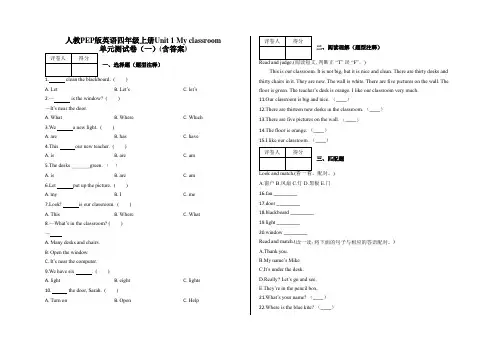
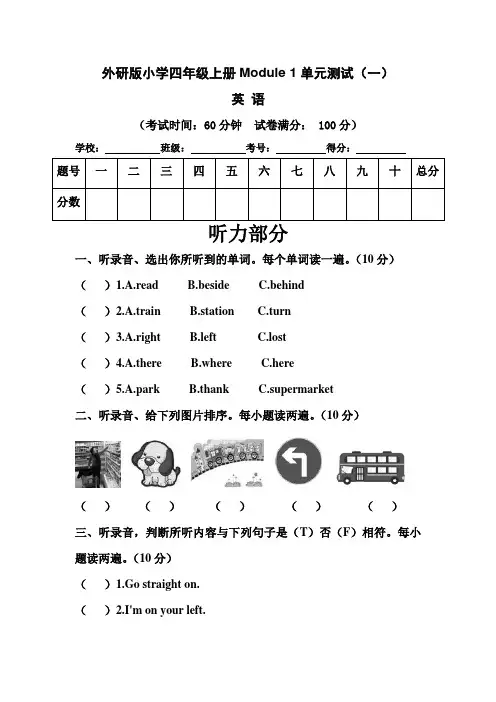
四年级英语上册第一单元测试卷
- 格式:docx
- 大小:14.58 KB
- 文档页数:9
博学笃行 自强不息
1
四年级英语上册第一单元测试卷
Part 1: Listening
1. Listen and choose the correct picture. (5 points)
You will hear five sentences. Look at the pictures and choose
the correct one that matches the sentence you hear. Write
the corresponding letter in the box provided.
Example:
Sentence: The cat is sleeping.
Picture: (B)
Answer: B
1. Sentence: The boy is playing football.
Picture:
Answer:
2. Sentence: The girl is reading a book.
Picture:
Answer: 博学笃行 自强不息
2
3. Sentence: The dog is barking.
Picture:
Answer:
4. Sentence: The teacher is writing on the blackboard.
Picture:
Answer:
5. Sentence: The students are listening to the teacher.
Picture:
Answer:
Part 2: Vocabulary
2. Match the words to their correct meanings. (10 points)
Match the words on the left with their correct meanings on
the right. Write the corresponding letter in the box provided.
Example:
Word: apple 博学笃行 自强不息
3
Meaning: a type of fruit
Answer: A
1. Word: table
Meaning: a piece of furniture with a flat surface and legs
Answer:
2. Word: chair
Meaning: a piece of furniture for one person to sit on, with a
back and four legs
Answer:
3. Word: book
Meaning: a written or printed work consisting of pages glued
or sewn together along one side
Answer:
4. Word: pen
Meaning: a writing instrument
Answer:
博学笃行 自强不息
4
5. Word: school
Meaning: an institution for educating children
Answer:
6. Word: bag
Meaning: a flexible container with an opening at the top
Answer:
7. Word: pencil
Meaning: a thin pointed instrument used for writing or
drawing
Answer:
8. Word: window
Meaning: an opening in the wall or roof of a building
Answer:
9. Word: door
Meaning: a movable barrier used to close an entrance
Answer: 博学笃行 自强不息
5
10. Word: teacher
Meaning: a person who helps students learn
Answer:
Part 3: Grammar
3. Fill in the blanks with the correct form of the verbs in
parentheses. (10 points)
Complete the sentences by filling in the blanks with the
correct form of the verbs in parentheses. Write your answers
in the space provided.
Example:
I (play) _____ football every day.
Answer: play
1. My brother (clean) _____ his room yesterday.
Answer:
2. They (eat) _____ lunch at twelve o'clock.
Answer: 博学笃行 自强不息
6
3. She (watch) _____ TV in the evening.
Answer:
4. We (study) _____ English at school.
Answer:
5. Tom (visit) _____ his grandparents last weekend.
Answer:
6. The cat (sleep) _____ on the couch now.
Answer:
7. The children (play) _____ in the park every evening.
Answer:
8. My parents (work) _____ in the office from Monday to
Friday.
Answer:
博学笃行 自强不息
7
9. The birds (sing) _____ loudly in the trees.
Answer:
10. The students (do) _____ their homework after school.
Answer:
Part 4: Reading Comprehension
4. Read the passage and answer the questions. (15 points)
Read the following passage carefully and answer the
questions below.
Last weekend, my family and I went to the zoo. We saw many
animals there. The monkeys were swinging from tree to tree.
The lions were sleeping under the shade. The elephants were
eating leaves. The giraffes were stretching their long necks to
reach the leaves on the trees. We had a great time!
Questions:
1. Where did the family go last weekend?
Answer: 博学笃行 自强不息
8
2. What were the monkeys doing?
Answer:
3. Where were the lions?
Answer:
4. What were the elephants eating?
Answer:
5. What were the giraffes doing?
Answer:
Part 5: Writing
5. Write a story. (20 points)
Write a story using the following words: cat, ball, tree, happy,
jump.
Remember to use correct punctuation, capitalization, and
grammar. 博学笃行 自强不息
9
Guidelines:
- Try to make your story interesting and engaging.
- Use descriptive words to create a vivid picture in your
reader's mind.
- Make sure your story has a clear beginning, middle, and end.
(Write your story on the back of this paper or on a separate
sheet.)
Total: 60 points
Note: The answers to the questions and the story writing
exercise are not provided as they are subjective and may vary
from person to person.