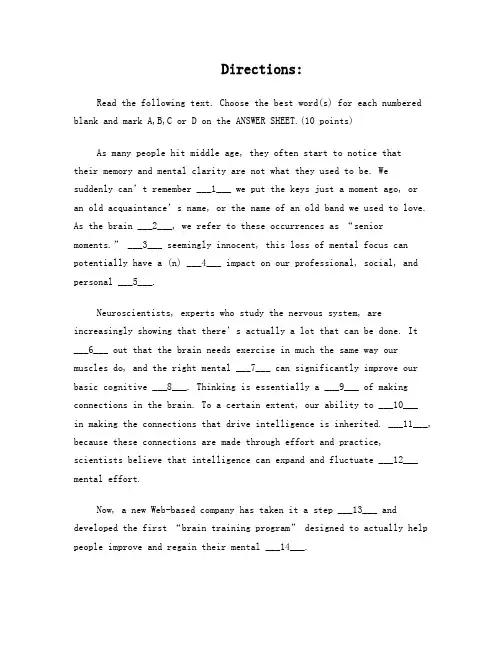
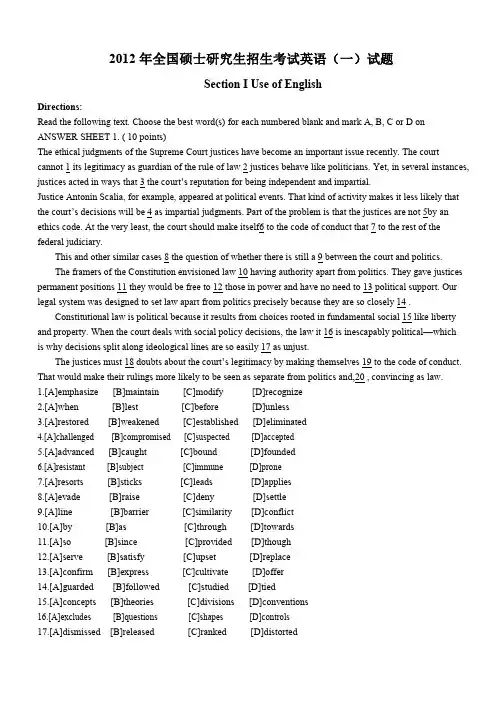
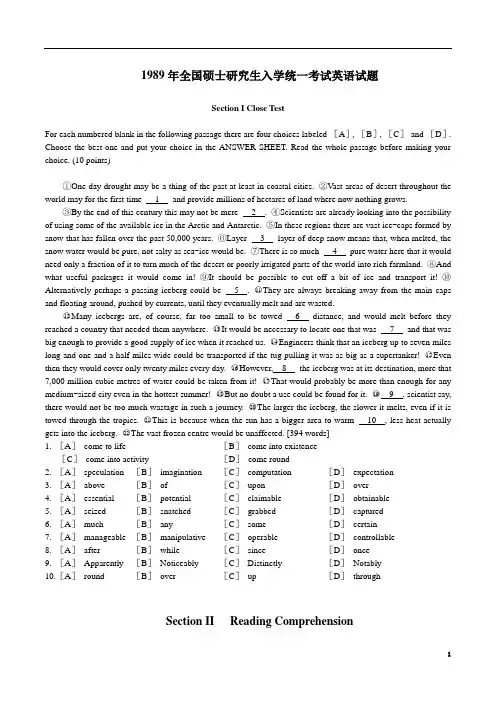
2014考研英语一真题(含答案解析)
- 格式:docx
- 大小:37.48 KB
- 文档页数:3
2014考研英语一真题(含答案解析)
Introduction:
The 2014 Graduate Entrance Examination (GEE) English Paper I is a
significant subject of discussion for candidates aspiring to pursue
postgraduate studies in China. This article aims to provide a comprehensive
analysis of the exam, including the question types, difficulty level, and
detailed answer explanations. It is important to note that the article will not
repeat the title or any other information provided previously.
Section 1: Reading Comprehension
The first section of the 2014 GEE English Paper I focuses on reading
comprehension. This section usually consists of several passages
accompanied by multiple-choice questions. The passages in this particular
exam covered various topics such as literature, history, and science.
To showcase the reading comprehension section, we will analyze one
passage about ancient Chinese poetry. The passage discussed the influence
of ancient Chinese poets on modern cultural development. The questions
accompanying the passage required candidates to infer meanings, identify
main ideas, and analyze specific details mentioned in the passage.
Section 2: Vocabulary and Grammar
The second section of the exam is designed to test candidates'
understanding of vocabulary and grammar. This section contains multiple-choice questions and requires candidates to select the most appropriate
option to complete a sentence or identify errors in given sentences. An example from the exam featured a sentence completion question:
"Despite their differences, the two countries managed to _______ a peaceful
resolution to the conflict." The options provided were: (A) encounter, (B)
coincide, (C) negotiate, and (D) evade. Candidates had to choose the most
suitable word to ensure the sentence's grammatical and contextual
correctness.
Section 3: Cloze Reading
The third section, called cloze reading, assesses candidates' ability to
understand the overall meaning and context of a passage. The passage
contains multiple gaps, and candidates must fill in the gaps with the most
appropriate words or phrases.
For instance, the 2014 exam included a passage about climate change.
Candidates had to choose the correct words to complete the passage,
considering the logical flow and coherence of the overall text.
Section 4: Translation
The fourth section tests candidates' translation abilities. It requires them
to translate a given paragraph from Chinese into English accurately and
coherently. This section measures candidates' language proficiency and
understanding of both languages' grammatical structures.
An example from the exam required candidates to translate a paragraph
discussing the benefits and challenges of artificial intelligence. Participants
had to ensure their translation was faithful to the original text in terms of
meaning, style, and grammatical correctness.
Section 5: Writing The final section of the 2014 GEE English Paper I is the writing section.
Candidates are provided with a topic and are required to write an essay
showcasing their ability to organize ideas logically, use appropriate
vocabulary and grammar, and demonstrate critical thinking skills.
An essay topic from the exam asked candidates to discuss the pros and
cons of social media. Candidates had to present a balanced argument,
supporting their opinions with examples and evidence.
Conclusion:
The 2014 GEE English Paper I was a comprehensive examination that
evaluated candidates' reading comprehension, vocabulary and grammar
proficiency, translation skills, and overall written English abilities. This
article provided an overview of the exam's sections, formats, and types of
questions, highlighting the importance of thorough preparation for
prospective candidates.