人教版八年级下册英语复习 Unit 9 重要短语、句型、重点讲解及作文范文
- 格式:docx
- 大小:32.28 KB
- 文档页数:12
第 1 页 共 12 页 人教版八年级下册英语 Unit 9重要短语、句型、重点讲解及作文范文
Unit 9 Have you ever been to a museum?
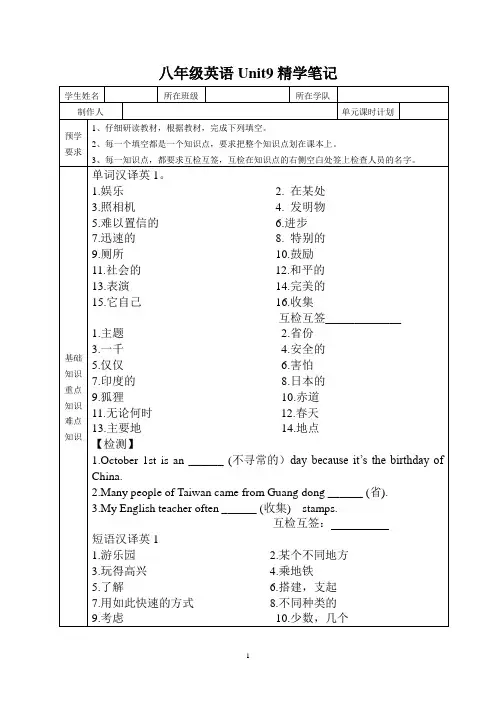
一、重点短语
1. at night在夜晚
2. all year round一年到头;终年
3. be far from 离……远
4. in the dark 在黑暗中
5. in the past 在过去
6. have been to 去过某地
7. go somewhere different 去不同的地方
8. take the subway 坐地铁
9. put up a tent搭帐篷
10. different kinds of各种各样的
11. thousands of 数以千计的
12. three quarters 四分之三
13. have problem doing sth. 做某事很难
14. a couple of times 好几次
15. right now 现在;目前
16. hear of 听说
17. take a ride兜风
第 2 页 共 12 页 18. encourage sb. to do sth. 鼓励某人做某事
19. on the one hand... on the other hand. 一方面,另一方面
二、重点句型
1. Have you ever been to... ?
Have you ever been to a science museum? 你曾经去过科学博物馆吗?
2. Let’s. … Let’s go somewhere different today. 我们今天去个不同的地方吧。
3. It’s +adj. +that...
It’s unbelievable that technology has progressed in such a rapid way!
科技以如此迅猛的方式发展真是令人难以置信啊!
4. Whether... , you’ll...
Whether you like Indian food or Japanese food, you’ll find it all in Singapore!
不管你喜欢印度食品还是日本食品,在新加坡你都能找到!
5. One great thing… is that….
One great thing about Singapore is that the temperature is almost the same all
year round. 新加坡一个很大的特征是它的气温几乎一年到头都是一样的。
三、重点语法
1. 现在完成时(been,ever,never)
词汇讲解
1. invent
(1)invent 作动词,意为“发明;创造”。例如:
Edison invented the light bulb. 爱迪生发明了电灯。
(2)invent还可以表示“虚构”。例如:
The whole story was invented. 整个故事是虚构的。
(3)invent的名词形式有两个,一个是inventor(发明者;发明家),另一个是invention(发明物)。例如:
Edison is a great inventor in history.
第 3 页 共 12 页 爱迪生是历史上伟大的发明家。
Human history is also a history of great inventions.
人类的历史也是一个伟大发明的历史。
【拓展】
invent和discover的辨析:
(1)invent 意为“发明,发明之物”指“从无到有”。例如:
Alexander Graham Bell invented the telephone in 1876.
亚历山大•格雷厄姆•贝尔在1876年发明了电话。
(2)discover 意为“发现”,指“本来就已经存在,但不为人知”的事物。例如:
Columbus discovered America in 1492.
哥伦布在1492年发现了美洲。
2. unbelievable
unbelievable作形容词,意为“难以置信的;不真实的”,是由believable“可相信的;可信任的”加否定前缀un-派生而来的。其动词形式为believe,意为“相信;以为”。例如:
It’s unbelievable that you are a writer.
我难相信你是一个作家。
【拓展】
un-是个前缀,意为“不”。例如:
happy“高兴的”— unhappy“不高兴的”;
lucky“幸运的”— unlucky“不幸的”;
important“重要的”— unimportant;“不重要的”;
第 4 页 共 12 页 healthy“健康的”— unhealthy“不健康的”。
3. encourage
encourage 作动词,意为“鼓励”。encourage sb. to do sth.意为“鼓励某人做某事”。例如:
The teacher often encourages us to study hard.
老师经常鼓励我们要努力学习。
My mother encouraged me to enter the contest.
妈妈鼓励我参加那场比赛。
【拓展】
(1)encourage sb. in sth. 意为“在……方面鼓励/助长某人”。例如:
Don’t encourage him in laziness.
别助长他的懒惰行为。
(2)encouragement是encourage的名词形式,意为“鼓舞/鼓励”。例如:
The teacher’s words were a great encouragement to him.
老师的话对他是极大的鼓舞。
4. collect
collect作及物动词,意为“收集,搜集”。例如:
collect stamps 收集邮票 collect coins 收集硬币
【拓展】
collection作名词,意为“收藏品、收集物”。是动词collect 的名词形式,是由动词collect后缀-tion变化来的。collector 作名词,意为“收藏家”。例如:
These are my collections.
第 5 页 共 12 页 这些是我的收藏品。
My brother has a very good collection of stamps.
我的弟弟收集了许多邮票。
Mark is a famous stamp collector.
Mark是一位著名的邮票收藏家。
5. a couple of
a couple of意为“少数;几个”。例如:
He bought a couple of books for his daughter.
他为他的女儿买了几本书。
【拓展】
a couple of还可意为“一双;一对”。例如:
I found a couple of socks in the room but they did not make a pair.
我在房间里找到两只袜子,但他们不是一双。
6. thousands of
thousand是数词,意为“千”,当表示具体的“几千”时,用“基数词 + thousand”,注意不加-s。例如:
There are six thousand students in the city.
这个城市有6000名学生。
【拓展】
(1)thousands of 表示“数千,成千上万的”这时thousand后要加-s,且后面有介词of,但是不能与数词连用。例如:
There are thousands of people on the square.
在广场上有成千上万的人。
第 6 页 共 12 页 (2)表示数词的还有hundred“百”,million“百万”,billion“十亿”。它们的用法和thousand一样,可以用来表示约数和确数。
7. whether
whether常引导宾语从句,表示“是否”之意。当把一般疑问句的直接引语转化成间接引语时,常用if或whether作引导词。例如:
I asked her, “Do you study English here?”
我问她:“你在这里学习英语吗?” →
I asked her if/ whether she studied English there.
我问她是否在那里学习英语。
【拓展】
if和whether的辨析:
if和whether均可表示“是否”,一般情况下二者可以互换。但在下列条件下,只能用whether而不能用if:
(1)if后不能直接接or not。
(2)whether可作介词的宾语。
(3)whether后可接不定式。
(4)whether可用于句首。
(5)whether可引导主语从句、表语从句。例如:
Everything depends on whether we have enough money.
一切都取决于我们是否有足够的钱。
Whether it is right or wrong, I don’t know.
正确与否,我不知道。
It doesn’t matter whether he will come or not.
他来不来没关系。