Rayleigh Damping Coefficients 的 计算
- 格式:pdf
- 大小:187.93 KB
- 文档页数:11
&& + {φ }T [C]{φ } ξ & + {φ }T [K ]{φ }{ {φ }T [M ]{φ } ξ ξ } = {φ }T {Pt }
{}
{}
(3)
Eqn. (3), subsequently reduces to an n-uncoupled equations of the form
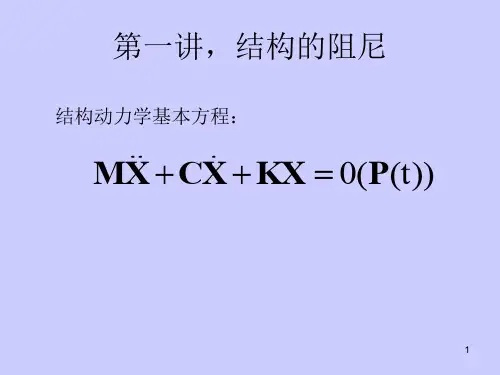
&& + [C] X & + [K ]{X} = {P } [M] X t
{}
{}Leabharlann (2)in which {Pt } force vector which is a function of time. By orthogonal transformation, the above equation reduces to
Computation of Rayleigh Damping Coefficients for Large Systems
By Indrajit Chowdhury Chief Discipline Supervisor Civil & Structural Engineering Petrofac International Limited Sharjah, U.A.E. and Shambhu P. Dasgupta Professor Department of Civil Engineering Indian Institute of Technology Kharagpur 721302, India. e-mail: dasgupta@civil.iitkgp.ernet.in Summary For systems with large degrees of freedom, it is difficult to guess meaningful values of Rayleigh damping coefficients α and β at the start of an analysis. A number of general-purpose commercially available have the provision of providing the value of α and β for calculation of Rayleigh damping matrix for dynamic analysis of systems with multi-degree of freedom. Since an engineer may not be in a position to pre-assess the same at the beginning, has no option but to assume an unrealistic constant damping ratio for all modes. Based on the present technique it is very simple to develop a spreadsheet and arrive at a rational value of α and β which develops a damping ratio sequence increasing progressively with each of the subsequent modes and one can furnish input data for the dynamic analysis. The present paper outlines a procedure, which ensures a rational estimate of α and β even for a system with large degrees of freedom. The results obtained have been checked against different class of real life structure and foundation systems and the results are presented graphically. Key-Words: Dynamics, damping, eigen values, finite element method, natural frequency, soil-foundation system.
Basic Formulation on Rayleigh Damping A system having multi-degrees of freedom, the equation of motion under externally applied time dependent force is given by
Computation of Rayleigh Damping Coefficients for Large Systems
Introduction In dynamic analysis of structures and foundations damping plays an important role. However due to the limitation in our knowledge about damping the most effective way to treat damping within modal analysis framework is to treat the damping value as an equivalent Rayleigh Damping in form of
[C] = α [M] + β [K]
(1)
in whch [C] = damping matrix of the physical system; [M] = mass matrix of the physical system; [K] = stiffness matrix of the system; α and β are pre-defined constants. The major advantage gained in converting the damping matrix into an equivalent Rayleigh damping lies in the fact that using orthogonal transformation a structure having n degrees of freedom can be reduced to n-number of uncoupled equations. However, for systems with large degrees of freedom, it is difficult to guess meaningful values of α and β at the start of the analysis. As such in most of the practical engineering analysis the analyst makes simplifying assumptions in selecting damping ratios (constant for all significant modes) based on his experience or standard literature that would hopefully be valid for the overall system. It is a fact that modal mass participation decreases with increase in modes e. g. say, for first mode mass participation be 45%, second mode 20%, third mode 10% etc… till nearly 100% mass participation is achieved. Based on above, one can infer that [ω = √(k/m)], as mass participation decreases with higher modes, the frequency increases and it is indeed an observed phenomenon. Considering cc (critical damping) = 2√(km), we can conclude that with reduction in modal mass for successive modes, cc will decrease with increase in mode. Overall damping of a system being a constant (since k and m are constant for a system), the damping ratio, D, is given by D = c/cc. As cc decreases with increase in modes, D will increase with increasing modes. Thus the main digression from reality in such case is that while damping goes on increasing with each mode with a guessed unique value of damping ratio at the advent of the analysis the damping ratio remains constant for all modes. For a particular system where higher mode contribution is significant the results obtained based on the presumptive damping ratio will surely not be realistic. The present paper outlines a procedure, which ensures a rational estimate of α and β even for a system with large degrees of freedom. The results obtained have been checked against different class of real life structure and foundation systems and the results are presented graphically.
{}
{}
(3)
Eqn. (3), subsequently reduces to an n-uncoupled equations of the form
&& + [C] X & + [K ]{X} = {P } [M] X t
{}
{}Leabharlann (2)in which {Pt } force vector which is a function of time. By orthogonal transformation, the above equation reduces to
Computation of Rayleigh Damping Coefficients for Large Systems
By Indrajit Chowdhury Chief Discipline Supervisor Civil & Structural Engineering Petrofac International Limited Sharjah, U.A.E. and Shambhu P. Dasgupta Professor Department of Civil Engineering Indian Institute of Technology Kharagpur 721302, India. e-mail: dasgupta@civil.iitkgp.ernet.in Summary For systems with large degrees of freedom, it is difficult to guess meaningful values of Rayleigh damping coefficients α and β at the start of an analysis. A number of general-purpose commercially available have the provision of providing the value of α and β for calculation of Rayleigh damping matrix for dynamic analysis of systems with multi-degree of freedom. Since an engineer may not be in a position to pre-assess the same at the beginning, has no option but to assume an unrealistic constant damping ratio for all modes. Based on the present technique it is very simple to develop a spreadsheet and arrive at a rational value of α and β which develops a damping ratio sequence increasing progressively with each of the subsequent modes and one can furnish input data for the dynamic analysis. The present paper outlines a procedure, which ensures a rational estimate of α and β even for a system with large degrees of freedom. The results obtained have been checked against different class of real life structure and foundation systems and the results are presented graphically. Key-Words: Dynamics, damping, eigen values, finite element method, natural frequency, soil-foundation system.
Basic Formulation on Rayleigh Damping A system having multi-degrees of freedom, the equation of motion under externally applied time dependent force is given by
Computation of Rayleigh Damping Coefficients for Large Systems
Introduction In dynamic analysis of structures and foundations damping plays an important role. However due to the limitation in our knowledge about damping the most effective way to treat damping within modal analysis framework is to treat the damping value as an equivalent Rayleigh Damping in form of
[C] = α [M] + β [K]
(1)
in whch [C] = damping matrix of the physical system; [M] = mass matrix of the physical system; [K] = stiffness matrix of the system; α and β are pre-defined constants. The major advantage gained in converting the damping matrix into an equivalent Rayleigh damping lies in the fact that using orthogonal transformation a structure having n degrees of freedom can be reduced to n-number of uncoupled equations. However, for systems with large degrees of freedom, it is difficult to guess meaningful values of α and β at the start of the analysis. As such in most of the practical engineering analysis the analyst makes simplifying assumptions in selecting damping ratios (constant for all significant modes) based on his experience or standard literature that would hopefully be valid for the overall system. It is a fact that modal mass participation decreases with increase in modes e. g. say, for first mode mass participation be 45%, second mode 20%, third mode 10% etc… till nearly 100% mass participation is achieved. Based on above, one can infer that [ω = √(k/m)], as mass participation decreases with higher modes, the frequency increases and it is indeed an observed phenomenon. Considering cc (critical damping) = 2√(km), we can conclude that with reduction in modal mass for successive modes, cc will decrease with increase in mode. Overall damping of a system being a constant (since k and m are constant for a system), the damping ratio, D, is given by D = c/cc. As cc decreases with increase in modes, D will increase with increasing modes. Thus the main digression from reality in such case is that while damping goes on increasing with each mode with a guessed unique value of damping ratio at the advent of the analysis the damping ratio remains constant for all modes. For a particular system where higher mode contribution is significant the results obtained based on the presumptive damping ratio will surely not be realistic. The present paper outlines a procedure, which ensures a rational estimate of α and β even for a system with large degrees of freedom. The results obtained have been checked against different class of real life structure and foundation systems and the results are presented graphically.