句子成分和基本句型
- 格式:pdf
- 大小:160.60 KB
- 文档页数:8
句⼦成分和基本句型
句⼦成分和基本句型
什么是句⼦?
句⼦是由词按照⼀定的语法结构组成的,是能表达⼀个完整概念的语⾔单位.句⼦的第⼀个字母必须⼤写,结尾要有.?!I am a teacher.
Are you a student?
How beautiful the girl is !
*句⼦成分由词或词组充当
英语的基本成分有七种:
主语(subject)、谓语(predicate)、表语(predicative)、宾语(object)、定语(attribute)、状语(adverbial)补语(complement)
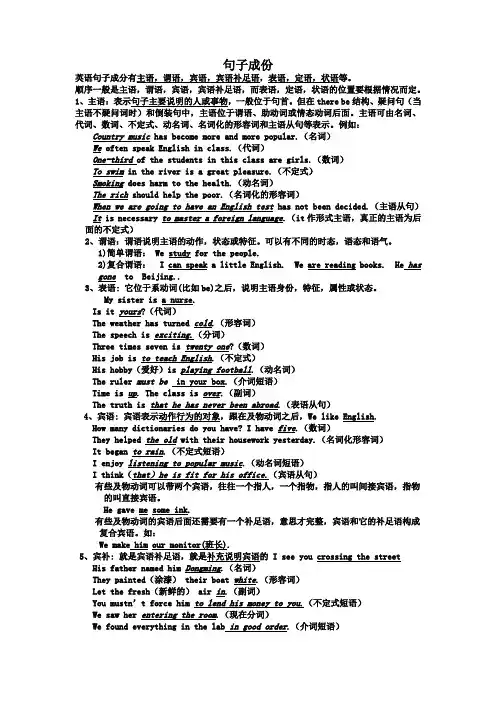
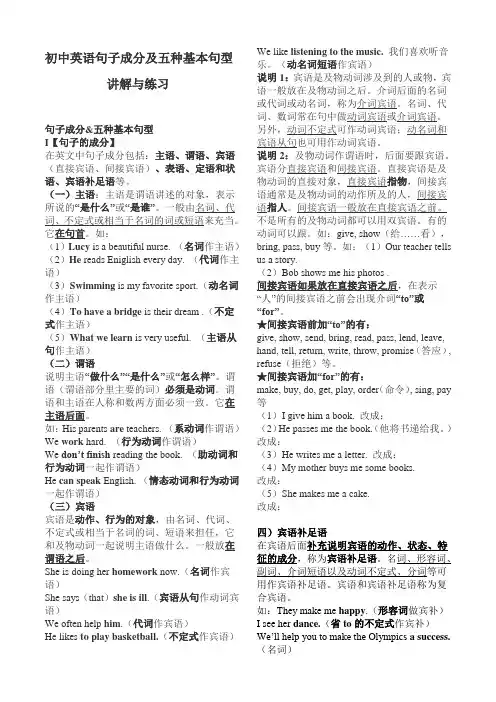
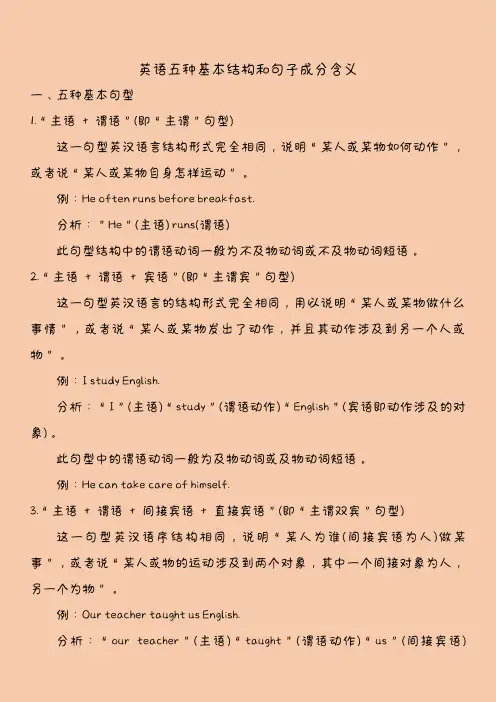
1.主语:主语是在句⼦中说明全句中⼼主题的部分.⼀般由名词,代词,不定式,动名词或从句充当.它的位置⼀般在句⾸.The girl is pretty.
Reading is useful.
To see is to believe.
They are good friends.
谓语:
谓语说明主语做什么,是什么,怎么样,由简单动词或者动词短语构成.They are teachers.
She looks well.
He studies hard.
He laughed at his classmates.
He can speak English.
表语:
表语说明主语是什么,或者怎么样,由名词,形容词,副词,介词短语,不定式,动名词,短语,或者从句充当.表语位于系动词后⾯.I am a teacher.
She is happy.
Everybody is here.
They are at home now.
My job is to teach English.
Seeing is believing.
宾语
宾语是动作,⾏为的对象,由名词,代词,短语,不定式,动名词,从句充当.它和及物动词⼀起说明主语做了什么,在谓语之后.She plays the piano.He often helps me.
I like watching TV.
She likes to go to shop this afternoon.
I think that he is good guy.
宾语补⾜语在英语中,有些句⼦只有宾语并不能表达完整的意思,还必须在宾语后⾯家上宾语补⾜语才能表达完整的意思.它起补充说明宾语⼲什么,怎么样的作⽤.它可以由名词,形容词,副词,介词短语,不定式,现在分词和过去分词充当.
If you let me go, I’ll make you king.
Leave the door open.
We found John out when we arrived.
Make yourself at home.
I saw him enter the hall.
The boss keeps them working all day.I heard my name called.
掌握这五种基本句型, 是掌握各种英语句⼦结构的基础。
⼀: SV(主+谓)
⼆: SVP(主+系+表)
三: SVO(主+谓+宾)
四: SVoO(主+谓+间宾+直宾)
五: SVOC(主+谓+宾+宾补)
基本句型⼀:SV(主+谓)主语: 可以作主语的成分有名词, 主格代词,动词不定式, 动名词等等。主语⼀般在句⾸。
谓语: 谓语由动词构成, 是英语时态、语态变化的主⾓, ⼀般在主语之后。不及物动词(vi.)没有宾语, 形成主谓结构。
如: We come.
S│V(不及物动词)1. The sun│rose.
2. Who │cares?
3. What he said │does not matter.
4. They │talked for half an hour.
5. The pen │writes smoothly
此句型的句⼦有⼀个共同特点, 即句⼦的谓语动词都能表达完整的意思。这类动词叫做不物动词,后⾯可以跟副词、介词短语、状语从句等。
基本句型⼆:SVP(主+系+表)
此句型的句⼦有⼀个共同的特点: 句⼦谓语动词都不能表达⼀个完整的意思, 必须加上⼀个表明主语⾝份或状态的表语构成复合谓语, 才能表达完整的意思。这类动词叫做连系动词。
系动词分两类: be, look, keep, seem等, 表情况; get, grow, become, turn等属另⼀类, 表变化。be 本⾝没有什么意义, 只起连系主语和表语的作⽤。其它系动词仍保持其部分词义。感官动词多可⽤作连系动词: look well/⾯⾊好, sound nice/听起来不错, feel good/感觉好, smell bad/难闻
S│V(是系动词)│P(表语)1. This│is│an English-Chinese dictionary.
2. The dinner│smells│good.
3. He│fell│in love.
4. Everything│looks│different.
5. He│is growing│tall and strong.
6. Our well│has gone│dry.
7. His face│turned│red.
基本句型三:SVO(主+谓+宾)
此句型句⼦的共同特点是:谓语动词都具有实义, 都是主语产⽣的动作, 但不能表达完整的意思, 必须跟有⼀个宾语, 即动作的承受者, 才能使意思完整。这类动词叫做及物动词。
S│V(及物动词)│O(宾语)1. Who│knows│the answer?
2. He │has refused│to help them.
3. He│enjoys│reading.
4. He│said│“Good morning.”
5. He│admits│that he was mistaken.
基本句型四:SVoO(主+谓+间宾+直宾)
有些及物动词可以有两个宾语, e.g. give/pass/bring/show。这两个宾语通常⼀个指⼈(间接宾语); ⼀个指物(直接宾语)。--Give me a cup of tea please.
--Show this house to Mr. Smith.
--Bring it to me, please.
S│V(及物)│o(多指⼈)│O(多指物)1.She│ordered│herself│a new dress.
2. He│brought│you│a dictionary.
3. I│showed│him│my pictures.
4. I│told│him│that the bus was late.
5. He│showed│me│how to run the machine.
基本句型五:SVOC(主+谓+宾+宾补)此句型的句⼦的共同特点是: 动词虽然是及物动词, 但是只跟⼀个宾语还不能表达完整的意思, 必须加上⼀个补充成分来补⾜宾语, 才能使意思完整。
宾语补⾜语: 位于宾语之后对宾语作出说明的成分。可以⽤作宾语补⾜语的有名词, 形容词, 不定式,动名词, 分词, 介词短语等。
名词/代词宾格+ n./adj./ 介词短语/动词不定式/分词The war made him a soldier.
New methods make the job easy.
I often find him at work.
The teacher ask the students to close
the windows.
I saw a cat running across the road.
S│V(及物)│O(宾语) │C(宾补)1. They│painted│the door│green.
2. This│set│them │thinking.
3. They│found│the house│deserted.
4. He│asked│me│to come back soon.
5. I │saw│them│getting on the bus.
注意:⽤it 做形式宾语,⽽将真正的宾语放到宾语补⾜语的后⾯,以使句⼦结构平衡,是英语常⽤的句型结构⽅式。即:主语+谓语+it+宾补+真正宾语。如:I found it very pleasant to be with your family.
英语基本句型6 There be 句型
说明:此句型是由“there+be+主语+状语”构成,⽤以表达存在关系可以称“……有……”。它其实是倒装的⼀种情况,主语位于谓语动词be 之后,there 仅为引导词,并⽆实际语意。
此句型有时不⽤be动词,⽽⽤live, stand, come, go, lie, remain, exist, arrive等。如:There stands a hill in the middle of the park.
Once upon a time there lived an old king in the town.
Be 与其后的主语在⼈称和数量上⼀致,有时态和情态变化。如:现在有there is/are …
过去有there was/were…
将来有there will be…;there is /are going to be...现在已经有there has/have been…
可能有there might be...
肯定有there must be …/there must have been...
过去曾经有there used to be …
似乎有there seems/seem/seemed to be …
碰巧有there happen/happens/happened to be …
练习a. SV
b. SVP
c. SVO
d. SVoO
e. SVOC
1. Pleas tell us a story. _______
2. She smiled. ______
3. I have a lot work to do. _____
4. His job is to train swimmers. _____
5. He noticed a man enter the room. _____
6. Please look at the picture. _____
但常⽤的英语句⼦并不都象基本句型这样简短, 除了基本句型的成分不变外, 通常是在这些成分的前⾯或后⾯增加⼀些修饰语⽽加以扩⼤。这些修饰语可以是单词(adj./adv./num. 数词)短语(主要是介词短语、不定式短语和分词短语)。我们称之为: 定语、状语The little boy needs a blue pen.
⼀、定语:
定语是对名词或代词起修饰、限定作⽤的词、短语或句⼦, 译为‘‘……的’’。形容词,代词,数词,名词,介词短语,不定式,动名词,分词,从句都可以充当定语.定语通常位于被修饰的成分前。复合不定代词(something/nothing)之后;
不定式/分词短语/从句作定语时要放在被修饰的成分后;副词⽤作定语时须放在名词之后。Two boys need two pens.
His name is Tom.
The boy in blue is Tom.
The boy there needs a pen.
The boy needs a ball pen.