新概念英语第一册Lesson 57-58 练习题
- 格式:docx
- 大小:39.07 KB
- 文档页数:11
新概念英语第一册Lesson 57-58 练习题
The longest day has an end。This quote by Howell reminds
us that even the toughest times will eventually come to an end。In
Lesson 57 and Lesson 58.we will focus on identifying words with
different ns and using the correct forms of words in sentences.
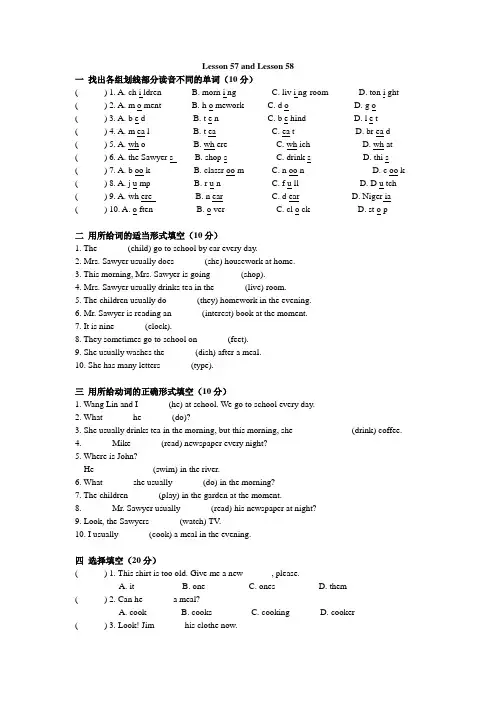
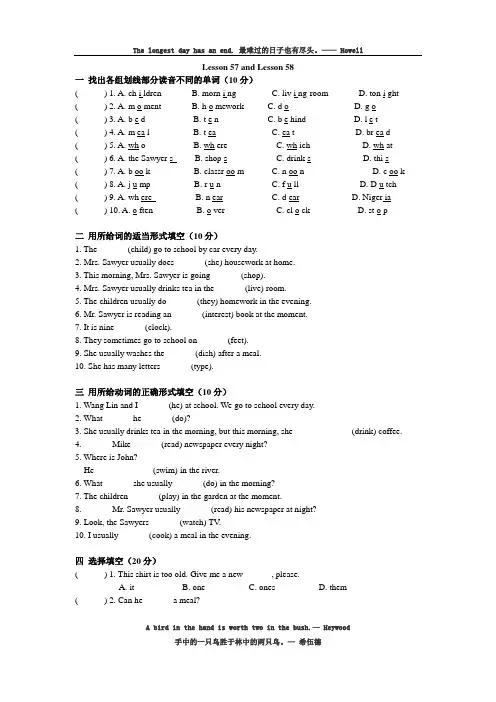
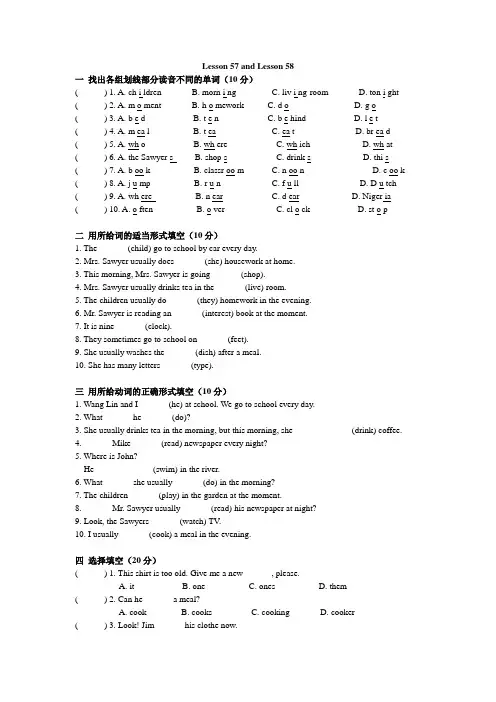
First。let's identify the words with different ns。In each of
the following groups。one word has a different n than the others。Can you find it。
1.A。children B。morning C。living-room D。tonight
2.A。moment B。homework C。do D。go
3.A。bed B。ten C。behind D。let
4.A。meal B。tea C。eat D。bread
5.A。who B。where C。which D。what
6.A。the Sawyers B。shops C。drinks D。this
7.A。book B。classroom C。noon D。cook
8.A。jump B。run C。full D。Dutch
9.A。where B。near C。dear D。Nigeria 10.A。often B。over C。clock D。
Now。let's practice using the correct forms of words in
sentences。Fill in the blanks with the appropriate form of the word
in parentheses.
1.The children (child) go to school by car every day.
2.Mrs。Sawyer usually does her (she) housework at home.
3.This morning。Mrs。Sawyer is going (shop).
4.Mrs。Sawyer usually drinks tea in the (live) room.
5.The children usually do their (they) homework in the
evening.
6.Mr。Sawyer is reading an (interest) book at the moment.
7.It is nine (clock).
8.They sometimes go to school on (foot).
By practicing these skills。we can improve our n and
language use。Remember。even the longest day will eventually
come to an end.
9.She usually washes the dishes after a meal. 10.She has many letters to type.
三用所给动词的正确形式填空:
1.Wang Lin and I go (he) to school。We go to school every
day.
2.What does he do (do)?
3.She usually drinks tea in the morning。but this morning。she drank (drink) coffee.
4.Does Mike read (read) newspaper every night?
5.Where is John。He is swimming (swim) in the river.
6.What does she usually do (do) in the morning?
7.The children are playing (play) in the garden at the moment.
8.Does Mr。Sawyer usually read (read) his newspaper at
night?
9.Look。the Sawyers are watching (watch) TV.
10.I usually cook (cook) a meal in the evening.
四选择填空:
1.This shirt is too old。Give me a new one (B)。please.
2.Can he cook (A) a meal? 3.Look。Jim is wearing his clothes now.
4.The children aren't going to school by car today。They are
going to school on foot.
5.Where do you put the table?
6.Where is your bag。I can't find it.
7.We can't put it in the basket。The basket isn't empty.
8.She usually washes the dishes at night。but tonight she is
washing clothes.
9.Does your mother come from Beijing?
10.Don't play in the street!
11.Give the knife to me。please.
12.How many cats can you see。I can see none.
13.What are they doing today。They are walking to school
today.
What do the children usually do in the evening?
2.She is going to visit her grandparents next weekend.(改为一般疑问句)
Is she going to visit her grandparents next weekend?
3.They have been studying English for three years.(改为否定句)
They haven't been studying English for three years.
4.He sings very well.(改为感叹句)
How well he sings!
5.The cat is sleeping on the sofa.(改为被动语态)
The sofa is being slept on by the cat.
B: I’m ___4___ my homework。I have a lot to do.
A: Oh。___5___ you finish your homework。we can still
play later.
B: ___6___。but I’m not sure when I’ll be done.
A: That’s alright。Just ___7___ me a call when you’re
finished.
B: ___8___。I will。Thanks for understanding.
A: No problem。___9___ you later then.
B: ___10___.
B: I'm working on my homework。Can you go and find Jim?
A: Sure。Where is he? B: He's at home.
A: I'll go to his house and ask him。Finish your homework
and I'll be back.
1.Where does Mrs。Sawyer usually stay in the morning。
2.How are the children getting to school today。
3.What does Mr。Sawyer usually do at night。
4.Is the book you're reading interesting。
5.Who usually cooks dinner in the evening。
6.What is their daily routine。
7.Which season do you like best。
8.How is the climate where you live。
9.Does Mrs。Sawyer eat lunch at noon。
10.Where is he from?
A bird in the hand is worth two in the bush." - Heywood
This means it's better to have something for certain than to
risk losing it by trying to get something better.
The longest day has an end." - Howell