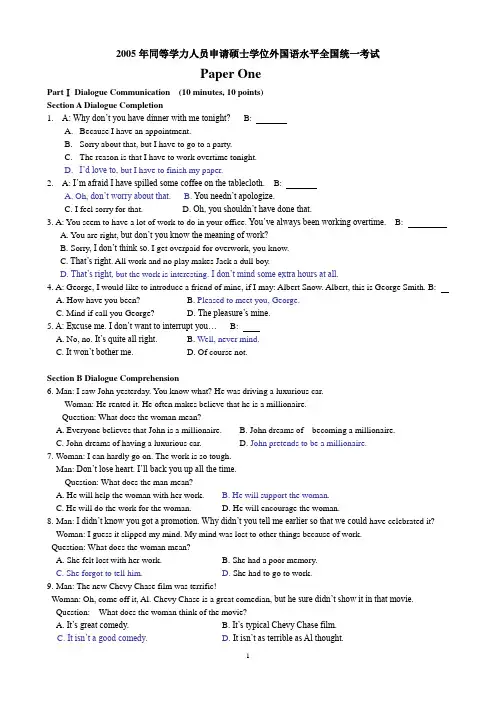
2005年同等学力人员申请硕士学位外国语水平全国统一考试Paper OnePartⅠ Dialogue Communication (10 minutes, 10 points)Section A Dialogue Completion1.A: Why don‟t you have dinner with me tonight?B:A.Because I have an appointment.B.Sorry about that, but I have to go to a party.C.The reason is that I have to work overtime tonight.D.I‟d love to, but I have to finish my paper.2.A: I‟m afraid I have spilled some coffee on the tablecloth.B:A. Oh, don‟t worry about that.B. You needn‟t apologize.C. I feel sorry for that.D. Oh, you shouldn‟t have done that.3. A: You seem to have a lot of work to do in your office. You‟ve always been working overtime. B:A. You are right, but don‟t you know the meaning of work?B. Sorry, I don‟t think so. I get overpaid for overwork, you know.C. That‟s right. All work and no play makes Jack a dull boy.D. That‟s right, but the work is interesting. I don‟t mind some extra hours at all.4. A: George, I would like to introduce a friend of mine, if I may: Albert Snow. Albert, this is George Smith. B:A. How have you been?B. Pleased to meet you, George.C. Mind if call you George?D. The pleasure‟s mine.5. A: Excuse me. I don‟t want to interrupt you…B:A. No, no. It‟s quite all right.B. Well, never mind.C. It won‟t bother me.D. Of course not.Section B Dialogue Comprehension6. Man: I saw John yesterday. You know what? He was driving a luxurious car.Woman: He rented it. He often makes believe that he is a millionaire.Question: What does the woman mean?A. Everyone believes that John is a millionaire.B. John dreams of becoming a millionaire.C. John dreams of having a luxurious car.D. John pretends to be a millionaire.7. Woman: I can hardly go on. The work is so tough.Man: Don‟t lose heart. I‟ll back you up all the time.Question: What does the man mean?A. He will help the woman with her work.B. He will support the woman.C. He will do the work for the woman.D. He will encourage the woman.8. Man: I didn‟t know you got a promotion. Why didn‟t you tell me earlier so that we could have celebrated it? Woman: I guess it slipped my mind. My mind was lost to other things because of work.Question: What does the woman mean?A. She felt lost with her work.B. She had a poor memory.C. She forgot to tell him.D. She had to go to work.9. Man: The new Chevy Chase film was terrific!Woman: Oh, come off it, Al. Chevy Chase is a great comedian, but he sure didn‟t show it in that movie. Question: What does the woman think of the movie?A. It‟s great comedy.B. It‟s typical Chevy Chase film.10. Woman: You haven‟t said a word about my dress, Dave. Don‟t you like it?Man: I‟m sorry I didn‟t say anything about it sooner. I don‟t think I‟ve seen anything like is before.Question: What does the man probably think of the dress?A. It is in fashion.B. It surely is unique.C. It is a bit old-fashioned.D. It surely suits her.Part Ⅱ Vocabulary (10 minutes, 10 points)Section A11.Should English classes be compulsory at the elementary or primary school level in countrieswhere it is not the native language?A. requiredB. necessaryC. selectedD. permanent讲义3.Next semester, Susan must take three compulsory courses.A. formalB. voluntaryC. practicalD. required12.In the end, both attacks and defenses of the free market and conventional economics haveimmense philosophical implications.A. traditionalB. novelC. capital-centeredD. consumption-centered 讲义9. Tiny atomic electric batteries have certain advantages over the ______ storage batteries.A. universalB. inclusiveC. indefinite22. The girl of ten has such exceptional abilities that everyone is jealous of her.A. regularB. specificC. extraordinary13.Applicant will be asked to provide information on how they will disseminate information toother students at their university or college.A. discloseB. deliverC. spreadD. analyze14.In general, the British people belong to one of the more affluent countries of Europe and enjoy ahigh standard of living compared to the rest of the world.A. plentifulB. powerfulC. friendlyD. wealthy15.To absorb a younger work force, many companies offered retirement plans as incentives forolder workers to retire and make way for the younger ones who earned lower salaries.A. rewardsB. opportunitiesC. motivesD. stimuli讲义2. The fun of playing the game was a greater incentive than the prize.A. motiveB. initiativeC. excitementD. entertainment16.Their business flourished at its new location a year later owing to their joint efforts and hardwork.A. prevailedB. failedC. boomedD. shrank讲义:11. The Timber rattlesnake is now on the endangered species list, and is extinct in two eastern states in which it once ______.A. thrivedB. swelledC. prospered17.The pressure on her from her family caused her to resort to the drastic measures.A. turn toB. keep toC. stick toD. lead to18.I shall never forget the look of intense anguish on the face of his parents when they heard thenews.A. stressB. dilemmaC. miseryD. surprise19.If minor disputes are left unsettled, tough ones will pile up sooner or later.A. accumulateB. vanishC. lingerD. emerge20.The police tried in vain to break up the protest crowds in front of the government building.A. unskillfullyB. violentlyC. ineffectivelyD. eventuallyyour department.A. satisfactionB. gratitude D. sincerity讲义:1. I' d like to take this opportunity to extend my heart-felt gratitude to the host.A. increaseB. prolongC. intensifyD. express22.The objective of this popular consultation is to determine, , the final political status of theregion, whether to remain part of the country as a special district, or to part from it.A. once upon a timeB. once and againC. all at onceD. once and for all从前一而再,屡次断然地, 坚决地23.The two countries will assign counter-drug officials to their respective embassies ona basis.A. fundamentalB. similarC. reciprocal 互惠的D. reasonable24.Tennessee‟s population is nearly two-fifths rural, and no single city or group ofcities the state.A. dominatesB. managesC. manipulatesD. controls25.We all know that in a situation like this a cool head is .A. called forB. called offC. called onD. called up讲义:9. A well-written composition ______ good choice of words and clear organization among other things.A. calls onB. calls forC. calls upD. calls off26.The destruction an earthquake causes depends on its and duration, or the amount ofshaking that occurs.A. altitudeB. magnitudeC. multitudeD. aptitude讲义:35. In my opinion, you can widen the ______ of these improvements through your active participation.A. dimensionB. volume D. scope27.The El Nino has affected the regional weather and temperature over much of the tropics,sub-tropics and some mid-latitude areas.A. externallyB. consistentlyC. insistentlyD. internally28.During all these years of absence he had a tender feeling for his mother and the family.A. enclosedB. huggedC. enrichedD. cherished29.The choice for a consumer, therefore, is the choice among the available ones that willenable him or her to maximize utility.A. optimalB. optionalC. opticalD. optimistic30.Mrs. Smith tears when she heard her daughter had died in the road accident.A. broke inB. broke upC. broke throughD. broke intoPart Ⅲ Reading Comprehension (45 minutes, 25 points)Passage OneIt was Friday, the day of the field trip on which Miss Joan would take her class to pick apples.Miss Joan enjoyed picking apples with her students. She smiled as she led her students to the bus that would take them to the Greenly Apple Orchard(果园).The bus ride was bumpy and the kids were a little noisy, but still Miss Joan was smiling.The bus stopped in front of the Greenly Orchard Store and the class got off quickly and quietly. Miss Joan made sure everyone was there. “What a glorious,sunny, apple picking day,” Miss Joan announced with her grandest smile.Mr. Greenly was there to greet them. “Let see, there are eighteen children and two adults atMiss Joan held u p the brochure in her hand. “It says that the price is two dollars each,”she pointed ort. “That‟s what I collected from everyone.”“We‟ve had to raise the price,” Mr. Greenly stated.“You sent me this brochure after we made our reservation,” Miss Joan complained, “and it says two dollars!”“Miss Joan, if you look at the bottom of this brochure,” Mr. Greenly said, “you‟ll notice a very important statement.”Sure enough, in very tiny letters, it said, “Prices are subject to change without notice.”Miss Joan was determined to keep her good mood. She took a twenty dollars bill out of her own purse and handed it to Mr. Greenly with the forty dollars she had in an envelope.“Now children, do you all have your baskets?” Miss Joan called out. “Remember, you can pic k as many apples six apples each.”“I beg your pardon!”Miss Joan was not smiling now. “The brochure says,…ALL YOU CAN PICK‟!”Mr. Greenly pointed to the tiniest letters Miss Joan had ever almost seen. It also says, “Terms and conditions of group reservat ions are subject to change without notice.”Miss Joan‟s good mood was now history. She didn‟t want to set a bad example for her students, so she said in a calm and quiet voice, “We‟re going home, give me our money back, please.”31.How many dollars did Miss Joan hand to Mr. Greenly?A. 20.B. 40.C. 60.D. 1832.The phrase “subject to change without notice” suggests .A.Mr. Greenly could change the terms at will.B.the customers should read the brochure carefullyC.Mr. Greenly could determine what apples to be picked.D.the customers should be informed beforehand.33.The students could not pick as many apples as they would like because .A.they were children.B. there were not enough apples.C. they had made a group reservation.D. they would eat up too many apples.34.“Miss Joan‟s good mood was now history?”(the last paragraph) means .A.Miss Joan had been happy until that moment.B.Miss Joan was no longer interested in history.C.Miss Joan taught her students the history of the orchard.D.Miss Joan was good at concealing her feelings35.What can we learn about Miss Joan from the story?A. She did not read the brochure carefully.B. She made a reservation after seeing the brochure.C. She lost her temper in the end.D. She didn‟t know h ow to complain.Passage TwoBoth civilization and culture are fairly modern words, having come into prominent use during the 19th century by anthropologists(人类学家), historians, and literary figures. There has been a strong tendency to use them interchangeably as though they mean the same thing, but they are not the same.Although modern in their usage, the two words derived from ancient Latin. The word civilization is based on the Latin civis, of a city. Thus civilization, in its most essential meaning, isit would seem that certain insects, such as ants or bees, are also civilized. They live and work together in social groups. So do some microorganisms. But there is more to civilization, and that is what culture brings to it. So, civilization is inseparable from culture.The word culture is derived from the Latin verb colere, till the soil. But colere also has a wider range of meanings. It may, like civis, mean inhabiting a town or village. But most of its definitions suggest a process of starting and promoting growth and development. One may cultivate a garden; one may also cultivate one‟s interests, mind, and abilities. In its modern use the word culture refers to all the positive aspects and achievements of humanity that make mankind different from the rest of the animal world. Culture has grown out of creativity, a characteristic that seems to be unique to human beings.One of the basic and best-know features of civilization and culture is the presence of tools. But more important than their simple existence is that the tools are always being improved and enlarged upon, a result of creativity. It took thousands of years to get from the first wheel to the latest, most advanced model of automobile.It is the concept of humans as toolmakers and improvers that differentiates them from other animals. A monkey may use a stick to knock a banana from a tree, but that stick will never, through a monkey‟s clevernes s, be modified into a hook or a ladder. Monkeys have never devised a spoken language, written a book, composed a melody, built a house, or painted a portrait. To say that birds build nests and beavers(海狸)their dens is to miss the point. People once lived in caves, but their cleverness, imagination, and creativity led them to progress beyond caves to buildings.36. What does the author think of the words “civilization”and “culture”?A. They are identical.B. They are different concepts.C. They can often be used interchangeably.D. They are defined differently by different people.37. According to the author the word “civilization” originally refers to .A. people‟s way of life in citiesB. people‟s ability to live together in citiesC. a type of social organizationsD. an advanced level of social life38. The Latin verb colere originally means “”.A. live in a cityB. develop oneselfC. promote growthD. cultivate the land39. The author believes that creativity .A. is a unique feature of civilized beingsB. brings forth the improvement of toolsC. is the result of human developmentD. helps the advance of culture40. The author mentions monkeys in the last paragraph to show that .A. monkeys are the same as birdsB. people once lived in caves like monkeysC. monkeys can never develop into human beingsD. man is different from other animals such as monkeysPassage ThreeThe huge growth of global “ecotourism”industry is becoming an increasing concern for conservationists with mounting evidence that many wild species do not respond well to contact with human beings. Overexposure to tourists has been linked to stress, abnormal behaviour and adverse health effects in species such as polar bears, dolphins and gorillas(大猩猩),says a report in New Scientist.While regulated ecotourism can help conservation efforts by encouraging people to manage endangered species and their habitats, many projects are poorly designed and unregulated, it says.environmentally friendly policies and operations.”While regulated ecotourism can help conservation efforts by encouraging people to manage endangered species and their habitats, “many projects are p oorly designed and hint they are based on environmentally friendly policies and operations.”Ecotourism is growing by 10 to 30 percent a year and an estimated 20 percent of tourists are thought to visit a conservation-based project. Philip Seddon, of the University of Otago in New Zealand, said that although most tourist projects conformed to basic guidelines on land use and not scaring wildlife, their full impact was rarely considered.“Transmission of disease to wildlife, or subtle changes to wildlife health through disturbance of daily routines or increased stress levels may translate to lowered survival and breeding,” he said. Research at the University of Auckland has shown that dolphins become restless and overactive when many tourist boats are present. When three or more boats are near, the dolphins rest for 0.5 percent of the time, compared with 68 percent when they are accompanied by a single boat. The findings are backed up by studies of dolphins in Britain. Researchers at the University of Manitoba in Canada have found that male polar bears easily disturbed by tourist vehicles, with a possible effect on their heart rate and metabolism(新陈代谢). That could reduce body fat levels and fitness, critical for survival.In Africa, gorillas have picked up parasites introduced to their habitat by tourists and mongooses(蠓)have caught lung diseases from human beings. Experts said that the answer to the problems was better regulation and supervision of ecotourism. The Galapagos Islands, where visitor numbers are strictly controlled, is a good model.41. Ecotourism is meant to .A. have tourists help in the conservation of wildlifeB. have wild species respond well to contact with humansC. make wild species reduce stress and abnormal behaviourD. make conservationists more concerned with wildlife42. According to New Scientist, many ecotourist projects .A. really encourage people to protect wildlife and its habitatB. strictly follow environmentally friendly policiesC. actually lack proper examination and official approvalD. seriously damage the habitats of endangered species43. What will happen to wildlife ul timately if the present “ecotourism” practice goes on?A. It will disturb their life.B. It will affect their health.C. It will increase their stress.D. It will threaten their survival.44. According to the passage, the growth in the global “ecotourism” industry .A. reflects an increasing concern for conservationB. arouses a growing concern for conservationC. coincides with a mounting concern for conservationD. originates from a grater concern for conservation45. According to the passage, a solution to the “ecotourism” problem is to .A. encourage people to manage endangered speciesB. reduce the exposure of wildlife to human beingsC. help wild animals increase their fitnessD. prevent wildlife from catching human diseasesComputers can beat chess champion Gary Kasparov at his game, count all the atoms in a nuclear explosion, and calculate complex figures in a fraction of a second, but they still fail at the slight differences in language translation. Artificial Intelligence computers have large amounts of memory, capable of storing huge translating dictionaries and extensive lists of grammar rules. Yet, today‟s best computer language translators have just a 60 percent accuracy rate. Scientist s are still unable to program the computer with human-like common sense reasoning power.Computer language translation is called Machine Translation, or MT. While not perfect, MT is surprisingly good. MT was designed to process dry, technical language that people find tedious to translate. Computers can translate basic phrases, such as “You foot bone‟s connected to your ankle bone, your ankle bone‟s connected to your leg bone.” They can translate more difficult phrases, such as “Which witch is which?” Computers can also accurately translate “Wild thing, you make my heart sing!” into other languages because they can understand individual words, as long as the words are pre-programmed in their dictionary.But highly sensitive types of translating, such as important diplomatic conversations, are beyond the scope of computer translating programs. Human translators use intuitional meaning, not logic, to process words and phrases into other languages. A human can properly translate the phrase, “The pen is in the pe n(围养禽畜的圈),” because most humans know that it means that a writing instrument is in a small enclosed space. Many times, computers do not have the ability to determine in which way two identical words in one sentence are to be used.In addition to using massive rule-programmed machines, computer programmers are also trying to teach computers to learn how to think for themselves through the “experience” of translating. Even with these efforts, programmers admit that a “thinking” computer might not ever be invented in the future.46. Computers today are capable of .A. defeating the best chess player in the worldB. telling subtle differences between languagesC. translating over 60 percent of difficult textsD. doing human-like common sense reasoning47. According to the passage, which of the following is NOT true?A. Computers can translate dry and difficult phrases.B. Computers can understand sensitive language.C. Computers can translate technical language.D. Computers can understand pre-programmed words.48. The major problem with computer translating programs is that computers .A. can not translate illogical sentencesB. do not have a large enough capacity of memoryC. can not understand grammatical rulesD. do not have intuition to process language49. To improve machine translation, computer programmers are trying to .A. use powerful rule-programmed computersB. teach computers to think by practiceC. have computers compile translating dictionariesD. add explanations of words in computer programs50. The passage suggests that .A. the accuracy rate of machine translation cannot be raisedB. it is impossible for computers to think as humans doC. only technical language is suitable for machine translationD. it is impossible to determine of identical wordsSeveral years ago during the dot-com passion, Manhattan lawyer John Kennedy sometimes wore a dark blue suit to meet potential Internet clients. But he soon realized that his conservative clothes were a strike against him before he even shook hands. So he began to do business in casual, open-shirt clothes.But now the tables have turned. Today Silicon Valley executives are the ones often coming out in suits. No wonder that Fortune 500 executives are dusting off their silk ties and pants.” I would say there is a trend now toward a little more business dress,” said Kennedy. “I find myself wearing suits more.”While there isn‟t a rush toward formal office wear, clothiers and executives say the workplace uniform is heading that way. In many offices, men are wearing jackets, ties and pants more frequently than a year age. Top women executives never went as casual as men, so the shift doesn‟t affect them as dramatically.“Business casual” took several years to catch on. It started with casual Fridays, evolved to casual summers, then became casual everyday. A return to the button-down look also will take time, observers say. Lehman Brothers is one of the few major firms that has officially returned to a formal dress policy, at least for offices that clients visit. Men were told to wear suits and ties and women to wear suits or dresses. The shift is due to a rethinking of work environments and more contacts with clients as the firm has grown.Observers mention many factors driving the trend. Internet companies helped lead the dress-down movement and other industries followed suit to attract workers. But with the collapse of many dot-coms, the relaxed look is becoming a style to avoid. Moreover, as the economy stumbles, more people are hunting for jobs or trying to keep the ones they have, and appearance counts.US President Bush wears a coat and tie in the White House office and expects his staff to dress “professionally,” which some say sets a tome for the nation.Chuck Wardell, managing director of a recruiting firm, believes a lot of employees like a stiffer uniform. “They‟re going to work. They don‟t want to feel like they‟re going to a picnic.”51.”Business casual” was prevalent several years ago because _____.A. the Manhattan law business grew very quicklyB. shaking hands with clients became popularC. the country was fighting the conservativesD. the Internet companies boomed then52. When the “bu siness ca sual” prevailed, _____.A. businessmen wore ties only in workplaceB. businessmen didn‟t wear ties at allC. businesswomen didn‟t wear formally in workplaceD. businesswomen still wore formally everywhere53. The Fortune 500 executives__________.A. set the trend toward more casual wearB. are particular about what they wearC. begin to wear suits more often than beforeD. are usually indifferent to fashion trend54. At the beginning of the “business casual” trend, business people wore casually___________.A. when meeting clientsB. on weekendsC. in summerD. almost every day55. It is implied in the passage that the change of business dress from the casual to the formalreflects_____.A. the changed of people‟s taste in fashionB. the ups and downs of the fashion industryC. the ups and downs of the Internet companiesD. people‟s different preference in business dressPart IV CloseThe United States has historically had higher rates of marriage than those of other industrialized countries. The current annual marriage 56 in the United States ---about 9 new marriages for every 1,000 people ---is 57 higher than it is in other industrialized countries. However, marriage is 58 as widespread as it was several decades ago. 59 of American adults who are married 60 _ form 72 percent in 1970 to 60 percent in 2002.This does not mean that large numbers of people will remain unmarried 61 their lives. Throughout the 20th century, about 90 percent of Americans married at some 62 in their lives. Experts_ 63 that about the same proportion of today‟s young adults will eventually marry.The timing of marriage has varied 64 over the past century. In 1995 the average age of women in the United States at the time of their first marriage was 25.The average age of men was about 27.Men and women in the United States marry for the first time at an average of five years later than people did in the 1950s. 65 ,young adults of the 1950s married younger than did any previous 66 in U.S. history. Today‟s later age of marriage is 67 the age of marriage between 1890 and 1940. Moreover, a greater proportion of the population was married (95 percent)during the 1950s than at any time before 68 .Experts do not agree on why the “marriage rush” of the late 1940s and 1950s occurred, but most social scientists believe it represented a 69 to the return of peaceful life and prosperity after 15 years of severe economic 70 and war.56. A. rate B. ratio C. percentage D. poll57. A. potentially B. intentionally C. randomly D. substantially相当大的58. A. not any longer B. no more C. no longer D. not any more59. A. A proportion B. The proportion C. The number D. A number60. A. declined B. deteriorated C. deduced D. demolished61. A. past B. passing C. throughout D. through62. A. period B. level C. point D. respect63. A. project B. plan C. promise D. propose64. A . unexpectedly B. irregularly C. flexibly D. consistently65. A. Besides B. However C. Whereas D. Nevertheless66. A. descendants B. ascendants C. population D. generation67. A. according to B. in line with C. based on D. caused by68. A. and after B. or after C. or since D. ever since69. A. refusal B. realization C. response D. reality70. A. repression B. aggression C. restriction D. depressionPart V Error Detection71. It is an accepted custom for guests to take their gifts to the wedding reception when the coupleinvited them to attend.72. Some international students use a cassette recorder to make tapes of their classes so that theycan repeat the lectures again.73. Despite of diligent efforts to promote domestic production during the war years, the ContinentalArmy had to rely primarily on captures and imports for much of its military hardware and even for clothing.74. In a sense, farmers began primitive genetic engineering at the dawn of agriculture, which theykept seeds from their best plants, gradually improving the quality of successive generations.。