003第三讲 初中形容词副词用法专题精讲
- 格式:doc
- 大小:170.50 KB
- 文档页数:12
第三讲形容词副词用法专题精讲学习形容词和副词,主要掌握形容词和副词的一般用法和主要作用、形容词和副词的“三级比较”、形容词和副词的常用句型。
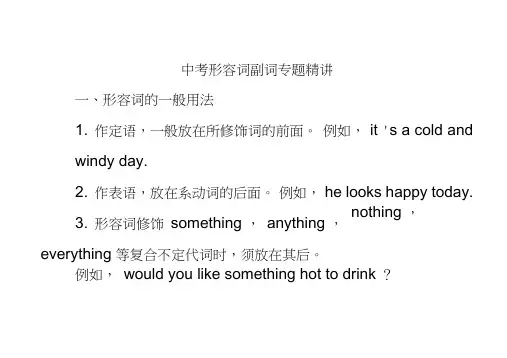
第一节形容词一、形容词的一般用法1.作定语,一般放在所修饰词的前面。
例如,I t‟s a cold and windy day.2.作表语,放在系动词的后面。
例如,He looks happy today.3.形容词修饰something,anything,nothing,everything等复合不定代词时,须放在其后。
例如,Would you like something hot to drink?4.表示长、宽、高、深及年龄的形容词,应放在相应的名词之后。
例如,How long is the river?It‟s about two hundred metres long.5.只能作表语的形容词:afraid害怕;alone独自的;asleep睡着的;awake醒着的;alive活着的;well健康的;ill病的;frightened害怕的例如,The man is ill.(正)The ill man is my uncle.(误)6.只能作定语的形容词:little小的;only唯一的;wooden木质的;woolen羊毛质的;elder年长的例如,My elder brother is in Beijing.(正)My brother is elder. (误)7.貌似副词的形容词:lonely独自的;friendly友好的;lively生动的;lovely可爱的8.复合形容词:snow-white雪白的English-speaking说英语的;glass-topped玻璃罩的;full-time全日制的;well-known众所周知的;kind-hearted善良的;man-made人造的;take-away可以带走的;ten-year-old十岁的。
二、多个形容词修饰名词时,其顺序为:限定词(冠词、指示代词、形容词性物主代词、数词)—描绘词(大小,长短,形状,新旧,长幼,颜色)—出处—材料性质—类别—名词A small round table一张小圆桌A tall white building一幢高大的白色建筑物A dirty old black shirt一件又脏又旧的黑色衬衣A famous american medical school一个非常著名的美国医学院三、形容词常用句型1.“I t‟s +adj.+of+sb.+不定式”表示“某人(做某事)怎么样”。
注意:这一句型中常用描述行为者的性格、品质的形容词,如good(好的),kind(友善的),nice(友好的),polite(有礼貌的),clever(聪明的),foolish(愚蠢的),lazy(懒惰的),careful(细心的),careless(粗心的),right(正确的),wrong(错误的)等。
例如,I t‟s very kind of you to help me.(=you are very kind to help me.)你能帮助我,真好。
It‟s very rude of her to say such words.(=she is very rude to say such words.)她说这样的话,真粗鲁。
It‟s foolish of him to go alone.(=he is foolish to go alone.)他单独出去太傻了。
2.“I t‟s+adj.+for+sb.+不定式”表示“做某事对某人来说怎么样”。
注意:这一句型中常用的形容词有important(重要的),necessary(必要的),difficult(困难的),easy(容易的),hard(艰难的),dangerous(危险的),safe(安全的),useful(有益的),pleasant(舒适的),interesting(有趣的),impossible(不可能的)等。
例如,I t‟s not e asy for them to learn a foreign language.(=to learn a foreign language is not easy for them.) 对于他们来说学好一门外语不容易。
It‟s very important for students to listen to teachers carefully.(=to listen to teachers carefully is very important for students.)对于学生来说上课认真听老师讲课是非常重要的。
It‟s necessary for us to get to school on time.(=to get to school on time is necessary for us.)对于我们来说按时到校是非常必要的。
3.表示感情或情绪的形容词,如glad(高兴的),pleased(高兴的),sad(忧伤的),thankful(感激的)等常接不定式。
例如,Glad to see you.见到你非常高兴。
I‟m very sad to hear the bad news.听到这个坏新闻,我非常难过。
4.表示能力和意志的形容词,如ready(乐意的,有准备的),able(有能力的),sure(一定),certain(一定)等常接不定式。
例如,Lei Feng is always ready to help others.雷锋总是乐于助人。
He is sure to get to school on time.他一定会按时到校。
第二节副词一、副词的分类副词按词汇意义可分为:方式副词:well,fast,slowly,carefully,quickly程度副词:very,much,enough,almost,rather,quite地点副词:here,there,out,somewhere,abroad,home,时间副词:today,early,soon,now,then,recently,still频度副词:always,often,usually,sometimes,seldom,never否定副词:no,not,neither,nor,疑问副词:where,how,why其他:also,too,only二、副词的基本用法:副词是用来修饰动词、形容词、其他副词以及全句话的词类,表示时间、地点、程度、方式等概念。
例如,1.We should listen to our teachers carefully.我们应该认真听老师讲课。
2.He is very happy today.他今天非常高兴。
3.“What happened?”I asked,rather angrily.“发生什么事情了?”我相当生气地问。
4. In spring,I can see flowers everywhere.在春天,我到处都能看到花。
三、常见副词用法辨析1.already与yet的区别Already用于肯定句句中,表示“已经”;yet用于否定句句末,表示“还”,用于疑问句句末,表示“已经”例如,He had already left when I called.当我给他打电话时,他已经离开了。
Have you found your ruler yet?你已经找到你的尺子了吗?I haven‟t finished my homework yet.我还没有完成作业。
注意:already还可以表示惊奇,惊讶等语气,常用于疑问句句末例如:has your son gone to school already?你的儿子已经上学了吗?(表示很惊讶)2 very,much和very much.的区别very用于修饰形容词或副词的原级;much用于修饰形容词或副词的比较级;修饰动词要用very much.例如,john is very honest.约翰非常诚实。
This garden is much bigger than that one.这个花园比那个大的多。
Thank you very much.非常感谢你3.so与such的区别⑴so修饰形容词或副词;such 修饰名词,例如,my brother runs so fast that I can‟t follow him.我弟弟跑得那么快以至于我跟不上他。
He is such a boy.他是一个这样的孩子。
⑵so修饰的形容词后可以有一个单数的可数名词,其结构是“so+形容词+a/an+可数名词单数”.Such可以修饰可数名词单复数和不可数名词,名词前可以有形容词作定语,其结构是“such+a/an+形容词+可数名词单数”,“such+形容词+可数名词复数/不可数名词”,例如,He is so clever a boy.=he is such a clever boy.他是一个如此聪明的孩子。
It is such cold weather.这么冷的天气。
(正)it is so cold weather.(误)They are such good students. 他们是那么好的学生。
(正)they are so good students. (误)⑶如果可数名词复数前有many,few或不可数名词前有much,little修饰,用so不用such.例如,so many(如此多的);so few(如此少的)可以加可数名词复数So much(如此多的);so little(如此少的)可以加不可数名词4.also,too,as well与either 的区别Also,as well,too,用于肯定句,also常用于be动词,情态动词,助动词之后,行为动词之前;as well,too 用于句末;either用于否定句中,置于句末。
例如,My father is a teacher. My mother is also a teacher.=My father is a teacher. My mother is a teacher as well.=My father is a teacher. My mother is a teacher,too.我爸爸是一名老师,我妈妈也是。
I can‟t speak french.. Jenny can‟t speak french,either.我不会说法语,詹妮也不会。
5.sometime,sometimes,some time与some times的区别Sometime:某一时间,某一时刻,可指将来时,也可指过去时Sometimes:有时,不时的some time:一段时间some times:几次,几倍. 例如,we‟ll have a test sometime next month.下个月的某一时间,我们要进行一次测试。