lec评价法定义和公式
- 格式:docx
- 大小:11.93 KB
- 文档页数:3
lec评价法定义和公式
英文文档:
The LEC (Loss of Equivalent Clearance) evaluation method is a
quantitative risk assessment technique used in the field of chemical
process safety.It was developed by the United Kingdom Health and Safety
Executive (HSE) as a tool for evaluating the potential risk associated with
the release of hazardous substances in chemical plants.
The LEC method is based on the concept of Equivalent Clearance,
which is a measure of the distance required to prevent the occurrence of
harmful effects in the event of a release of a hazardous substance.The
method involves the following steps:
1.Identify the hazardous substances present in the plant and the
potential release scenarios.
2.Determine the potential consequences of the release, such as the
toxicity, flammability, and reactivity of the substances.
3.Calculate the Equivalent Clearance for each hazardous substance
by considering the worst-case release scenario and the potential
consequences.
4.Evaluate the risk by comparing the calculated Equivalent Clearance
with the safe distance criteria.
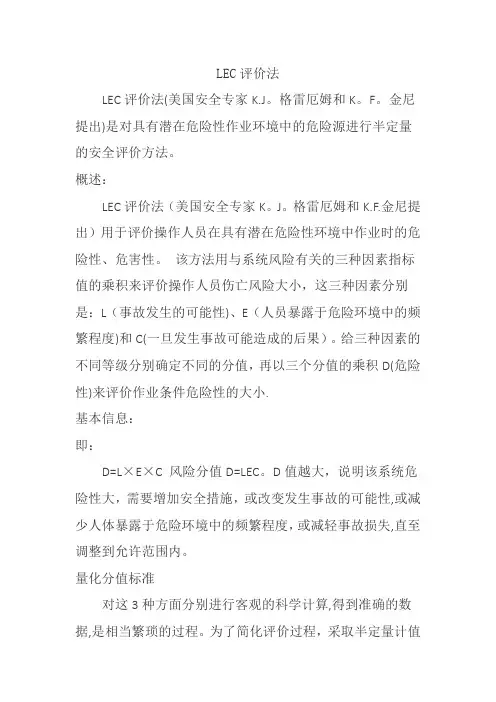
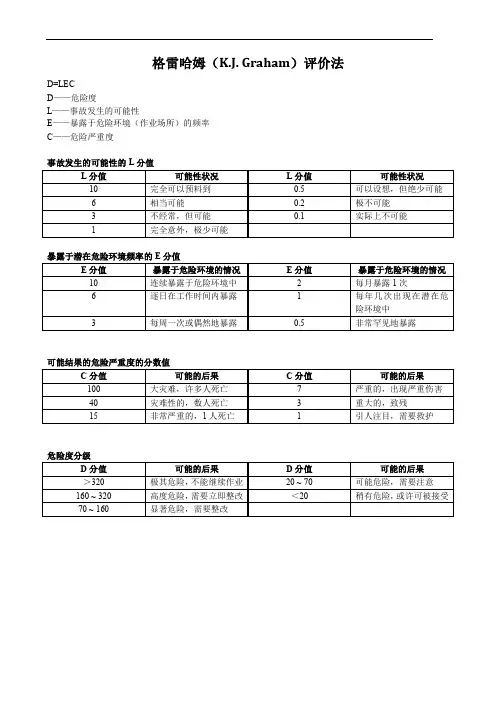
The formula for calculating the LEC is as follows: LEC = (C * Q * T) / S
Where:
- C is the Consequence factor, which represents the potential
consequences of the release.
- Q is the Quantity factor, which represents the amount of the
hazardous substance released.
- T is the Time factor, which represents the duration of the release.
- S is the Safe distance, which is the distance required to prevent the
occurrence of harmful effects.
The LEC evaluation method provides a systematic approach for
assessing the potential risk associated with the release of hazardous
substances in chemical plants.It helps in identifying the need for
additional safety measures and in ensuring the safe operation of the plant.
中文文档:
LEC(等效清空距离)评估法是一种用于量化风险评估的化学过程安全领域的技术。它是由英国健康与安全执行局(HSE)开发的一种工具,用于评估化学工厂中有害物质释放潜在风险。
LEC方法基于等效清空距离的概念,这是在有害物质释放事件中防止发生有害效果所需的距离的度量。该方法包括以下步骤:
1.确定工厂中存在的有害物质和潜在的释放情景。
2.确定释放的潜在后果,如物质的毒性、易燃性和反应性。
3.通过考虑最坏情况释放情景和潜在后果,计算每种有害物质的等效清空距离。
4.通过将计算的等效清空距离与安全距离标准相比较,评估风险。
计算LEC的公式如下:
LEC = (C * Q * T) / S
其中:
- C是后果因子,它代表释放的潜在后果。
- Q是数量因子,它代表释放的有害物质的数量。
- T是时间因子,它代表释放的持续时间。
- S是安全距离,它是防止有害效果发生的所需距离。
LEC评估方法为评估化学工厂中有害物质释放的潜在风险提供了一种系统的方法。