
unit 2 Engineering Materials
- 格式:ppt
- 大小:20.46 MB
- 文档页数:23


ContentPART 1 Introduction to Materials Science &Engineering 1 Unit 1 Materials Science and Engineering 1 Unit 2 Classification of Materials 9 Unit 3 Properties of Materials 17 Unit 4 Materials Science and Engineering: What does the Future Hold? 25 Part ⅡMETALLIC MATERLALS AND ALLOYS33 Unit 5 An Introduction to Metallic Materials 33 Unit 6 Metal Manufacturing Methods 47 Unit 7 Structure of Metallic Materials 57 Unit 8 Metal-Matrix Composites 68 Part ⅢCeramics 81 Unit 9 Introduction to Ceramics 81 Unit 10 Ceramic Structures —Crystalline and Noncrystalline 88 Unit 11 Ceramic Processing Methods 97 Unit 12 Advanced ceramic materials –Functional Ceramics 105 PARTⅣNANOMATERIALS 112 Unit 13 Introduction to Nanostructured Materials 112 Unit14 Preparation of Nanomaterials 117 Unit 15 Recent Scientific Advances 126 Unit 16 The Future of Nanostructure Science and Technology 130 Part ⅤPOLYMERS 136Unit17 A Brief Review in the Development of Synthetic Polymers 136 Unit18 Polymer synthesis: Polyethylene synthesis 146 Unit19 Polymer synthesis: Nylon synthesis 154 Unit 20 Processing and Properties Polymer Materials 165 PART VI POLYMERIC COMPOSITES 172 Unit21 Introduction to Polymeric Composite Materials 172 Unit22 Composition, Structure and Morphology of Polymeric Composites 178 Unit23 Manufacture of Polymer Composites 185 Unit24 Epoxy Resin Composites 191 Part 7 Biomaterial 196 Unit 25 Introduction to Biomaterials 196 Unit 26 Biocompatibility 205 Unit 27 Polymers as Biomaterials 213 Unit 28 Future of Biomaterials 224 PARTⅧMaterials and Environment 237 Unit29 Environmental Pollution & Control Related Materials 237 Unit30 Bio-degradable Polymer Materials 241 Unit 31 Environmental Friendly Inorganic Materials 248 Unit 32 A Perspective on the Future: Challenges and Opportunities 256 附录一科技英语构词法263 附录二科技英语语法及翻译简介269附录三:聚合物英缩写、全名、中文名对照表280附录四:练习题参考答案284PART 1 Introduction to Materials Science &EngineeringUnit 1Materials Science and EngineeringHistorical PerspectiveMaterials are probably more deep-seated in our culture than most of usrealize. Transportation, housing, clothing, communication, recreation, and food production —virtually every segment of our everyday lives is influenced to one degree or another by materials. Historically, the development and advancement of societies have been intimately tied to the members’ ability to produce and manipulate materi- als to fill their needs. In fact, early deep-seated根深蒂固的, 深层的civilizations have been designated by the level of their materials development (Stone Age, Bronze Age, Iron Age).The earliest humans had access to only a very limited number of materials, those that occur naturally: stone, wood, clay, skins, and so on. With time they discovered techniques for producing materials that had propertiessuperior to those of the natural ones; these new materials included pottery and various metals. Furthermore, it was discovered that the properties of a material could be altered by heat treatments and by the addition of other substances. At this point, materials utilization was totally a selection process that involved deciding from a given, rather limited set of materials the one best suited for an application by virtue of its characteristics.①It was not until relatively recent times that scientists came to understand the relationships between the structural elements of materials and their properties. This knowledge, acquired over approximately the past 100 years, has empowered them to fashion, to a large degree, the characteristics of materials. Thus, tens of thousands of different materials have evolved with rather specialized charac- teristics that meet the needs of our modern and complex society; these include metals, plastics, glasses, and fibers.The development of many technologies that make our existence so comfortable has been intimately associated with the accessibility of suitable materials. An advancement in the understanding of a material type is often the forerunner to the stepwise progression of a technology. For example, pottery // 陶器structural elements结构成分;property //.性能automobiles would not have been possibl- e without the availability of inexpensive steel or some other comparable substitute. In our contemporary era, sophisticated electronic devices rely on components that are made from what are called semiconducting materials.Materials Science and EngineeringThe discipline of materials science involves investigating the relationships that exist between the structures and properties of materials. In contrast, materials engineering is, on the basis of these structure–property correlations, designing or engineering the structure of a material to produce a predetermined set of properties.“Structure’’is at this point a nebulous term that deserves some explanation. In brief, the structure of a material usually relates to the arrangement of its internal components. Subatomic structure involves electrons within the individual atoms and interactions with their nuclei. On an atomic level, structure encompasses the organization of atoms or molecules relative to one another. The next larger structural realm, which contains large groups of atoms that are normally agglomerated together, is termed ‘‘microscopic,’’meaning that which is subject to direct observation using some type of microscope. Finally, structural elements that may be viewed with the naked eye are termed ‘‘macroscopic.’’The notion of ‘‘property’’ deserves elaboration. While in service use, all materials are exposed to external stimuli that evoke some type of response. stepwise//逐步的sophisticated//精制的,复杂的;semiconducting materials 半导体材料nebulous//含糊的,有歧义的subatomic//亚原子的microscopic//For example, a specimen subjected to forces will experience deformation; or a polished metal surface will reflect light. Property is a material trait in terms of the kind and magnitude of response to a specific imposed stimulus. Generally, definitions of properties are made independent of material shape and size.Virtually all important properties of solid materials may be grouped into six different categories: mechanical, electrical, thermal, magnetic, optical, and deteriorative. For each there is a characteristic type of stimulus capable of provoking different responses. Mechanical properties relate deformation to an applied load or force; examples include elastic modulus and strength. For electrical properties, such as electrical conductivity and dielectric constant, the stimulus is an electric field. The thermal behavior of solids can be represented in terms of heat capacity and thermal conductivity. Magnetic properties demonstrate the response of a material to the application of a magnetic field. For optical properties, the stimulus is electro- magnetic or light radiation; index of refraction and reflectivity are representative optical properties. Finally, deteriorative characteristics indicate the chemical reactivity of materials.In addition to structure and properties, two other important components are involved in the science and engineering of materials, viz. ‘‘processing’’and ‘‘performance.’’With regard to the relationships of these four components, the structure of a material will depend on how it is processed. 微观的// 宏观的deformation// 变形deteriorative//破坏(老化的)elastic modulus 弹性模量strength //强度;dielectric constant介电常数;heat capacity 热容量refraction。
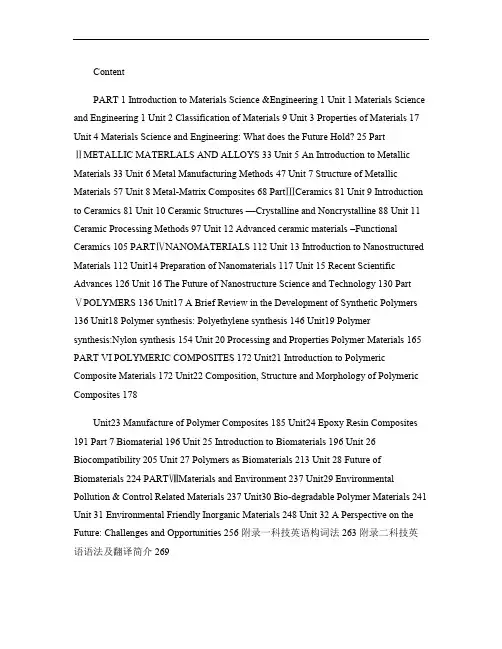
ContentPART 1 Introduction to Materials Science &Engineering 1 Unit 1 Materials Science and Engineering 1 Unit 2 Classification of Materials 9 Unit 3 Properties of Materials 17 Unit 4 Materials Science and Engineering: What does the Future Hold? 25 PartⅡMETALLIC MATERLALS AND ALLOYS 33 Unit 5 An Introduction to Metallic Materials 33 Unit 6 Metal Manufacturing Methods 47 Unit 7 Structure of Metallic Materials 57 Unit 8 Metal-Matrix Composites 68 PartⅢCeramics 81 Unit 9 Introduction to Ceramics 81 Unit 10 Ceramic Structures —Crystalline and Noncrystalline 88 Unit 11 Ceramic Processing Methods 97 Unit 12 Advanced ceramic materials –Functional Ceramics 105 PARTⅣNANOMATERIALS 112 Unit 13 Introduction to Nanostructured Materials 112 Unit14 Preparation of Nanomaterials 117 Unit 15 Recent Scientific Advances 126 Unit 16 The Future of Nanostructure Science and Technology 130 PartⅤPOLYMERS 136 Unit17 A Brief Review in the Development of Synthetic Polymers 136 Unit18 Polymer synthesis: Polyethylene synthesis 146 Unit19 Polymer synthesis:Nylon synthesis 154 Unit 20 Processing and Properties Polymer Materials 165 PART VI POLYMERIC COMPOSITES 172 Unit21 Introduction to Polymeric Composite Materials 172 Unit22 Composition, Structure and Morphology of Polymeric Composites 178Unit23 Manufacture of Polymer Composites 185 Unit24 Epoxy Resin Composites 191 Part 7 Biomaterial 196 Unit 25 Introduction to Biomaterials 196 Unit 26 Biocompatibility 205 Unit 27 Polymers as Biomaterials 213 Unit 28 Future of Biomaterials 224 PARTⅧMaterials and Environment 237 Unit29 Environmental Pollution & Control Related Materials 237 Unit30 Bio-degradable Polymer Materials 241 Unit 31 Environmental Friendly Inorganic Materials 248 Unit 32 A Perspective on the Future: Challenges and Opportunities 256 附录一科技英语构词法263 附录二科技英语语法及翻译简介269附录三:聚合物英缩写、全名、中文名对照表280 附录四:练习题参考答案284 PART 1 Introduction to Materials Science &EngineeringUnit 1Materials Science and Engineering Historical PerspectiveMaterials are probably more deep-seated in our culture than most of us realize. Transportation, housing, clothing, communication, recreation, and food production —virtually every segment of our everyday lives is influenced to one degree or another by materials. Historically, the development and advancement of societies ha ve been intimately tied to the members‘ ability to produce and manipulate materi- als to fill their needs. In fact, early civilizations have been designated by the level of their materials development (Stone Age, Bronze Age, Iron Age.The earliest humans had access to only a very limited number of materials, those that occur naturally: stone, wood, clay, skins, and so on. With time they discovered techniques for producing materials that had properties superior to those of the natural ones; these new materials included pottery and various metals. Furthermore, it was discovered that the properties of a material could be altered by heat treatments and by the addition of other substances. At this point, materials utilization was totally a selection process that involved deciding from a given, rather limited set of materials the one best suited for an application by virtue of its characteristics.①It was not until relatively recent times that scientists came to understand the relationships between the structural elements of materials and their properties. This knowledge, acquired over approximately the past 100 years, has empowered them to fashion, to a large degree, the characteristics of materials. Thus, tens of thousands of different materials have evolved with rather specialized charac- teristics that meet the needs of our modern and complex society; these include metals, plastics, glasses, and fibers. deep-seated根深蒂固的, 深层的pottery / ☐☯❑♓陶器structural elements结构成分;property / ☐❑☐☜♦♓/⏹.性能The development of many technologies that make our existence so comfortable has been intimately associated with the accessibility of suitable materials. An advancement in the understanding of a material type is often the forerunner to the stepwise progression of a technology. For example, automobiles would not havebeen possibl- e without the availability of inexpensive steel or some other comparable substitute. In our contemporary era, sophisticated electronic devices rely on components that are made from what are called semiconducting materials. Materials Science and EngineeringThe discipline of materials science involves investigating the relationships that exist between the structures and properties of materials. In contrast, materials engineering is, on the basis of these structure–property correlations, designing or engineering the structure of a material to produce a predetermined set of properties.―Structure‘‘ is at this point a nebulous term that deserves some explanation. In brief, the structure of a material usually relates to the arrangement of its internal components. Subatomic structure involves electrons within the individual atoms and interactions with their nuclei. On an atomic level, structure encompasses the organization of atoms or molecules relative to one another. The next larger structural realm, which contains large groups of atoms that are normally agglomerated together, is termed‗‗microscopic,‘‘ meaning that which is subject to direct observation using some type of microscope. Finally, structural elements that may be viewed with the naked eye are termed ‗‗macroscopic.‘‘The notion of ‗‗property‘‘ deserves elaboration. While in service use, all materials are exposed to external stimuli that evoke some type of response. For example, aspecimen subjected to forces will experience deformation; or a polished metal surface will reflect light. Property is a material trait in terms of the kind and magnitude of response to a specific imposed stimulus. Generally, definitions of properties are made independent of material shape and size.Virtually all important properties of solid materials may be grouped into six different categories: mechanical, electrical, thermal, magnetic, optical, and stepwise /♦♦♏☐♦♋♓/ ♎逐步的sophisticated/♦☯♐♓♦♦♓♏♓♦♓♎/ ♎精制的,复杂的; semiconducting materials 半导体材料nebulous/ ⏹♏♌✞●☯♦/♎含糊的,有歧义的subatomic/ ♦✈♌☯❍♎亚原子的microscopic/❍♓❑☯☐♓♎微观的❍♋♍❑☐♦♍☐☐♓♍/❍✌❑☯✞☐♓♎宏观的deteriorative. For each there is a characteristic type of stimulus capable of provokingdifferent responses. Mechanical properties relate deformation to an applied load or force; examples include elastic modulus and strength. For electrical properties, such as electrical conductivity and dielectric constant, the stimulus is an electric field. The thermal behavior of solids can be represented in terms of heat capacity and thermalconductivity. Magnetic properties demonstrate the response of a material to the application of a magnetic field. For optical properties, the stimulus is electro- magnetic or light radiation; index of refraction and reflectivity are representative optical properties. Finally, deteriorative characteristics indicate the chemical reactivity of materials.In addition to structure and properties, two other important components are involved in the science and engineering of materials, viz. ‗‗processing‘‘ and‗‗performance.‘‘ With regard to the relationships of these four components, the structure of a material will depend on how it is processed. Furthermore, a material‘s perf ormance will be a function of its properties.Fig. 1.1 Photograph showing the light transmittance of three aluminum oxide specimens. From left to right: single crystal material (sapphire, which is transparent;a polycrystalline and fully dense (nonporous material, which is translucent; and a polycrystalline material that contains approximately 5% porosity, which is opaque. (Specimen preparation, P. A. Lessing; photography by J. Telford.We now present an example of these processing-structure-properties-perfor- mance principles with Figure 1.1, a photograph showing three thin disk specimens placed over some printed matter. It is obvious that the optical properties (i.e., the deformation/♎♓♐❍♏♓☞☯变形deteriorative/♎♓♓☯❑♓☯❑♏♓♦♓破坏(老化的elastic modulus 弹性模量strength /♦♦❑♏⏹♑强度;dielectric constant介电常数;heat capacity 热容量refraction/❑♓♐❑✌☞☯折射率; reflectivity/ ❑♓♐●♏♓♓♦♓/ 反射率processing/☐❑☯◆♏♦♓☠加工light transmittance of each of the three materials are different; the one on the left is transparent (i.e., virtually all of the reflected light passes through it, whereas the disks in the center and on the right are, respectively, translucent and opaque.All of these specimens are of the same material, aluminum oxide, but the leftmost one is what we call a single crystal—that is, it is highly perfect—which gives rise to its transparency. The center one is composed of numerous and verysmall single crystals that are all connected; the boundaries between these small crystals scatter a portion of the light reflected from the printed page, which makes this material optically translucent.②And finally, the specimen on the right is composed not only of many small, interconnected crystals, but also of a large number of very small pores or void spaces. These pores also effectively scatter the reflected light and render this material opaque.Thus, the structures of these three specimens are different in terms of crystal boundaries and pores, which affect the optical transmittance properties. Furthermore, each material was produced using a different processing technique. And, of course, if optical transmittance is an important parameter relative to the ultimate in-service application, the performance of each material will be different.Why Study Materials science and Engineering?Why do we study materials? Many an applied scientist or engineer, whether mechanical, civil, chemical, or electrical, will at one time or another be exposed to a design problem involving materials. Examples might include a transmission gear, the superstructure for a building, an oil refinery component, or an integrated circuit chip. Ofcourse, materials scientists and engineers are specialists who are totally involved in the investigation and design of materials.Many times, a materials problem is one of selecting the right material from the many thousands that are available. There are several criteria on which the final decision is normally based. First of all, the in-service conditions must be charac- terized, for these will dictate the properties required of the material. On only rare occasions does a material possess the maximum or ideal combination of properties. transmittance/♦❑✌❍♓♦☜⏹♦/ ⏹. 透射性sapphire /♦✌♐♓☯蓝宝石transparent/♦❑✌☐☪☯❑☯⏹♦/ ♎透明的;polycrystalline/ ☐♓❑♓♦♦☯♓多晶体; translucent/♦❑✌✞♎半透明的; opaque☯✞☐♏♓♎不透明的single crystal 单晶体Thus, it may be necessary to trade off one characteristic for another. The classic example involves strength and ductility; normally, a material having a high strength will have only a limited ductility. In such cases a reasonable compromise between two or more properties may be necessary.A second selection consideration is any deterioration of material properties that may occur during service operation. For example, significant reductions in mecha- nical strength may result from exposure to elevated temperatures or corrosive envir- onments.Finally, probably the overriding consideration is that of economics: What will the finished product cost? A material may be found that has the ideal set of proper- ties but is prohibitively expensive. Here again, some compromise is inevitable.The cost of a finished piece also includes any expense incurred during fabrication to produce the desired shape. The more familiar an engineer or scientist is with the various characteristics and structure–property relationships, as well as processing techniques of materials, the more proficient and confident he or she will be to make judicious materials choices based on these criteria.③Reference:William D. Callister, Materials science and engineering : anintroduction, Press:John Wiley & Sons, Inc.,2007;2-5 transmission gear传动齿轮dictate/♎♓♏♓决定trade off 权衡;折衷ductility♎✈♓●♓♦♓延展性/ ☯✞☯❑♋♓♎♓☠/♎最主要的judicious/♎✞✞♎♓☞☯♦/♎明智的Notes1.At this point, materials utilization was totally a selection process that involved deciding froma given, rather limited set of materials the one best suited for an application by virtue of itscharacteristics由此看来,材料的使用完全就是一个选择过程,且此过程又是根据材料的性质从许多的而不是非有限的材料中选择一种最适于某种用途的材料。