
语言学第六章chapter6
- 格式:ppt
- 大小:3.67 MB
- 文档页数:66


第一章 语言学和语言
教学目的与要求:
通过本章的学习,了解语言学的研究对象和研究方法。
教学重点与难点:
语言学的概念;现代语言学的研究领域;语言研究中的一些重要对立;语言的概念
复习思考题:
1. How do you interpret the following definition of linguistics: Linguistics is the scientific
study of language?
2. What are the major branches of linguistics? What does each of them study
3. In what basic ways does modern linguistics differ from traditional grammar?
4. How is Saussure’s distinction between langue and parole similar to Chomsky’s distinction
between competence and performance?
5. What characteristics of language do you think should be included in a good,
comprehensive definition of language?
6. What are the main features of human language that have been specified by C. Hockett to
show that it is essentially different from animal communication system?
第二章 音位学
教学目的与要求:
通过本章的学习,了解英语语音学和音位学的研究内容。

今泰学院推荐文档
第 1 页 共 5 页
Chapter6Watertalk教学设计
Chapter 6 watertalk teaching design
今泰学院推荐文档
第 2 页 共 5 页 Chapter6Watertalk教学设计
前言:小泰温馨提醒,英语作为在许多国际组织或者会议上都是必需语言,几乎所有学校选择英语作为其主要或唯一的外语必修课。英语教学涉及多种专业理论知识,包括语言学、第二语言习得、词汇学、句法学、文体学、语料库理论、认知心理学等内容。本教案根据英语课程标准的要求和针对教学对象是初中生群体的特点,将教学诸要素有序安排,确定合适的教学方案的设想和计划、并以启迪发展学生智力为根本目的。便于学习和使用,本文下载后内容可随意修改调整及打印。
chapter 6 water talk
part a language
i. words and expressions
1.freeze v. 结冰,僵住 freezing adj. 寒冷的 frozen adj. 冷冻的
it’s freezing outside. look! the ground is frozen.
外面寒冷,看地上结冰了。
danny froze when he heard the news. 当丹尼听到这消息时,他愣住了。
2.impatient adj. 不耐烦的 patient adj. 耐心的 n. 病人
we mustn’t be impatient with the patients. 对待病人我们不能不耐烦。 今泰学院推荐文档
第 3 页 共 5 页 3.chemical n. on the morning of jan. 12st; on a
cold evening
4.be going to/will表示将来时的区别
be going to 结构常用来表示事先经过考虑的意图、打算或准备;或很快就要发生的将来的情况或行动。
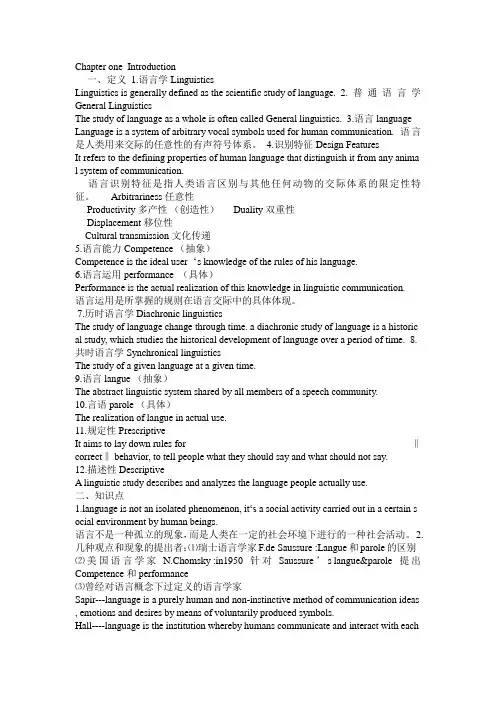
Chapter one Introduction
一、定义 1.语言学Linguistics
Linguistics is generally defined as the scientific study of language. 2.普通语言学General Linguistics
The study of language as a whole is often called General linguistics. 3.语言language
Language is a system of arbitrary vocal symbols used for human communication. 语言是人类用来交际的任意性的有声符号体系。 4.识别特征Design Features
It refers to the defining properties of human language that distinguish it from any animal system of communication.
语言识别特征是指人类语言区别与其他任何动物的交际体系的限定性特征。 Arbitrariness任意性
Productivity多产性 (创造性) Duality双重性
Displacement移位性
Cultural transmission文化传递
5.语言能力Competence (抽象)
Competence is the ideal user‘s knowledge of the rules of his language.
6.语言运用performance (具体)
Performance is the actual realization of this knowledge in linguistic communication.

语言学名词解释 point of view, i.e. Chapter 1: In troducti on
I. Lin guistics: Lin guistics is gen erally defi ned as the scie ntific study of Ian guage.
8. Iangue: Lange refers to the abstract linguistic system shared by all the members of a
speech com mun ity.
9. parole :Parole refers to the realizati on of Ian gue in actual use.
10. compete nee : The ideal user ' s kno wledge of the rules of his Ian guage.
II. performanee : The actual realization of this knowledge in linguistic com muni cati on.
12. la nguage : Lan guage is a system of arbitrary vocal symbols used for huma n com muni
cati on.
13. design features : Design features refer to the defining properties of human Ian guage that
dist in guish it from any an imal system of com muni cati on.
14. arbitrari ness: Arbitrari ness refers to no logical conn ecti on betwee n meaning and sound.