译林英语四年级下册Unit3 My day第一课时公开课教学设计
- 格式:docx
- 大小:37.31 KB
- 文档页数:3
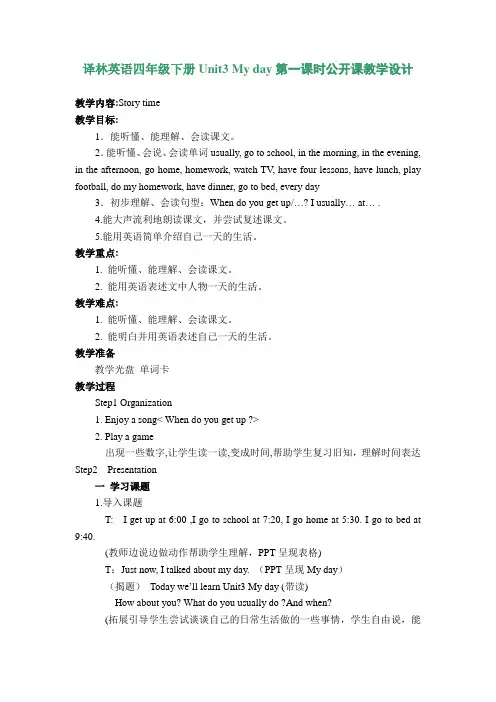
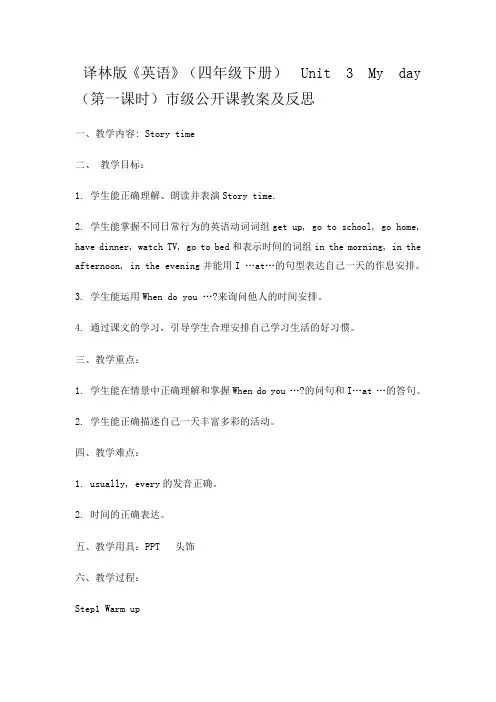
译林英语四年级下册Unit3 My day第一课时公开课教学设计
Teaching Design for the First Lesson of Unit 3 "My Day" in Grade Four
of Yilin English
Introduction:
In the first lesson of Unit 3 "My Day" in the fourth grade of Yilin
English, the focus is on introducing and practicing vocabulary related to
daily routines. This teaching design aims to engage students actively and
help them develop their listening, speaking, and reading skills while
enhancing their vocabulary acquisition.
Warm-up:
To start the lesson, the teacher can draw a picture of a clock on the board
and ask the students to tell the time in English. The teacher can guide the
students to use phrases such as "It's eight o'clock" or "It's two thirty."
Main Activities:
1. Vocabulary Introduction:
- Start by presenting flashcards with pictures of daily routines, such as
waking up, brushing teeth, having breakfast, going to school, etc. The
teacher can introduce each activity by saying the phrase and demonstrating
the corresponding action.
- After introducing the vocabulary, the teacher can play a game of
"Simon Says" using the daily routines. For example, the teacher says, "Simon says, 'Brush your teeth!'" and the students perform the action. This
game helps reinforce the vocabulary and engages students in physical
movement.
2. Listening and Speaking:
- The teacher plays an audio recording that describes a typical daily
routine, including waking up, getting dressed, having breakfast, going to
school, etc. After playing the recording, the teacher asks comprehension
questions to check the students' understanding.
- To practice speaking, the students can work in pairs and take turns
describing their own daily routines using the vocabulary introduced in the
lesson. The teacher can encourage the use of complete sentences and provide
prompts if needed.
3. Reading and Writing:
- Provide each student with a short passage or a worksheet that
contains sentences about daily routines. The students should read the
sentences and match them to the corresponding pictures.
- Afterwards, the students can copy the sentences into their notebooks,
paying attention to proper handwriting and spelling. The teacher can provide
individual guidance and support as necessary.
4. Group Activity:
- Divide the students into small groups and give each group a set of
picture cards representing various daily routines. The students should take
turns describing a picture while the others listen and try to guess the corresponding activity. This activity encourages collaboration, listening
skills, and review of the vocabulary learned.
Conclusion:
For the conclusion of the lesson, the teacher can lead a brief class
discussion about the importance of daily routines and how they contribute to
a well-organized day. The teacher can also recap the vocabulary learned
throughout the lesson, asking individual students to provide examples of
daily routines.
By implementing this teaching design, students are actively engaged in
various language activities, allowing them to practice and reinforce the
vocabulary related to daily routines. Through interactive games, listening
tasks, speaking exercises, and reading and writing activities, students can
develop their language skills while enjoying the learning process.