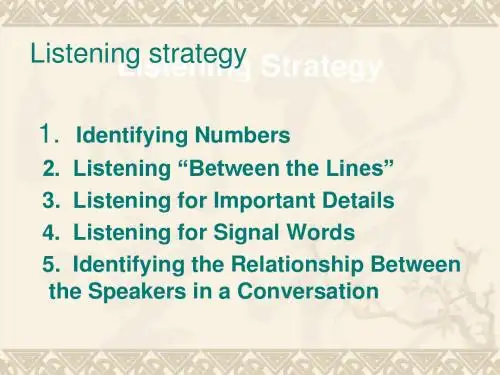
Unit 4 MusicPart AListening StrategyListening for Signal WordsThe ability to identify signal words can help us follow the thread of the speaker’s thought. People often use signal words or phrases like “but”, “yet”, “on the contrary”, “however”, “because”, “therefore” and “as a result” to add a comment that contrasts with what has just been said or to signal what they are about to say is the result or cause of their previous remarks. S imilarly, words and phrases like “for example”, “most importantly”, “first”, “second”, “f inally”and “then” usually signal that the speaker is going to provide an illustration or emphasize a certain point or discuss several aspects of a certain topic. So we should pay attention to signal words in listening as they will prepare us for what is going to be said.You’re going to hear four short passages. Listen carefully and write down the signal word(s) in each passage. Then choose a, b, c or d to indicate the function of the signal word(s) used in each of the passages.The signal words in the passages you have heard may perform the following functions:a. leading towards a statement that is a contrast or an opposite to what has been saidb. summarizing what has been saidc. setting out the stages of the talkd. suggesting cause and effect1. ________2. ________3. ________4. ________Part BPre-listening Task (Assignment)Questions for DiscussionYou are going to talk about music. Read the following questions and discuss them with your partner.1. Do you like music? What type of music do you like best? Traditional Chinese music or Western music? Classical or popular?2. Who is your favorite singer / composer?3. Do you play any musical instrument? If you do, what is it? How long have you played it? If not, what instrument would you like to learn to play?4. What do you think is the value of music?Additional Question for DiscussionDo you listen to music while studying? Do you think it is a good habit?Language FocusHere are some sentences and structures that you might find useful in discussing the above questions.●I enjoy rock / country / jazz / light music.●I prefer chamber music to electronic music.●I like classical music best.●My tastes in music are quite varied, from Italian operas to pop songs.●I don’t usually like pop songs, but there’re always some exceptions.●My favorite composer is … His / Her works are full of life.●I find his / her music rhythmic / melodious / sweet / moving / soothing / stimulating / harmonious / exciting.●Classical / light music is soothing / calming.●I play drums / the guitar / the violin / the piano.●I can play a little piano / trumpet / flute.●I love to listen to the violin / the piano, but I’ve never learned to play it.●How I envy those who can play the piano very well / can sing melodiously / have a beautiful voice!●How I wish I could sing well!●Music can affect our physical, mental and emotional states of being.●We can express ourselves, our thoughts and feelings, through music.●Music can express not only love, longing, happiness, unity, but also sadness, sorrow and anger.●Music can make us laugh, cry, feel happy / strong.●Music is the universal language. Sometimes, it communicates more clearly than words.Listening TasksBackground MusicWord Bankintend v. to plan 打算使……(成为)soothing a. calming and comforting 宜人的,使心旷神怡的boost v. to increase; to raise 增加;提高receipts n. (pl.) amount of money received by a business during a particular period 进款,收入spot v. to pick out with the eye 找出overall a. total 总的indigestion n. illness or pain caused by the stomach being unable to deal with the food which hasbeen eaten 消化不良find its way into to spread into 传入increase by as much as to add as much as ... to the total of ... 增长多达……have an effect on to affect 影响slow down to become slower 慢下来,减速Language and Culture Notes1. Background informationDifferent types of music can have different effects on us. When we listen to exciting music with fast rhythms, our hearts beat fast, and we feel greatly stimulated. Light music, on the other hand, has a soothing effect. We feel relaxed when we are exposed to beautiful melodies. The changes in our bodies caused by different kinds of music will in turn affect our behavior. This explains why slow music played in shops can increase sales and why the speaker suggests in a playful way that faster music be played in restaurants to keep the flow of diners at a desirable rate.2. Yet, slow music isn’t always the answer.But playing slow music is not always effective.3. to keep the customers movingto make the diners finish their meals quickly so that more customers can be served4. unless, of course, the resulting indigestion leads to complaintsunless customers complain that faster music makes them eat so quickly that they suffer from indigestion Exercise 1Listen to the passage. As you listen, read the signal words in your book and put a tick ( ) in the brackets after the ones you have heard.1. for instance ( )2. but ( )3. in addition ( )4. first ( )5. very soon ( )6. in consequence ( )7. despite ( ) 8. on the contrary ( )9. admittedly ( ) 10. to begin with ( )11. firstly ( ) 12. however ( )13. because ( ) 14. on one hand ( )15. on the other hand ( ) 16. yet ( )17. so ( ) 18. hopefully ( )Exercise 2Listen to the passage again and choose the right answers to the questions.1. Where was recorded background music first used?a. In factories, shops and offices in Europe.b. In factories, shops and restaurants in the USA.c. In factories, shops and snack bars in the USA.d. In factories, shops and restaurants in Japan.2. What was the original purpose of background music?a. To boost sales.b. To increase factory production.c. To make sure that diners eat quickly.d. To produce a pleasant atmosphere.3. What kind of music can have a powerful effect on customers in shops?a. Rock music.b. Lively music.c. Light music.d. Traditional music.4. Why do esn’t the same kind of music work in restaurants according to the passage?a. It may slow down the flow of customers.b. It may result in indigestion.c. It may interrupt diners’ conversations.d. It may spoil diners’ appetite.Conversation 1A: Do you like English songs?B: I’m crazy about them.A: What’s your favorite song?B: It’s hard to say. There are so many beautiful songs.A: Who’s your favorite singer th en?B: Sarah Brightman, undoubtedly. I do admire her, you know. I love all her songs.A: I like her, too, but not that much.Conversation 2A: Do you care for opera?B: Yes, I do, very much.A: Which do you like better, opera or musical?B: Opera.A: Do you just listen to it or go to performances?B: I prefer going to a performance. It has everything, color and spectacle and great music.A: Why don’t we go and see Aida together? It’s being performed at the Grand Theater.B: I’ve seen it already.It’s excellent.A: Oh, lucky you!Conversation 3A: Do you enjoy listening to music?B: Yes, very much. I enjoy listening to music more than any other pastime.A: What’s your favorite music?B: It depends. When I am in a good mood, I’d prefer somethi ng exciting, with a fast rhythm. But if I feel low, I can only listen to something soft and quiet.A: Mm, me too.Exercise (Assignment)Now make similar conversations. Use the structures and expressions above where appropriate. Your conversations should include the following points.1. The type of music / song / singer / composer / instrument you like.2. The reason why you like it.Part CTest Your ListeningA Compound DictationListen to the passage three times and supply the missing information.Celine Dion is the youngest of 14 children in a working-class family in Quebec, Canada. Her parents, who both loved music, 1) ________ her to develop her musical 2) ________. At 12, Celine had 3) ________ the song “It Was Only a Dream”. Her mother and brother helped her to make a recording of that song and sent it off to an address they found on an album of a popular French singer. The address was that of Rene Angelil, who became her first 4) ________, but there would be millions more.Celine’s rise from a teenage singer to a pop superstar has been 5) ________, but not without difficulties. Record companies were at first less 6) ________ about 7) ________ in a teenager than Angelil, who mortgaged his own home to pay for her first album. But her first two albums won a great success. And by 1983 she became the first Canadian ever to have a gold record in France.In 1990, Celine made her first English language record with Unison but 8)________________________________________________________________________________________. The song went to No.1 on the chart and won both a Grammy and an Academy award. 9) ________ ________________ ________ ________ ________ ________ ________ ________ ________ and in 1997 she recorded the theme song for Titanic, and her name became synonymous with the enormously successful film.Celine Dion’s favorite theme is love.10) ________ ________ ________ ________ ________ ________________ ________ ________ ________ ________ ________ ________ ________ ________ ________ and, of course, the theme song of Titanic, “My Heart Will Go On”.Part DTime to TalkLook at these pictures and describe them one by one. If possible, try also to find something relevant to talk about.Hints:1. A: egg-shaped objects, “xun” (埙,陶埙) in Chinese, an ancient musical instrument, played by blowing into the big hole at the top, expressive in presenting a sad story in the pastB: violin, bow (琴弓),alongside, a typical classical musical instrument, compared with the “xun”, more expressive, show different emotions, happiness, excitement, sadness2. Michael Jackson, king of American pop music, a black, world-famous, give concerts around the world, his songs, very dynamic (有活力的) and exciting, more famous than presidents3. orchestra (管弦乐队), a conductor (指挥), be held in concert halls, different musical instruments, dressed in black, audience, polite, clap hands at the endMovie TimeNew Wordssupplement n.补充剂dose n.剂量hectic a.繁忙的bungalow n.平房cocktail n.混合物crucial a.重要的;关键性的vigorous a.精力充沛的dairy a.乳品的;奶制的liver n.肝脏deformity n.畸形citrus fruit 柑橘类水果scurvy n.坏血病rickets n.佝偻病infectious agent 感染原deficiency n.缺乏daily allowance 每日剂量Exercise AChoose the best answer to the following questions.1. What are scientists concerned about vitamins?a. Whether taking large doses of some vitamins are safe.b. Which vitamins are the most beneficial.c. Whether taking vitamins can be popularized.d. Which vitamins can cure diseases.2. What does the female scientist say about taking vitamins?a. One doesn’t have to take vitamins at all.b. One has to take vitamins as many as possible.c. One needs to pay attention to doses of vitamins.d. One may replace meals with vitamins.Exercise BMatch the types of vitamins with their sources and their functions.Vitamin A Found in fish To end scurvy Vitamin C Found in fruits To prevent rickets Vitamin D Found in dairy products To prevent blindness。