完整虚拟语气用法表格归纳图
- 格式:doc
- 大小:60.00 KB
- 文档页数:10
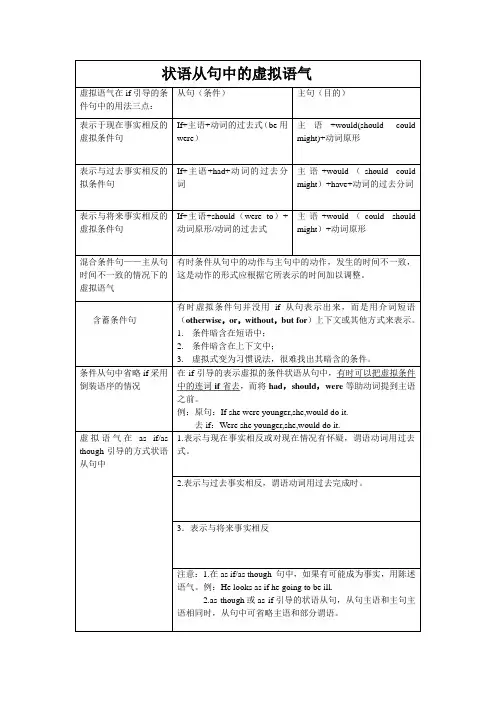
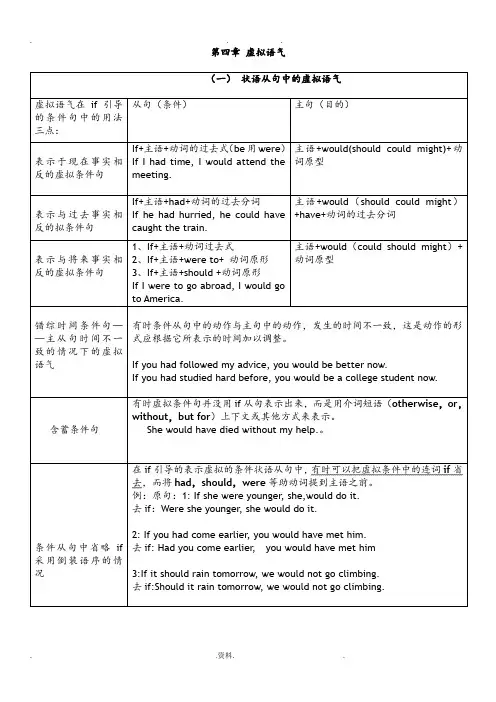
实用文档. 状语从句中的虚拟语气
虚拟语气在if引导的条件句中的用法三点: 从句〔条件〕 主句〔目的〕
表示于现在事实相反的虚拟条件句 If+主语+动词的过去式〔be用were〕
If I had time, I would
attend the meeting.
主语+would(should could
might)+动词原型
表示与过去事实相反的拟条件句 If+主语+had+动词的过去分词
If he had hurried ,he
could have caught the
train. 主语+would〔should could
might〕+have+动词的过去分词
表示与将来事实相反的虚拟条件句 1、If+主语+动词过去式
2、If+主语+were to+ 动词原形
3、If+主语+should +动词原形
If I were to go abroad ,I
would go to America. 主语+would〔could should
might〕+动词原型
错综时间条件句——主从句时间不一致的情况下的虚拟语气
有时条件从句中的动作与主句中的动作,发生的时间不一致,这是动作的形式应根据它所表示的时间加以调整。
If you had followed my advice , you would be better now.
If you had studied hard before, you would be a college
student now.
含蓄条件句 有时虚拟条件句并没用if从句表示出来,而是用介词短语〔otherwise,or,without,but for〕上下文或其他方式来表示。
1. 条件暗含在短语中;
2. 条件暗含在上下文中;
3. 虚拟式变为习惯说法,很难找出其暗含的条件。
条件从句中省略if采用倒装语序的情况 在if引导的表示虚拟的条件状语从句中,有时可以把虚拟条件中的连词if省去,而将had,should,were等助动词提到主语之前。
例:原句:1: If she were younger,she,would do it.
去if:Were she younger,she,would do it.
2: If you had come earlier, you would have met
him.
去if: Had you come earlier, you would have met 实用文档. him 实用文档.
3:If it should rain tomorrow, we would not go
climbing.
去if:Should it rain tomorrow, we would not go
climbing.
虚拟语气在as if/as
though引导的方式状语从句中 1.表示与现在事实相反或对现在情况有疑心,谓语动词用过去式。
He treats the boy as if he were his own son.
2.表示与过去事实相反,谓语动词用过去完成时。
He spoke as if he had known about it.
3.表示与将来事实相反,(表示将来的可能性不大),用would
(might, could)+动词原形
He acts as if he could win in the game .
注意:1.在as if/as though 句中,如果有可能成为事实,用陈述语气。
例:He looks as if he going to be ill.
2.as though或as if引导的状语从句,从句主语和主句主语一样时,从句中可省略主语和局部谓语。
虚拟语气用在lest,for fear that,so that及in order that引导的目的状语从句中表示“以防,以免〞等意思
谓语动词多用should/could/might+动词原型构成
For fear that it may rain tomorrow, we should bring an
umbrella.
由“providing〔that〕/provided〔that〕/on
condition
that/suppose〔that〕/supposing〔that〕〞引导的条件从句
根据情况,1.可以用虚拟语气。
例:suppose/supposing that it rained,we
shouldn’t go out.
2.也可以用陈述语气。
例:They are willing to surrender provided they
are given free pardon..
实用文档.
“In case〞引导的从句中即可用陈述句,也可以用虚拟语气 〔should〕+动词原型
例:1.The game will be put off in case it (should) snow.
2.The game will be put off in case it snows.
名词性从句中的虚拟语气
一:宾语从句中的虚拟语气
pe后的宾语从句中的虚拟语气,表示一种不可能实现的愿望。 对现在情况的虚拟:从句谓语动词用过去式或过去进展式。
I wish (that) I were a bird.
对过去情况的虚拟:从句谓语动词用过去完成时,或would,could,might+现在完成时。
I wish (that) I had seen the film last night.
对将来情况的虚拟:从句谓语“would/should/could/might+动词原形〞。
I wish (that) I would\could go.
在表示建议,命令,要求,忠告,等动词的后面的宾语从句中的虚拟语气 均以“should+动词原型〞表示这种语气,“should〞常被省略。
We suggested that the meeting (should) be put off.
They insisted that the boy (should) go with them.
常用的此类动词有:
表示“提议,劝告,建议〞的:propose,suggest,recommend,advise.
表示“要求〞的:ask,desire, request,demand,require,beg
表示“同意,坚持〞的:insist
表示“决定,命令〞的:decide,order
注意:suggest,insist不表示建议或坚持要某人做某事时,即它们用于其本意暗示,说明,坚持认为时,宾语从句用陈述语气。
The smile on his face suggested(暗示〕 that he was satisfied
with our work.
The man insisted 【坚持认为】that he had never stolen the
money. 实用文档.
在expect,believe,think,suspect等动词的否认或疑问形式后的宾语从句中的虚拟语气 经常用“should+动词原型〔或完成形式〕,表示惊奇,疑心,不满等情绪。
I cannot believe that you should think so.
Would rather,had
rather,后的宾语从句中的虚拟语气 谓语动词用过去式表示与现在或将来相反
I would rather you told me the truth.
用过去完成式表示与过去事实相反。表示“宁愿做什么〞或“对过去做的事的懊悔〞。
I would rather you had gone there last Sunday.
注意:1.假设某人愿自己做某事,would rather后用动词原型
2.would rather…..than……中用动词原型
I would rather do it by myself.
I would rather watch TV at home than go to the
cinema.
主语从句中的虚拟语气
“It is(was)+形容词〔或过去分词〕+that….〞构造中的虚拟语气 表达形式为should+动词原形或省略should
It’s quite necessary that we should have a walk now.
常用的形容词:natural,appropriate,advisable,necessary,important,urgent,probable,possible,desirable,strange。
注意:在上述所列形容词后面用that引出的宾语从句中,谓语动词也要用虚拟语气。
例:I don’t think it advisable that tom be assigned to the
job since he has no experience.(汤姆缺乏经历,指派他做这项工作我认为是不恰当的).
在“It is (was)+名词+that 表示建议,命令,请求,抱歉,疑心,惊奇等。
It’s a pity that you (should) miss a good chance.