计算机网络实验三参考答案
- 格式:pdf
- 大小:624.63 KB
- 文档页数:7
1. What is the IP address and TCP port number used by the client computer (source) that
is transferring the file to gaia.cs.umass.edu? To answer this question, it’s probably
easiest to select an HTTP message and explore the details of the TCP packet used to carry
this HTTP message, using the “details of the selected packet header window” (refer to
Figure 2 in the “Getting Started with Wireshark” Lab if you’re uncertain about the
Wireshark windows).
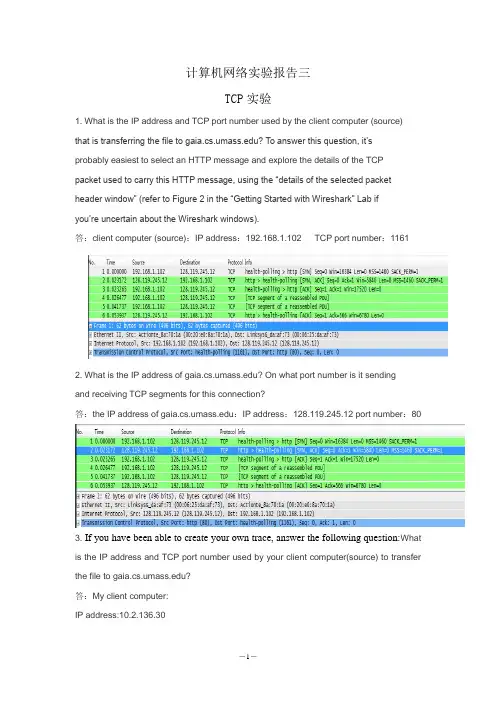
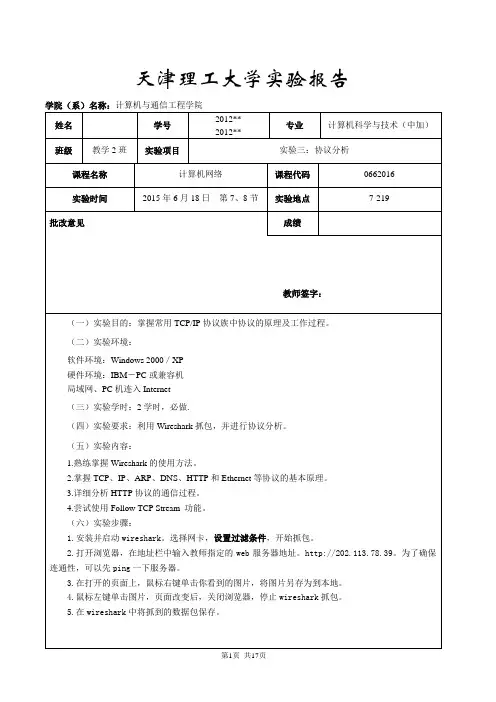
Ans: IP address:192.168.1.102 TCP port:1161
2. What is the IP address of gaia.cs.umass.edu? On what port number is it sending and
receiving TCP segments for this connection?
Ans: IP address:128.119.245.12 TCP port:80
If you have been able to create your own trace, answer the following question:
3. What is the IP address and TCP port number used by your client computer
(source) to transfer the file to gaia.cs.umass.edu?
ANS: IP address :10.211.55.7 TCP port:49265
4. What is the sequence number of the TCP SYN segment that is used to initiate the TCP
connection between the client computer and gaia.cs.umass.edu? What is it in the segment
that identifies the segment as a SYN segment?
ANS: sequence number: 0 Syn Set = 1 identifies the segment as a SYN segment 5. What is the sequence number of the SYNACK segment sent by gaia.cs.umass.edu to the
client computer in reply to the SYN? What is the value of the ACKnowledgement field in
the SYNACK segment? How did gaia.cs.umass.edu determine that value? What is it in the
segment that identifies the segment as a SYNACK segment?
ANS: The sequence number: 0
ACKnowledgement number : 1 which is sequence number plus 1
Both the sequence flag and the ACKnowledgement flag been set as 1, identifies
the segment as SYNACK segment.
6. What is the sequence number of the TCP segment containing the HTTP POST command? Note
that in order to find the POST command, you’ll need to dig into the packet content field
at the bottom of the Wireshark window, looking for a segment with a “POST” within its
DATA field.
Ans: The sequence number : 1
7. Consider the TCP segment containing the HTTP POST as the first segment in the TCP
connection. What are the sequence numbers of the first six segments in the TCP connection
(including the
segment containing the HTTP POST)? At what time was each segment sent? When was the ACK
for each segment received? Given the difference between when each TCP segment was sent,
and when its acknowledgement was received, what is the RTT value for each of the six
segments? What is the EstimatedRTT value (see page 249 in text) after the receipt of each
ACK? Assume that the value of the EstimatedRTT is equal to the measured RTT for the first
segment, and then is computed using the EstimatedRTT equation on page 249 for all
subsequent segments.
Note: Wireshark has a nice feature that allows you to plot the RTT for each of the TCP
segments sent. Select a TCP segment in the “listing of captured packets” window that is
being sent from the client to the gaia.cs.umass.edu server. Then select: Statistics->TCP
Stream Graph- >Round Trip Time Graph.
Segment 1
Segment 2
Segment 3
Segment 4
Segment 5
Segment 6
ANS:
Sequence
number Sent time ACK
received
time RTT EstimatedRTT
value
Length
/bytes
Segment 1 1 0.026477 0.053937 0.02746 0.02746 565
Segment 2 566 0.041737 0.077294 0.035557 0.028472 1460
Segment 3 2026 0.054026 0.124085 0.070059 0.033670 1460
Segment 4 3486 0.054690 0.169118 0.11443 0.043765 1460
Segment 5 4946 0.077405 0.217299 0.13989 0.055781 1460
Segment 6 6406 0.078157 0.267802 0.18964 0.072513 1460
EstimatedRTT = 0.875 * Last EstimatedRTT + 0.125 * sample RTT
After Segment 1 : EstimatedRTT = 0.02746
After Segment 2 : EstimatedRTT = 0.875 * 0.02746 + 0.125*0.035557 = 0.028472
After Segment 3 : EstimatedRTT = 0.875 * 0.028472 + 0.125*0.070059 = 0.033670
After Segment 4 : EstimatedRTT = 0.875 * 0.033670 + 0.125*0.11443 = 0.043765
After Segment 5 : EstimatedRTT = 0.875 * 0.043765 + 0.125*0.13989 = 0.055781
After Segment 6 : EstimatedRTT = 0.875 * 0.055781 + 0.125*0.18964 = 0.072513
8. What is the length of each of the first six TCP segments?(see Q7) 9. What is the minimum amount of available buffer space advertised at the received for
the entire trace? Does the lack of receiver buffer space ever throttle thesender?
ANS:The minimum amount of buffer space (receiver window) advertised at
gaia.cs.umass.edu for the entire trace is 5840 bytes;
This receiver window grows steadily until a maximum receiver buffer size of 62780
bytes.
The sender is never throttled due to lacking of receiver buffer space by
inspecting this trace.
10. Are there any retransmitted segments in the trace file? What did you check for (in