英语名词
- 格式:docx
- 大小:34.09 KB
- 文档页数:38
英语名词
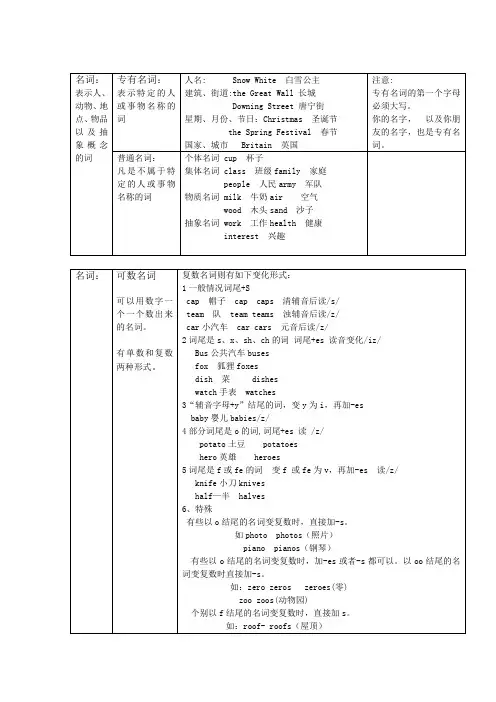
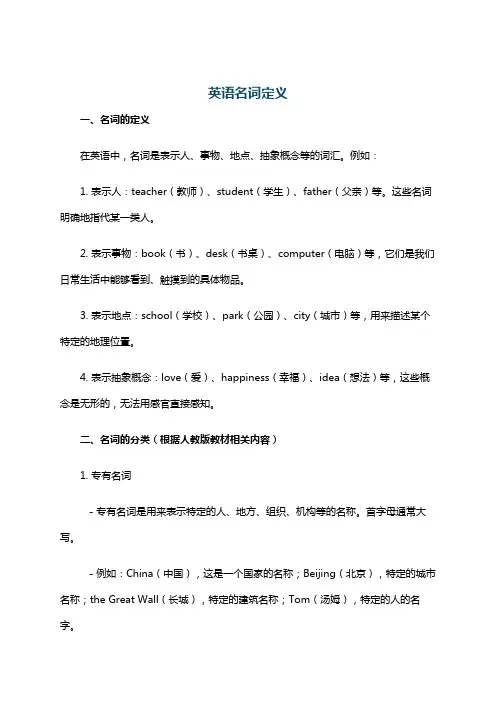
英语名词可分为两类:
(1)专有名词(Proper noun):它是特定的某个人、地方或机构的名称。专有名词的第一个字母必须大写。如:Newton牛顿,San Francisco旧金山,Russia俄罗斯,United Nations联合国。
(2)普通名( common noun):它是某一类人、事物或某种物质或抽象概念的名称。如:
lawyer律师,market市场,computer计算机,rice大米,magazine杂志,freedom自由。
英语名词又可分为可数名词(countable
noun)与不可数名词(uncountable noun)。可数名词有单、复数之分。绝大多数名词的复数形式由在单数形式后面加—s或—es构成。如:
Farm--farms农场,bus --buses公共汽车,toy --toys玩具,1ibrary --libraries图书馆,potato--potatoes土豆,leaf -- leaves树叶。
名词,复数形式的构成规则如下:
(1)绝大多数名词的复数形式是在名词词尾加—x。例如:
bank banks银行,house houses房屋,holiday holidays节日,如field fields领域。
(2)以字母s,sh,ch,x,o结尾的名词,变复数时在问尾加—es。例如:
Class--classes班级,box --boxes盒子,brush -- brushes刷子,hero -- heroes英雄。但某些以。结尾的名词变复数时只加—s。如:
piano -- pianos钢琴,photo-- photos照片,radio -- radios收音机,memo -- memos便函。
(3)以字母f或fe结尾的名词,变复数时把f或fe改为v,再加-es。例如:
leaf -- leaves树叶,life—lives生活,
shelf -- shelves架子,knife -- knives刀。但也有例外,如:roof -- roofs屋顶,chief--chiefs首领,handkerchief
handkerchiefs手帕。
(4)以辅音字母+y结尾的名词,变复数时,y变为i,再加—es。例如:
Baby-- babies婴儿,family--families家庭,laboratory—laboratories实验室,city—cities城市。
有些英语名词的复数形式是不规则的。例如:
Man-- men男人,woman -- women女人,child
-- children儿童,mouse -- mice老鼠, foot--
feet脚;英尺,tooth -- teeth齿,ox--oxen公牛,总datum--data数据,phenomenon--phenomena现象,crisis --crises危机, thesis--theses论文,analysis--analyses分析。
还有少数英语名词的单、复数形式相同池如:
贸 sheep羊,deer鹿,fish鱼,aircraft飞机,means手段,works工厂;著作,Chinese中国人,Japanese日本人。
个别英语名词通常只有复数形式。例如:
goods货物,clothes衣服,scissors剪刀,trousers裤子,spectacles眼镜。
2) 冠 词
冠词讲解录音
冠词(article)放在名词之前,帮助说明该名词的含义。冠词 分为不是冠词(indefinite
article)和定冠词definite article)两种。
不定冠词为a(an),用在单数名词之前,表示某一类人或事物中的“一个”。a用在辅音之前,an用在元音之前。如:
A buyer—位买主, a suggestion一项建议, a
commercial bank一家商业银行,an umbrella—把伞,an Indian poet一位印度诗人,an hour—个小时(hour中的第一个字母h虽为辅音字母但不发音,因此该词仍应看成是元音为首),a
university一所大学(在university中,第—个字母。读[ju:]而[j]是辅音,故该词前用不定冠词a)。
不定冠词通常用于下列情况:
(1)第一次提及或介绍某人或某事物时。例如:
One day a big ship hit a small ship while
they were both going from England to
America.
有一天一大一小两条船从英国向美国行驶时,大船撞上了小船。
Just then she saw a mouse running about
her kitchen.
正在那个时候,她看见一只老鼠在她厨房里跑来跑去。
(2)表示“一”这个概;念,但不着重强调这个数目时。例如:
She has two sons and a daughter. 她有两个儿子,—个女儿。
The special apparatus had a cage for the
rat and three doors. 该特殊装置有一个鼠笼和三扇门。
(3)表示人和事物的某一类,以区别其它种类时。如:
Her father is a bench worker. 她父亲是钳工。(而不是其他工人)
What you saw in the sky last night was
a man-made satellite. 昨晚在天空中你看到的是一颗人造卫星。(而不是其他星体)
(4)加在单数名词前,表示该人或物代表其一类时。例如:
A steel worker makes steel. 钢铁工人炼钢。(不要译为一个钢铁工人炼钢,这里是指这一工种的工人)
A bus is a means of public
transportation. 公共汽车是—种交通工具。(这里a bus不要泽为—辆公共汽车,而应看成是公共汽车这一类车辆)
(5)指某人、某物但不具体说明何人、何物时。例如:
He has just come back from an African
country. 他刚从非洲某个国家回来。
A Mr.Smith is coming to see you this
afternoon. 有个叫史密斯的先生今天下午要来看你。
A library could hardly be used if the
books were kept in random order. 图书馆的藏书如果编排得没有规律,就难以利用。
(6)在某些可表示单位或数量的名词前,表示“每个”的意思。例如:
The Chinese Export Commodities Fair is
held in Guangzhou twice a year. 中国出口商品交易会每年在广州举办两次。
The doctor told him to take the medicine
three times a day. 医生叫他每天服药三次。
(7)在某些抽象名词前,使这类名词的概念具体化或具有动作性。例如:
“Teach Yourself English” is a great
help to me.《自学英语课本》对我帮助很大。
Her performance was a big success. 她的演出非常成功。
It’s honour for me to attend the
meeting. 我能参加这次会议非常荣幸。
(8)在某些习惯用浯中的名词前。例如:
a great deal大量,a lot of许多,as a
result因此,in a hurry匆忙,in a word总之,keep an eye on留意,on a large scale大规模地,once upon a time从前,once in a
while偶尔,quite a few相当多。
定冠词只有一个,即如+表示某一类人或事物中特定的—个或某一些。可用于单数或复数名
词前,也可用于不可数名词前。如:
the chain store那家连锁店,the TV
programs那些电视节目,the Olympic Gaines这次奥运会
定冠词通常用于下列情况:
(1)前面已经提到过的人或事物。例如:
"There is a boy and an old lady standing
at the bus stop.I think the old lady must
be the boy’s grandmother.
有个男孩和老太太站在汽车站。我想那个老太太—定是男孩的奶奶。
I got a letter yesterday.The letter was sent
from Russia by my uncle.
昨天我收到—封信。这封信是我叔叔从俄罗斯寄来的。