2016年6月英语四级真题及答案解析(第二套)
- 格式:doc
- 大小:53.50 KB
- 文档页数:9
2016年6月英语四级真题 第二套(文字版整理)
Part I Writing (30 minutes)
Directions:For this part, you are allowed 30 minutes to write a letter to express
your thanks to one of your school teachers upon entering college. You should write
at least 120 words but no more than 180 words.
Part III Reading Comprehension (40 minutes)
Section A
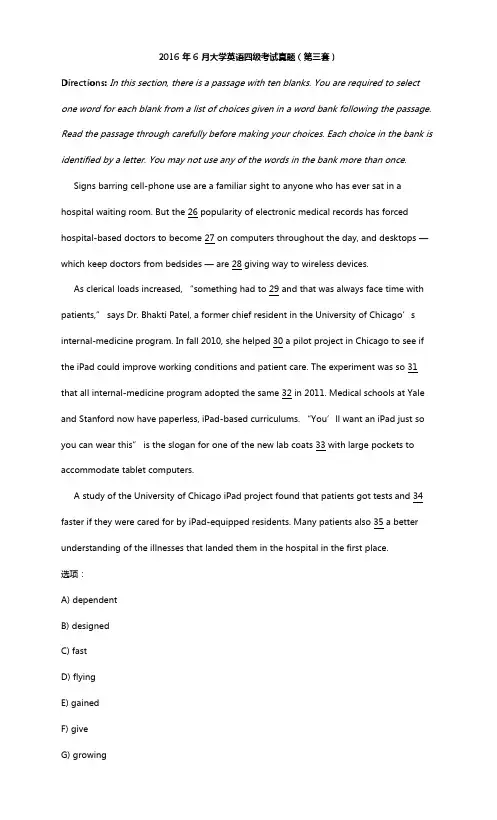
Directions: In this section, there is a passage with ten blanks. You are required
to select one word for each blank from a list of choices given in a word bank following
the passage.
Contrary to popular belief, older people generally do not want to live with their
children. Moreover, most adult children _____(26)every bit as much care and support
to their aging parents as was the case in the "good old days", and roost older people
do not feel _____(27).
About 80% of people 65 years and older have living children, and about 90% of
them have _____(28)contact with their children. About 75% of elderly parents who
don't go to nursing homes live within 30 minutes of at least one of their children.
However, _____(29)having contact with children does not guarantee happiness in
old age. In fact, some research has found that people who are most involved with
their families have the lowest spirits. This research may be _____(30), however,
as ill health often makes older people more _____(31)and thereby increases contact
with family members. So it is more likely that poor health, not just family
involvement, _____(32)spirits.
Increasingly, researchers have begun to look at the quality of relationships,
rather than at the frequency of contact, between the elderly and their children.
If parents and children share interests and values and agree on childrearing
practices and religious _____(33)they are likely to enjoy each other's company.
Disagreements on such matters can _____(34)cause problems. If parents are angered
by their daughter's divorce, dislike her new husband, and disapprove of how she is
raising their grandchildren, _____(35)are that they are not going to enjoy her
visits.
A.abandoned
B.advanced
C.biased
D.chances
mitment
F.dampens
G.dependent
H.distant
I.frequent J.fulfillment
K.grant
L.merely
M.provide
N.understandably
O.unrealistically
Section B
Directions: In this section, you are going to read a passage with ten statements
attached to it. Each statement contains information given in one of the paragraphs.
Identify the paragraph from which the information is derived. You may choose a
paragraph more than once. Each paragraph is marked with a letter. Answer the
questions by marking the corresponding letter on Answer Sheet 2.
Could Food Shortages Bring Down Civilization?
[A] For many years I have studied global agricultural, population, environmental
and economic trends and their interactions. The combined effects of those trends
and the political tensions they generate point to the breakdown of governments and
societies. Yet I, too, have resisted the idea that food shortages could bring down
not only individual governments but also our global civilization.
[B] I can no longer ignore that risk. Our continuing failure to deal with the
environmental declines that are undermining the world food economy forces me to
conclude that such a collapse is possible.
[C] As demand for food rises faster than supplies are growing, the resulting
food-price inflation puts severe stress on the governments of many countries. Unable
to buy grain or grow their own, hungry people take to the streets. Indeed, even before
the steep climb in grain prices in 2008, the number of failing states was expanding.
If the food situation continues to worsen, entire nations will break down at an ever
increasing rate. In the 20th century the main threat to international security was
superpower conflict; today it is failing states.
[D] States fail when national governments can no longer provide personal
security, food security and basic social services such as education and health care.
When governments lose their control on power, law and order begin to disintegrate.
After a point, countries can become so dangerous that food relief workers are no
longer safe and their programs are halted. Failing states are of international
concern because they are a source of terrorists, drugs, weapons and refugees(难民), threatening political stability everywhere.
[E] The surge in world grain prices in 2007 and 2008—and the threat they pose
to food security——has a different, more troubling quality than the increases of
the past. During the second of the 20th century, grain prices rose dramatically