初三英语Unit1Unit2单元练习卷
- 格式:doc
- 大小:142.50 KB
- 文档页数:6
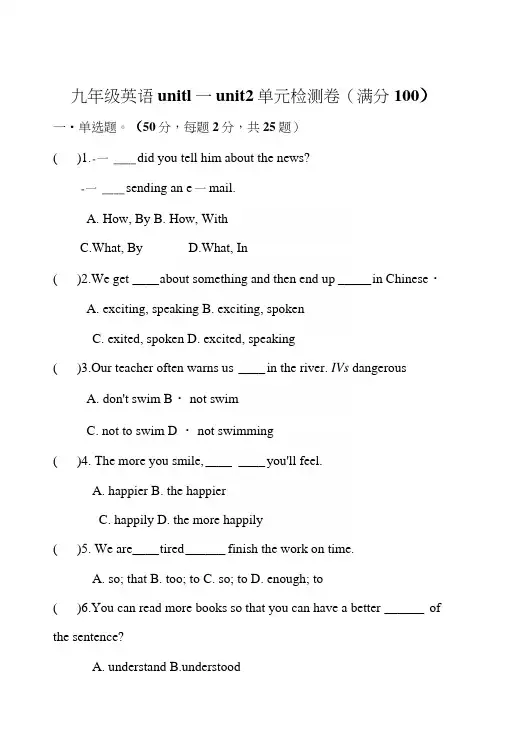
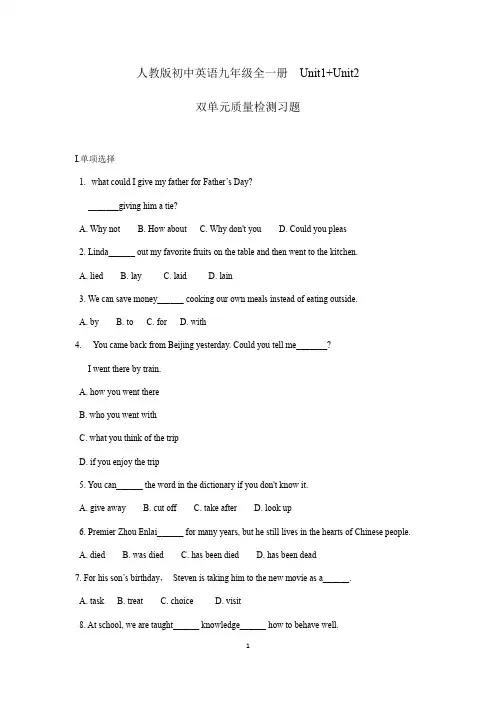
初三英语Unit1—2 单元测试卷 一、 单项选择(本大题共20分,每小题1分) ( )1. I was born _____ the evening _____ March 12. 1977. A. in; of B. in; in C. on; of D. on; in ( )2. It’s very nice of you _______ each of us a gift. A. give B. giving C. gave D. to give ( )3. There ______ ice and snow in winter. A. are too much B. is too much C. are much too D. is much too ( )4. “Do you mind if I sit here?” “_______. It’s for Mr Brown.” A. Not at all B. Never mind C. Better not D. Of course not ( )5. He always works hard, so he is a person. A. hard working B. working-hard C. hard-working D. working hard ( )6. Some young people are now to buy private(私人的) cars. A. rather rich B. very rich C. rich enough D. enough rich ( )7. Mr. Green felt lonely because____ of his friends came to see him. A. none B. nobody C. no one D. everybody ( )8. Half of the class done most of the work. The left rather difficult. A. have; is B. has; is C. have; are D. has; are ( )9. “You must keep in the hospital,” the woman said to me . A. quietly; quiet B. quietly; quietly C. quiet; quietly D. quiet; quiet ( )10. The river is too wide for the swimmers . A. to swim B. to swim in C. to swim across D. swimming ( )11. When I looked into the room, I found Philip himself ______in bed. A lies B. lie C. lay D. lying ( )12. Teachers often ask us make any noise in class. A. to try not to B. not try to not C. not to try to D. try not to ( )13. What colour do you think_____ you feel calm? A. making B. makes C. to make D. make ( )14. “Mum, I think I’m to get back to school.” “Oh, my dear. You’d better stay at home for another day.” A. so well B. so good C. well enough D. good enough ( )15. He is organized and is often . I hope he will have more at his business. A. success; successful B. successful; success C. successfully; successful D. successful; successful ( )16. Han Mei had the _______ apples among us. A. more B. many C. much D. most ( )17. He found it hard ________ new ideas. A. to come up B. come up with C. come up D. to come up with ( )18. To answer correctly is more important than _______ quickly. A. finish B. to finish C. finishing D. to be finished ( )19. Don't worry. She you a call as soon as she Shanghai. A. will give; reach B. gives; will get to C. will give; arrives in D. gives; will get ( )20. Which_____ you rather_____, tea or coffee? A. would, to drink B. would, like C. would, drink D. would, / 二、完形填空。(本大题共10分,每小题1分) Antarctica(南极洲) is the continent which is the most southern area of land on the Earth and is mostly covered with ice. This is one of the driest and 21 in the world. But people from all over the world come to 22 there. Near the South Pole ,three thousand people live in a place 23 Amundsen-Scott Station. The station has libraries, cinemas, shops, sports rooms, canteens and laboratories. There is electricity(电), and they have 24 -- the system that they use to have a conversation(交谈)with someone in another place. And they have 25 -- electronic machines that stores information and uses programs to help them find, organize, or change the information. . But the people here 26 travel by car, or train, or bus, because there aren’t any roads or railways near the station. They travel by ship, helicopter, plane, or snow tractor, or 27 dogs. There aren’t 28 trees or flowers there, but there are hundreds of different birds and other animals. Most of the people here are 29 . They study plant and animal life and how ice moves. The ice can tell us about changes in climate. Ray Kingman is an expert at Amundsen-Scott Station, telling us on the phone, “This is my second year here. It’s a very interesting and beautiful place, but life is very hard 30 . In the summer we can go swimming in hot pools of water. We welcome newcomers here for further study of the continent!” ( )21. A. warm areas B. coldest places C. cool areas D. hottest places ( )22. A. travel B. go sightseeing C. work D. enjoy themselves ( )23. A. called B. call C. calls D. calling ( )24. A. telephones B. radios C. televisions D. record players ( )25. A. printers B. icons C. mouses D. computers ( )26. A. don’t B. didn’t C. weren’t D. aren’t ( )27. A. with B. instead of C. on D. in front of ( )28. A. much B. any C. many D. either ( )29. A. teachers B. scientists C. doctors D. workers ( )30. A. during the autumn season B. in the springtime C. in all weathers D. in the winter
三,阅读理解。 (共30分,每题2分) A In 1826, a Frenchman named Niepce needed pictures for his business .But he was not a good artist .So he invented a very simple camera (照相机).He put it in a window of his house and took a picture of his garden .That was the first photo. The next important date in the history of photography (摄影术) was in 1837.That year , Daguerre, another Frenchman ,took a picture of his reading room .He used a new kind of camera in a different way. In his picture you could see everything very clearly , even the smallest thing. This kind of photo was called a Daguerreotype. Soon, other people began to use Daguerre’s way . Travellers brought back wonderful photos from all around the world .people took picture of famous buildings, cities and mountains. In about 1840, photography was developed .Then photographers could take picture of people and moving things .That was not simple .The photographers had to carry a lot of film and other machines. B ut this did not stop them ,for example, some in the United States worked so hard. Mathew Brady was a famous American photographers. He took many picture of great people .The picture were unusual because they were very lifelike(栩栩如生的) Photographers also became one kind of art by the end of the 19th century .Some photos were nor just