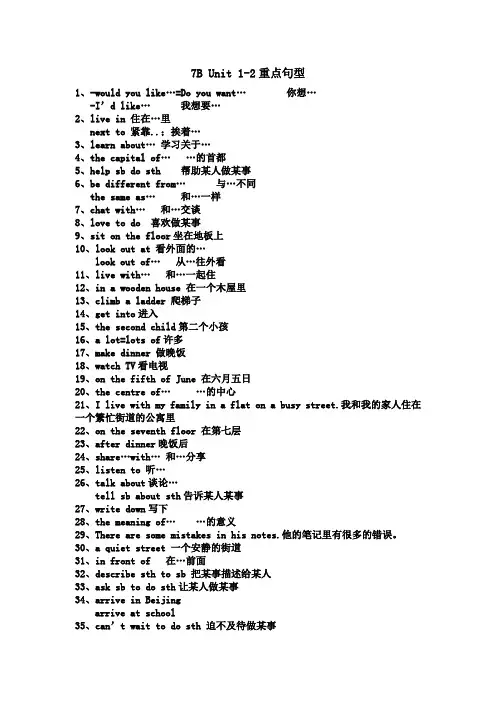
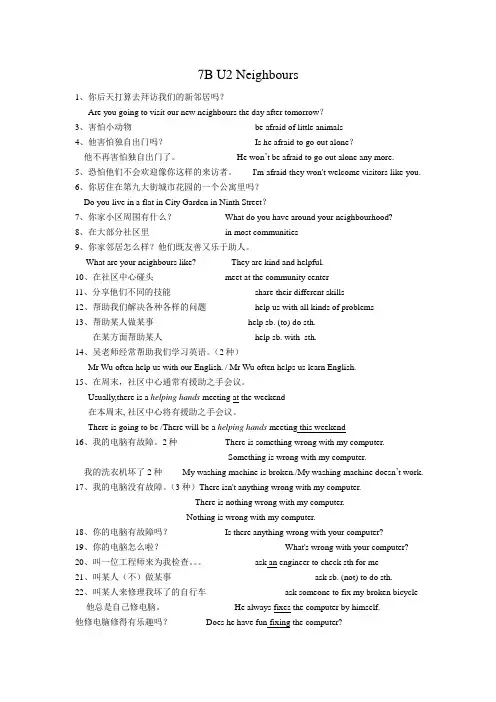
初一下册7B U2 基本知识点 自己总结很有价值
- 格式:doc
- 大小:505.00 KB
- 文档页数:8
七年级英语下U2 Neighbours By Wangyu 1 U2 Neighbours Comic stripe 1. I'm afraid they won't welcome visitors like you. 恐怕他们不会欢迎像你这样的客人。 I'm afraid 译为“恐怕”,是一种口语表达习惯,通常不用 he's afraid, she's afraid. 例: I'm afraid it is going to rain tomorrow. 恐怕明天要下雨了。 翻译:恐怕他下个星期不能去上学了因为他得了感冒。I'm afraid he can't go to school next week, because he has a bad cold. 补充:be afraid of sth 害怕某物 I'm afraid of snacks. I'm afraid so. 我恐怕是这样的。 I‘m afraid not. 我恐怕不是这样的。 I think so. 我如此认为。 I don't think so. 我不这样认为。 ---Can I have dinner with you?我能与你共进晚餐吗?--- Sorry,I'm afraid not.这里的意思是:对不起,不能 例:( ) —Will you come to join us in the trip?— . You see, I have to get ready for the coming party. A. Thank you B. I'd love to C. I am afraid not D. All right 2. Most of them have 14 floors.大多数楼有14层。 most的用法 表示“数量上最多,最大”,为many或much 的最高级。 例: She had the most money of all of them.在这些人中,她最有钱。 most of + the/this/these/that/those/物主代词+名词,指某一范围内的多数。(名词前面一定要有修饰词) 例:Most of the students come from China. most of my books most of +可数名词复数+ V复 most of +不可数名词+V单 ④most 与 most of 的区别 1 most+名词 表泛指,无范围 如: most young people II most of + 名词 指某一范围的多数 III most of +人称代词,of 不能少 如: most of them 两者有时可互换: Most teachers in this school are women.= Most of the teachers in this school are women.
Reading 1. They are kind and helpful. 他们友好而且乐于助人。 helpful (adj.) 乐于助人,有帮助的 help---helpful care---careful 如:琳达经常帮助我,她是一位乐于助人的女孩。 Linda always helps me, she is a helpful girl. 对于划线部分提问: How are they? What do you think of them? 2. There's something wrong with my computer. 我的电脑坏了。 ◎there's something wrong with sth =sth is not working well=sth is broken 意为“某物失灵” ◎something ---复合不定代词,类似有anything,nothing,everything, somebody, nobody, everybody 等 ◎形容词,动词不定式,else 等词修饰不定代词时,要后置 如: nothing interesting 没什么有趣的 anything else 其他任何东西 There's nothing new in today's newspaper. 3. I'm going to ask a computer engineer to check it. 我打算叫一个电脑工程是来检查一下。 ◎ask sb to do sth 要求/请求某人做某事 ask sb not to do sth 要求/请求某人不做某事 ◎ask (sb) for help (向某人)请求帮助 例: You can ask 110 for help when you have trouble. ◎ask (sb) for sth (向某人)要求得到某物 例: Don't ask your parents too much money to buy snacks. ◎ask sb about sth 询问某人关于某事 例: She asks me some questions about animals. 4. My cousin Annie's bicycle is broken, so she's going to ask someone to fix it. 我堂妹的自行车坏了,因此她打算叫人帮她修一下。
◎broken 形容词 “坏的,破的,折了,断了” 例: The glass is broken, who broke it?玻璃坏了,谁弄碎的?
◎break---broke---broken 打破,打断,,弄坏 例: Don't break the eggs, they are for you. 5. Some college students are ready to help. 一些大学生很乐于帮忙。 college students 大学生 go to college 上大学 be ready to do sth 乐意/准备干某事=be willing to do sth 例: One of my classmates is always ready to help other students. 我的一个同班同学一直很乐于帮助其他同学。 七年级英语下U2 Neighbours By Wangyu 2 翻译:他总是乐意帮助他人。He is always ready to help others. ④be ready for sth 为...做好准备 翻译: 孩子们,请准备好上课。Please be ready for the lessons, boys and girls. ⑤get sth ready for sb 为某人准备好某物 翻译:我的奶奶经常为我准备好早饭。 My grandma often gets breakfast ready for me. 6. Some of them often visit the old people and do some shopping for them. 他们中一些人经常拜访这些老人并帮他们买些东西。
① visit 参观,拜访 visitor 游客 例: 参观长城 visit the Great Wall 来自日本的许多游客A lot of visitors from Japan ② do some shopping 意为“买些东西,购物”“do+some+ving”短语表示一些笼统而不明指的事 例: do some cleaning 做些打扫 do some reading 读些东西 do some washing 洗些东西 7. You're lucky to live in a neighbourhood like that,Simon.你住在一个像那样的社区真的很幸运,西蒙。 ① lucky(adj.)---luck (n.) ---luckily (adv.) be lucky to do sth 意为“很幸运做某事” 翻译:1)成为你的朋友我很幸运。 I'm lucky to be your friend. 2)你足够幸运得到这份工作。You're lucky enough to get the job. 3) _______________(luck), I could get the last ticket to the concert. ② good luck to sb with sth 祝某人某事好运
Grammar 一般将来时(Simple Future Tense) 1.定义:表示将来发生的动作或情况 2.三种结构:(1).will+动词原型 (2).shall+动词原形 (3).be going to +动词原形 He will play cards with his brother this evening. I shall meet my friends in the park tomorrow. She is going to visit her uncle next Monday. 3.否定句和疑问句 否定句:will/shall+not+do(won't/shan't+do) am/is/are+not+going to+do 疑问句:Will/Shall+主语+do; Am/Is/Are+主语+going to do ①School will be over in two hours. →School will not be over in two hours.→ Will school be over in two hours? We shall take a bus to school next week. →Shall we take a bus to school next week? ②The policemen are going to catch the thief this afternoon. →The policemen aren't going to catch the thief this afternoon. →Are the policemen going to catch the thief this afternoon? 4.常用的时间状语 A. 由tomorrow 组成的,如:tomorrow morning/evening明天早晨、晚上 the day after tomorrow 后天 B. 由next组成的,如:next Tuesday/Sunday 下周二/日 C. 由this 组成的,如:this afternoon/evening 今天下午/晚上 D. 由coming组成的,如:the coming Sunday 下个星期天