考点06介词-2018中考英语语法考点纵览
- 格式:doc
- 大小:156.51 KB
- 文档页数:13
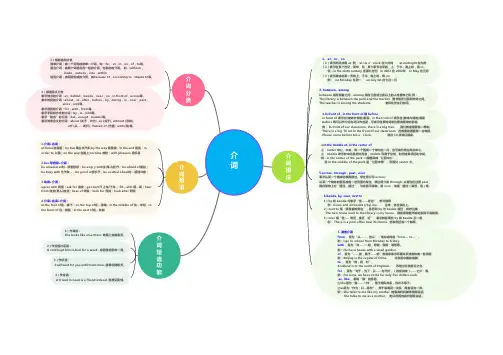
中考英语语法考点纵览6——介词一、介词概述1、介词的定义:介词是一种虚词,用来表示名词或相当于名词的其它词语在句中与其它词的关系,不能单独使用。
介词可与名词或相当于名词的其它词构成介词短语。
介词短语可在句中作定语,状语,表语和宾语补足语。
2、介词的分类:时间介词、地点介词、方式介词、原因介词等。
3. 介词短语的句法作用介词短语作为一个成分在句中可用作定语、状语、表语、宾语补足语等。
(1)作定语介词短语作定语时,一般放在被修饰词的后面,作后置定语。
The book on the desk is very interesting.书桌上的那本书很有趣。
China is a great country with a long history.中国是一个具有悠久历史的国家。
(2)作状语介词短语作状语时,一般放在动词后面或句末、句首。
用来表示时间、地点、目的、方式和原因等。
The basketball match will start at nine.篮球比赛将在9点开始。
(表示时间)He likes to swim in the river.他喜欢去河里游泳。
(表示地点)I went there to get my book back.我去那里取回我的书。
(表示目的)I came here by bike.我骑自行车来到这里。
(表示方式)She was trembling with fear.她吓得直发抖。
(表示原因)(3)作表语介词短语作表语时,一般放在be动词和连系动词之后。
I’m on duty today.今天我值日。
My English teacher is from Australia.我的英语老师来自澳大利亚。
(4)作宾语补足语介词短语作宾语补足语时,一般放在宾语之后。
I found everything in good condition.我发现一切状况良好。
When he woke up, he found himself in the hospital. 当他醒来时,他发现自己在医院里。
二、介词考点纵览考点一:表示时间的介词考点1:in的用法。
①与morning, afternoon, evening连用表示在上午、下午、晚上。
They always play basketball in the afternoon. 他们经常在下午打篮球。
Don’t eat too much in the evening. 晚上不要吃太多。
②表示在某世纪、年代、年、月、季节的含义时。
She came to this factory in 1970. 她是在1970年来到这个工厂工作的。
It often snows heavily here in winter. 这儿冬天经常下大雪。
③表示从现在起一段时间以后。
(这个用法常用将来时)Tom will be back from America in a week. 汤姆一周之后将从美国回来。
I will go to visit you in a month. 一个月后我将会去拜访你。
典型例题 1The train is starting ___five minutes.A. inB. atC. forD. of答案:A典型例题 2Mrs. Brown came to China ____ 1996.A. onB. ofC. toD. in答案:D典型例题 3I like making snowmen ___ winter.A. inB. atC. forD. on答案:A考点2:at的用法。
①表示某一具体时刻(几点几分时)。
She gets up at seven o'clock in the morning.她早晨七点钟起床。
Bella got home at eight yesterday evening.Bella昨晚八点钟到家。
②用在特定的时候(时节、时机)。
We were happy at that time.我们那个时候很幸福。
I think the school has been closed at this time.我想学校这个时间已经关门了。
③与noon、night、weekends连用。
You can see many stars in the sky at night.在夜里你会看到天空有许多星星。
What do you always do at noon?你中午经常做些什么?④表示“在……岁”时。
At the age of two, the girl could run.在2岁的时候,这个小女孩就会跑了。
典型例题 1The English teacher told me to get there____ half past ten.A in B. at C. on D. of答案:B典型例题 2He often goes ____ school ____ six thirty.A. for; toB. to; atC. to; for D, for; at 答案:B典型例题 3I often have lunch ____ noon.A. forB. toC. inD. at答案:D考点3:on的用法。
①表示“在具体的某一天”或“(在具体的某一天的)早上、中午、晚上”等,须用介词on。
Jack was born on May 10th,1982.杰克生于1982年5月10日。
They left on a rainy morning.他们是在一个雨天的早上离开的。
②表示“在星期几”或“在星期几的早上、中午、晚上”等,须用介词on。
We don’t go to school on Saturday and Sunday. 我们星期六和星期天不上学。
What time do you get up on weekdays? 你在平日什么时候起床?I heard this story on Saturday morning. 我是在星期六的早晨听到这个故事的。
③表示“在某一节日”时,须用介词on。
We usually eat mooncakes on Mid-autumn Festival. 我们通常在中秋节吃月饼。
Mr. Hu received a card on Teachers’Day. 胡老师在教师节那天收到了一张卡片。
典型例题 1He went back to America a summer afternoon.A in B. at C. on D. of答案:C典型例题 2He often goes to the library ____ Saturday morning.A. onB. atC. to D, for答案:A典型例题 3I met him ____ the afternoon of September 12thA. forB. toC. onD. at答案:C考点4:before、after和from的用法。
① before表示“在……之前”。
Wash your hands before dinner. 在晚餐之前你要洗手。
I have to finish my homework before 10 o’ clock. 我不得不在十点之前完成家作。
② after表示“在……之后”。
They often play football after class. 他们经常在下课后踢足球My father often watches TV after dinner. 我爸爸经常晚饭后看电视。
③ from表示时间时,常和to连用,构成from…to…的结构,表示“从…到…”。
He kept on working from seven to twelve last night. 他昨晚从7点一直工作到12点。
I go to school from Monday to Friday. 我周一到周五要去学校。
典型例题 1经理七点后回来。
翻译:The manager will come back after seven o’clock.典型例题2三天后,我去参加了一个聚会。
翻译:After three days I went to a party.典型例题 3她从早唱到晚。
翻译:She is singing from morning to night.考点二:表示地点、方位的介词考点1:in的用法。
①表示在较大的地方。
in the factory 在工厂in Shanghai 在上海in China 在中国②表示“在……里面”。
There are many apples in the box. 盒子里有许多苹果。
He put his hands in his pockets. 他把他的手放进口袋。
典型例题 1They arrived at the famous town ___ South Jiangsu.A. inB. onC. atD. of 答案:A典型例题 2She is living ___ Nanjing.A. onB. inC. atD. of 答案:B典型例题 3Can you see the book ___ the box?A.atB. inC. onD. of答案:B考点2:at的用法。
①表示在较狭窄较小的地方。
Shall we meet at the station?我们在车站见面好吗?②用于门牌号码前。
He lives at 115 Zhongshan Road. 他住在中山路115号典型例题 1They arrived at the famous town ___ South Jiangsu.A. inB. onC. atD. of答案:A典型例题 2Do you notice the bread ___ the table?A. toB. inC. atD. of答案:C典型例题 3My brother stayed ___home last night.A. atB. inC. onD. Of答案:A考点3:on,over和above的用法。
① on表示“在……之上”(两物体接触)。
There are some apples on the tree. 树上有一些苹果。
There is a book on the desk. 桌上有一本书。
② over表示“在……正上方”(两物体的表面没有接触)。
The sky is over our heads. 天在我们的头顶上。
③ above表示“在……之上”(不一定垂直,两物体的表面没有接触)。