课程名称:高级英语
- 格式:doc
- 大小:76.01 KB
- 文档页数:14
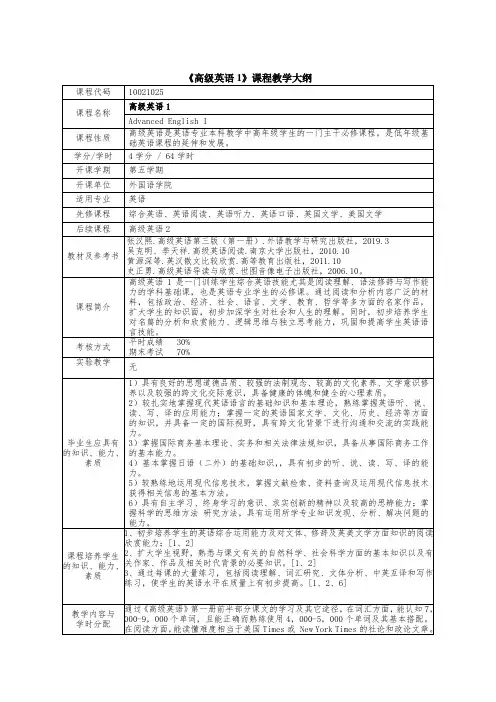
课程名称:高级英语学时:64课程层次: 专业核心课修读类型:专业必修课考核方式:笔试开课学期:5--6学期适用专业:英语专业教学目标:高级英语属于英语专业高年级阶段课程。
它是基础阶段的综合英语课程在高层次上的延续。
高级英语是一门训练学生综合英语技能尤其是阅读理解、语法修辞与写作能力的课程。
通过阅读和分析内容广泛的材料,包括涉及政治、经济、社会、语言、文学、教育、哲学、法律、宗教及自然科学等方面的名家作品,扩大学生的知识面,加深学生对社会和人生的理解,培养学生对名篇的分析和理解能力、逻辑思维能力与独立思考的能力,增强对文化差异的敏感性,巩固和提高学生英语语言技能。
每课后都配有大量的相关练习,包括阅读理解、词汇研究、问题分析、中英互译和写作练习等。
通过该课程的学习,使学生的英语水平在质量上有较大的提高。
教学基本要求:1、提高独立工作能力,学会查找有关参考书,会自己动手写注释、做笔记。
2、培养分析、欣赏写作技巧的能力。
3、掌握基本的英语修辞手段的使用技巧。
4、准确掌握课文内容,学会分析课文的写作技巧,并能将其应用于写作。
5、培养语篇分析能力,学会词语释义,即用英语解释英语短语或句型转换。
6、逐步培养对语言与文化之间的关系的敏感性。
7、学习、巩固构词法、区分同义词的差别,更好地掌握词义。
本学期的教学内容:张汉熙主编的《高级英语》第二册的2、3、4、5、7及14单元,共64学时。
教学安排:本学期共需学习7个单元,平均每个单元约需10课时。
其中背景知识介绍、相关文化知识介绍及文章结构概述约需1学时,课文讲解约需6学时,课后练习约需3学时。
教学要求:要求学生课前对每一个单元的相关文化背景知识作必要的了解;能够较为熟练、准确地用英语对某些词语、句子进行释义;能准确地指出文章中出现的修辞;能够在老师的指导下分析、欣赏文章的写作技巧、文章的结构、语言特点;学会查找有关参考书,并自己动手写注释、做笔记等。
Unit 2: Marrakech by George OrwellI. Additional Background Knowledge1. George Orwell2. Morocco3. Marrakech4. The Jewish peopleII. Introduction to the Passage1. Type of literature: a piece of exposition2. The purpose of a piece of exposition:-- to inform or explain3. Ways of developing the thesis of a piece of exposition:-- comparison, contrast, analogy, identification, illustration, analysis, definition, etc.4. The central thought or thesisIII. Effective Writing Skills:1. making effective use of specific verbs2. using the methods of contrast, illustration, comparision, etc.3. clever choice of words and scenes and tensesIV. Rhetorical Devices:1. rhetorical questions2. repetition3. metaphor4. simile5. elliptical sentencesV. Special Difficulties1. Making sentences more compact by proper subordination, such as subordinate clauses, appositives, prepositional or verbal phrases.2. Discriminating groups of synonyms:--wail, cry, weep, sob, whimper, moan--glisten, glitter, flash, shimmer, sparkle3. Paraphrasing some sentences4. Identifying figures of speechVI. Questions1. Orwell shows the poverty of the natives in at least five ways. Identify them.2. Could paragraphs 4-7 just as well come after 8-15 as before? Why or why not?3. Does this essay give readers a new insight into imperialism?4. Comment on Orwell’s lucid style and fine attention to significant descriptive details.选用教材:由张汉熙主编、外语教学与研究出版社出版的《高级英语》第二册Unit 3: Pub Talk and King’s English by Henry FairlieI. Additional Background Knowledge1. pub/pub-friends2. Dumas/Three Musketeers3. Carlyle4. Charles LambII. Introduction to the Passage1. Type of literature: a piece of exposition2. The thesis3. What makes a good conversation4. Seemingly loose organization●Title●Transitional paragraph●Digression5. Highly informal language●Abundance of simple idiomatic expressions cheeked by jowl with copiousliterary and historical allusions● A mixed metaphor in paragraph 2III. Effective Writing Skills:1. Deliberately writing this essay in a conversational style to suit the theme2. Making effective use of specific verbsIV. Rhetorical Devices:1. Metaphor2. Mixed metaphor3. SimileV. Special Difficulties1. Idiomatic expressions:--be on the rocks--get up on the wrong side of the bed--be on wings--turn up one’s nose at sth.--into the shoes of2. Allusions--descendants of convicts--Saxon churls--Norman conquerors--musketeers of Dumas3. The use of transitional devices--transitional words and expressions--pronoun reference--repetition of important words4. Paraphrasing some sentences5.Identifying figures of speechVI. Questions1. What, according to the author, makes a good conversation? What spoils it?2. What is the author’s attitude of the writer towards “ the King’s English”?3. How does the use of words show class distinction?4. What does the writer mean when he says, “the King’s English, like the Anglo- French of the Normans, is a cla ss representation of reality”?选用教材:由张汉熙主编、外语教学与研究出版社出版的《高级英语》第二册Unit 4: Inaugural Address by John F. KennedyI. Additional Background Knowledge1. John F Kennedy2. His assasination3. Inauguration4. Inaugural address5. Cold war period: socialist camp vs. capitalist campII. Introduction to the Passage1. Type of literature: political speech2. Object of a political speech:--to explain--to convince--to persuade3. Well organized and highly rhetorical4. Biblical style/language5. Often-quoted passagesIII. Effective Writing Skills:1. Employing suitable rhetorical devices and words to create the desired emotional impact2. clear order and appropriate tone to the different groups he is addressing3. Employing Biblical style deliberatelyIV. Rhetorical Devices:1. metaphor2. antithesis1. parallelism2. repetitionV. Special Difficulties1. Biblical language/quotations/style2. Using the following methods for force, vividness and emotional appeal:--Parallel and balanced structure--Repetition of important words--Antithesis3. Paraphrasing some sentences4. Identifying figures of speechVI. Questions1. Cite examples to show that Kennedy is very particular and careful in his choice and use of words.2. Is the address well organized? Comment on the order in which he addressed all the different groups of nations and people.3. Is Kennedy’s argument and persuasion based mainly on facts and logic or on an appeal to emotions? Would this type of speech be successful on all occasions?4. Is the tone and message suited to the different groups he addresses? Give your reasons.选用教材:由张汉熙主编、外语教学与研究出版社出版的《高级英语》第二册Unit 5: Love Is a Fallacy by Max ShulmanI. Additional Background Knowledge1. The meaning of Logical fallacies2. Logical fallacies:--Dicto Simpliciter--Hasty Generalization--Poisoning the Well--Ad MisericordiamII. Introduction to the Passage1. Type of literature: a piece of narrative writing--protagonist/antagonists--climax--denouement2. The main theme3. Well chosen title and words4. Style--a very fast pace with a racy dialogue full of American colloquialism and slang --employing a variety of writing techniques to make the story vivid, dramatic and colorfulIII. Effective Writing Skills:1. Employing colorful lexical spectrum, from the ultra learned terms to the infra clipped vulgar forms2. Too much figurative language and ungrammatical inversion for specific purposes3. The using of short sentences, elliptical sentences and dashes to maintain the speed of narrationIV. Rhetorical Devices:1. metaphor2. antithesis3. transferred epithet4. hyperbole5. metonymy6. litotes7. ellipsis8. synecdoche9. inversion10. simile11. mixed metaphor12. rhetorical questionsV. Special Difficulties1. Analyzing the logical fallacies2. Using inverted sentences to achieve emphasis3. Effectively using many figures of speech4. Understanding colloquial expressions and slangVI. Questions1. Define and give an example of each of the logical fallacies discussed in this essay.2. Can you find any evidence to support the view that the writer is satirizing a bright but self-satisfied young man?3. Comment on the language used by Polly. What effect does her language create?4. Why does the writer refer to Pygmalion and Frankenstein? Are these allusions aptly chosen?5. In what sense is the conclusion ironic?选用教材:由张汉熙主编、外语教学与研究出版社出版的《高级英语》第二册Unit 7 The Libido for the Ugly By H. L. MenchenI. Background knowledgeThe AuthorHenry Louis Mencken (1880 - 1956)--- the most prominent newspaperman--- book reviewer--- political commentatorHe was a prolific writer of his day.--- his prose is as clear as an azure sky--- his rhetoric as deadly as a rifle shotII. Introduction to the Passage1.This is a subjective and highly emotional piece of description.Ugliness is the dominant impression.2.Description--- person--- place--- object--- idea3.Description is organized usually by space order.--- from a fixed position to moving position--- from close up to distance--- from general to specific--- from subjective to objective4.Thesis:By revealing the ugliness of Westmoreland, the author attacks the whole American race--- a race that loves ugliness for its own sake, that lusts to make the world intolerable; a race which hates beauty as it hates truth.III. Text Analysis1. Choose the strongest words possible---abominable, agonizing ugliness, revolting monstrousness, leprous, etc.2. Use figures of speechIV. Rhetorical Devices1. hyperboles2. sarcasm3. ridicule4. irony5. Metaphor6. simileSpecial Difficulties1. Some striking words2. Understanding the metaphorical phrase3. The use of topic sentences4. Paraphrasing some sentences5. Identifying figures of speechV. Questions1. Why does the writer use the uncommon word libido in his title?2. Does Mencken achieve or defeat his own purpose by using so many striking metaphors and hyperboles?3. Sum up the main views of the writer and comment on how they are organized and presented.选用教材:由张汉熙主编、外语教学与研究出版社出版的《高级英语》第二册Unit 11: The Future of the English by J. B. PriestleyI. Additional Background Knowledge1. A brief introduction to the author, Priestley:--English novelist, dramatist and critic2. AdmassII. Introduction to the Passage1. Type of literature: part exposition and part persuasion or argument--chief difference between exposition and argument--honest persuasion and dishonest persuasion--formal argument and informal argument2. The thesis stated in the title of the essay3. The structural organization of this essay: loose4. 5 or 6 points of the argument around the central topic5. insufficient evidence to support the writer’s position, and his reasoning on some points not logically sound6. a quite informal piece of argument which appeals more to the emotion of his English readersIII. Style1. smooth and polishedrmalIV. Rhetorical Devices:1. metaphor2. simile3. ellipsis4. transferred epithet5. metonymy6. euphemismV. Special Difficulties1. Identifying and understanding British English in this essay--to take a whip to--whole troublesome mob of them--cosy--safe to say--along the way--shrug off--nudge2. Understanding some colloquialism--swing--junk--Victorian3. Paraphrasing some sentences4. Identifying figures of speech5. Understanding some important terms--American counterculture--Madison Avenue--Hippy California--Hippie--road to Katmandu--Englishness--state of mind--industrial action--do-it-yourself--repertory company--Common MarketVI. Questions1. What role, according to Priestley, does instinctive feeling play in the behavior of an Englishman?2. How, according to the writer, are the real English people different?3. What is the dominant intention of this piece of argument? Is the proposition clearly stated?4. How does the writer make use of emotional appeals? Cite some examples.5. What conflicts or issues are put forward in this argument? Are all the conflicts resolved?选用教材:由张汉熙主编、外语教学与研究出版社出版的《高级英语》第二册Unit 14: Loving and Hating New York by Thomas GriffithI. Additional Background Knowledge1. A few words about the author2. The importance of New YorkII. Introduction to the Passage1. Type of literature: a piece of expositive writing2. The thesis stated in the title of the essay3. The thesis developed by both objective and emotional description of New York and the life and struggle of New Yorkers4. The structural organization of this essay: clear and simple--paras. 1-5 acting as a general introduction--the last sentence in the 5th para. functioning as a transition to the actual description of New York city itself5. Full of American English terms, phrases and constructions.III. Rhetorical Devices:1. metaphor2. personification3. metonymy4. transferred epithet5. alliteration6. simile7. synecdoche8. irony9. euphemismIV. Special Difficulties1. Identifying and understanding Americanisms in this essay--T-shirt--holdout--comeback--put-down--expense-account--adman--high-rise--measure up2. Some terms/phrases/structures--out-of-phase--television generation--economy of effort--wrong side--sitcoms cloned and canned--Mecca--measure up against--Ivy League schools--commercial Broadway/off-Broadway/off-off-Broadway--Madison Avenue/Wall Street--like seeks like--Wasps3. Paraphrasing some sentences4. Identifying figures of speech5. Methods to develop the central idea of a paragraph: topic sentenceV. Questions1. In what fields can New York no longer be regarded as the leading American city?2. Why do many Europeans call New York their favorite city?3. Why did the writer go and live in New York?4. What technique does the writer use to develop his main theme? Is the technique effective? Cite examples.5. Does the writer really both love and hate New York? Cite examples to back up your analysis.6. Explain fully the following sentence from paragraph 11: “A market for knowingness exists in New York that doesn’t exist for knowledge.”选用教材:由张汉熙主编、外语教学与研究出版社出版的《高级英语》第二册。