
Industry Grease all range (+Ceran HV)
- 格式:ppt
- 大小:10.76 MB
- 文档页数:33

ny-190溶剂油标准英文回答:NY-190 Solvent Oil Standards.NY-190 solvent oil is a clear, colorless, and volatile liquid with a characteristic hydrocarbon odor. It is commonly used as a solvent in the paint and coatings industry, as well as in the manufacture of adhesives, inks, and other products.The following are the key standards for NY-190 solvent oil:Appearance: Clear, colorless liquid.Odor: Characteristic hydrocarbon odor.Density: 0.78-0.80 g/mL at 15°C.Viscosity: 1.0-1.5 mPa·s at 20°C.Flash point: >100°F (38°C)。
Boiling point: 150-200°C.Solubility: Insoluble in water, soluble in organic solvents.NY-190 solvent oil is a flammable liquid and should be handled with care. It is important to store the oil in a cool, well-ventilated area away from sources of ignition.中文回答:纽约-190 溶剂油标准。
King Industries, Inc. High Performance Products for Coatings, Inks, Adhesives andSealantsNACURE® & K-CURE®Acid & Blocked Acid CatalystsK-KAT®Non-tin Catalysts for UrethanesNACURE® SUPER CATALYSTSCationic Cure of EpoxiesK-FLEX®Resin Modifiers & Reactive DiluentsK-STAY®Rheology ModifiersK-SPERSE®Wetting & Dispersing AdditivesNACORR®Rust & Corrosion InhibitorsDISPARLON®Thixotropes & Surface Control AdditivesTechnology OverviewSince 1932, King Industries has been supplying specialty chemical products to a variety of industries that are performance driven with ever changing requirements. This is especially true for the coatings, inks, adhesivesand sealant markets, the audience for this product guide. While the brochure covers our standard products,this overview has been designed to give you a summary of our areas of technical expertise and to urge youto contact us if you feel we may be of assistance for your specific product needs.CATALYSISWith over four decades of experience in catalysis, King offers the industry’s broadest spectrum of catalysts including:• Acid and blocked acid (latent) catalysts for amino thermoset systems• Non-tin, mercury-free catalysts for urethanes, foams and cast elastomers• Latent and super acid catalysts for the cationic cure of epoxies• Hydrophobic catalysts for the moisture cure of siloxane functional polymers• Powder catalysts for uretdione crosslinked powder coatings and caprolactam blocked isocyanate powder systemsCORROSION INHIBITIONKing offers ferrous and non-ferrous protection for a wide variety of metals and systems based on threeunique platforms:• Modified trialzole compounds• Amino acid derivativesDISPERSANT TECHNOLOGYWhether organic or inorganic pigment/fillers, King offers a variety of dispersant technologies including:• Solvent free polymeric wetting and dispersing agents for solventless and epoxy systems• Sulfonate based dispersants for non-aqueous, solvent-free and powder systemsRESIN MODIFIERS/REACTIVE DILUENTS• Unique polyester polyols based upon low molecular weight, linear, saturated aliphatic structures with pendent hydroxyl groups• Novel, low molecular weight diols with an all urethane backbone• Acetoacetate functional reactive diluentsRHEOLOGY MODIFIERS• Unique sulfonate based modifiers for non-aqueous systems• Polyamide based thixotropes• Hydrophobically modified ethoxylated urethane thickeners for waterborne systemsSURFACE CONTROL ADDITIVESIn addition to King’s internally developed products, the Disparlon® product line represents over 25 years of a technology alliance with Kusumoto Chemical Ltd. of Japan. The Disparlon line offers a broad range of level-ing, defoaming, anti-popping and anti-cratering additives for aqueous, solvent, solventless, UV and powder systems.© All materials copyrighted 2006, King Industries, Inc., Norwalk, CT, USAPRODUCT LINESSYSTEMHigh SolidsWaterborneConventionalPowderUVSECTION I - CATALYSTSNACURE® & K-CURE®ACID & BLOCKED ACID CATALYSTS 3 K-KAT® NON-TIN CATALYSTS FOR URETHANES9NACURE® SUPER CATALYSTS LATENT CURE OF EPOXIES13SECTION II - RESIN MODIFIERS/REACTIVE DILUENTSK-FLEX®SPECIALTY PRODUCTS 15 K-FLEX®POLYESTER POLYOLS 17K-FLEX®URETHANE DIOLS21SECTION III - SPECIALTY ADDITIVESK-STAY®RHEOLOGY MODIFIERS23 NACORR®RUST & CORROSION INHIBITORS 25 K-SPERSE®WETTING & DISPERSING ADDITIVES 28 DISPARLON® THIXOTROPES30 DISPARLON® DEFOAMERS & ANTI-POPPING AGENTS35 DISPARLON® DISPERSANTS,ANTI-FLOOD & ANTI-FLOAT AGENTS 36DISPARLON® LEVELING & ANTI-CRATERING ADDITIVES37CONTACT INFORMATION: PAGEAPPLICATION CHART Centerfold Table of Contents and System Reference ChartWorld Headquarters King Industries, Inc.Science Road, CT 06852 USA(800) 431-7900 or (203) 866-5551 (203) 866-1268coatings@European Sales Office King International EuropeNoordkade 64, 2741 EZ Waddinxveen The Netherlands+31 182-631360 +31 182-621002 info@kingintl.nlNACURE ® & K-CURE ®Acid & Blocked Acid CatalystsCatalyst By Acid Type Acid Type Acid Catalysts Blocked Catalysts NACURE 155 NACURE X49-110 NACURE 3525NACURE 3327 NACURE 3483 NACURE 1051 NACURE 1323 NACURE 1419NACURE 1557 NACURE 1953NACURE 5076 NACURE 5225NACURE 5414NACURE 5528 NACURE 5925 K-CURE 1040 K-CURE 1040W NACURE 4054 NACURE XC-C207 NACURE 4167 NACURE XP-297 NACURE 4575 NACURE 2107 NACURE 2500 NACURE 2501NACURE 2522 NACURE 2530 NACURE 2547 NACURE 2558AAP & PAPAlkyl Acid Phosphate Phenyl Acid Phosphate Why Use Catalysts? Today’s need for high solids and waterborne coatings requires greater use of high reactivity, lowviscosity resins and crosslinkers. Conversion ofthese systems into tough, chemically resistant, high performance coatings at reduced cure temperatures can be accomplished with the use of a catalyst. Acrylics, alkyds, epoxies and polyesters with reactive functional groups, such as hydroxyl, carbamate or amide can be reacted with melamine, urea and benzoguanamine crosslinkers. Selection of the proper catalyst can facilitate the crosslinking reaction resulting in the following benefits:• Shorter cure schedules• Lower cure temperatures for thermoset highsolids and waterborne coatings• Improved hardness, gloss, humidityand corrosion resistance • Improved mechanical propertiesKing Industries continues to develop catalysts to meet the ever expanding needs of a rapidly changing market.Free Acid Or Latent Catalyst? While acid catalysts provide the fastest cure and lower curing temperatures, blocked catalysts aretypically chosen for systems requiring greater package stability. In addition, troublesome catalyst-pigment interaction can be reduced oreliminated.As can be seen in the table which follows, King’s catalyst line is based upon a variety of acids shownin their structural form. The middle column denotesthe free acid versions while the far right columnshows amine blocked or covalently bondedderivatives for applications requiring extended package stability.Catalyst SelectionThe first thing to consider when selecting a catalyst is what type of crosslinking agent is being used. High solids and waterborne coatings are typicallyformulated with monomeric crosslinkers such as hexa(methoxymethyl)melamine (HMMM) or mixed ether melamine; reaction of these crosslinkers with hydroxy or carbamate functional groups is best achieved with strong acid catalysts like DNNDSA or p-TSA.N A C U R E & K -C U R E A C I D & B L O C K E D A C I D C A T A L Y S T SSO 3H C 9H19HO 3S H 19C9DNNDSAC 9H 19SO 3H H 19C 9DNNSA SO 3HC 12H 25DDBSA CH3SO 3HpTSAMore reactive crosslinkers, which are more polymeric but contain high levels of -NH groups, respond better to a weaker acid such as acid phosphates or low dosages of amine blocked sulfonic acids. The chemical structure of the catalyst, as well as the quantity used, can have a profound impact on such film properties as adhesion, corrosion resistance, flexibility and impact resistance. These differences are apparent not only among different acid types but also among different products within the same chemical family. The table that follows matches the type of crosslink-ing agent and the acid catalyst most suitable for each class.Formulating ConsiderationspH Range - Both fully and partially alkylated amino resins are reactive under acidic pH conditions andrelatively stable in the neutral range. To acceleratethe reaction between binder resin and amino crosslinker, it is necessary to reduce the pH of thesystem through the addition of an acid catalyst. Forfully alkylated melamines, a pH of 3 or lower isrequired to induce cure. Partially alkylated melamines of the high imino type will react in the pH range of 3 to 5.Blocking the acid catalyst with an amine will effectively raise the pH, inhibiting the cure at low temperatures and allowing the formulation of stable one package systems. Amine blocked catalysts canCrosslinking Agent General Acid Category Acid Types Fully alkylated monomeric M/F resins: Fully methylated Fully butylated Mixed ethers Urea formaldehyde resins Benzoguanamine resinsGlycoluril resinsStrong Acids pKa<1 Highly alkylated, high imino M/F resins Partially alkylated poly-meric M/F resinsWeak Acids pKa 1-3Metal SaltsCarboxylic Acid PhosphatesRELATIVE ACID STRENGTH:p-TSA>DNNDSA>DDBSA>DNNSA>Phosphates>CarboxylatesP-TSA DNNDSADDBSADNNSA be prepared at virtually any pH, but usually the best combination of cure and package stability is obtained in the 6.5-7.5 range. Cure Schedule and Temperature Generally, the time and temperature conditions of cure can prescribe the correct catalyst for the application. Strong acids with typical pKa strengths of approximately 0.5-0.7 should give equivalent rates of cure at equal molar concentrations of the acid group. Amine neutralized or polymeric blocked catalysts will demand higher temperatures for full activation, and the pKa of the amine and type of polymer attached to the acid will also influence therate of reactivity. On the next page a table can be found that providesthe various cure profiles for acid catalysts basedupon a 30 minute cure schedule for a typicalResin/HMMM (75/25 ratio) coating. Likewise, priorto the blocked catalyst descriptions, a graph showscure profiles for blocked catalysts under the same conditions.In both cases, the data should be viewed as astarting point and a ladder study should be conducted to optimize the formulation.Quick Formulating Tips Do not over catalyze. Using too much catalyst canbe a costly mistake and one that can cause film properties to suffer significantly.As with any component in a coating, the level, method and order of addition may mean the difference between formulation success or failure. When incorporating catalysts, the following factors should be considered: method of mixing, solvents used, pigments used, pH sensitivity of the resins, temperature at time of addition, substrate and stability/pot life requirements. While some general recommendations can be found in the product description charts, feel free to contactKing’s Technical Service Department at (800) 431-7900 or by email coatings@ for assistance in selecting the proper catalyst for your particular application. N A C U R E & K -C U R E A C I D & B L O C K E D A C I D C A T A L Y S T S4NACURE ® & K-CURE ® Acid CatalystsPRODUCT Acid Type Volatile % Active Acid # lbs./gal. Gardner Color Minimum Cure*Attributes/UsesNACURE 155DNNDSA Isobutanol 55 112-116 8.16 12 max. RT General purpose catalyst. Excellent water, detergent and salt spray resistance.NACURE 1051 DNNSA2-Butoxyethanol50 60-64 8.16 N/A 125°C Best water and corrosion resistance. Recommended for high temperature applications on metal. NACURE 5076 DDBSA Isopropanol 70 130-140 8.27 4 RT Complies with FDA 21 CFR, Sec. 175.300 (b) (3) xiii (a&b)NACURE 4054 AAP Isobutanol50155-165 7.49 1 110°C Weak acid for high NH/polymeric melamines and phenolic crosslinkers.K-CURE 1040 p-TSA Isopropanol 40 130-140 8.25 1 RT Highest gloss. Fastest cure. Excellent weathering and exterior durability.K-CURE 1040W p-TSA Water 40 130-140 9.40 2 RT As above, non-flammable for waterborne applications.K-CURE 129B Mixed AcidsMethanol/n-Butanol50 200-210 8.90 1 RT Fastest cure.Wood and paper coatings.NACURE XC-C207Alkyl Acid Phosphate10065011.8180˚CBroad solubility and excellent ad-hesion, Good package stabilityRT= Room Temperature, cures are possible at catalyst levels of 4-10% *30 minute cure schedule – Resin/Urea (60/40 ratio)NACURE 4046 Phosphate Xylene/Butanol 17 100-112 7.60 2 80°C Complies with FDA 21 CFR, Sec. 175.300 (b) (3) xiii (a&b) Acid Catalysts - Suggested Starting LevelsProduct 70°C90°C110°C125°C150°C175°C200°CNACURE 155 4.7% 2.7% 1.6% 1.2% 0.6% 0.5% 0.3% NACURE 1051 NR NR NR 2.2% 1.4% 0.9% 0.6% NACURE 5076 4.5% 2.5% 1.5% 1.1% 0.7% 0.5% 0.3% NACURE 4054 NR NR 4.0% 2.0% 1.0% NR NR K-CURE 1040/W 4.2% 2.3% 1.4% 1.0% 0.7% 0.4% 0.3% K-CURE 129B 2.6%1.5%0.9%0.7%0.4%0.3%0.2%30 Minute Cure Schedule, catalyst as supplied on Total Resin Solids, Resin/HMMM (75/25 ratio), NR=Not recommendedNACURE 4046 NR 3.0% 2.0% 1.5% 1.0% 0.8% 0.5% NACURE XC-C2072.5% 2.0% 1.0% 0.75% 0.5% 0.3% 0.2%Acid Catalysts - Typical Use LevelsThe chart below can be used as a starting point guideline. The suggested cure schedules are based upon a 30 minute cure for typical Resin/HMMM (75/25 ratio) coatings. The suggested starting levelis the percentage of catalyst based on total resin solids.Once a schedule is established, a ladder study should be conducted to optimize the formulation.N A C U R E & K -C U R E A C I D & B L O C K E D A C I D C A T A L Y S T SNACURE® Blocked Acid CatalystsPRODUCT Acid TypeVolatile%ActivepH lbs./gal. GardnerColorMinimumCure*Attributes/UsesNACURE X49-110 DNNDSAIsobutanolIsopropanol25 6.5 - 7.5 7.55 10 max. 90°CBest overall properties. Excellentwater and corrosion resistance, andadhesion.NACURE 3525 DNNDSAIsobutanolIsopropanol25 7.0 - 8.5 7.65 10 max. 120°CBetter solubility than X49-110,slower curing. Good salt sprayresistance and adhesion.NACURE 3327 DNNDSAIsobutanolIsopropanol25 6.5 - 7.5 7.40 N/A 107°CBetter solubility than other amineblocked DSA catalysts.NACURE 3483 DNNDSAXylene25 N/A 8.20 10 max. 120°CLow conductivity for electrostaticspray. High gloss, reduced pigmentinteraction.NACURE 1323 DNNSAXylene 21 6.8 - 7.5 7.43 N/A 150°CHigh temperature applications.Excellent solubility in aromaticand aliphatic solvents.NACURE 1419DNNSAXylene/MIBK 30 N/A 7.74 N/A 150°CElectrostatic spray. High bakeapplications for water, detergentand salt spray resistance.NACURE 1557DNNSAButanol2-Butoxyethanol25 6.5 - 7.5 7.56 N/A 150°CResolves solvent popping in thickfilms. Excellent humidity anddetergent resistance.NACURE 1953DNNSAButanol2-Butoxyethanol25 6.5 - 6.9 7.48 N/A 150°CHigh bake amino crosslinkedsystems such as coil coatingsand metal decorating.NACURE 5225DDBSAIsopropanol 25 6.0 - 7.0 7.40 2 120°CBest solubility in high solidsenamels. Good solubility inaliphatic solvents.NACURE 5414 DDBSAXylene 25 N/A 8.30 4 130°CPolymeric blocked. Excellentelectrostatic spray (non-aqueous).Good intercoat adhesion.NACURE 5528DDBSAIsopropanol 25 7.0 - 8.0 7.50 2 120°CBroad solubility.Excellent color stability.NACURE 5925DDBSAIsopropanol 25 7.0 - 7.5 7.50 2 120°CComplies with FDA 21 CFR, Sec.175.300 (b) (3) xiii (a&b)NACURE 2107p-TSAIsopropanol 25 8.0 - 9.0 7.57 1 90°CGood metal mark resistance.NACURE 2500p-TSAIsopropanol 26 6.0 - 7.0 8.15 1 80°CLow temperature cure.Excellent stability.NACURE 2501TSAMethanolIsopropanol25 6.0 - 7.2 8.01 1 80°CSlightly higher resistivity than 2500.Better ketone solubility.NACURE 2522p-TSAIsopropanolMethanol25 3.5-3.9 7.85 1 80°CPartially neutralized to provide fastercure and reduce wrinkling at highercuring temperatures.NACURE 2530p-TSAMethanolIsopropanol25 5.7 - 6.5 7.90 1 80°CLow temperature cure.Low tendency to yellow or wrinkle.More Blocked Catalysts Continued On Next PageNACURE&K-CUREACID&BLOCKEDACIDCATALYSTSPRODUCTAcid Type Volatile % Active pHlbs./gal.Gardner ColorMinimum Cure* Attributes/UsesNACURE 2547 p-TSA Water 258.0 - 9.0 9.18 1 107°C Readily soluble in waterborne systems. Solvent-free.NACURE 2558 p-TSA Ethylene Glycol 25 3.5 - 4.5 9.64 1 80°C Excellent control of popping and blistering.NACURE XC-8224Mixed Acids Water258.0 - 9.09.08180°CFast cure response and solubility in waterborne coatings.NACURE 4167 Acid PhosphateIsopropanol Isobutanol25 6.8 - 7.5 7.16 2 80°C Blocked phosphate for high NH/polymeric melamines.NACURE XP-297 Acid PhosphateWater Isopropanol25 6.5 - 7.5 8.20 2 90°C Aqueous systems using high NH/polymeric melamines.NACURE 4575Acid PhosphateMethanol Butanol257.0 - 8.08.302100°CHigh gloss. Superb storage stability with polymeric amino resins.NACURE ® Blocked Acid Catalysts - ContinuedTypical Use Levels - Blocked CatalystsThe chart below can be used to as a starting point reference for blocked catalysts. Cure schedules and use levels are based upon a 30 minute cure for typical Resin/HMMM (75/25 ratio) coatings. The percent of catalyst shown is as supplied on TRS.Once a temperature and use level is established from the chart, a ladder study should be conducted to optimize the formulation.Typical Use Levels for Blocked Catalysts Based On Cure Temperature30 Minute Cure - 75/25 Ratio - Resin/HMMM, % Catalyst (as supplied) on Total Resin Solids100 150 200 250 300 350 400 °F(38) (65) (93) (121) (150) (177) (204) °CBlocked p-TSA - (25% Active) 5%1.6% 0.4%Blocked DDBSA - (25% Active)3%1.3% 0.8%Blocked DNNDSA - (25% Active)6% 2.4% 0.7%Blocked DNNSA - (21% Active)3% 2% 1.1%HydrophobicHydrophilicN A C U R E & K -C U R E A C I D & B L O C K E D A C I D C A T A L Y S T SCatalyst Selection by Applications & PerformanceApplication areas for acid and blocked acid catalysts cover a broad spectrum of end-uses, from medium to high solid solvent-based formulations to water reducible and latex systems. Typical applications are summarized below.The cross reference chart shows you specific performance properties to types of catalysts. As always, our technical service staff can assist you with meeting your particular requirements .ApplicationSolvent SystemsWaterborne SystemsAppliancesNACURE 1323, NACURE X49-110 NACURE 1419, NACURE 3483 NACURE 155, NACURE X49-110NACURE 3525 Automotive BasecoatNACURE 5525, NACURE 2500 NACURE 5528, NACURE 3525NACURE 2500, NACURE 5076 NACURE 2547, NACURE 5528Automotive Topcoat/Clearcoat NACURE 5225, NACURE 2500, 2522, 4054, 5414 & 5528 NACURE 2500, NACURE 5076NACURE 2547, 5528, 5225 and 4167 Can NACURE 5925, NACURE 155NACURE 3483, NACURE 3525 & 4046 NACURE 155, NACURE 5925NACURE 5076 Coil (PCM) NACURE 1051, NACURE 1323 NACURE 1419, NACURE 2107 & 4046NACURE 2500, NACURE 5225NACURE X49-110InksNACURE 155, NACURE 1051K-CURE 1040 NACURE 155 K-CURE 1040W Metal Decorating NACURE 155, K-CURE 1040K-CURE 129B NACURE 155 K-CURE 1040WPaper Coatings K-CURE 1040, K-CURE 129BNACURE 155 K-CURE 1040W, NACURE 155NACURE 2530 Primers NACURE X49-110, NACURE 3525NACURE 1323 NACURE 155, NACURE X49-110NACURE 3525 Wood FinishingNACURE 155, K-CURE 1040K-CURE 129BNACURE 155, K-CURE 1040WNACURE 2530Catalyst Selection by Performance PropertiesPerformance Property Adhesion ▲ ■ ■ Chip Resistance ▲ ■ Corrosion Resistance ▲ ▲ Detergent Resistance ■ ▲ Electrostatic Conductivity ■ ▲ ■ FDA 175.300 ▲ Film Flexibility ▲ ■ Film Hardness ■ ▲ Flow & Leveling ■ ▲ ■ High Gloss▲ ▲ Moisture Resistance ▲ ▲ ■ Package Stability ▲ ■ QUV Resistance▲■KEY: ▲ - Highly Recommended ■ - RecommendedDNNDSA DNNSA DDBSA p-TSA AAP/PAPN A C U R E & K -C U R E A C I D & B L O C K E D A C I D C A T A L Y S T SK-KAT ® Non-Tin Catalysts for PolyurethanesIntroductionAmines and organometallic catalysts are commonlyused as accelerators in the polyol/isocyanate reac-tion to produce polyurethanes. When formulating a polyurethane coating, it has been found that bothperformance and properties can be affected by the choice of catalyst.Amine catalysts are typically used in foam applica-tions. Their catalytic activity accelerates the reactionof aromatic isocyanates with water and alcohols, releasing carbon dioxide. Use of amines in coatingapplications, however, is generally not acceptablebecause of their negative effect on film properties,especially yellowing.King Industries has developed a range ofcatalysts for isocyanate-hydroxyl crosslinking that are based on bismuth, aluminum and zirconium metal chelates and complexes. These K-KAT cata-lysts are not only environmentally more acceptable than organotin compounds, but can offer perform-ance advantages as well.PRODUCT Composition%Non-volatilelbs./gal.Typical Use Levels(% on total resin solids) 2K Blocked NCO Attributes/UsesK-KAT 348 Bismuth Carboxylate7510.00.03-0.1 0.5-2Similar to DBDTL, particularly effective for blocked isocyanates and elastomers K-KAT XC-B221 Bismuth Carboxylate1009.40.03-0.1 0.5-2Improved hydrolytic stability. Especially effective in cationic electro-coatings.K-KAT XC-C227 Bismuth Carboxylate 88 9.3 0.05-0.5 0.5-2Resistant to hydrolysis. Im-proved potlife & high reactivity in forced dried applications K-KAT 4205 Zirconium Chelate 2,4 - PentanedioneN/A 8.11-2 NotRecommendedGood potlife, recommended for ambient cure (not bake/force dry)K-KAT 5218 Aluminum ChelateComplex Reactive Diluent 659.11-2 NotRecommendedExcellent potlife with 2,4, pentanedioneK-KAT 6212 Zirconium Complex Reactive Diluent 95 8.20.3-2 NotRecommended Fast cure, waterborne systems Plural componentK-KAT XK-602 Metal Complex100 Powder 1.0-5.0 Powder CoatingsUretdione crosslinked andcaprolactam blocked isocyanate powder coatings.K-KAT XK-604Organometallic Complex100 10.0 0.1-0.5%100% solids 2K urethanes for cast elastomers. Similar cure profile to mercury catalysts.K-KAT A209 Zirconium Complex Reactive Diluent 35 7.9O0.05-1 NotRecommendedFast cure, waterborne, slow reacting systems Resin synthesisSpecific K-KAT catalysts can be selected to enhance these advantages, including reduced water reaction, improved pot life, faster cure, improved catalysis in cationic electrocoating and reduced hydrolysis of ester groups. Unique Non-tin Catalysts K-KAT 348, XC-B221 and XC-C227 - Bismuth Carboxylate Catalysts Provide properties similar to DBTDL. They are particularly effective in blocked isocyanate and elastomer systems.K-KAT 4205, 6212, and A209 - Zirconium Catalysts can offer fast, selective catalysis of 2K urethane coatings. K-KAT 5218 - Aluminum Chelate Catalyst is used in 2K systems where extended potlife is desired.K-KAT XK-602 - Metal complex designed for powder coatings. K-KAT XK-604 - Mercury Replacement Catalyst based on a proprietary organometallic complexes.K -K A T C A T A L Y S T S F O R U R E T H A N E SK-KAT Products and PerformanceK-KAT 348K-KAT 348 is a bismuth carboxylate which can be used in blocked isocyanate and two component urethane systems offering: • Excellent exterior durability • Non-yellowing characteristics • Excellent gloss retention K-KAT 348 Vs. DBTDL - YellowingA good indicator of resistance to yellowingisb* Color Value where a higher number corresponds to increased yellowing. The graph below demonstrates that similar QUVdurability is obtainable with K-KAT 348 as compared to DBTDL. K-KAT 4205K-KAT 4205 is a liquid zirconium complex which isan effective catalyst for 2K urethane coatings offering: • Fast tack free time • Excellent viscosity stability/pot life • Excellent exterior durability • Use levels at low metal concentrations K-KAT 4205/DBTDL TACK-FREE TIME COMPARISON Polyester/Isocyanate , Ambient Cure, Equal Pot LifeK-KAT 4205 (0.0012% metal) DBTDL (0.0042% metal) 0 0.5 1.0 1.5 2.0 2.5 3.0 3.5 HOURSK-KAT 5218K-KAT 5218 can be used in both baked and ambient cured 2K urethane systems offering:• Synergy with pot life extenders such as2,4 - Pentandione• Excellent exterior durabilittyK-KAT 5218/DBTDL POT LIFE COMPARISON 2K Polyester/HDI Trimer, Ambient Cure, Equal Dry TimeK-KAT XC-C227K-KAT XC-C227 offers excellent resistance to hydrolysis compared to conventional bismuth carboxylate catalysts as shown in the photos below.K-KAT XC-C227 Conventional Bismuth CatalystTwo Months Humidity Exposure Open ContainerBismuth carboxylate catalysts will also hydrolyze when diluted with solvents that contain trace amounts of water.K -K A T C A T A L Y S T S F O R U R E T H A N E SQUV STUDY - K-KAT 348/DBTDLAcrylic/Blocked NCO - 30 Minutes/138˚CK-KAT A209 K-KAT A209 is a concentrated version of 6212 that is best suited for slower curing formulations. Typical uses include:• Slow curing formulations such as IPDIcrosslinked coatings• Resin synthesis• NCO terminated prepolymersK -K A T C A T A L Y S T S F O R U R E T H A N E SK-KAT XK-602K-KAT KX-602 was specifically designed to for use in uretdione crosslinked powder coatings to lower cure temperatures while preventing yellowing which is a common problem associated with standard amine based catalysts used in these coatings. These performance characteristics are shown in the table which follows.Polyester/Uretdione Powder CostingTest results show the use of K-KAT XK-602 can lower cure temperatures and even under overbake curing conditions reduce yellowing.TEST RESULTS(Overbake)Control1.25% XK-602 On TRS 5.0% XK-602 On TRSSubstrate Initial Cure Schedule 20 minutes at 200˚ 20 minutes at 170˚C30 minutesat 150°C b*0.12 -0.2 0.43 White index 89.5 90.8 90.8 Yellow index -0.8 -1.7 -0.03 1st Overbake Schedule (∆) 20 minutes at 200˚C 20 minutes at 170˚C 30 minutes at 150°C b*2.5 (2.4) -0.05 (0.20) 0.5 (0.1) White index 79.2 (10.3) 90.1 (0.7) 90.3 (0.5) Yellow index3.7 (4.5) -1.1 (0.6) 0.16 (0.2) 2nd Overbake Schedule (∆) 20 minutes at 200˚C 20 minutes at 170˚C 20 minutes at 200°C b* 3.3 (3.2) 0.09 (0.3) 3.2 (2.8) White index 73.8 (15.7) 89.3 (1.5) 76.9 (13.9) BONDERITE 1000 With the use of an acid scavenger, K-KAT XK-602 has shown to be effective at temperatures as low as 140˚C. K-KAT XK-604 K-KAT XK-604 is based on a blend of proprietaryorganometallic complexes and is highly effectivewhen used to cure cast elastomers, such as 100% solids 2K urethanes. As shown in the profile belowK-KAT XK-604 offers a similar cure profile to mer-cury catalysts without the environmental and toxicity issues.In addition to offering good latency before snap curing, XK-604 can also provide improved post-gel cure compared to other mercury replacement cata-lysts. Gel Cure Profile K-KAT XK-604 to Mercury Catalyst K-KAT XK-604Mercury CatalystK-KAT 6212 K-KAT 6212 is recommended for use in two com-ponent plural gun or in-line mixing applications pro-viding advantages as follows. • Rapid cure response and fast tack free time • Excellent low temperature cure response • High selectivity for - NCO/OH reaction overthe NCO/water reaction K-KAT 6212 must be added to the isocyanate com-ponent.。

nance M anualMaMai i n te tenanceI N T RODUCRODUCT T I O N介绍The Hazelett twin-belt continuous casting machine is a precision machine which requires a sensible and consistent maintenance program to prolong its life and achieve desired production goals.It should be entrusted only to persons with good technical ability.哈兹雷特双钢带连续浇铸机是一件精密的设备,它需要一套合理而持续的保养程序来延长设备的使用寿命,从而达到预期的生产目标,应委托给有较高技术水平的人员来管理。
In case of difficulty,you are urged to contact Hazelett before attempting any changes within the machine itself.We particularly counsel against the unadvised changing of anything which would affect the flow of cooling water within the machine or any of the safety devices.如遇困难,在您试图对设备本身进行任何改变前,请联系哈兹雷特公司,我们特别忠告,请不要随意改变设备内部可能影响冷却水流量的部件,或改变任何安全装置。
Hazelett Strip-Casting Corporation哈兹雷特板带铸造公司P.O.Box600柯彻斯特市,佛蒙特州Colchester,VT05446美国05446-0600U.S.A.Telephone:802/863-6376电话:802/863-637Fax:802/863-1523传真:802/863-1523E-mail:*********************E-mail:*********************Contact:Manager of Field Services联系人:现场服务部经理enti i a li lit t y保密性Confi i d entConfWe respectfully advise that the information contained in the data transmitted herein includes confidential and valuable proprietary know-how,technical data and designs of Hazelett Strip-Casting Corporation(Hazelett),which is being entrusted to the recipient.This information shall not be copied or revealed to third parties without the prior written consent of Hazelett,or used for any purpose detrimental to the interest of Hazelett.我们真诚地忠告,此手册所传递的信息包括具有保密性和有价值的专有技术、数据及哈兹雷特板带铸造公司(哈兹雷特),用户须妥善保管,在没有经过哈兹雷特公司书面同意前,不得将其拷贝或告知第三者,或以任何目的为由侵害本公司的利益。
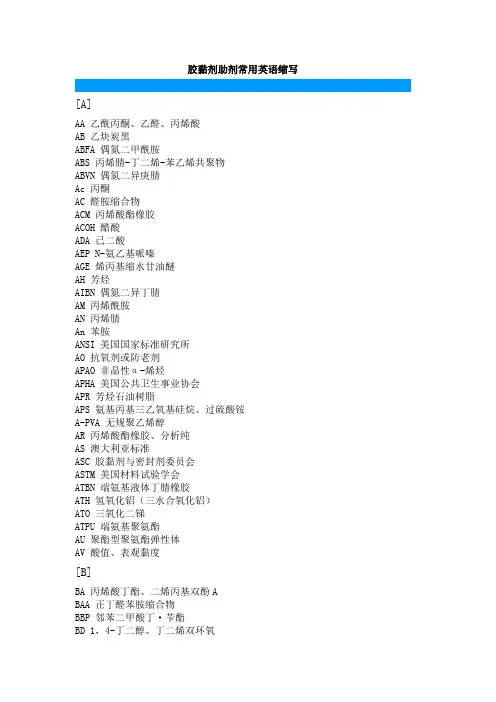
胶黏剂助剂常用英语缩写[A]AA 乙酰丙酮、乙醛、丙烯酸AB 乙炔炭黑ABFA 偶氮二甲酰胺ABS 丙烯腈-丁二烯-苯乙烯共聚物ABVN 偶氮二异庚腈Ac 丙酮AC 醛胺缩合物ACM 丙烯酸酯橡胶ACOH 醋酸ADA 已二酸AEP N-氨乙基哌嗪AGE 烯丙基缩水甘油醚AH 芳烃AIBN 偶氮二异丁腈AM 丙烯酰胺AN 丙烯腈An 苯胺ANSI 美国国家标准研究所AO 抗氧剂或防老剂APAO 非晶性α-烯烃APHA 美国公共卫生事业协会APR 芳烃石油树脂APS 氨基丙基三乙氧基硅烷、过硫酸铵A-PVA 无规聚乙烯醇AR 丙烯酸酯橡胶、分析纯AS 澳大利亚标准ASC 胶黏剂与密封剂委员会ASTM 美国材料试验学会ATBN 端氨基液体丁腈橡胶ATH 氢氧化铝(三水合氧化铝)ATO 三氧化二锑ATPU 端氨基聚氨酯AU 聚酯型聚氨酯弹性体AV 酸值、表观黏度[B]BA 丙烯酸丁酯、二烯丙基双酚ABAA 正丁醛苯胺缩合物BBP 邻苯二甲酸丁·苄酯BD 1,4-丁二醇、丁二烯双环氧BDDE 1,4-丁二醇缩水甘油醚BDMA 苄基二甲胺BEE 苯偶姻乙醚Bé波美度BF3MFA 三氟化硼单乙胺BGE 丁基缩水甘油醚(501稀释剂)BHT 2,6-二叔丁基对甲酚(264)BIIR 溴化丁基橡胶Bis A 双酚ABis F 双酚FBis S 双酚Sγ-BL γ-丁内酯BMA 甲基丙烯酸丁酯BMI 双马来酰来胺BN 安息香BOA 已二酸苄基辛基酯BOP 苯二甲酸苄基辛基酯BP 聚丁二烯橡胶、二苯酮B.P.英国专利BPA 双酚ABPF 双酚FBPFER 双酚F环氧树脂BPO 过氧化苯甲酰BPO/DMA 过氧化苯甲酰/二甲基苯胺BPPD 过氧化二碳酸双(2-苯基乙氧基)胺BPS 双酚SBQ 对苯醌BQN 对苯醌二肟BR 顺丁橡胶BS 英国标准BT 聚1-丁烯BTA 苯并三氮唑BTDA 苯酮四羧酸二酐[C]CA 醋酸纤维素CAB 醋酸丁酸纤维素CAC 醋酸溶纤剂(乙二醇乙醚醋酸酯)CAP 氯化无规聚丙烯、醋酸丙酸纤维素CAR 碳纤维Cat 催化剂CB 槽法炭黑CBA 化学发泡剂CC 化学成分、导电炭黑CEVA 氯化EVACF 甲酚-甲醛树脂、导电炉黑CHONE 环已酮CHP 异丙苯过氧化氢CHR 氯化(醇)橡胶CHX 环已烷CIP 氯化等规聚丙烯CIIR 氯化丁基橡胶CMC 羧甲基纤维素(钠)CMHEC 羧甲基羧乙基纤维素CMS 羧甲基淀粉CNR 氯化橡胶CP 氯化石蜡CPDA 环戊四酸二酐CPP 氯化聚丙烯CPPD 防老剂4010CPVC 氯化聚氯乙烯CR 氯丁橡胶CRL 氯丁胶乳CS 酪朊、烧碱、玉米淀粉CSA 加拿大标准CSM 氯磺化聚乙烯CTA 三醋酸纤维素CTB 液体丁腈橡胶CTBN 羰羧基液体丁腈橡胶CTE 热膨胀系数CTI 环已烷三异氰酸酯CTPB 羰羧基液体聚丁二烯橡胶CTPU 端羧基聚氨酯CX 环已烷[D]DAA 二丙酮醇DAIP 间苯二甲酸二烯丙酯DAM 顺丁烯二酸二烯丙酯DAP 邻苯二甲酸二烯丙酯DAS 双醛淀粉DATBP 四溴邻苯二甲酸二烯丙酯DBAPA 二丁氨基丙胺DBDPO 十溴二苯醚DBE 高沸点聚合酯类溶剂DBM 马来酸二丁酯DBMP 甲基膦酸二丁酯DBP 邻苯二甲酸二丁酯DBS 癸二酸二丁酯、十二烷基苯磺酸钠DBTDL 二月桂酸二丁基锡DBU 二环咪固化剂DCA 二氰二胺DCBPO 2,4-二氯过氧化苯甲酰DCE 二氯乙烷DCHP 邻苯二甲酸二环已酯DCM 二氯甲烷DCP 过氧化二异丙苯DCPD 过氧化二碳酸二环已酯DDM 二氨基二苯甲烷、十二碳硫醇DDP 邻苯二甲酸二癸酯DDS 二氨基二苯砜DDSA 十二烯基丁二酸酐DEA 二乙醇胺、N,N-二乙基苯胺、二乙氨基乙醇DEAPA 二乙氨基丙胺DEF 二乙基甲酰胺DEG 二甘醇DEP 邻苯二甲酸二乙酯DETA 二乙烯三胺DETDA 二乙基甲苯二胺DETU 二乙烯基硫脲DGE 二缩水甘油醚(600稀释剂)DGEBA 双酚A二给水甘油醚DHA 已二酸二已酯DHP 邻苯二甲酸二庚酯DHXP 邻苯二甲酸二已酯DIBA 已二酸二异丁酯DIBK 二异丁酮DICY 二氰二胺(双氰胺)DIDP 邻苯二甲酸二异癸酯DIN 德国标准DINP 邻苯二甲酸二异壬酯DIOA 已二酸二异辛酯DIOP 邻苯二甲酸二异辛酯DIOS 癸二酸二异辛酯DIOZ 壬二酸二异辛酯DIPE 二异丙醚DIPP 邻苯二甲酸二异戊酯DM 二硫化二苯并噻唑DMA N,N-二甲基乙酰胺DMAE 二甲基氨基乙醇DMAPA 二甲氨基丙胺DMBA 二羟甲基丁酸DMBPH 过氧化叔丁基已烷DMF N,N-二甲基甲酰胺DMIZ 1,2-二甲基咪唑DMM 马来酸二甲酯DMMP 甲基膦酸二甲酯DMP 邻苯二甲酸二甲酯DMP-10 2-二甲氨基甲基苯酚DMP-30 2,4,6-三(二甲氨基甲基)苯酚DMPA 二羟甲丙酸FMPDA N,N-二甲基对苯二胺DMSO 二甲基亚砜DMT 对苯二甲酸二甲酯DMTDA 二甲硫基甲苯二胺DNA 已二酸二壬酯DNOP 邻苯二甲酸二正辛酯DNP 邻苯二甲酸二壬酯DNPD 防老剂DNPDNPT 发泡剂HDO 二氧六环(二噁烷)DOA 已二酸二辛酯DODP 邻苯二甲酸二辛基癸基酯DOIP 间苯二甲酸二辛酯DOM 马来酸二辛酯DOP 邻苯二甲酸二辛酯DOS 癸二酸二辛酯DP 聚合度DPA 二苯胺DPG 二苯胍DPP 邻苯二甲酸二丙酯、二酚基丙烷(双酚A)DPPD防老剂HDPT N,N’-二亚硝基五次甲基四胺(发泡剂H)D.S.取代度DSC 示差扫描量热法DSB 十二烷基苯磺酸DTA 差热分析法、二乙烯三胺DTBP 二叔丁基过氧化物DVB 二乙烯基苯[E]EA 丙烯酸乙酯EAc 醋(乙)酸乙酯EAL 乙醇EB 水性环氧丙烯酸酯EC 乙基纤维素ECH 环氧氯丙烷EDA 乙二胺EDTA 乙二胺四乙酸EEP 3-乙氧基丙酸乙酯EEW 环氧当量EG 乙二醇EGDA 二丙烯酸乙二醇酯EGDE 乙二醇二缩水甘油醚(669稀释剂)EGDMA 双甲基丙烯酸乙二醇酯2-EI 2-乙基咪唑Em 乳化剂EMA 甲基丙烯酸乙酯EMI-2,4 2-乙基-4-甲基咪唑EP 环氧树脂E-PVC 乳液法聚氯乙烯(糊树脂)E-SBR 乳液聚合丁苯橡胶ESO 环氧大豆油ET 高温ETA 乙醇胺ETBN 端环氧基液体丁腈橡胶ETPDMS 端环氧基聚硅氧烷ETU 乙烯基硫脲EU 聚醚型聚氨酯橡胶EV 环氧值EVA 乙烯-醋酸乙烯共聚物EVCL 乙烯-氯乙烯乳液[F]FDA 食品及药物管理局(美国)FR 阻燃剂F.P.法国专利[G]GB 中国标准GB/T 国家推荐标准GC 气相色谱法GDE 乙二醇二甲醚GF 玻璃纤维GL 甘油、重质碳酸钙GMA 甲基丙烯酸缩水甘油酯GMF 对苯醌二肟GO 乙二醛GPO 凝胶渗透色谱法GPF 通用炭黑GR-M 氯丁橡胶GR-N 丁腈橡胶GR-P 聚硫橡胶GR-S 丁苯橡胶GTT 玻璃化转变温度[H]HA 环烷酸HAC 醋(乙)酸HAF 高耐磨炉黑HAPs 有害气体污染物目录HBB 六溴苯HBCD 六溴环十二烷HBMC 羟丁基甲基纤维素HCH/Co 过氧化环已酮/环烷酸钴HCPE 高氯化聚乙烯HD 1,6-已二胺HAD 已二胺HDI 1,6-已二异氰酸酯HDT 热变形温度HEA 丙烯酸-2-羟乙酯HEC 羟乙基纤维素HEMA 甲基丙烯酸-2-羟乙酯HEMC 羟乙基甲基纤维素HET 氯茵酸酐HEXA 六亚甲基四HFAH 六氟丙酮水合物HHPA 六氢苯酐HMDA 已二胺HMDI 氢化二苯甲烷二异氰酸酯H-MNA 氢化甲基纳迪克酸酐HMP(A)六甲基磷酸三酰胺HPA 丙烯酸-2-羟丙酯HPC 羟丙基甲基纤维素HQ 氢醌(对苯二酚)HQEE 对苯二酚二羟乙基醚HSE 安全、环境、健康HS 高苯乙烯橡胶HTBN 端羟基液体丁腈橡胶HTDI 甲苯环已基二异氰酸酯THE 端羟基聚醚HTPB 端羟基液体聚丁二烯橡胶[I]IFR 民泡阻燃剂IFT 界面张力IIR 丁基橡胶IM 聚异丁烯IMDA 咪唑IPA 异丙醇、间苯二甲酸IPDA 异佛尔酮二胺IPDI 异佛尔酮二异氰酸酯IPP 二异丙基过氧化二碳酸酯ISAF 中超耐磨炭黑ISO 国际标准化组织ITBN 端异氰酸酯基丁腈橡胶ITPB 端异氰酸酯基聚丁二烯IV 特性黏度[K]K 乙醛苯胺缩合物KPS 过硫酸钾[L]LCR 液体氯丁橡胶LD50半致死剂量LMP 低聚物LMW 低相对分子质量LNBR 液体丁腈橡胶LOI 极限氧指数L.P.石油醚LPB 液体聚丁二烯LPO 过氧化二月桂酰(引发剂B)LP 实验试剂Ltx 胶乳LV 低黏度[M]MA 丙烯酸甲酯、马来酸酐MAA 甲基丙烯酸MAC 最高容许浓度MAF 中超耐磨炉黑MAL 甲醇MBI 2-巯基苯并咪唑MBS 甲基丙烯酸甲酯-丁二烯-苯乙烯共聚物MBT 2-巯基苯并噻唑MC 甲基纤维素、微胶囊MCB 氯苯MDA 二氨基二苯甲烷、烷二胺MDEA 甲基二乙醇胺MDI 二苯甲烷-4,4’-二异氰酸酯ME 甲基丙烯酸环氧树脂MEA 一乙醇胺MEHQ 氢醌单甲醚MEK 甲乙酮(丁酮)MEKP 过氧化甲乙酮MEKP/Co 过氧化甲酮/环烷酸钴MF 三聚氰胺甲醛树脂MFT 最低成膜温度MHEC 甲基羟乙基纤维素MI 云母、熔体指数MIBK 甲异丁酮MIL 美国军用标准MIPK 甲基异丙基甲酮MMA 甲基丙烯酸甲酯MNA 甲基纳迪克酸酐MOCA 3,3’-二氯-4,4’-二氨基二苯甲烷(莫卡)mol 摩尔MP 熔点MPDA 间苯二胺MPF 蜜胺-苯酚-甲醛树脂MPO 改性聚苯醚MS α-甲基叔丁基醚MTBE 甲基叔丁基醚MTBN 端巯基液体丁腈橡胶M.V.门尼黏度MW 相对分子质量MED 相对分子质量分布MX 间二甲苯MXDA 间苯二甲胺[N]NA 纳迪克酸酐NBA 正丁醇NBR 丁腈橡胶NBR-C 羧基丁腈橡胶NDI 萘-1,5-二异氰酸酯NDPA N-亚硝基二苯胺NF 法国标准N-MAM N-羧甲基丙烯酰胺NO 环烷油NMP N-甲基-2-吡咯烷酮NMR 核磁共振NPG 新戊二醇NR 天然橡胶NVM 不挥发物[O]OBSH 4,4’-氧代双苯磺酰肼OHV 羟值OI 氧指数OMC 氧化微晶蜡OMS 无臭石油溶剂OSHA 职业安全和保健管理局OTD 邻甲苯二胺OX 草酸Oxin 8-羟基喹啉[P]PA 苯酐PAA 聚丙烯酸PAES 聚苯醚砜PAL 丙醇PAM 聚丙烯酰胺PAN 苯基-α-萘胺PAPA 聚壬二酸酐、聚芳酰胺PAPI 多亚甲基多苯基多异氰酸酯PASF 聚芳砜PB 聚丁二烯、聚丁烯PBN 苯基-β-萘胺PC 聚碳酸酯PCR 聚氯丁二烯PDA 丙二胺PDO 1,3-丙二醇PEEK 聚醚醚酮PEG 聚乙二醇PEHA 五乙烯六胺PEI 聚醚砜亚胺PEO 聚氧化乙烯(聚环氧乙烷)PES 聚醚砜PF 酚醛树脂PG 丙二醇、没食子酸丙酯PGE 苯基缩水甘油醚(690稀释剂)PHR 每100份树脂的份数PI 聚酰亚胺、聚异戊二烯PIB 聚异丁烯PM 丙二醇甲醚PMA 聚马来酸酐、丙二醇甲醚醋酸酯PMAA 聚甲基丙烯酸PMDA 均苯四甲酸二酐PMMA 聚甲基丙烯酸甲酯PMP 丙二醇甲醚丙酸酯PMS 聚α-甲基苯乙烯PN 波兰国家标准PNA 苯基-β-萘胺PNBR 粉末丁腈橡胶POE 聚氧化乙烯POP 对辛基苯酚PPA 多聚磷酸PPD 六氢吡啶、对苯二胺PPESK 聚芳醚砜酮PPG 聚丙二醇PPI 聚异氰酸酯PPTA 聚对苯二甲酰对苯二胺(芳纶)PSBRL 丁苯吡胶乳PSO 聚砜PSPA 聚癸二酸酐PTBP 对叔丁基苯酚PTHF 聚四氢呋喃PTMG 聚四氢呋喃二醇PTR 聚硫橡胶PU 聚氨酯PUR 聚氨酯橡胶PV 叔丁基过氧化特戊酸酯PVA(L)聚乙烯醇PVAc 聚醋酸乙烯酯PVB 聚乙烯醇缩丁醛PVCA 氯乙烯-醋酸乙烯共聚物PVFM 聚乙烯醇缩甲醛PVP 聚乙烯吡咯烷酮PW 石蜡[R]RA 松香酸RF 间苯二酚甲醛树脂RFL 间苯二酚甲醛乳液RH 相对湿度RI 折射率RPO 橡胶操作油RT 室温[S]S 硫黄SA 硬脂酸、氨基磺酸SAA 表面活性剂、丁二酸酐SAC 硅铝炭黑SAF 超耐磨炉黑SBR 丁苯橡胶SBRL 丁苯胶乳SBS 苯乙烯-丁二烯-苯乙烯嵌段共聚物SDH 癸二酸二酰肼SDS 苯乙烯-二烯烃-苯乙烯嵌段共聚物、十二烷基硫酸钠SEM 扫描电子显微镜SGP 淀粉接枝共聚物SIS 苯乙烯-异戊二烯-苯乙烯嵌段共聚物SLS 十二烷基硫酸钠SM 苯乙烯单体SP 溶解度参数SPCP 五苯酚钠SRF 半补强炉黑S-SBE 溶聚丁苯橡胶S.T.表面张力STP 三聚磷酸钠[T]TBA 四溴双酚ATBAER 四溴双酚A环氧树脂TBB 四溴丁烷TBC 对叔丁基邻苯二酚、柠檬酸三丁酯TBP 磷酸三丁酯、三溴苯酚TBPA 四溴邻苯二甲酸TBPB 酐叔丁基过苯甲酸酯TBPO 叔丁基过氧化氢TBS 四溴双酚STBT 钛酸四丁酯TCAA 三氯异氰尿酸TCE 三氯乙烯TCP 磷酸三甲苯酯TEA 三乙醇胺TETA 三乙烯四胺[U]UF 脲醛树脂UP 不饱和聚酯树脂UPVC 未增塑聚氯乙烯UV 紫外线[V]VAc 醋酸乙烯VAE 醋酸乙烯-乙烯共聚乳液VC/VAc 氯乙烯-醋酸乙烯共聚物VOC 挥发性有机化合物VTMS 乙烯基三甲氧基硅烷[W]WBPU 水性聚氨酯WPE 环氧当量[X]XCF特导电炉黑XCRL 羧基氯丁胶乳XDI 苯二亚甲基二异氰酸酯XFR 二甲苯甲醛树脂XNBR 羧基丁腈橡胶XNBRL 羧基丁腈胶乳XPS X射线光电子光谱法XSBR 羧基丁苯橡胶XSBRL 羧基丁苯胶乳xyL 二甲苯[Y]YSBR 热塑性丁苯橡胶YXSBR 热塑性羧基丁苯橡胶[Z]ZB 硼酸锌ZBDC 促进剂BZZDC 促进剂EZZDMD 促进剂PZZO 氧化锌ZS 硬脂酸锌。