2013年八年级英语上册《Module 4 Planes, boats and trains》检测题(含解析) 外研版 2
- 格式:doc
- 大小:552.00 KB
- 文档页数:6
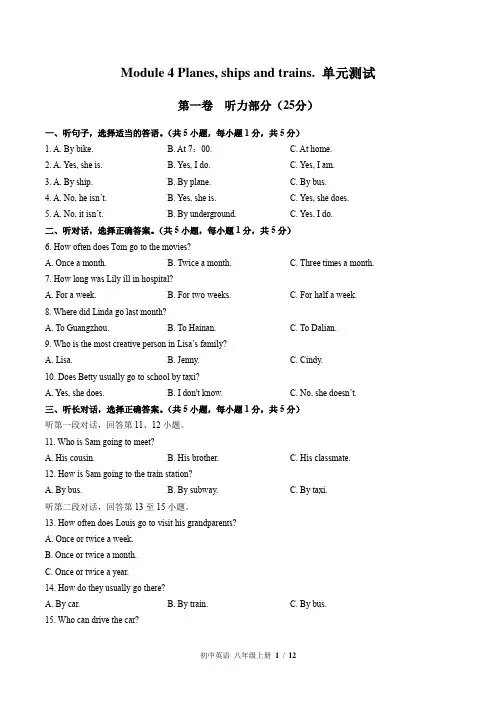
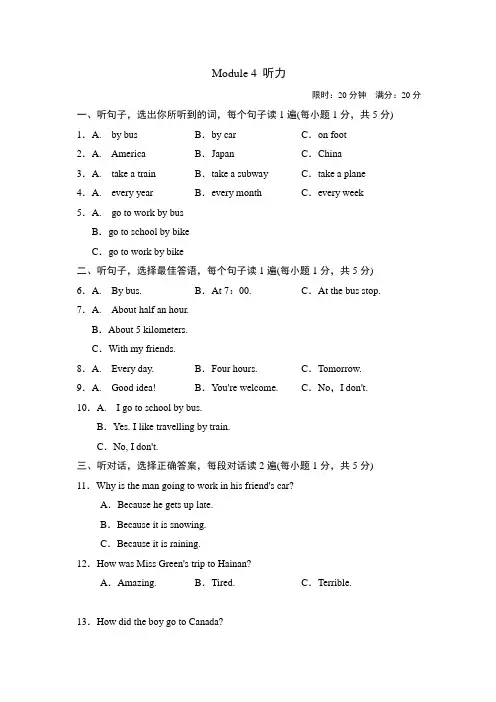
1 MODULE 4 Planes, ships and trains检测题 (时间:60分钟;满分:100分) 一、 听力测试(满分15分)
I. 听句子,选择与所听内容相符的图片。(每个句子读一遍)(5分)
A. B. C. D. E. 1._______ 2. _______3. _______4. _______5. _______ II. 听句子,选择适当的答语。(每个句子读一遍)(5分) 6. A. By bike. B. At 7:00. C. At home. 7. A. Yes, she is. B. Yes, I do. C. Yes, I am. 8. A. By bus. B. By plane. C. By bike. 9. A. No, he isn’t. B. Yes, she is. C. Yes, he does. 10. A. On feet. B. By bus. C. Yes, I do. III. 听对话,选择正确答案。(每段对话读两遍)(5分) 11. How does Lily go to school? A. By bus. B. By train. C. By taxi. 12. Who lives farthest from the school? A. Tony. B. Daming. C. Lingling. 13. How is Lingling’s father going to Beijing? A. On foot. B. By bus. C. By plane. 14. How will Mary go to Dalian? A. By train. B. By boat. C. By plane. 15. Whose home is the closest to the school? A. Mike’s. B. Betty’s. C. Tom’s. 二、单项填空(每小题1.5分,满分15分) 16. The Yellow River is the second _______river in China. A. longer B. the longest C. longest D. long 17. —_______ does Kitty go to school? —She takes the bus. A. How B. Why C. When D. Where 18.—What’s the most expensive way to travel? —_______. A. By bike B. On foot C. By air D. By bus 19. Of all the students, Li Lei is _______to Mr Wang. A. close B. closer C. the closest D. the most closest 20.Stop_______now!Please listen to me. A. talk B. talks C. talking D. to talk 21. Mary usually goes to school her father’s car. 2
A. by B. in C. with D. on 22.—_______ is it from here to the railway station? —About two kilometres. A. How long B. How much C. How soon D. How far 23. There are a lot of _______friends. A. way to make B. ways of make C. ways to make D. way making 24. How long does it _______to go there by plane? A. spent B. spend C. took D. take 25. My father is _______sixty. A. in B. on C. over D. with 三、完形填空(每小题1.5分,满分15分) Have you ever been to Hong Kong? When you travel in Hong Kong, you must 26 of the traffic rules, because they are different from those of the interior (内地) of China, and the traffic keeps to 27 .Before 28 the street, you must look to the right and then to the left. If the traffic lights turn 29 ,the traffic must stop, and people can cross the zebra line. If the traffic lights turn 30 ,the traffic can go, but people 31 cross the road. In the morning and in the evening, when people go to or come from 32 ,the streets are very busy. The traffic is 33 . When you go somewhere by bus in Hong Kong, you must be careful, 34 .Always remember the traffic keeps to the left. Have a look first, or you may go to the wrong way. In Hong Kong, there are a lot of big buses 35 two floors. You may sit on the second floor. From there you can watch the city very well. 26. A. careless B. be carefully C. be careful D. careful 27. A. the left B. left C. the right D. right 28. A. across B. cross C. crossed D. crossing 29. A. yellow B. green C. red D. red and yellow 30. A. orange B. red and yellow C. green D. red 31. A. may not B. not C. aren’t D. mustn’t 32. A. sea B. work C. hotel D. school 33. A. the most dangerous B. dangerousest C. the dangerous D. most dangerous 34. A. too B. also C. either D. but 35. A. with B. in C. having D. being 四、阅读理解(每小题2分,满分20 分) A New York is a very large city with 8 million people. How do so many people move on their way to work or school? In New York you can travel by subway, bus, taxi and private car. The subway runs on the railroad lines under the city. Travelling by subway is the fastest way to get around the city. The second way to travel around the city is by public bus. It is a slower way to travel. This is because the traffic is very heavy. 3
You can also travel around the city by taxi. This is very expensive, but the taxi will take you to the very place you want to. If traffic is heavy, the taxi will be slow, too. During the mornings and afternoons, there is the “rush hour”.This is the time when the traffic is very heavy with people going to and from work. The last way to get around New York is using your own private car. It is inconvenient (不方便的) because you will perhaps be driving during the “rush hour”.The best time to travel around the city is from 9 am to 4 pm, because it isn’t the “rush hour”. 36.How many ways of travelling around the city are mentioned (提到) in the passage? A. Two. B. Three. C. Four. D. Five. 37. The fastest way to travel in New York is_______ . A. by public bus B. by subway C. by taxi D. by private car 38.How about travelling by taxi? A. It’s cheap, and the taxi will take people to the very place they want to. B. It’s expensive and slow. C. It’s expensive, but the taxi will take people to the very place they want to. D. It’s cheap and fast. 39. From the passage we know that in New York_______ . A. there is no “rush hour” from 9 am to 4 pm B. traffic is heavy at noon C. most people have lunch at home D. people go to work or school at 9 am 40. Why is it inconvenient to use private cars? A. Many people can’t buy private cars. B. We will perhaps be driving during the “rush hour”. C. Most people aren’t at school or at work. D. Traffic is very heavy. B My aunt works in a hospital in the centre of the city. The hospital is not far from her home. It’s about one kilometre away, so she seldom (很少) goes to work by bus. She usually goes there by bike, sometimes on foot. It takes her twenty-five minutes to get there by bike, and fifty minutes on foot. Today her bike is broken. She wants to walk there. Now she’s having some food. She usually leaves home at five to eight, but today she needs to walk twenty minutes earlier. She starts to work at half past eight in the morning and finishes at five in the afternoon. 41.The writer’s aunt is a _______. A. student B. doctor C. bookseller D. teacher 42. The writer’s aunt sometimes goes to work_______ . A. by bus B. by bike C. on foot D. by subway 43.How long does it take her to get there by bike? A. Fifteen minutes. B. Fifty minutes. C. Twenty minutes. D. Twenty-five minutes. 44.She needs to walk to work today, because_______ .