
2016全国小学生英语竞赛试题讲解
- 格式:pdf
- 大小:5.21 MB
- 文档页数:20

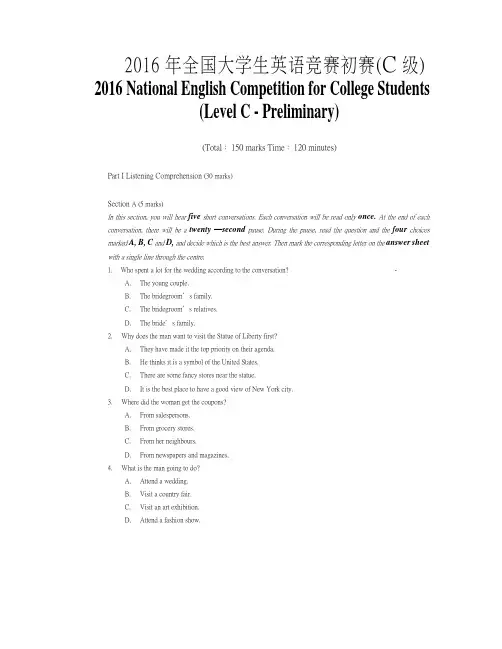
2016年全国大学生英语竞赛初赛(C级) 2016 National English Competition for College Students(Level C - Preliminary)(Total: 150 marks Time: 120 minutes)Part I Listening Comprehension (30 marks)Section A (5 marks)In this section, you will hear five short conversations. Each conversation will be read only once. At the end of each conversation, there will be a twenty —second pause. During the pause, read the question and the four choices marked A, B, C and D, and decide which is the best answer. Then mark the corresponding letter on the answer sheet with a single line through the centre.1.Who spent a lot for the wedding according to the conversation? -A.The young couple.B.The bridegro om’s family.C.The bridegroom’s relatives.D.The bride’s family.2.Why does the man want to visit the Statue of Liberty first?A.They have made it the top priority on their agenda.B.He thinks it is a symbol of the United States.C.There are some fancy stores near the statue.D.It is the best place to have a good view of New York city.3.Where did the woman get the coupons?A.From salespersons.B.From grocery stores.C.From her neighbours.D.From newspapers and magazines.4.What is the man going to do?A.Attend a wedding.B.Visit a country fair.C.Visit an art exhibition.D.Attend a fashion show.5.What can we infer about the speakers from the conversation?A.They are discussing the local weather.B.They are going to help each other in their study.C.Neither of them is going to cheat in exams.D.Neither of them is a top student in their class.Section B (10 marks)In this section, you will hear two long conversations. Each conversation will be read only once. At the end of each conversation, there will be a one—minute pause. During the pause, read the questions and the four choices marked A, B, C and D, and decide which is the best answer. Then mark the corresponding letter on the answer sheet with a single line through the centre.Conversation One6.What is the accident happening in Regent Street?A.Two cars ran into each other.B. A double-decker bus is on fire.C. A roadside building is burning.D. A man was run over by a double-decker bus.7.Where is the crowd standing and singing?A.In Regent Street.B.In Oxford Street.C.In Euston Road.D.In London Road.8.What is the lion doing on the road?A.Looking at the camera.B.Walking around the cars.C.Sitting and looking around.D.Running and roaring.9.What is the traffic problem in East London?A.Somebody is driving on the wrong side of a road there.B.Drivers stop to watch an escaped lion running on a road.C.Too many cars get stuck because of a big parade going on.D. A huge lorry is overturned right in the middle of a road.10.When will the traffic news be updated?A.In half an hour.B.At noon.C.In two hours.D.At half past ten.Conversation Two11.What does Liz McCartney think of her winning the prize?A.All her hardworking efforts are paid back.B.Other hero nominees are better than her.C.She is only a representative of the heroes.D.People in St. Bernard Parish will love her more.12.What happened to people in St. Bernard Parish according to Liz?A.Many of them lost their homes in a fierce storm.B. A fire broke out and burnt many of their houses.C. A serious earthquake occurred to them suddenly.D.They couldn’t go out because of a huge flood.13.What does Liz McCartney say about the prize?A.It is an honor the people of St. Bernard Parish deserve.B.It shows the courage of the people of St. Bernard Parish.C.It makes people realize the importance of guarding against disasters.D.It is a reminder there is still much to be done after the disaster.14.How much did Liz get as this year’s CNN Hero of the Year prize?A.25,000 dollars.B.50,000 dollars.C.100,000 dollars.D.125,000 dollars.15.How will Liz spend the prize money?A.Setting up a fund for the local community.B.Building houses for more suffering families.C.Buying clothes for victims of the accident.D.Donating it to a charity organisation.Section C (5 marks)In this section, you will hear five short news items. After each item,which will be read only once, there will be a twenty -second pause. During the pause, read the question and the four choices marked A, B, C and D, and decide which is the best answer. Then mark the corresponding letter on the answer sheet with a single line through the centre.16.Why did NASA send New Horizons spacecraft to Pluto?A.To find out its relations with other planets.B.To test its new per-second speed in space.C.To collect more detailed data about the planet.D.To see whether there are any life forms on it.write the answers on tne answer sheet.17. What is the title Geneva plans to regain? A. City of Negotiation. B. Peace Capital of the World. C.UN European Headquarters.D. Centre of Controlling Nuclear Weapons. 18.What was Merriam-Webster’s criterion for choosing the 2015 Word of the Year? A. Whether it is related to politics, beliefs or discrimination. B. How often it is looked up in its online dictionary. C.Whether it ends in the suffix -ism.D. How often it is used in people’s life. 19.What measures did the nations agree to take to fight climate change? A. Reducing their greenhouse gas emissions. B. Burning no fossil fuels from now on. C.Planting more trees.D. Using more solar power. 20.Where did many of the richest in Britain get their increased wealth? A. From their investments in the stock market. B. From their accumulated bank savings. C.From their business earnings overseas.D. From their rising private retirement payments.Section D (10 marks)In this section, you will hear a short passage. There are 10 missing words or phrases. Fill in the blanks with the exactwords or phrases you hear. The passage will be read twice.Remember toThe most common legend about the discovery of coffee is that it happened in the ninth century A.D. A goat herder in Ethiopia named Kalil noticed that his goats became very active after they ate redberries from a leafy 21. ______________ . He tried a few berries himself, and he was soon as 22. ________________ ashis herd. Kalil told other people in his tribe about his experience, and for the next four hundred years, people chewed the berriesbecause they 23. •Recent botanical evidence indicates that Coffea arabica was first grown on the plateaus ofcentral Ethiopia. There, the Galla tribe used to mix the beans with animal fat and eat thismixture as a source of 24. ________________ . In 1000 A.D., the Arabs began to boil the beans and25. ________ a drink they called “qahwa,” which means wine, coffee, or any drink made fromplants. Coffee was also used by the people of that region to get more energy. However, the Turkswere the first to adopt coffee as an everyday drink, often adding 26. _________________________ to the brew. The world’s first coffeehouse was opened in Constantinople in 1475.The introduction of coffee in Europe 27. ________________ . The delicacy was guarded like a militarysecret, and transportation of the plant out of the Muslim regions 28. __________________________ .In the 1600s,coffee was introduced in Europe by Italian traders through the port of Venice. Soon coffeebecame a popular European beverage, too. Coffeehouses 29. ________________________ in one country after another, and became popular meeting places. The first coffeehouses were opened in Englandaround 1650, and almost twenty years later coffee 30. _________________ beer as New York City’s breakfastdrink.Today coffee is drunk in millions of homes and workplaces all over the world, and coffee shops are found at almost every intersection in major cities.Part II Vocabulary, Grammar and Culture (15 marks)There are 15 incomplete sentences in this section. For each blank there are four choices marked A, B, C and D. Choose the one that best completes the sentence. Then mark the corresponding letter on the answer sheet with a single line through the centre.Section A Vocabulary and Grammar (10 marks)31.Jessica told me that she had absolutely no ______________ of ever meeting them before.A.reviewB. recollectionC. memorizationD. mind32.I cannot bea r the noise of my brother’s radi o; it _________________ me from my work.A.distractsB. interferesC. dismissesD. interrupts33.You don’t object ______ you by your first name, don’t you?A. my callingB. to my callingC. for me to callD. me calling34.After careful deliberation the shareholders voted to _______________ the offer of a merger. .A. refuteB. refrainC. retreatD. reject35.To rid the world ___________ m any people believe that we must some fundamentalchanges in the way many of us live.A. to pollution; haveB. with pollution; takeC. of pollution; makeD. in pollution; bring36.The wife of Steve Carvey, the baseball star, _____________ about being left alone too often.A. bitterly has complainedB. has bitterly complainingC. has been complained bitterlyD. has been complaining bitterly一 6 -T H E O D O R E D R E I S E R wtih*n«w»y UnfltmwB.H A /i n t i L t fAN AMERICAN TRAGEDYGONE WITH UNW INDTHE OLD MANANDTHE SEAT O K I L L Al\/\ocki}u^biiiiA.C.D.37. The doctor’s efforts were _________ . The patient refused to accept the treatment. A. of no availB. in no availC. by. no availD. on no avail38. It is thought that modem corn may be a _______________ of teosint and other wild species that no longer exist. A. hybridB. combinationC. compoundD. mixture39. —Didn’t you think that joke was funny? —No, I didn’t really get it.—You are like my grandmother. She can’t understand jokes.一_______ I’m not that old yet.A. You should teach her a lesson!B. I think it takes time to do that.C.Well, it’s not her fault.D. Come on, you are so mean! 40.—My doctor has suggested that I try music therapy to reduce my pain. —Really? __________—At the hospital or at a private office. A. Do you think it will work? B. Where can you get music threapy? «C.How come you would believe in it?D. Who does music threapy for you?Section B Culture (5 marks)41.Renaissance was the revival of classical _______________ in European history. A. education and religion B. science and technology C. music and sport D. literature and artistic styles42.Written by Margaret Mitchell, _____________ was popular with American readers. As of 2014, a Harris poll found it to be the second favourite book of American readers, just behind theBible.43.Queen Mary was known as the ____________ ” and also remembered as the monarch who lost thelast British possessionon the continent——French port of Calais.A. Butcher MaryB. Bloody MaryC. Lion HeartD. Great Conqueror44.People often say that the history of Canada is a history of __________________ .A. European colonisationB. foreign interventionC. immigrationD. internationalisation45.The largest state of the United States is _____________ . It is also known as “the great land”.A. AlaskaB. CaliforniaC. MontanaD. TexasPart III Cloze (10 marks)Read, the following passage and fill in each blank with one word. Choose the correct word in one of the following three ways: according to the context, by using the correct form of the givenword, or by using the given letter(s) of the word. Remember towrite the answers on the answer sheet.What’s the weather like where you are? Chances are there’s acloud somewhere on your horizon——a collection of millions ofmicroscopic water droplets formed as moist air rises, cools andexpands. If the cloud is dense enough, it46._____ . If it’s cold enough, it snows. And ifit’s low enough, we call it fog.But until 230 years ago, people didn’t know what to callthem and the fluffy things that passed overhead were known by their47.resem ______ to things such as mare’s tails or mackerel’s scales.In 1783, huge volcanic eruptions in Iceland and Japan produced spectacular sunsets acrossthe northern 48. hemi ____________ . Eleven -year-old Luck Howard was entranced by these displaysand became a keen student of the young science of meteorology. Twenty years later, he madethe first internationally recognised 49. _______________ (classify) of clouds.One day, the sky was full of cirrus (high, threadlike cloud) and stratus (low, layered cloud), nimbus (rainclouds) andcumulus (low, puffy cloud). By combining these Latin names and grouping them by the 50. _________________ (high) at which they occurred, Howard came up with a 10-point system for identifying clouds.Some countries may be sick of the sight of them, but drought-stricken areas are crying out for a bit of cloud cover. Scientists in the US and Russia have attempted to create clouds bycloud seeding—dropping condensation agents such as dry ice from aeroplanes to 51. _____________________________ (courage) nascent clouds to form.Poets and artists, too, have found 52. insp ___________________ in the clouds——Wordsworth wanderedlonely as one, Shelly named a poem 53. ___________________ “the daughter of earth and water a nd thenursling of the sky”,while Turner and Constable captured their fleeting likenesses on canvas.54. Whe _________ you are under one, on top of one or have your head in one, clouds, likeour moods, are ever changing. And perhaps that is the 55. ____________________ (beautiful) of them.Part IV Reading Comprehension (35 marks)Read the following passages. Each passage is followed by several questions. Respond to the questions using information from the passage. Remember to write the answers on the answer sheet.Section A (5 marks)Questions 56—60 are based on the following passage.In order to get information about distant planets, scientistsinvented spacecraft to travel into the solar system to see theplanets up close. These spacecraft do not carry people, and theynever return to Earth. However, while they are in space, theycan take photographs of planets that are too far away for us tostudy from Earth. One famous spacecraft that has done this ispart of the Voyager Project. This spacecraft is called Voyager I.NASA started the Voyager Project in the 1970s. During the 1960s and the 1970s, NASA sent many spacecraft into space to collect scientific information about the solar system, but none of those spacecraft carried astronauts. Two of the spacecraft that NASA built in the 1970s were called Voyager I and Voyager II. The original jobs of Voyager I and II were to get information about Jupiter and Saturn. The two spacecraft both left the Earth in 1977.Voyager I reached Jupiter in 1979 and began to take photographs. The spacecraft was able to get very close to Jupiter. By getting close to Jupiter, it could take very clear photographs of Jupiter’s rings and planets. Voyager I also t ook good photographs of Jupiter’s “Great Red Spot.” This spot is a large place on Jupiter where there is a strong storm. The Great Red Spot is so large that it could hold three planets the size of Earth inside of it! After taking pictures of Jupiter, Voyager I went to Saturn. It reached Saturn in 1980 and collected important information about Saturn’s rings.- 8 —After Voyager I finished its work on Saturn, the spacecraft still worked well. So, NASA sent Voyager I on a new job. This time it was sent out of the solar system. NASA wanted to see how far it could go.Voyager I is still working today. It is now NASA’s oldest working spacecraft. It has travelled more than 9.3 billion miles, making it the spacecraft that has travelled furthest from Earth. Actually, the spacecraft has now travelled much further than expected. As it travels, it continues to send new information back to Earth. It is expected that Voyager I will no longer work by the year 2020. At that time it will not have enough power to keep working. Still, we can certainly say that this spacecraft has done a great service in helping us to learn more about space.Questions 56一60Decide whether the following statements are true (T) or false (F) according to the passage.56.Voyager I and Voyager II are only a p art of NASA’s Voyager Project started in the 1970s.57.Voyager I and Voyager II were specifically designed to carry astronauts to outer space.58.Voyager I has successfully fulfilled its mission of collecting information about Jupiter and Saturn.59.Voyager I is still in normal working condition inside the solar system.60.As expected, Voyager I will return to the Earth by the year of 2020 with morevaluable information.Section B (10 marks)Questions 61—65 are based on the following passage.Can we trust our memori es? Psychologist Elizabeth Loftus doesn’t think so. Loftus is anexpert on false memories. A false memory is a memory of something that never happened.Are people with false memories lying? Not at all, says Loftus. They really believe theirmemories. And that is why it can be difficult to know if a memory is real.61. _________________________ These people didn’t know eachother, but 36 percent of them had the same memory. What was it?They remembered hugging Bugs Bunny at Disneyland. But wait a minute. Bugs Bunny isnot a Disney character, and he was never at Disneyland. These people’s memories werefalse.62. ___________________ Loftus says it is easy to put a false memoryinto someone’s mind. How? You just talk to the person. In the Bugs Bunny experiment, Loftus talked to peoplewho had visited Disneyland as children. Then she asked them about Bugs Bunny. She asked if he had soft ears. She asked if his body was furry. Later, more than one-third falsely remembered hugging Bugs Bunny.63. ________________________ That is why Loftus used the words “furry” and “soft” in theexperiment. Those words helped people imagine the experience. They saw Bugs Bunny in their imagination. They felt his soft fur. It seemed so real. They were sure it really happened.64. ________________________ Loftus says it shows the dangers of false memory. Of course, afalse memory of Bugs Bunny is not dangerous, but imagine this situation. A man hits a woman on the head. Then he steals her car. The police ask the victim if the thief smelled of cigarettes.In fact, he did not, but after the woman hears the question, she becomes 100 percent sure that he did. She adds the smell of cigarettes to her real memory and creates a false memory. The police then accuse the wrong person, a smoker. As a result, theynever find the guilty man. He’s a nonsmoker, so the police don’t evenlook for him.65. _______ ____________________________ If they aren’tcareful, they won’t find the truth. Instead, they will find only falsememories, and the real criminals will go free.Questions 61—65Complete the article with the following sentences. There are two extrasentences that you do not need to use.A.When we remember something, we use all of our senses: sight, touch, taste, smell, and hearing.B.The police often create false memories when they ask crime victims questions.C.In one experiment on false memories, Loftus talked to people about their childhoods.D.Why are many of our childhood memories probably false ones?E.But what is the purpose of the Bugs Bunny experiment?F.How could a group of strangers all have the same false memory?G.That is why the police need to be very careful about how they ask questions, says Loftus.Section C (10 marks)Questions 66—70 are based on the following passage.One of the interesting things about languages is the way they change overtime. In English, everything from spelling to vocabulary has gone throughmajor changes over the years. In fact, to a modern speaker, the English of1,000 years ago looks like a foreign language!The history of English dates back around 1,500 years. At that time,groups of Europeans invaded England, bringing their language with them. Itdeveloped into Old English. Later, in 1066, England was invaded by theNormans from France. The language went through an important shift,leading to what we now call Middle English. Over the next 500 years, the language underwent further shifts, leading to Modern English. As the language has developed over time,many things about it have changed.Pronunciation is one of the most obvious areas. For example, in Old English, people said “hus” and “mus”. Now, we say “house” and “mouse”. These days, there are many differences in the way English is pronounced in the U.S., India, and elsewhere. When people live in groups separated by great distances, the pace of change can be fast.Spelling has also gone through interesting changes. For example, in Old English, one wrote “riht”. A “g” was added in Middle English, making the spelling “right”. Also, in the distant past, people did not always follow standards of spelling. I n the eighteenth and nineteenth centuries, scholars like Noah Webster wrote dictio varies which made the spelling more consistent. However, different standards were decided on in England and the U.S. So, some differences remain—for example, “color” vs. “colour”.Vocabulary changes happen even more quickly. English has grown by borrowing words from languages such as French, Spanish, and Arabic, to name a few. This often happens with types of food—for example, “tofu”. Then there is slang which enters and leaves the language every year! Thirty years ago, one often heard people saying “groovy”,meaning “great”. These days, you’ll rarely hear the word except on old TV shows and movies.Because English is spoken by so many people worldwide, it really is an exciting time for the language. Just as American and British versions are always changing, so are versions spoken in Canada, Singapore, and elsewhere. At the same time, an entirely new version of English is appearing on the Internet with whole new slang and writing styles. In a way, learning English is a never-ending process, even for native speakers!11Questions 66—70Answer the following questions according to the passage.66.Why does the English of 1,000 years ago seem a foreign language to modern speakers?67.What aspects are discussed to show the changes of English in history?68.When did scholars try to make English spelling more consistent?69.What are some languages that English has borrowed words from?70.Where can we see an entirely new version of English?Section D (10 marks)Questions 71——75 are based on the following passage.Wine can be made with red grapes or whitegrapes, and, especially in the case of red wines, a number ofdoctors have reported that a moderate amount of wine hascertain health benefits. This may be one of the reasons why thenumber of people drinking wine has risen over the past years.As new wine -shoppers browse the shelves of their localmarkets, they face a tough decision. Should they buy a winewith a cork or a screw top? And shoppers are not alone in theirdilemma. Wineries are also facing tough choices in the bestway to seal their products.The root of the problem lies in “cork taint”. Corktaint refers to a problem with wine that has been sealed with abad cork. Traditionally, all corks are made from a special oak tree that grows around the Mediterranean. In the process of making the corks and sealing wine bottles, a certain type of mold may start to grow on some corks. Over time, this mold can produce a chemical that makes the wine inside the bottle taste musty. In fact, the human tongue is so sensitive to this particular compound that people can taste it even diluted up to six parts per trillion!How big is the problem of cork taint? Some experts from the wine industry claim cork taint affects one out of every ten bottles of wine. And as one spokesperson for an American winery says, “No other packaging industry in the world would put up with that kind of failure rate.”Some wine makers see a possible solution to the problem of cork taint through adopting the tried and true method of sealing bottles with screw tops. However, many wineries are still playing it safe and sticking to corks for two reasons. First, there is the old belief among cork users that small amounts of oxygen are able to penetrate corks. This oxygen, they say, is necessary for the proper aging of fine wines, especially those aged 10 years or more. Screw tops12 -do not allow for any oxygen to get into the bottles after they are sealed.Another problem arises from the image screw tops have with the public. In most people’s minds, screw tops are only found on cheap, low-quality wines. It will take a lot of efforts from wineries to re-educate the public if they want to change the image of screw tops. In addition, there is the problem of losing the romantic, elegant mood produced by the ceremonial popping of the cork. Consumers don’t seem to feel the same thrill when unscrewing a top.Questions 71—75 Complete the summary with words from the passage, changing the form wherenecessary, with only one word for each blank.The wine industry is facing a 71. _______________ . What is the bestway to seal wine bottles? Many people think that it is onlyproper for wine 72. ____________ to be sealed with corks. Theybelieve that oxygen needs to be able to 73. _____________________ thecork. Other experts, however, suggest that wineries change to screw tops. Usingcorks can lead to cork taint, a badtaste in the wine caused by 74. _________________ . However, it isunlikely that the public will accept this solution. They willmost likely 75. ___________ to buying wine with corks for theromantic and elegant mood it brings.Part V Translation (15 marks)Section A (5 marks) Translate the following paragraph into Chinese. Remember to write the answers on the answer sheet.76. Kite flying is one of the most popular traditional sports in China. Kite, called Feng Zheng in Chinese, originated in China and ithas been praised as the forerunner of modern aircrafts. Its history can be traced back to more than 2,000 years ago. Legend has it that, the first Chinese kites were made of wood by the famous architect and carpenter Lu Ban during the Spring and Autumn Period (770-476BC); after the invention of paper, kites began to be made of this new material. People nowadays make colourful kites in the shapes of animals, birds, butterflies, fishes, etc.13 -Section B (10 marks)Translate the following sentences into English by using the hints given in brackets. Remember to write the answers on the answer sheet.77.你走后如果有你的信件9我会转寄给你。
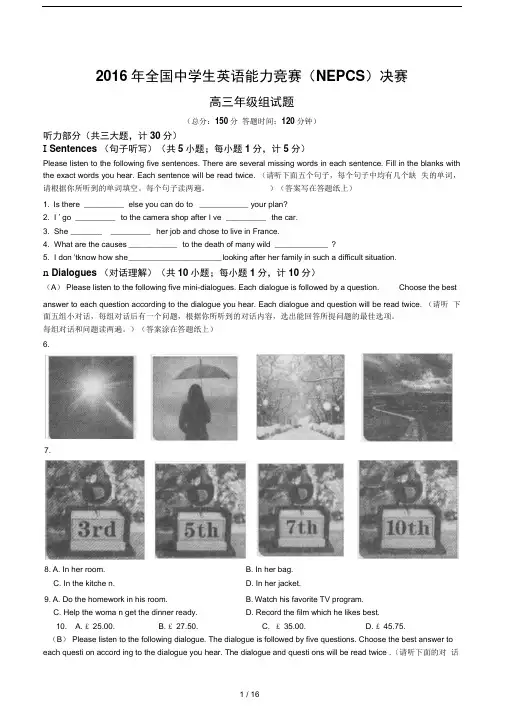
2016年全国中学生英语能力竞赛(NEPCS)决赛高三年级组试题(总分:150分答题时间:120分钟)听力部分(共三大题,计30分)I Sentences (句子听写)(共5小题;每小题1分,计5分)Please listen to the following five sentences. There are several missing words in each sentence. Fill in the blanks with the exact words you hear. Each sentence will be read twice. (请听下面五个句子,每个句子中均有几个缺失的单词,请根据你所听到的单词填空。
每个句子读两遍。
)(答案写在答题纸上)1. Is there _________ else you can do to ___________ your plan?2. I 'go _________ to the camera shop after I ve _________ the car.3. She _______ _________ her job and chose to live in France.4. What are the causes ___________ to the death of many wild ____________ ?5. I don 'tknow how she _____________________ looking after her family in such a difficult situation.n Dialogues (对话理解)(共10小题;每小题1分,计10分)(A) Please listen to the following five mini-dialogues. Each dialogue is followed by a question. Choose the bestanswer to each question according to the dialogue you hear. Each dialogue and question will be read twice. (请听下面五组小对话,每组对话后有一个问题,根据你所听到的对话内容,选出能回答所提问题的最佳选项。
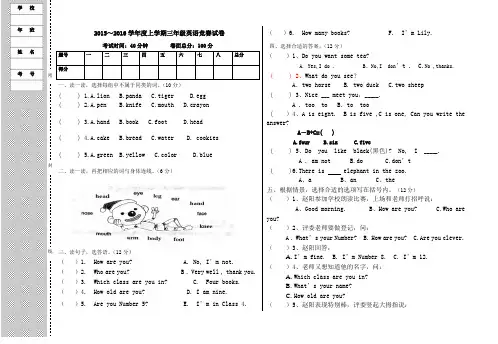
2015~2016学年度上学期三年级英语竞赛试卷考试时间:40分钟 卷面总分:100分题号 一 二 三 四 五 六 七 八 总分 得分一、读一读,选择每组中不属于同类的词。
(10分)( ) 1.A.lion B.panda C.tiger D.egg( ) 2.A.pen B.knife C.mouth D.crayon ( ) 3.A.hand B.book C.foot D.head ( ) 4.A.cake B.bread C.water D. cookies ( ) 5.A.green B.yellow C.color D.blue二、读一读,再把相应的词与身体连线。
(6分)三、读句子,选答语。
(12分)( )1. How are you? A. No, I ’m not. ( )2. Who are you? B . Very well , thank you. ( )3. Which class are you in? C. Four books. ( )4. How old are you? D. I am nine. ( )5. Are you Number 5? E. I’m in Class 4.( )6. How many books? F. I ’m Lily.四、选择合适的答案。
(12分)( )1、Do you want some tea?A. Yes,I do . B 、No,I don ’t . C.No ,thanks.( ) 2、What do you see ?A .two horse B. two duck C.two sheep( ) 3、Nice ___ meet you ,_____.A . too to B. to too( )4、A is eight. B is five ,C is one, Can you write the answer?A -B+C=( )A.fourB.sixC.five( ) 5、Do you like black(黑色)? No, I _____.A . am not B.do C.don’t( )6.There is elephant in the zoo. A 、a B 、an C 、the五、根据情景,选择合适的选项写在括号内。

2016年全国大学生英语竞赛d类试题2016年全国大学生英语竞赛D类试题涵盖了英语语言知识、应用能力、阅读理解、翻译、写作等多个方面,旨在全面考察大学生的英语综合能力。
以下是试题的大致内容:一、听力理解(Listening Comprehension)1. 短对话理解:包含若干段简短对话,考生需根据所听内容选择正确答案。
2. 长对话理解:一段较长的对话或访谈,考生需回答相关问题。
3. 短文听力:播放一篇短文,考生需根据短文内容选择或回答相关问题。
二、词汇和语法(Vocabulary and Grammar)1. 词汇题:提供一系列词汇选择题,考生需根据上下文选择最合适的词汇。
2. 语法题:包含一系列语法问题,考生需根据语法规则选择或填空。
三、阅读理解(Reading Comprehension)1. 快速阅读:提供一篇或多篇文章,考生需快速阅读并回答相关问题。
2. 深度阅读:提供较长的文章,考生需仔细阅读并回答深入理解的问题。
四、完形填空(Cloze Test)考生需阅读一篇有空白处的文章,从所给选项中选择最合适的词汇填入空白处,使文章意思通顺、完整。
五、翻译(Translation)1. 英译汉:提供一段英文材料,考生需将其翻译成中文。
2. 汉译英:提供一段中文材料,考生需将其翻译成英文。
六、写作(Writing)1. 应用文写作:考生需根据给定情景写一封书信、通知或其他应用文。
2. 议论文写作:考生需就某一话题发表自己的观点,并进行论证。
七、智力测试(Intelligence Test)包含逻辑推理、数学问题解决等题型,考察考生的逻辑思维和问题解决能力。
注意:- 所有试题均需在规定时间内完成。
- 听力部分可能包含录音材料,考生需仔细聆听并迅速作答。
- 阅读和写作部分要求考生具备良好的语言组织和表达能力。
- 翻译部分考察考生的语言转换能力,需注意语言的准确性和流畅性。
- 智力测试部分要求考生具备快速思考和逻辑分析的能力。