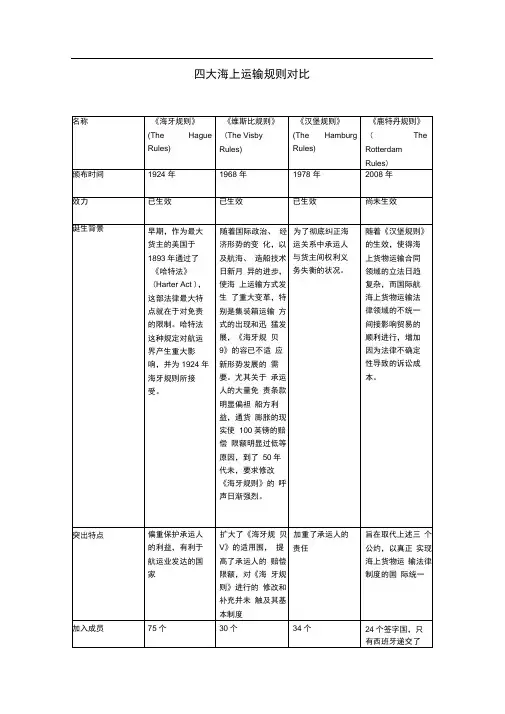
汉堡规则(中英文对照)
- 格式:doc
- 大小:150.50 KB
- 文档页数:67
United Nations Convention on the
Carriage of Goods by Sea
("Hamburg Rules")
(Hamburg, 31 March 1978)
PREAMBLE
THE STATES PARTIES TO THIS CONVENTION,
HAVING RECOGNIZED the desirability of determining by
agreement certain rules relating to the carriage of goods by sea,
HAVING DECIDED to conclude a convention for this purpose and
have thereto agreed as follows:
PART I. GENERAL PROVISIONS
Article 1. Definitions
In this Convention:
1. "Carrier" means any person by whom or in whose name a
contract of carriage of goods by sea has been concluded with a
shipper. 2. "Actual carrier" means any person to whom the performance of
the carriage of the goods, or of part of the carriage, has been
entrusted by the carrier, and includes any other person to whom
such performance has been entrusted.
3. "Shipper" means any person by whom or in whose name or on
whose behalf a contract of carriage of goods by sea has been
concluded with a carrier, or any person by whom or in whose name
or on whose behalf the goods are actually delivered to the carrier
in relation to the contract of carriage by sea.
4. "Consignee" means the person entitled to take delivery of the
goods.
5. "Goods" includes live animals; where the goods are consolidated
in a container, pallet or similar article of transport or where they
are packed, goods includes such article of transport or packaging
if supplied by the shipper.
6. "Contract of carriage by sea" means any contract whereby the
carrier undertakes against payment of freight to carry goods by
sea from one port to another; however, a contract which involves
carriage by sea and also carriage by some other means is deemed to be a contract of carriage by sea for the purposes of this
Convention only in so far as it relates to the carriage by sea.
7. "Bill of lading" means a document which evidences a contract of
carriage by sea and the taking over or loading of the goods by the
carrier, and by which the carrier undertakes to deliver the goods
against surrender of the document. A provision in the document
that the goods are to be delivered to the order of a named person,
or to order, or to bearer, constitutes such an undertaking.
8. "Writing" includes, inter alia, telegram and telex.
Article 2. Scope of application
1. The provisions of this Convention are applicable to all contracts
of carriage by sea between two different States, if:
(a) the port of loading as provided for in the contract of carriage
by sea is located in a Contracting State, or
(b) the port of discharge as provided for in the contract of carriage
by sea is located in a Contracting State, or
(c) one of the optional ports of discharge provided for in the
contract of carriage by sea is the actual port of discharge and such
port is located in a Contracting State, or (d) the bill of lading or other document evidencing the contract of
carriage by sea is issued in a Contracting State, or
(e) the bill of lading or other document evidencing the contract of
carriage by sea provides that the provisions of this Convention or
the legislation of any State giving effect to them are to govern the
contract.
2. The provisions of this Convention are applicable without regard
to the nationality of the ship, the carrier, the actual carrier, the
shipper, the consignee or any other interested person.
3. The provisions of this Convention are not applicable to
charter-parties. However, where a bill of lading is issued pursuant
to a charter-party, the provisions of the Convention apply to such
a bill of lading if it governs the relation between the carrier and
the holder of the bill of lading, not being the charterer.
4. If a contract provides for future carriage of goods in a series of
shipments during an agreed period, the provisions of this
Convention apply to each shipment. However, where a shipment is
made under a charter-party, the provisions of paragraph 3 of this
article apply.
Article 3. Interpretation of the Convention In the interpretation and application of the provisions of this
Convention regard shall be had to its international character and
to the need to promote uniformity.
PART II. LIABILITY OF THE CARRIER
Article 4. Period of responsibility
1. The responsibility of the carrier for the goods under this
Convention covers the period during which the carrier is in charge
of the goods at the port of loading, during the carriage and at the
port of discharge.
2. For the purpose of paragraph 1 of this article, the carrier is
deemed to be in charge of the goods
(a) from the time he has taken over the goods from:
(i) the shipper, or a person acting on his behalf; or