(完整)高中情态动词用法总结,推荐文档
- 格式:doc
- 大小:90.35 KB
- 文档页数:8
1 情态动词的用法
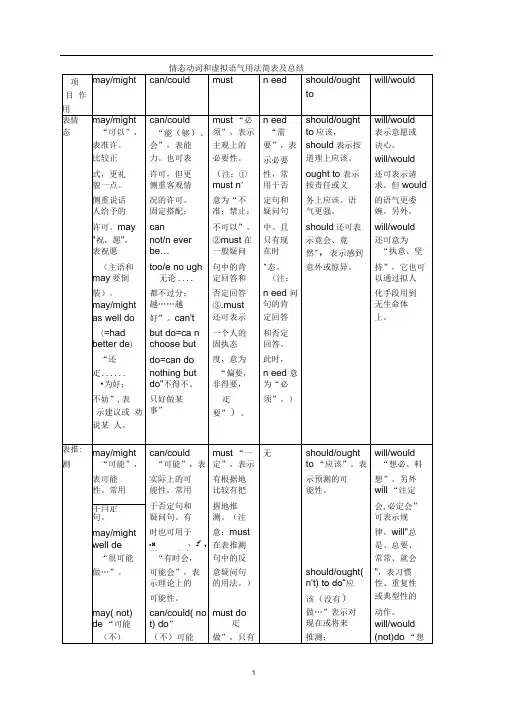
A. can; could; be able to
Can 1. 表示“能力”(此时过去时是could)
2.表示许可、请求,“可以”。--Can/Could I go now?
3 表示推测, 把握很大,could也可表推测,把握比can小。
--Look! Someone is coming! Who can it be?
--It can’t be him. He has gone to Paris.(不可能)/ He could be here soon. 他很快就来。
4 表示感情(惊异/不耐烦)“究竟,到底”(主要用于否定句,疑问句和感叹句中。)
How can you be so foolish?
What can it possibly be? 到底那是怎么一回事?
They can’t be working at this time of day.
5 肯定句中客观存在的可能性。“有时会,偶尔”
It can be quite windy there, especially in spring.
Could 1.表示能力, can 的过去式,过去能够
Could you speak English then? 那时候你会说英语吗?
2. 请求允许(委婉语气)(问句的答语不用could,而用can,)
Could [Can] I use your pen? ” “Yes, of course you can.”/ No, I’m afraid not.
3. 表示推测可能性(肯,否,疑)
We could go there this summer. 今年夏天我们可能要去那儿。(将来可能性)
You could be right, but I don’t think you are. 你可能是对的,但我并不认为你是对的。
4. could have done ①对过去推测,可能已经。。。②本来能够却没做,差点就
He can’t [couldn’t] have seen her there. 他不可能在那儿见到她。
He could have gone home. 他可能已回家了
He could have told her, but he didn’t choose to. 他本来可以告诉她的,但他却没有。
B. may 和 might
1.表示允许﹑许可,might提问更委婉。
---May/Might I watch TV after supper?
---Yes, you may./ Yes, please./ Certainly.
---No, you mustn't. / No, you may not. / No, you can’t./No, you’d better not.
2. 表示推测,有“或许”、“可能”的意思。might把握更小。疑问句用can/ could.
• He may/might be right./ I hear there may be a few copies left.
• He may/might come today (tomorrow).
3. may表示祝愿,倒装。May +主语+动词原形。May you succeed!/May you all be happy.
☆may [might] as well…意为“不妨”、“还是…为好”等,用 might 比用 may 语气更委婉。如: I’m ready,so I might as well go now.我已准备好,因此不妨现在就走。
There’s nothing to do, so I may [might] as well go to bed.
☆may well... 完全可能
C. must, have to
Must 1. 表示“必须”。否定式mustn’t表示“不可以”、“不准”、“禁止”等。
Everybody must obey the rules../You mustn’t lend it to others./You mustn’t speak like that
to your mother.
☆在回答有“must” 的询问时,--- Must I go now? --- Yes, you must.
---No, you needn’t. / No, you don’t have to. 2 2. must表示推测(“一定”、“必定”),表肯定的推测, 其否定的推测用can’t,表示“不可能” 。
You must be hungry after the long walk. / It can't be Jim, for he has gone to Beijing.
The Chinese language must have the large number of speakers.
3.must 表示说话人不耐烦的态度,“干嘛偏要”
☆ must + have + done,表示对过去事物的肯定推测。 “一定做过...”
He must have told my parents about it. 他一定把这件事情告诉我父母亲了。
☆ must表示推测时,其反意疑问句应根据动词的实际时态而变化。如:
▪ It must be nice to take a walk here, isn’t it?
▪ Tom buys a lot of apples ,he must like eating them, doesn't he?
Must have done 的反意疑问句有三种情况:
①从句中含有过去的时间状语,反意疑问句用过去时.
▪ The ground is wet , it must have rained last night, didn’t it?
②从句中含有过去完成时的时间状语,反意疑问句用过去完成时.
▪ By the end of last term, we must have learnt 2000 words, hadn’t we?
③若从句中不含任何时间状语,反意疑问句用现在完成时
▪ We must have been met somewhere (before), haven’t we?
☆must 表示“必须” “有必要”时,反义疑问句部分用mustn’t...? 或 needn’t ...?
You must go home right now, needn’t you?
☆must 用否定形式 mustn’t时,附加疑问句部分用may或must…?
You mustn’t cheat in the examination, must you?
3. 表示与说话人愿望相反及不耐烦.意为“偏要”.
-____you make so much noise?
-Sorry, I will take care not to. A Must B Can C May D Would
4. must 和 have to 的区别:
D. ought to/ should/ shall
Ought to ought to用于反映客观情况或涉及义务和规定时,常译作“应该”、“应当”(和should差不多, 只是语气较强),有时表示非常可能的事情。
• There ought not to be much noise in a hospital.
• --- Ought he to go? --- Yes, he ought to.
• If she is completely well, she ought to be back at school today.
ought to have done指过去动作,表示一件事情该做而未做。
ought not to have done 表示一件不该做的事情却做了。
should 1.用于表示劝告和建议,“应该”.表示自己的主观看法,语气比ought to弱。
☆ should + have done 指过去动作,表示一件事情该做而未做。
should not + have done 表示一件不该做的事情却做了。
--- Who did it sound like? Anybody you know?
--- Well, perhaps Jeff. I should have asked who was calling before he hung it up.
2.表推测,“按道理,按常理应该”
They should have arrived by two o’ clock.
3.表示惊讶,赞叹,不满,责备 “竟然”
I am sorry that you should do such a thing.
4. 用于if引导的虚拟条件句中,表示一件事听起来可能性小,但也不是完全不可能。有“万一”的意思
Should I be free tomorrow, I’ll come. 3 Ask Tom to ring me up if you should see him.
shall
1. shall 作为情态动词,用于第二、第三人称,陈述句,表示说话人的意愿,有“命令”、“警告”、“威胁”、“强制”、“允诺”等意思。“必须,应,可以”.
• You shall do as I say. (命令)
• Tell him that he shall have the book tomorrow. (允诺)
• You shall be punished if you break the law. (表警告)
2. 用于第一、第三人称, 在疑问句中,shall 用来征询对方意见。“……好吗?”“要不要……?”
Where shall I wait for you?/ Shall he come at once?/ Shall we start the meeting now?
3.在条约﹑规定﹑法令等文件中表示义务或规定,用于第三人称
The new regulation shall take effect on June 1st.
E. will 和 would
1) 表示“意志”、”决心” 、“意愿”,可用于多种人称。will 指现在,would 指过去。
• I will tell you all about it./ He won’t go.
(2) 表示询问对方的意愿或向对方提出请求,在疑问句中用语第二人称时,委婉语气would.
• I’m going to go shopping after school. Will you go with me?
• Will/would you please give him a message when you see him?