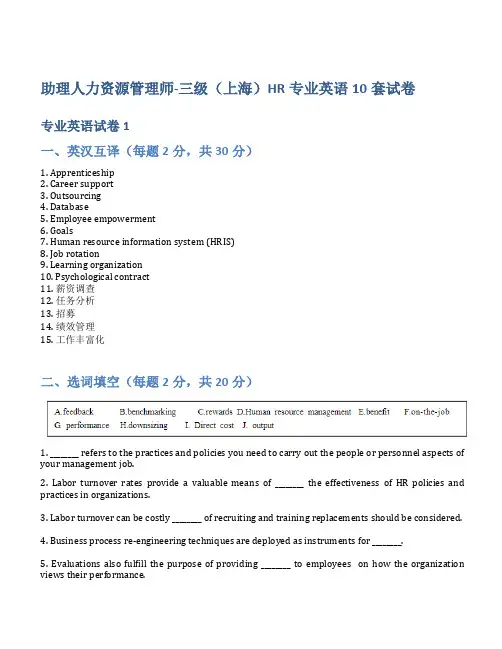
助理人力资源管理师-三级(上海)HR专业英语10套试卷专业英语试卷1一、英汉互译(每题2分,共30分)1. Apprenticeship2. Career support3. Outsourcing4. Database5. Employee empowerment6. Goals7. Human resource information system (HRIS)8. Job rotation9. Learning organization10. Psychological contract11. 薪资调查12. 任务分析13. 招募14. 绩效管理15. 工作丰富化二、选词填空(每题2分,共20分)1. ________ refers to the practices and policies you need to carry out the people or personnel aspects of your management job.2. Labor turnover rates provide a valuable means of ________ the effectiveness of HR policies and practices in organizations.3. Labor turnover can be costly ________ of recruiting and training replacements should be considered.4. Business process re-engineering techniques are deployed as instruments for ________.5. Evaluations also fulfill the purpose of providing ________ to employees on how the organization views their performance.6. The ________ of the job analysis should be a training or learning specification.7. Coaching is a personal ________ technique designed to develop individual skills, knowledge, and attitudes.8. Extrinsic ________ include direct compensation, indirect compensation, and nonfinancial rewards.9. Flexible benefits allow employees to pick and choose from among a menu of ________ options.10. China’s economic reformers have used material incentives in order to stimulate ________.三、单项选择(每题2分,共20分)1. The process of helping redundant employees to find other work or start new careers is________.A. replacementB. outplacementC. releaseD. downsizing2. ________ focus the evaluator’s attention on those behaviors that are key in making the difference between executing a job effectively or ineffectively.A. The group order rankingB. Written essayC. The individual rankingD. Critical incidents3. The ________ plan should include plans for attracting good candidates by ensuring that the organization will become an ‘employer of choice’.A. outplacementB. evaluationC. recruitmentD. training4. Organizational ________ and corporate plans indicate the direction in which the organization is going.A. goalsB. resourceC. resultD. process5. ________ aims to broaden experience by moving people from job to job or department to department.A. Job analysisB. Job rotationC. Job satisfactionD. Job involvement6. HR planning is ________.A. a technique that identifies the critical aspects of a jobB. the process of determining the human resources required by the organization to achieve its strategic goalsC. the process of setting major organizational objectives and developing comprehensive plans to achieve these objectivesD. the process of determining the primary direction of the firm7. Career development programs benefit organizations in all of the following ways except ________.A. Giving managers more control over their subordinatesB. Giving managers increased skill in managing their own careersC. Providing greater retention of valued employeesD. Giving an increased understanding of the organization8. The area from which employers obtain certain types of workers is known as the________.A. labor marketB. regionC. recruiting areaD. supply region9. A set of standards of acceptable conduct and moral judgment is known as ________.A. moralesB. ethicsC. rulesD. legislation10. Hiring someone outside the company to perform tasks that could be done internally is known as ________.A. outplacementB. contractingC. outsourcingD. employee leasing四、阅读理解(每题3分,共30分)(一)The context for obtaining the people required will be the labor markets in which the organization is operating which are:The internal labor market - the stocks and flows of people within the organization who can be promoted, trained, or re-deployed to meet future needs.The external labor marker- the external local, regional, national and international markets from which different sorts of people can be recruited. There are usually a number of markets, and the labor supply in these markets may vary considerably. Likely shortages will need to be identified so that steps can be taken to deal with them, for example by developing a more attractive ‘employment proposition’.As part of the human resource planning proce ss, an organization may have to formulate ‘make or buy’ policy decisions. A ‘make’ policy means that organization prefers to recruit people at a junior level or as trainee, and rely mainly on promotion from within and training programs to meet future needs. A ‘buy’ policy means that more reliance will be placed on recruiting from outside- ‘bringing fresh blood into the organization’. In practice, organizations tend to mix the two choices together to varying degrees, depending on the situation of the firm and the type of people involves. A highly entrepreneurial company operating in the turbulent conditions, or one which has just started up, will probably rely almost entirely on external recruitment. When dealing with knowledge workers, there may be little choice—they tend to be much more mobile, and resourcing strategy may have to recognize that external recruitment will be the main source of supply. Management consultancies typically fall into this category. Firms which can predict people requirements fairly and accurately may rely more on developing their own staff once they have been recruited.1. A ‘make’ policy means that organization prefers to promote people from ________.A. regional labor marketB. national labor marketC. internal labor marketD. international labor market2. According to the passge, management consultancies ________.A. are less mobile than people at a junior levelB. should be recruited from external labor marketC. should be promoted from within the organizationD. are not knowledge workers3. If a firm can predict people requirements fairly accurately, it may not________.A. develop their own staffB. formulate training programsC. promote people from within the organizationD. rely more on recruiting from outside4. ‘Make or buy’ policy decision is a part of________.A. human resource planningB. training and developmentC. performance appraisalD. job analysis5.The best title of this passage is________.A. The organizational context of human resource planningB. Aims of human resource planningC. The labor market context for human resource planningD. Limitations of human resource planning(二)Wlaters (1983) identifies nine sources of information which help to identify training priorities. These are:Organizational goals and corporate plans which indicate the direction in which the organization is going and, therefore, major training priorities.Human resource and succession planning which provides information on future skill requirements and managem Personnel statistics on, for example, labor turnover, which highlight HR issues which might be addressed by training.ent training needs.Exit interviews which might suggest deficiencies in training arrangements.Consultation with senior managers which obtains opinions on training needs from key decision makers.Data on productivity, quality and performance which show where there are any gaps between expectations and results or negative trends, and therefore suggest training needs.Departmental layout changes which provide information about future developments and related training needs.Management requests for training which set out perceived needs.Knowledge of financial plans which determine whether the funds will be available for training, and may encourage fresh approaches if resources are limited.Two other sources not directly mentioned by Walters are plans for introducing new technology or developing IT systems, and marketing plans which indicate where new skills are required to market new products or services, use different selling techniques or operate in new territories.1.According to Wlaters, ________is (are) major training priorities.A. human resource and succession planningB. personnel statisticsC. exit interviewsD. organizational goals and corporate plans2. Human resource and succession planning provides information on________.A. the direction in which the organization is goingB. future skill requirements and management training needsC. deficiencies in training arrangementsD. any gaps between expectations and results or negative trends3. The following sources of information which help to identify training priorities are mentioned by Wlaters except________.A. marketing plansB. departmental layout changesC. data on productivity, quality and performanceD. consultation with senior managers4.According to the passage, the following statements are true except ________.A. Departmental layout changes provide information about future developments and related training needs.B. Exit interviews highlight HR issues which might be addressed by training.C. Data on productivity, quality and performance show where there are any gaps between expectations and results or negative trends.D. Marketing plans indicate where new skills are required to market new products or services.5.The main topic about this passage is illustrating ________.A. sources of information which provide information on management training needsB. sources of information of major training prioritiesC. sources of information which help to identify training prioritiesD. sources of information which provide information about future developments and related training needs.专业英语试卷2一、英汉互译(每题2分,共30分)1. Centralization2. Assessment center3. Cultural shock4. Expatriate5. Hourly work6. Internship programs7. Job involvement8. Management by objectives(MBO)9. Pay-policy line10. Self-appraisal11. 360度反馈12. 甄选13. 绩效评价14. 工作规15. 间接成本二、选词填空(每题2分,共20分)1. International human resource management includes ________ qualified personnel for overseas assignments.2. Rapid ________ through an extensive staff ranking system is seen in one company as a very important motivational mechanism.3. ________ refers to the tendency of firms to extend their sales or manufacturing to new markets abroad.4. Developing a high-trust organization means creating trust between ________ and employees.5. ________ determines the human resources required by the organization to achieve its strategic goals.6. The ________ provides information on the nature and functions of the job.7. The halo effect or error is the tendency for an evaluator to let the ________ of an individual on one trait influence his or her evaluation of that person on other traits.8. Training is concerned with fitting people to take on extra responsibilities, increasing all-round________.9. A training or a learning specification breaks down the broad duties contained in the ________ into the detailed tasks that must be carried out.10. In case of labor disputes between the employer and laborers, the parties concerned can apply for ________ or arbitration, bring the case to courts, or settle them through consultation.三、单项选择(每题2分,共20分)1. The placement of an employee in another job at a higher level in the organization with an increasein pay and status is known as a ________ .A. job enlargementB. transferC. promotionD. job rotation2. Key jobs have all of the following characteristics except ________.A. they are important to employees and the organizationB. they vary in terms of job requirementsC. they are used in salary surveys for wage determinationD. they are likely to vary in job content over time3. A process that goes beyond TQM programs to a more comprehensive approach to process redesignis known as ________.A. job redesignB. process redesignC. reengineeringD. rightsizing4. The job specification describes job requirements relative to ________.A. skill and physical outputsB. skill and physical demandsC. age and physical demandsD. experience and physical description5. When determining where training emphasis should be placed, an examination of the goals, resources, and environment of the organization is known as ________.A. task analysisB. organization analysisC. resource analysisD. skills analysis6. The job evaluation system in which specific elements of the jobs to be evaluated are compared against similar elements of key jobs within the organization is known as ________.A. the point methodB. job rankingC. the comparison methodD. the Hay profile method7. The final decision to hire an applicant usually belongs to ________.A. the HR recruiterB. the HR managerC. line managementD. co-workers8. Determining what the content of a training program should be, based on a study of the job duties,is known as ________.A. organization analysisB. individual analysisC. job analysisD. task analysis9. Sometimes organizations provide services to terminated employees that help them bridge the gap between their old position and a new job. These services are known as ________.A. downsizing programsB. “headhunting” assistance programsC. outplacement assistanceD. employee assistance programs(EAPs)10. Job ________ form the basis for the administration of applicable employment tests.A. outlinesB. specificationsC. requirementsD. details四、阅读理解(每题3分,共30分)(一)Multiperson comparisons evaluate one individual’s performance against one or more others. It is a relative rather than an absolute measuring device. The three most popular comparisons are group order ranking, individual ranking, and paired comparisons.The group order ranking requires the evaluator to place employees into a particular classification, such as top one-fifth or second one-fifth. This method is often used in recommending students to graduate schools. Evaluators are asked to rank the student in the top five percent, the next five percent, the next fifteen percent, and so forth. But when used by managers to appraise employees, managers deal with all their subordinates. Therefore, if a rater has twenty subordinates, only four can be in the top fifth and, of course, four must also be relegated to the bottom fifth.The individual ranking approach rank orders of employees from best to worst. If the manager is required to appraise thirty subordinates, this approach assumes that the difference between the first and second employee is the same as that between the twenty-first and twenty-second. Even though some of the employees may be closely grouped, this approach allows for no ties. The result is a clean ordering of employees, from the highest performer down to the lowest.The paired comparison approach compares each employee with every other employee and rates each as either the superior or the weaker member of the pair. After all paired comparisons are made, each employee is assigned a summary ranking based on the number of superior scores he or she achieved. This approach ensures that each employee is compared against every other, but it can obviously become unwieldy when many employees are being compared.Multiperson comparisons can be combined with one of the other methods to blend the best from both absolute and relative standards. For example, a college might use the graphic rating scale and the individual ranking method to provide more accurate information about its students’ performance. The A, B, C, D, or E. A prospective employer or graduate school could then look at two students who each got a “B” in their different financial accounting courses and draw considerably different conclusions about each where next to one grade it says “ranked fourth out of twen ty-six”, while the other says “ ranked seventeenth out of thirty”. Obviously, the latter instructor gives out a lot more high grades!1. Multiperson comparisons is a(an) ________ measuring device.A. absoluteB. relativeC. accurateD. false2. According to the passage, there are three most popular comparisons except ________.A. group order rankingB. individual rankingC. graphic rating scalesD. paired comparisons3. From this passage, we can infer that ________.A. recommending students to graduate schools often uses individual rankingB. the paired comparison approach assumes that the difference between the first and second employee is sameC. group order ranking ensures that each employee is compared against every otherD. each method of multiperson comparisons can be used simultaneously4. The following statements about individual ranking are false except ________.A. it rank orders of employees from from the lowest performer up to the highestB. the result is a clean ordering of employeesC. it assumes that the difference between the first and second employee is differentD. this approach allows for some of the employees who may be closely grouped5.This article might be extracted from the paper about ________.A. performance appraisalB. recruitment and replacementC. training and developmentD. reward systems(二)Our knowledge of motivation tells us that people do what they to satisfy needs. Before they do anything, they look for the payoff or reward. Many of these rewards –salary increases, employee benefits, preferred job assignments – are organizationally controlled.The types of rewards that an organization can allocate are more complex than is generally thought. Obviously, there is direct compensation. But there are also indirect compensation and nonfinancial rewards. Each of these types of rewards can be distributed on an individual, group, or organization wide basis.Intrinsic rewards are those that individuals receive for themselves. They are largely a result of the worker’s satisfaction with his or her job. Techniques like job enrichment or any efforts to redesign or restructure work to increase personal worth to the employee may make his or her work more intrinsically rewarding.Extrinsic rewards include direct compensation, indirect compensation, and nonfinancial rewards. Of course, an employee expects some forms of direct compensation: a basic wage or salary, overtime and holiday premium pay, bonuses based on performance, profit sharing, and/or possibly opportunities to purchase stock options. Employees will expect their direct compensation generally to align with their assessment of their contribution to the organization and, additionally, will expect it to be comparable to the direct compensation given to other employees with similar abilities and performance.The organization will provide employees with indirect compensations: insurance, pay for holidays and vacations, services, and perquisites. In as much as these are generally made uniformly available to all employees at a given job level, regardless of performance, they are rally not motivating rewards. However, where indirect compensation is controllable by management and is used to reward performance, then it clearly needs to be considered as a motivating reward.1.Rewards are often considered as a ________function in human resource management.A. planningB. leadingC. motivatingD. controlling2. Extrinsic rewards include the following except ________.A. job enrichmentB. direct compensationC. indirect compensationD. nonfinancial rewards3.According to the passage, the following statements are false except ________.A. Nonfinancial rewards belong to intrinsic rewards.B. Overtime and holiday premium pay belongs to indirect compensation.C. Employees will expect their direct compensation to be comparable to the indirect compensation given to other employees with similar abilities and performance.D. Employees will expect their direct compensation generally to align with their assessment of their contribution to the organization.4.Perquisites which the organization provides employees belong to ________.A. intrinsic rewardsB. direct compensationC. indirect compensationD. nonfinancial rewards5. The author of this passage would most likely agree that ________.A. If indirect compensation is controllable by management, then it can’t be considered as a motivating reward.B. If indirect compensations are made uniformly available to all employees at a given job level, regardless of performance, they will lose their motivating function.C. Techniques like job enrichment or nonfinancial rewards to increase personal worth to the employee may make his or her work more intrinsically rewarding.D. Each type of rewards can be distributed on an individual or group, not organization wide basis.专业英语试卷3一、英汉互译(每题2分,共30分)1. Bonus2. Compensable factors3. Delayering4. Forecasting5. Gain sharing plans6. Job classification system7. Minimum wage8. Performance feedback9. Staffing tables10. Wage-rate compression11. 培训12. 即时奖金13. 工资结构14. 劳动力市场15. 精简二、选词填空(每题2分,共20分)1. For managers, the challenge of fostering intellectual or ________ lies in the fact that such Workers must be managed differently than were those of previous generations.2. In summary, is ________ an integral part of every manager’s job.3. In the area of ________ and hiring, it’s the line manager’s responsibility to specify the qualifications employees need to fill specific positions.4. HR manager also administers the various ________ (health and accident insurance, retirement, vacation, and so on).5. Performance evaluations are used as the basis for ________ allocations.6. Staff managers are authorized to assist and advise line managers in accomplishing these basic ________.7. Determining the nature of each employee’s job is ________.8. Laborers shall fulfill their tasks of labor, improve their professional skills, follow rules on labor safety and sanitation, and observe labor discipline and professional ________.9. Labor ________ are agreements reached between laborers and the employer to establish labor relationships and specify the rights, interests and obligations of each party.10. In a public employment ________ ,which served workers seeking employment and employers seeking workers, employment interviewers were appraised by the number of interviews they conducted.三、单项选择(每题2分,共20分)1. The tendency for an evaluator to let the assessment of an individual on one trait influence his or her evaluation of that person on other traits is known as ________.A. similarity errorB. halo effect or errorC. leniency errorD. single criterion2. The performance evaluation approach which compares each employee with every other employee and rates each as either the superior or the weaker member of the pair is known as ________.A. the paired comparisonB. the individual rankingC. the group order rankingD. critical incidents3. Determining whether or not task performance is acceptable and studying the characteristics of individuals and groups that will be placed in the training environment are known as ________.A. person analysisB. demographic analysisC. individual analysisD. group and individual analysis4. The lines of advancement for an individual within an organization are known as ________.A. career pathsB. job progressionsC. career linesD. job paths5. Freedom from criterion deficiency of performance appraisals refers to the extent to which ________.A. standards relate to the overall objectives of the organizationB. standards capture the entire range of an employee’s responsibilitiesC. individuals tend to maintain a certain level of performance over timeD. factors outside the employee’s control can influence performance6. The Hay profile method uses which three factors for evaluating jobs? ________.A. knowledge, skill, and responsibilityB. mental ability, skill, and responsibilityC. knowledge, mental ability, and responsibilityD. knowledge, mental ability, and accountability7. Which of the following is not an important component of a meaningful gain sharing plan? ________.A. establishing fair and precise measurement standardsB. ensuring that bonus payout formulas are easy to calculateC. ensuring that bonus payouts are large enough to encourage future employee effortD. depending on top management to develop the gain sharing program8. Giving employees more control over decisions about who their co-workers will be is known as ________.A. empowered selectionB. collaborationC. team selectionD. group development9. Which of the following is a technique used to elicit employee views in order to make decisions and initiate change? ________.A. suggestion systemB. downward communicationC. attitude surveyD. empowerment10. Assessing the degree to which what employees learned during the training program is translated into enhanced employee performance is known as ________.A. results evaluationB. reaction evaluationC. behavior evaluationD. learning evaluation四、阅读理解(每题3分,共30分)(一)A training or a learning specification is a product of job analysis. It breaks down the broad duties contained in the job description into the detailed tasks that must be carried out. It then sets out the characteristics or attributes that the individual should have in order to perform these tasks successfully. These characteristics are:knowledge–what the individual needs to know. It may be professional, technical or commercial knowledge. Or it may be about the commercial, economic, or market environment; the machines to be operated; the materials or equipment to be used or the procedures to be followed; or the customers, clients, colleagues and subordinates he or she is in contact with and the factors that affect their behavior. Or it may refer to the problems that occur and how they should be dealt with.skills– what the individual needs to be able to do if results are to be achieved and knowledge is to be used effectively. Skills are built progressively by repeated training or other experience. They may be manual, intellectual or mental, perceptual or social.Competences–the behaviors’ competences needed to achieve the levels of performance required. attitudes–the disposition to behave or to perform in a way that is in accordance with the requirements of the work.performance standards– what the fully competent individual has to be able to achieve.1. A training or a learning specification is a product of ________.A. job structureB. job evaluationC. job designD. job analysis2. According to this passage, which of the following isn’t the characteristic or attribute that the individual should have in order to perform the task successfully? ________A. knowledgeB. mental abilityC. competencesD. attitudes3. According to this passage, the knowledge that the individual should have in order to perform the task successfully may include the following except ________A. professional, technical or commercial knowledgeB. knowledge about the commercial, economic, or market environmentC. knowledge about the job descriptionD. the problems that occur and how they should be dealt with4. From this passage, we can infer that ________.A. In order to perform tasks successfully, individuals need know more than their professional knowledge.B. In order to perform tasks successfully, skills that the individual should have are built only by repeated training.C. In order to perform tasks successfully, the disposition to behave or to perform in a way needn’t be in accordance with the requirements of the work.D. In order to perform tasks successfully, performance standards should be based on what the average individual has to be able to achieve.5. The best title of this passage is ________.A. job analysisB. training or learning specificationC. job descriptionD. performance standards(二)Supply forecasting measures the number of people likely to be available from within and outside the organization, having allowed for attrition , absenteeism, internal movements and promotions, and changes in hours and other conditions of work.The forecast will be based on:An analysis of existing human resources in terms of numbers in each occupation, skills and potentials; Forecast losses to existing resources through attrition (the analysis of labor wastage is an important aspect of human resource planning, because it provides the basis for plans to improve retention rates);Forecast changes to existing resources through internal promotions;The effect of changing conditions of work and absenteeism;Sources of supply from within the organization;Sources of supply from outside the organization in the national and local labor markets. Mathematical modeling techniques aided by computers can help in the preparation of supply forecasts in situations where comprehensive and reliable data on stocks and flows be provided. As this is rarely the case, they are seldom used.The demand and supply forecasts can then be analyzed to determine whether there are any deficits or surplus. This provides the basis for recruitment, retention and, if unavoidable, downsizing plans. Computerized planning models can be used for this purpose. It is, however, not essential to rely on a software planning package. The basic forecasting calculations can be carried out with a spreadsheet which, for each occupation where plans need to be made, sets out and calculates the number required as in the following example:1. Number currently employed 702. Annual wastage rate based on past records 10%3. Expected losses during the year 74. Balance at end-year 635. Number required at end-year 756. Number to be obtained during year (=5-4) 8。