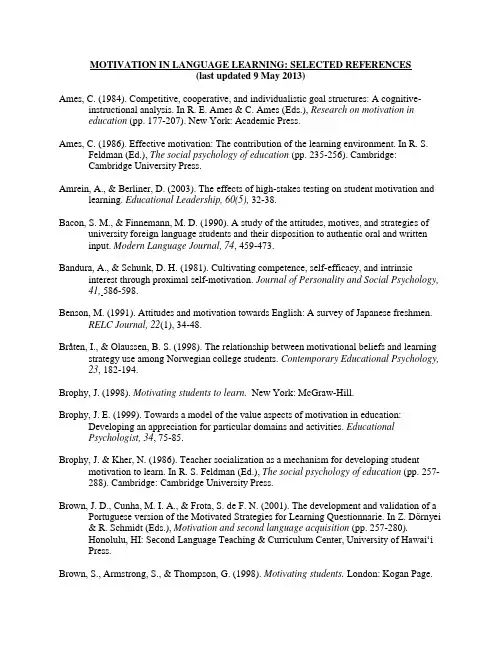
MOTIVATION IN LANGUAGE LEARNING: SELECTED REFERENCES(last updated 9 May 2013)Ames, C. (1984). Competitive, cooperative, and individualistic goal structures: A cognitive-instructional analysis. In R. E. Ames & C. Ames (Eds.), Research on motivation ineducation (pp. 177-207). New York: Academic Press.Ames, C. (1986). Effective motivation: The contribution of the learning environment. In R. S.Feldman (Ed.), The social psychology of education (pp. 235-256). Cambridge:Cambridge University Press.Amrein, A., & Berliner, D. (2003). The effects of high-stakes testing on student motivation and learning. Educational Leadership, 60(5), 32-38.Bacon, S. M., & Finnemann, M. D. (1990). A study of the attitudes, motives, and strategies of university foreign language students and their disposition to authentic oral and writteninput. Modern Language Journal, 74, 459-473.Bandura, A., & Schunk, D. H. (1981). Cultivating competence, self-efficacy, and intrinsic interest through proximal self-motivation. Journal of Personality and Social Psychology, 41, 586-598.Benson, M. (1991). Attitudes and motivation towards English: A survey of Japanese freshmen.RELC Journal, 22(1), 34-48.Bråten, I., & Olaussen, B. S. (1998). The relationship between motivational beliefs and learning strategy use among Norwegian college students. Contemporary Educational Psychology, 23, 182-194.Brophy, J. (1998). Motivating students to learn. New York: McGraw-Hill.Brophy, J. E. (1999). Towards a model of the value aspects of motivation in education: Developing an appreciation for particular domains and activities. EducationalPsychologist, 34, 75-85.Brophy, J. & Kher, N. (1986). Teacher socialization as a mechanism for developing student motivation to learn. In R. S. Feldman (Ed.), The social psychology of education (pp. 257-288). Cambridge: Cambridge University Press.Brown, J. D., Cunha, M. I. A., & Frota, S. de F. N. (2001). The development and validation of a Portuguese version of the Motivated Strategies for Learning Questionnarie. In Z. Dörnyei & R. Schmidt (Eds.), Motivation and second language acquisition (pp. 257-280).Honolulu, HI: Second Language Teaching & Curriculum Center, University of Hawai‘i Press.Brown, S., Armstrong, S., & Thompson, G. (1998). Motivating students. London: Kogan Page.Chambers, G. (1999). Motivating language learners. Clevedon, UK: Multilingual Matters. Cheng, H-F., & Dörnyei, Z. (2007). The use of motivational strategies in language instruction: The case of EFL teaching in Taiwan. Innovation in language learning and teaching, 1,153-174.Cohen, M., & Dörnyei, Z. (2002). Focus on the language learner: Motivation, styles and strategies. In N. Schmidt (Ed.), An introduction to applied linguistics (pp. 170-190).London, UK: Arnold.Cooper, H., & Tom, D. Y. H. 1984. SES and ethnic differences in achievement motivation. In R.E. Ames & C. Ames (Eds.), Motivation in education (pp. 209-242). New York:Academic Press.Cranmer, D. (1996). Motivating high level learners. Harlow, UK: Longman.Crookes, G., & Schmidt, R. W. (1991). Motivation: Re-opening the research agenda. Language Learning, 41, 469-512.Csikszentmihalyi, M., & Nakamura, J. (1989). The dynamics of intrinsic motivation: A study of adolescents. In R. Ames & C. Ames (Eds.), Handbook of motivation theory and research, Vol. 3: Goals and cognitions (pp. 45–71). New York, NY: Academic Press.Csizér, K., & Dörnyei, Z. (2005). Language learners’ motivational profiles and their motivated learning behavior. Language Learning, 55, 613-659.Csizér, K., Kormos, J., & Sarkadi, Á. (2010). The dynamics of language learning attitudes and motivation: Lessons from an interview study of dyslexic language learners. ModernLanguage Journal, 94(3), 470-487.deCharms, R. (1984). Motivation enhancement in educational settings. In R. E. Ames & C.Ames (Eds.), Motivation in education (pp. 275-310). New York: Academic Press. Deci, E. L., & Ryan, R. M. (1985). Intrinsic motivation and self-determination in human behavior. New York, NY: Plenum.Deci, E. L., & Ryan, R. M. (1991). A motivational approach to self: Integration in personality. In R. A. Dienstbier (Ed.), Perspectives on motivation: Nebraska Symposium on Motivation, 1990 (pp. 237-288). Lincoln, NE: University of Nebraska Press.Deci, E. L., Vallerand, R. J., Pelletier, L. G., & Ryan, R. M. (1991). Motivation and education: The self-determination perspective. Educational Psychologist, 26(3 & 4), 325-346.De Volder, M. L., & Lens, W. (1982). Academic achievement and future time perspective as a cognitive-motivational concept. Journal of Personality and Social Psychology, 44, 20-33Dörnyei, Z. (1990). Conceptualizing motivation in foreign language learning. Language Learning, 40, 45-78.Dörnyei, Z. (1994). Motivation and motivating in the foreign language classroom. Modern Language Journal,78, 273-284.Dörnyei, Z. (1998). Motivation in second and foreign language learning. Language Teaching, 31, 117-135.Dörnyei, Z. (2001). Motivational strategies in the language classroom. Cambridge, UK: Cambridge University Press.Dörnyei, Z. (2001). Teaching and researching motivation. Harlow, UK: Longman.Dörnyei, Z. (2002). The motivational basis of language learning tasks. In P. Robinson (Ed.), Individual differences and instructed language learning (pp. 137-158). Philadelphia, PA: John Benjamins.Dörnyei, Z. (2003). Attitudes, orientations, and motivations in language learning: Advances in theory, research, and applications. Language Learning, 53(Supplement 1), 3-32.Dörnyei, Z. (2007). Creating a motivating classroom environment. In J. Cummins & C. Davison (Eds.), International Handbook of English Language Teaching (Vol. 2) (pp. 719-731).New York, NY: Springer.Dörnyei, Z. (2008). New ways of motivating foreign language learners: Generating vision. Links, 38(Winter), 3-4.Dörnyei, Z. (2009). The L2 motivational self system. In Z. Dörnyei & E. Ushioda (Eds.), Motivation, language identity and the L2 self (pp. 9-42).Tonawanda, NY: MultilingualMatters.Dörnyei, Z., & Csizér, K. (1998). Ten commandments for motivating language learners: Results of an empirical study. Language Teaching Research, 2, 203-229.Dörnyei, Z., & Csizér, K. (2002). Some dynamics of language attitudes and motivation: Results of a longitudinal nationwide survey. Applied Linguistics, 23, 421-462.Dörnyei, Z., & K. Csizér. (2002). Some dynamics of language attitudes and motivation: Results of a longitudinal nationwide survey. Applied Linguistics, 23, 421–462.Dörnyei, Z., Csizér, K., & Németh, N. (2006). Motivation, language attitudes, and globalization:A Hungarian perspective. Clevedon, UK: Multilingual Matters.Dörnyei, Z., & Ottó, I. (1998). Motivation in action: A process model of L2 motivation. Working Papers in Applied Linguistics, 4, 43-69.Dörnyei, Z., & Schmidt, R. (Eds.). (2001). Motivation and second language acquisition.Honolulu: National Foreign Language Resource Center/ University of Hawai'i Press.Dörnyei, Z., & Skehan, P. (2003). Individual differences in second language learning. In C. J.Doughty & M. H. Long (Eds.), The handbook of second language acquisition (pp. 589-630). Malden, MA: Blackwell.Dweck, C. S. (1986). Motivational processes affecting learning. American Psychologist, 41, 1040-1048.Ehrman, M. (1996). An exploration of adult language learner motivation, self-efficacy, and anxiety. In R. Oxford (Ed.), Language learning motivation: Pathways to the new century (pp. 81-103). Honolulu, HI: University of Hawai’i Press.Gao, Y., Zhao, Y., Cheng, Y., & Zhou, Y. (2004). Motivation types of Chinese university undergraduates. Asian Journal of English Language Teaching, 14, 45-64.Gardner, R. (1985). Social psychology and second language learning: The role of attitude and motivation. London, UK: Edward Arnold.Gardner, R. (2001). Integrative motivation and second language acquisition. In Z. Dörnyei & R.Schmidt (Eds.), Motivation and language acquisition (pp. 1-19). Honolulu, HI:University of Hawai’i Press.Gardner, R. C. (2000). Correlation, causation, motivation, and second language acquisition.Canadian Psychology, 41, 10-24.Gardner, R. C. (2001). Integrative motivation: Past, present and future. Retrieved from ://publish.uwo.ca/~gardner/docs/GardnerPublicLecture1.pdfGardner, R. (2001). Integrative motivation and second language acquisition. In Z. Dörnyei & R.Schmidt (Eds.), Motivation and language acquisition (pp. 1-19). Honolulu: University of Hawai’i Press.Gardner, R. C. (2005). Integrative motivation and second language acquisition. Retrieved from ://publish.uwo.ca/~gardner/docs/caaltalk5final.pdfGardner, R. C. (2009). Gardner and Lambert (1959): Fifty years and counting. Retrieved from ://publish.uwo.ca/~gardner/docs/CAALOttawa2009talkc.pdfGardner, R. C., & Lambert, W. E. (1959). Motivational variables in second language acquisition.Canadian Journal of Psychology, 13, 266-272.Gardner, R. C., & Lambert, W. E. (1972). Attitudes and motivation in second language learning. Rowley, MA: Newbury House.Gardner, R. C., Masgoret, A.-M., Tennant, J., & Mihic, L. (2004). Integrative motivation: Changes during a year-long intermediate-level language course. Language Learning, 54, 1-34.Gardner, R. C., & Smythe, P. C. (1981). On the development of the attitude/ motivation test battery. The Canadian Modern Language Review, 37, 510-525.Gardner, R. C., & Tremblay, P. F. (1994). On motivation, research agendas, and theoretical frameworks. The Modern Language Journal, 78, 359-368.Grabe, W. (2009). Motivation and reading. In W. Grabe (Ed.), Reading in a second language: Moving from theory to practice (pp. 175-193). New York, NY: Cambridge UniversityPress.Graham, S. (1994). Classroom motivation from an attitudinal perspective. In H. F. J. O'Neil and M. Drillings (Eds.), Motivation: Theory and research (pp. 31-48). Hillsdale, NJ:Lawrence Erlbaum.Guilloteaux, M. J., & Dörnyei, Z. (2008). Motivating language learners: A classroom-oriented investigation of the effects of motivational strategies on student motivation. TESOLQuarterly, 42, 55-77.Hadfield, J. (2013). A second self: Translating motivation theory into practice. In T. Pattison (Ed.), IATEFL 2012: Glasgow Conference Selections (pp. 44-47). Canterbury, UK:IATEFL.Hao, M., Liu, M., & Hao, R. (2004). An empirical study on anxiety and motivation in English asa Foreign Language. Asian Journal of English Language Teaching, 14, 89-104.Hara, C., & Sarver, W. T. (2010). Magic in ESL: An observation of student motivation in an ESL class. In G. Park, H. P. Widodo, & A. Cirocki (Eds.), Observation of teaching:Bridging theory and practice through research on teaching (pp. 141-153). Munich,Germany: LINCOM EUROPA.Hashimoto, Y. (2002). Motivation and willingness to communicate as predictors of reported L2 use: The Japanese ESL context. Retrieved from :///sls/uhwpesl/20(2)/Hashimoto.pdf.Hawkins, J. N. (1994). Issues of motivation in Asian education. In H. F. O’Neill & M. Drillings (Eds.), Motivation—theory and research (pp. 101-115). Hillsdale, NJ: Erlbaum. Hsieh, P. (2008). Why are college foreign language students' self-efficacy, attitude, and motivation so different? International Education, 38(1), 76-94.Huang, S. (2010). Convergent vs. divergent assessment: Impact on college EFL students’ motivation and self-regulated learning strategies. Language Testing, 28(2), 251-270.Keller, J. M. (1983). Motivational design of instruction. In C. M. Reigeluth (Ed.), Instructional design theories and models (pp. 386-433). Hillsdale, NJ: Erlbaum.Kim, S. (2009). Questioning the stability of foreign language classroom anxiety and motivation across different classroom contexts. Foreign Language Annals, 42(1), 138-157. Komiyama, R. (2009). CAR: A means for motivating students to read. English Teaching Forum, 47(3), 32-37.Kondo-Brown, K. (2001). Bilingual heritage students’ language contact and motivation. In Z.Dörnyei & R. Schmidt (Eds.), Motivation and language acquisition (pp. 433-460).Honolulu, HI: University of Hawai’i Press.Koromilas, K. (2011). Obligation and motivation. Cambridge ESOL Research Notes, 44, 12-20.Lamb, M. (2004). Integrative motivation in a globalizing world. System, 32, 3-19.Lamb, T. (2009). Controlling learning: Learners’ voices and relationships between motivation and learner autonomy. In R. Pemberton, S. Toogood, & A. Barfield (Eds.), Maintaining control: Autonomy and language learning (pp. 67-86). Hong Kong: Hong KongUniversity Press.Lau, K.-l., & Chan, D. W. (2003). Reading strategy use and motivation among Chinese good and poor readers in Hong Kong. Journal of Research in Reading, 26, 177-190.Lepper, M. R. (1983). Extrinsic reward and intrinsic motivation: implications for the classroom.In J. M. Levine & M. C. Wang (eds.), Teacher and student perceptions: implications for learning (pp. 281-317). Hillsdale, NJ; Erlbaum.Li, J. (2009). Motivational force and imagined community in ‘Crazy English.’ In J. Lo Bianco, J.Orton, & Y. Gao (Eds.), China and English: Globalisation and the dilemmas of identity(pp. 211-223). Clevedon, UK: Multilingual Matters.Lopez., F. (2010).Identity and motivation among Hispanic ELLs. Education Policy Analysis Archives, 18(16), 1-29.MacIntyre, P. D. (2002). Motivation, anxiety and emotion in second language acquisition. In P.Robinson (Ed.), Individual differences and instructed language learning (pp. 45-68).Amsterdam, The Netherlands: John Benjamins.MacIntyre, P. D., MacMaster, K., & Baker, S. C. (2001). The convergence of multiple models of motivation for second language learning: Gardner, Pintrich, Kuhl, and McCroskey. In Z.Dörnyei & R. Schmidt (Eds.), Motivation and language acquisition (pp. 461-492).Honolulu, HI: University of Hawai’i Press.Maehr, M. L. & Archer, J. (1987). Motivation and school achievement. In L. G. Katz (ed.), Current topics in early childhood education (pp. 85-107). Norwood, NJ: Ablex.Manderlink, G., & Harackiewicz, J. M. 1984. Proximal versus distal goal setting and intrinsic motivation. Journal of Personality and Social Psychology, 47, 918-928.Markus, H. R., & Kitayama, S. (1991). Culture and self: Implications for cognition, emotion, and motivation. Psychological Review, 98(2), 224-253.Maslow, A. H. (1970). Motivation and personality. New York, NY: Harper & Row.McCombs, B. L. (1984). Processes and skills underlying continued motivation to learn.Educational Psychologist, 19(4), 199-218.McCombs, B. L. (1988). Motivational skills training: combining metacognitive, cognitive, and affective learning strategies. In C. E. Weinstein, E. T. Goetz & P. A. Alexander (Eds.),Learning and study strategies (pp.141-169). New York: Academic Press.McCombs, B. L. (1994). Strategies for assessing and enhancing motivation: keys to promoting self-regulated learning and performance. In H. F. O’Neill & M. Drillings (Eds.),Motivation: theory and research (pp. 49-69). Hillsdale, NJ: Erlbaum.McCombs, B. L., & Whisler, J. S. (1997). The learner-centered classroom and school: Strategies for increasing student motivation and achievement. San Francisco. CA:Jossey-Bass.McCrossan, L. (2011). Progress, motivation and high-level learners. Cambridge ESOL Research Notes, 44, 6-12.Melvin, B. S., & Stout, D. S. (1987). Motivating language learners through authentic materials.In W. Rivers (Ed.), Interactive language teaching (pp. 44–56). New York, NY:Cambridge University Press.Midraj, S., Midraj, J., O’Neil, G., Sellami, A., & El-Temtamy, O. (2007). UAE grade 12 students’ motivation & language learning. In S. Midraj, A. Jendli, & A. Sellami (Eds.), Research in ELT contexts (pp. 47-62). Dubai: TESOL Arabia.Molden, D. C., & Dweck, C. S. (2000). Meaning and motivation. In C. Sansone & J.Harackiewicz (Eds.), Intrinsic and extrinsic motivation: The search for optimalmotivation and performance (pp. 131-159). San Diego, CA: Academic Press.Mori, S. (2002). Redefining motivation to read in a foreign language. Reading in a Foreign Language, 14, 91-110.Noels, K. A., Clément, R., & Pelletier, L. G. (1999). Perceptions of teachers’ communicative style and students’ intrinsic and extrinsic motivation.Modern Language Journal,83, 23-34.Noels, K. A., Pelletier, L. G., Clément, R., & Vallerand, R. J. (2000). Why are you learning a second language?: Motivational orientations and self-determination theory. LanguageLearning, 50, 57-85.Oxford, R. L. (Ed.). (1996). Language learning motivation: pathways to the new century.Hono lulu: Second Language Teaching & Curriculum Center, University of Hawai’i.Oxford, R., & Shearin, J. (1994). Language learning motivation: Expanding the theoretical framework. Modern Language Journal, 78, 12-28.Papadimitriou, A. D. (2011). The impact of an extensive reading programme on vocabulary development and motivation. Cambridge ESOL Research Notes, 44, 39-47.Paris, S. C., & Turner, J. C. (1994). Situated motivation. In P. R. Pintrich, D. R. Brown, & C. E.Weinstein (Eds.), Student motivation, cognition, and learning (pp. 213-237). Hillsdale,NJ: Erlbaum.Peacock, M. (1997). The effect of authentic materials on the motivation of EFL learners. ELT Journal, 51(2), 144-156.Pedraza, P., & Ayala, J. (1996). Motivation as an emergent issue in an after-school program in El Barrio. In L. Schauble & R. Glaser (Eds.), Innovations in learning (pp. 75-91). Mahwah, NJ: Erlbaum.Pintrich, P. R. (1999). The role of motivation in promoting and sustaining self-regulated learning.International Journal of Educational Research, 31(6), 459-470.Pintrich, P. R., & De Groot, E. V. (1990). Motivational and self-regulated learning components of classroom academic performance. Journal of educational psychology, 82(1), 33.Pintrich, P. R., & Schunk, D. H. (1996). Motivation in education: Theory, research and applications. Englewood Cliffs: NJ: Prentice-Hall.Ramage, K. (1991). Motivational factors and persistence in second language learning. Language Learning, 40(2), 189-219.Rueda, R., & Moll, L. (1994). A sociocultural perspective on motivation. In H. F. O’Neill & M.Drillings (Eds.), Motivation: theory and research (pp. 117-137). Hillsdale, NJ: Erlbaum.Ryan, R. M., & Deci, E. L. (2000). Intrinsic and extrinsic motivations: Classic definitions and new directions. Contemporary Educational Psychology,25, 54-67.Ryan, R. M., & Deci, E. L. (2000). Self-determination theory and the facilitation of intrinsic motivation, social development, and well-being. American Psychologist, 55, 68-78. Schmidt, R., Boraie, D., & Kassabgy, O. (1996). Foreign language motivation: Internal structure and external connections. In R. Oxford (Ed.), Language learning motivation:Pathways to the new century (pp. 9-70). Honolulu: Second Language Teaching &Curriculum Center, University of Hawaii Press.Schutz, P. A. (1994). Goals as the transaction point between motivation and cognition. In P. R.Pintrich, D. R. Brown, & C. E. Weinstein (Eds.), Student motivation, cognition, andlearning (pp. 135-156). Hillsdale, NJ: Erlbaum.Scott, K. (2006). Gender differences in motivation to learn French. The Canadian Modern Language Review, 62, 401-422.Syed, Z. (2001). Notions of self in foreign language learning: A qualitative analysis. In Z.Dörnyei & R. Schmidt (Eds.), Motivation and second language acquisition (pp. 127-147).Honolulu, HI: University of Hawaii Press.Schmidt, R., Boraie, D., & Kassabgy, O. (1996). Foreign language motivation: Internal structure and external connections. In R. Oxford (Ed.), Language learning motivation: Pathways to the new century (pp. 9-70). Honolulu, HI: Second Language Teaching & Curriculum Center, University of Hawaii Press.Scott, K. (2006). Gender differences in motivation to learn French. The Canadian Modern Language Review, 62, 401-422.Sisamakis, M. (2010). The motivational potential of the European language portfolio. In B.O’Rourke & L. Carson (Eds.), Language learner autonomy: Policy, curriculum,classroom (pp. 351-371). Oxford, UK: Peter Lang.Smith, K. (2006). Motivating students through assessment. In R. Wilkinson, V. Zegers, & C. van Leeuwen (Eds.), Bridging the assessment gap in English-medium higher education (pp.109-121). Nijmegen, The Netherlands: AKS –Verlag.St. John, J. (2007). Motivation: The teachers’ perspective. In S. Midraj, A. Jendli, & A. Sellami (Eds.), Research in ELT contexts (pp. 63-84). Dubai: TESOL Arabia.Syed, Z. (2001). Notions of self in foreign language learning: a qualitative analysis. In Z.Dörnyei & R. Schmidt, (Eds.), Motivation and second language acquisition (pp. 127-148).Honolulu: National Foreign Language Resource Center/ University of Hawai'iPress.Ushioda, E. (2003). Motivation as a socially mediated process. In D. Little, J. Ridley, & E.Ushioda (Eds.), Learner autonomy in the language classroom (pp. 90-102). Dublin,Ireland: Authentik.Ushioda, E. (2008). Motivation and good language learners. In C. Griffiths (Ed.), Lessons from good language learners (pp. 19-34). Cambridge, UK: Cambridge University Press. Ushioda, E. (2009). A person-in-context relational view of emergent motivation, self and identity.In Z. Dörnyei & E. Ushioda (Eds.), Motivation, language identity and the L2 self (pp.215-228). Tonawanda, NY: Multilingual Matters.Ushioda, E. (2012). Motivation. In A. Burns & J. C. Richards (Eds.), The Cambridge guide to pedagogy and practice in language teahcing (pp. 77-85). Cambridge, UK: CambridgeUniversity Press.Verhoeven, L., & Snow, C. E. (Eds.). (2001). Literacy and motivation: Reading engagement in individuals and groups. Mahwah, NJ: Lawrence Erlbaum.Wachob, P. (2006). Methods and materials for motivation and learner autonomy. Reflections on English Language Teaching, 5(1), 93-122.Walker, C. J., & Quinn, J. W. (1996). Fostering instructional vitality and motivation. In R. J.Menges and associates, Teaching on solid ground (pp. 315-336). San Francisco, SF:Jossey-Bass.Warden, C. A., & Lin, H. J. (2000). Existence of integrative motivation in an Asian EFL setting.Foreign Language Annals, 33, 535-547.Weiner, B. (1984). Principles for a theory of student motivation and their application within an attributional framework. In R. Ames & C. Ames (Eds.), Research on motivation ineducation (pp. 15-38). New York: Academic Press.Weiner, B. (1992). Human motivation: Metaphors, theories and research. Newbury Park, CA: Sage.Weiner, B. (1994). Integrating social and personal theories of achievement motivation. Review of Educational Research, 64, 557-573.Williams, M., Burden, R., & Lanvers, U. (2002). French is the language of love and stuff: Student perceptions of issues related to motivation in learning a foreign language.British Educational Research Journal, 28, 503–528.Wlodkowski, R. J. (1985). Enhancing adult motivation to learn. San Francisco, CA: Jossey-Bass. Wu, X. (2003). Intrinsic motivation and young language learners: The impact of the classroom environment. System, 31, 501-517.Xu, H., & Jiang, X. (2004). Achievement motivation, attributional beliefs, and EFL learning strategy use in China. Asian Journal of English Language Teaching, 14, 65-87.Yung, K. W. H. (2103). Bridging the gap: Motivation in year one EAP classrooms. Hong Kong Journal of Applied Linguistics, 14(2), 83-95.。