一般现在时的构成及用法
- 格式:doc
- 大小:31.50 KB
- 文档页数:2
一般现在时的用法讲解
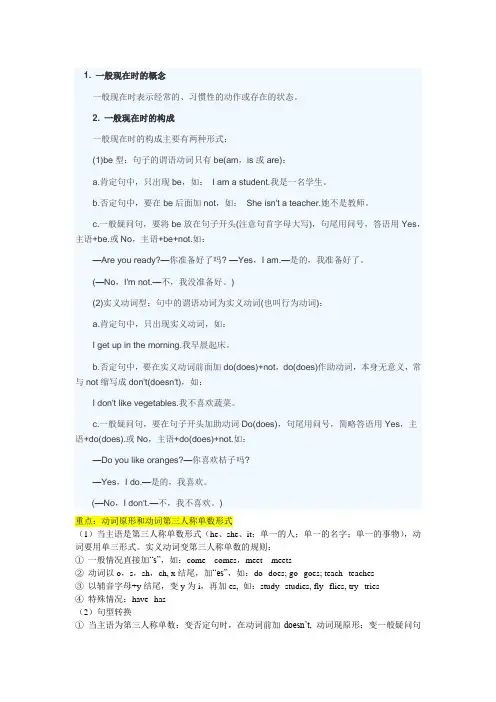
【No. 1】一般现在时的定义:表示现在经常反复发生的动作、存在的状态或习惯性的动作,以及客观存在的普遍真理等 。
1、表示现在的状态。如:My name is Mike. I am ten. I am a student.
2、表示经常或习惯性动作。如:I get up at six every day.(我天天6点起床)
Classes begin at eight.(8点开始上课)
3、表示言语具备的性格和能力等。She likes basketball games.(她喜欢篮球运动)
He speaks English well.(他英语讲得好)
4、表示客观事实和真理。There are seven days in a week.(一周有7天)
The earth goes around the sun.(地球绕着太阳转)
【No. 2】一般现在时的应用
(1)在实际应用中,一般现在时常与以下时间状语联用:always, usually, often, sometimes,
every week (day, year, once a week, on Sundays ……)例句:He usually plays football on
Sundays.(2)没有时间状语,可以分以下四种类型:
A.be型。这一类型由be动词+名词、形容词、副词、代词、数词或介词短语等一起构成谓语,表示主语的个性、特征或状态。如:
①I am a student.(主语+be动词+名词)②They are hungry.(主语+be动词+形容词)③He is
out.(主语+be动词+副词) ④That pen is mine.(主语+be动词+代词)
⑤I am fifteen.(主语+be+数词) ⑥The bike is under the tree.(主+be+介词短语)
B.do型。由行为动词充当谓语,表示经常性或习惯性的动作,其构成为“主语+动词原形或动词第三人称单数形式”。如:
①I know it. ②He believes me.
C.there be。 there be型句子表示“存在”,其构成为“there be+主语+其他”,表示客观事实。用法遵循“就近原则”,即主语是单数或并列主语中的第一个主语是单数,则用there is;主语是复数或并列主语中的第一个主语是复数,则用there are。如:
(1)There is an eraser on the teacher's desk.(主语an eraser是单数)
(2)There is an orange,five apples and eight bananas in the bag.(并列主语中
的第一个主语an orange是单数)
D.情态动词。情态动词型句子的构成为“主语+情态动词+动词原形”,情态动词和动词原形一起构成谓语,表示说话人对所叙述的动作或状态的看法。如:
①He can speak a little English.(can+speak)②May I have a book, please?(may+have)
【No. 3】一般现在时的构成:主语+动词原形+宾语
一般现在时用行为动词的原形,但第三人称单数作主语时,动词要用第三人称单数形式。(一般的动词词尾+S。以sh/ch/s/x结尾的词+es.以辅音字母Y结尾的把Y变成i再+es。辅音字母+o结尾的+es.) 【No.4】一般现在时的变化
肯定句: (1)主语+ am / is / are +表语
如:They are new students. I am tall. He is from Japan.
be用法:I用am ,you 用are ,is 连着他、她、它;单数用 is , 复数一律都用are。(2)a. 主语+ 实义动词+ 其它 b.单三人称主语+实义动词单三人称+其它
如:I read English every morning. 我天天早晨读英语。
He usually goes to school by bike. 他通常骑自行车去上学。
(用法歌诀: I 、you、 we 、they 动词用原形;he 、she、 it 动词用单三人称)
否定句:首先找句子中有没有be动词(is, am或者are)或情态动词(can),如果有,只要在be动词或情态动词后面加上not。如果句子中没有be动词(is, am或者are)或情态动词(can)那么根据主语在后面加入don’t(you, I或者复数)或doesn’t(第三人称单数)。
(1)主语 +am / is / are + not +表语
如:She is not a nurse. 她不是护士。
(2)a. 主语 +don’t +动词原形 +其它 b. 单三人称主语+doesn’t +动词原形+其它
如:I don’t play soccer after school. Wang Jun doesn’t go to the park after school.
一般疑问句:首先找句子中有没有be动词(is, am或者are)或情态动词(can),如果有,只要将be动词或情态动词提前,放到主语前面。注意:句中第一人称和第二人称要互换。如果句子中没有be动词(is, am或者are)或情态动词(can)那么根据主语判断加入do(you, I或者复数)或does(第三人称单数)注意:句中第一人称和第二人称要互换。(1)Am / Is / Are +主语 +表语 ?
如:Is your mother a teacher?你妈妈是老师吗? Are you from China. 你来自中国吗?
(2)a. Do + 主语 +动词原形 +其它 ? b. Does +单三人称主语+动词原形+其它 ?
如:Do you speak English? Does your brother have a wide mouth ?
(do does 用法歌诀:do、does构成疑问句、否定句,I、 you 、we 、they 用 do ,he、
she 、it 用does ,动词一律用原形。)
特殊疑问句:首先分析划线部分的意思,确定用哪个疑问词(what, where, who, when, which,
whose, how, how many, how much, what shape, what color, what … doing, where … going,
what … do),然后找句子中有没有be动词(is, am或者are)或情态动词(can),如果有,只要将be动词或情态动词放到主语前面(疑问词的后面)。如果句子中没有be动词(is,
am或者are)或情态动词(can)那么根据主语判断加入do(you, I或者复数)或does(第三人称单数)。注意:句中第一人称和第二人称也要互换。
特殊疑问词 +一般疑问句 ?
Where are you from ? How old is she ? What do you do every day?
What time does your mother get up every day? How often does Maria go to the library ?