
热力学第一定律作业
- 格式:ppt
- 大小:190.50 KB
- 文档页数:14

第二章 热力学第一定律英文习题1. Cooling of a hot fluid in a tankA rigid tank contains a hot fluid that is cooled while being stirred by apaddle wheel. Initially, the internal energy of the fluid is 800 kJ. During the cooling process, the fluid loses 500 kJ of heat, and the paddle wheel does 100 kJ of work on the fluid. Determine the final internal energy of the fluid. Neglect the energy stored in the paddlewheel.2. Heating of a gas by a resistance heaterA piston-cylinder device initially contains 0.5 m 3of nitrogen gas at 400 kPa and 27℃. An electric heater within the device is turned on and is allowed to pass a current of 2 A for 5 min from a 120-V source. Nitrogen expands at constant pressure, and a heat loss of 2800 J occursduring the process. Determine the final temperature of nitrogen.3. Cooling of an iron block by watercontains 0.5 A 50-kg iron block at 80℃ is dropped into an insulated tanks that equilibriumm 3of liquid water at 25℃. Determine the temperature when thermal is reached.4. Deceleration of air in a diffuserAir at 10℃ and 80 kPa enter the diffuser of a jet engine steadily with a velocity of 200 m/s. The inlet area of the diffuser is 0.4 m 2. The air leaves the diffuser with a velocity that isvery small compared with the inlet velocity. Determine (a) themass flow rate of the air and (b) the temperature of the air leaving the diffuser.5. Energy balance in turbineConsider a gas turbine power plant with air as the working fluid, Air enters at 100 kPa, 20ºC (ρ=1.19 kg/m 3), with a velocity of 130m/s through an opening 0.112 m 2cross-sectional area. After being compressed, heated and expanded through a turbine, the air leaves at 180 kPa, 150ºC (ρ=1.48 kg/m 3), through an opening of 0.100 m 2cross-sectional area. The power output of the plant is 375 kW. The internal energy and enthalpy of the air are given in kJ/kg byU=0.717T and h=1.004T, where T istemperature on the Kelvin scale. Determine the net amountofheatadded tothe air in kJ/kg.FIGURE 2-1FIGURE 2-2FIGURE 2-3FIGURE 2-42113111112.0/130/19.120100mA s m c m k g CT k Pa p f ===︒==ρ2112WsQ223222100.0/48.1150180m A m kg CT kPap ==︒==ρFIGURE 2-56. Air is compressed in a frictionless steady-flow processAir is compressed in a frictionless steady-flow process from 90 kPa, 150ºC (v=0.918 m 3/kg) to 130 kPa in such a manner that p(v+0.250)=constant, where v is in m 3/kg, inlet velocity is negligible small, and discharge velocity is 110 m/s. Calculate the work required per kilogram of air.7. Mixture processA mixture of air and water vapor with an enthalpy of 120 kJ/kg enters the dehumidifying section of an air-conditioning system at a rate of 320 kg/hr, liquid water drains out of the dehumidifier with an enthalpy of 42 kJ/kg at a rate of 7.0 kg/hr. An air vapor mixture leaves with an enthalpy of 47 kJ/kg.Determine the rate of heat removal from the fluids passing through the dehumidifier.8. Reviews problemA piston-cylinder device contains helium gas initially at 150 kPa, 20℃, and0.5 m 3. The helium is now compressed in a polytropic process (PV n=constant) to 400 kPa and 140℃. Determine the heat loss or gainduring this process.9. Two rigid tanks are connected by a valve. Tank Acontains 0.2 m 3of water at 400 kPa and 80 percent quality. Tank B contains 0.5 m 3of water at 200 kPa and 250℃. The valve is now opened, and the two tanks eventually come to the same state. Determine the pressure and the amount of heat transfer whenthe system reaches thermal equilibrium with the surrounding at 25 ℃.10. Consider a well-insulated horizontal rigid cylinder that isdividedm m 112233dehumidifierkgkJ h hrkg /126/32011==∙kgkJ h hr kg /42/0.722==∙kgkJ h /473=FIGURE 2-7FIGURE 2-8W in1122/918.0901311===f c kg m v kPa p sm c kPa p f /11013022==FIGURE 2-6FIGURE 2-9FIGURE 2-10into two compartments by a piston that is free to move but does not allow either gas to leak into the other side. Initially, one side of the piston contains 1 m 3of N 2 gas at 500 kPa and 80℃ while the other side contains 1 m 3of He gas at 500 kPa and 25℃. Now thermal equilibrium is established in the cylinder as a result of heat transfer through the piston. Using constant specific heats at room temperature, determine the final equilibrium temperature in the cylinder. What would your answer be if the piston were not free to move?工程热力学与传热学第二章 热力学第一定律 习题1. 一绝热刚性容器,中间用隔板分为两部分,左边盛有空气,右边为真空,抽掉搁板,空气将充满整个容器。

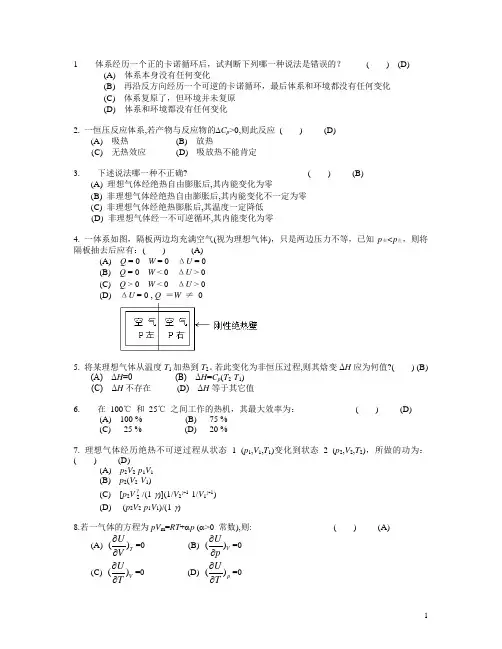
1 体系经历一个正的卡诺循环后,试判断下列哪一种说法是错误的? ( ) (D)(A) 体系本身没有任何变化(B) 再沿反方向经历一个可逆的卡诺循环,最后体系和环境都没有任何变化(C) 体系复原了,但环境并未复原(D) 体系和环境都没有任何变化2. 一恒压反应体系,若产物与反应物的∆C p >0,则此反应 ( ) (D)(A) 吸热 (B) 放热(C) 无热效应 (D) 吸放热不能肯定3. 下述说法哪一种不正确? ( ) (B)(A) 理想气体经绝热自由膨胀后,其内能变化为零(B) 非理想气体经绝热自由膨胀后,其内能变化不一定为零(C) 非理想气体经绝热膨胀后,其温度一定降低(D) 非理想气体经一不可逆循环,其内能变化为零4. 一体系如图,隔板两边均充满空气(视为理想气体),只是两边压力不等,已知p 右<p 左,则将隔板抽去后应有:( ) (A)(A) Q = 0 W = 0 ΔU = 0(B) Q = 0 W < 0 ΔU > 0(C) Q > 0 W < 0 ΔU > 0(D) ΔU = 0 , Q =W ≠ 05. 将某理想气体从温度T 1加热到T 2。
若此变化为非恒压过程,则其焓变ΔH 应为何值?( ) (B)(A) ΔH =0 (B) ΔH =C p (T 2-T 1)(C) ΔH 不存在 (D ) ΔH 等于其它值6. 在 100℃ 和 25℃ 之间工作的热机,其最大效率为: ( ) (D)(A) 100 % (B) 75 %(C) 25 % (D) 20 %7. 理想气体经历绝热不可逆过程从状态 1 (p 1,V 1,T 1)变化到状态 2 (p 2,V 2,T 2),所做的功为:( ) (D)(A) p 2V 2-p 1V 1(B) p 2(V 2-V 1)(C) [p 2V γ2/(1-γ)](1/V 2γ-1-1/V 1γ-1)(D) -(p 2V 2-p 1V 1)/(1-γ)8.若一气体的方程为pV m =RT +αp (α>0 常数),则: ( ) (A) (A) ()T U V∂∂=0 (B) ()V U p ∂∂=0 (C) ()V U T ∂∂=0 (D) ()p U T ∂∂=09. 氢气可看作理想气体,设H2为刚性分子,电子处于基态,其C V, m = ___________ ,C p, m = ____________ ,以气体常数R表示。
